If you wear alternative hair in the Pacific Northwest, you already know the elements can be a challenge. Between the sudden drizzle on a Tuesday afternoon and the dry indoor heat during the winter months, your wig is constantly battling the environment. Over time, even the most pristine units begin to face what we call the “maintenance cliff”—that moment when the hair loses its bounce, the nape gets suspiciously frizzy, and the lace just doesn’t sit right anymore. What accumulates on your wig—sebum, sweat, medical adhesives, and atmospheric pollutants—requires much more than a quick rinse in the bathroom sink.
Whether you are navigating medical hair loss, exploring personal transformation, or simply elevating your everyday style, finding the perfect piece is just the beginning of your journey. Discerning clients frequently consult our guide to the best wig stores in Tacoma, WA for local shopping and styling to pinpoint exactly where to find superior alternative hair. However, protecting that financial and emotional investment requires dedicated, localized care that goes far beyond generic internet advice.
Let’s dive into the fascinating science of fiber restoration, uncover why DIY washing often leads to heartbreak, and explore the best professional on-site wig cleaning and conditioning services right here in Pierce County.
The Science of Fiber Longevity: Why At-Home Washing Often Fails
When you first bring a wig home, it’s natural to assume you can care for it the way you care for biological hair. But alternative hair operates by an entirely different set of physical rules.
The Dish Soap and Laundry Detergent Fallacy
Browse any online wig forum, and you’ll inevitably find someone recommending Dawn dish soap or fabric softener to clean a wig. This is one of the most damaging myths in the alternative hair community. Dish detergents are heavily alkaline and formulated to strip stubborn grease. When used on a synthetic wig, they completely strip away the manufacturer’s delicate silicone coating. The result? Irreversible brittleness, severe static electricity, and rapid fraying.
The Mechanics of Fiber Memory vs. Cuticle Hydration
To understand proper care, it helps to think of synthetic fibers like fine polyester textiles, and human hair like porous wood.
- Synthetic hair doesn’t “absorb” moisture or botanical oils. It relies on polymer chains that hold a factory-set “style memory.” Hot tap water relaxes these polymer chains, leaving you with mangled, limp strands. To reset synthetic hair, it requires precisely heat-controlled steam to realign the fibers—not heavy hair oils.
- Human hair wigs, on the other hand, lack a living scalp to supply them with natural sebum. They oxidize, dry out, and demand regular low-pH lipid replenishment to keep their cuticles smooth and hydrated.
Lace Foundation Trauma and Inverted Shedding
Most at-home washers make the critical mistake of scrubbing their wig. Mechanical agitation (scrubbing, twisting, or wringing) pushes the delicate, hand-tied knots directly through to the underside of the lace. This causes “inverted shedding,” resulting in massive bald spots on the crown and a frayed, ruined hairline.
Inside a Professional On-Site Cleaning & Conditioning Protocol
So, what exactly happens when you hand your precious unit over to a Tacoma professional? Professional salon cleaning relies on gentle basin submersion and chemical displacement rather than physical scrubbing. Here is the magic that happens behind the salon curtain:
Stage 1: Tri-Point Triage
Before a single drop of water touches the hair, a specialist evaluates three critical points: the integrity of the delicate lace, the tightness of the hand-tied knots, and the elasticity of the cap.
Stage 2: Specialized Submersion & Lace De-Gluing
Professionals use solvents formulated specifically for medical-grade adhesives, spirit gum, and water-resistant lace tapes. These specialized formulas safely emulsify and dissolve stubborn glue and scalp sebum without pulling hair knots through the lace or degrading the mesh foundation.
Stage 3: Deep Conditioning & Cap Sterilization
To eliminate sweat odors and bacterial buildup, the cap (including polyurethane ear tabs and nape bands) undergoes an antimicrobial sanitation protocol. Following this, the hair receives targeted care. For synthetics, anti-static silicone smoothing emulsions are applied. For those investing in human hair wigs, intensive deep-conditioning hydration masks are applied mid-length to ends, processing under gently warmed towels to replenish vital lipids.
Stage 4: Controlled Temperature Steam De-Frizzing
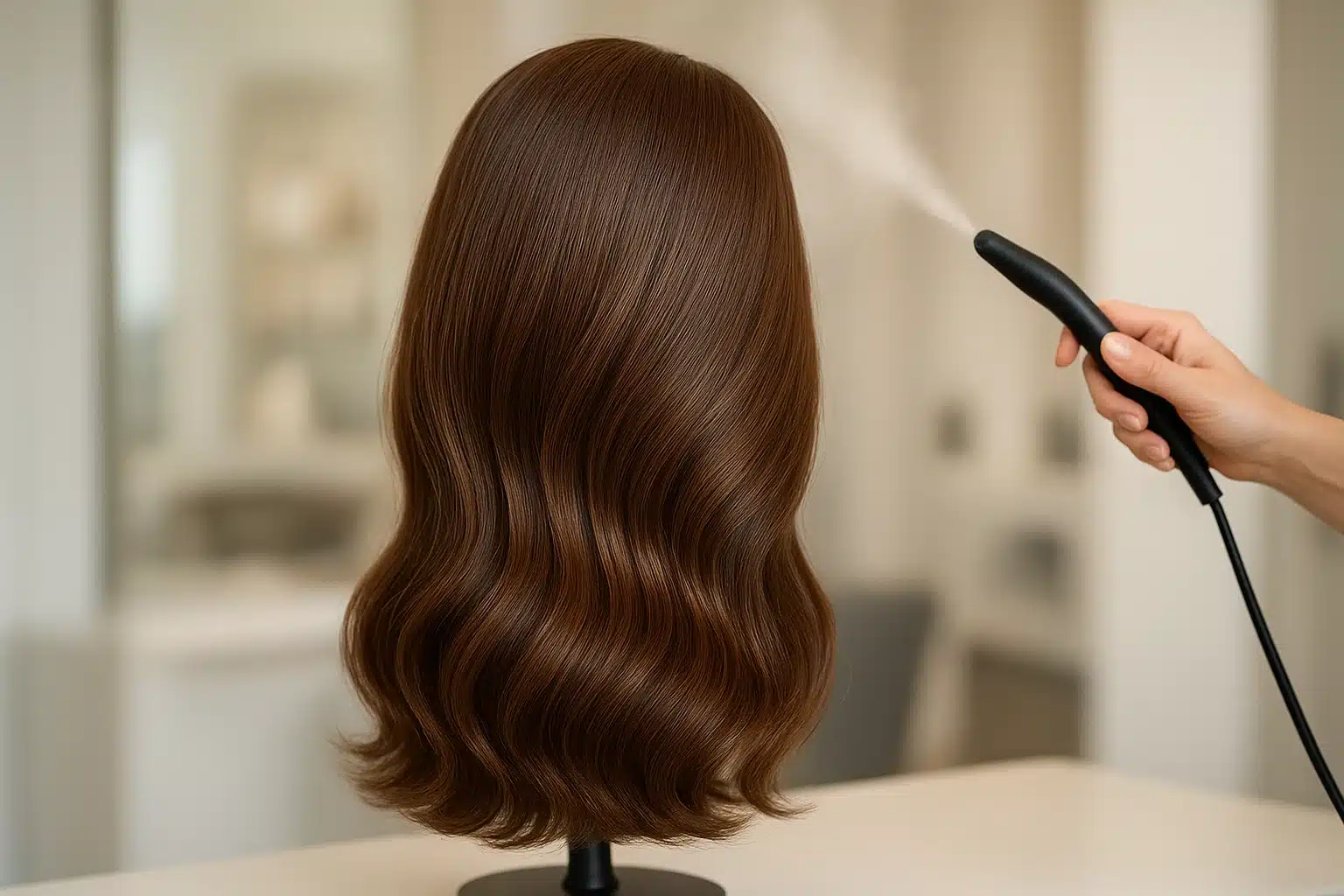
Have you ever noticed the frizzy “bird’s nest” that forms at the back of your neck? That’s called a friction bubble, caused by your collar rubbing against the hair. Professionals use a controlled wand steamer to meticulously smooth and resurface these damaged polymer chains, restoring the wig’s smooth, factory-fresh movement.
Top Tacoma & Pierce County Local Salon Profiles
While national mail-in wig repair services exist, they often require you to part with your hair for 14 to 30 days. For daily wearers in Tacoma, that is simply impractical. Here are some of the standout localized hubs offering professional care:
Upscale Hair Salon & Wigs (Downtown Tacoma / Theater District)
Located inside the beautiful Hotel Murano on Broadway, this salon specializes in luxury human hair wigs, toppers, and custom cutting. Offering a luxury hospitality salon model with private fitting rooms, they are ideal for wearers seeking high-end deep conditioning, color restoration, and discreet, personalized styling.
Virginia Mason Franciscan Health Wig Salon (Medical & Oncology Support)
For patients navigating medical hair loss, institutional trust is paramount. This specialized comfort salon offers highly sensitive cranial prosthesis consultations. They understand the unique hygienic needs of immunocompromised wearers, ensuring ongoing cap sanitization, deodorization, and safe care protocols.
Specialty Pierce County Providers & Boutiques
Throughout Central Tacoma, South Tacoma, and regional border towns like Federal Way and Steilacoom, businesses like Master Hair Care, Mattice Beauty Supply, and Shari’s Hair Loss Consulting offer vital community resources. From robust synthetic maintenance and multi-texture hair systems to personalized non-surgical hair replacement care and accessory supply, these localized hubs are lifelines for alternative hair wearers.
Cost Breakdown & Service Expectations in Tacoma
Transparent pricing helps you budget for the necessary upkeep of your hair. While prices vary by salon and the specific condition of your piece, here are the benchmark service expectations for localized 24- to 48-hour turnarounds:
- Drop-off cleaning & basic reset: $45 – $75
- Deep conditioning, lace adhesive detox & steam de-frizzing: $80 – $150
- Full reconstructive service (lace repair, knot re-sealing, re-styling): $150 – $250+
The Advantage: Spending $80 locally to rejuvenate a high-quality wig in 48 hours is vastly more economical—and far less stressful—than waiting a month for a mail-in service to return your daily hair.
Interactive Troubleshooting Checklist
Not sure if your wig is ready for a spa day? Use this quick diagnostic check:
- Symptom: Crunchy, stiff ends on a synthetic unit.Diagnosis: The fibers are suffering from nape friction and need professional steam resurfacing.
- Symptom: Hair is pulling through the underside of the lace.Diagnosis: Knots have been loosened, likely by improper home scrubbing. Needs professional knot assessment.
- Symptom: Dull, lifeless, or brassy human hair.Diagnosis: The cuticle is stripped and oxidizing. Requires a salon lipid re-acidification mask.
- Symptom: Persistent odor in the cap.Diagnosis: Cap mildew, often caused by drying the wig on a flat surface while wet. Requires professional sanitizing immersion.
Essential Between-Visit Care Protocol
While professional care extends the life of your wig by years, a solid wig care routine between salon visits is essential. Always detangle gently from the ends upward using a wide-tooth comb or specialized wig brush. At night, store your wig on a proper open-air wig stand to allow the cap to breathe and maintain its structural shape, keeping it away from direct sunlight and household heat sources.
Frequently Asked Questions (FAQ)
Can I wash my wig at home with Dawn dish soap or regular shampoo?
No. Dawn dish soap is too alkaline and strips the essential silicone coating off synthetic wigs, causing irreversible tangling. Regular drugstore shampoos often contain sulfates that strip the moisture out of human hair wigs and degrade delicate lace caps.
How often do synthetic vs. human hair wigs actually need to be washed?
As a general rule, if worn daily, a synthetic wig should be washed every 15 to 20 wears. Human hair wigs typically need washing every 7 to 10 wears. However, if you use heavy styling products, sweat heavily, or are frequently in smoky/polluted environments, you may need to visit your local salon for a refresh sooner.
Why did my synthetic wig get frizzy at the nape, and can salon steaming restore it?
Friction from shirt collars, sweaters, and body heat causes the synthetic polymer chains to warp and tangle (the “friction bubble”). Yes, professional salon steaming uses controlled, directional heat to safely realign these fibers, completely eliminating the frizz without melting the hair.
How do professionals dissolve bonded lace glue without pulling hair knots?
Professionals use advanced, specialized chemical solvents that act as an emulsion. Instead of peeling or scrubbing (which rips the hair right out of the lace), they soak the perimeter. The solvent safely breaks down the poly-acrylic adhesive into a soft gel that simply wipes away, protecting every delicate knot.