If you’ve recently purchased your first wig or alternative hair system, you might have experienced a surprisingly common moment of hesitation. You open the box, carefully lift out your beautiful new hairpiece, place it on your head, and realize it looks a bit… “wiggy.” It might feel overly full, the hairline may look unnaturally blunt, or the cap might gap slightly above your ears. Take a deep breath—this is completely normal. In fact, roughly 95% of manufactured wigs are designed with excess hair density and generic cap sizes specifically so they can be tailored to you.
Finding the perfect hairpiece is only the first half of the journey. While many shoppers start by consulting The Ultimate Guide to the Best Wig Stores in Madison, WI to discover reputable local brick-and-mortar suppliers, their next questions shift from retail discovery to technical craftsmanship. Who can thin out a heavy synthetic unit without ruining it? How do you shrink a cap that feels too baggy? Fortunately, Madison is home to a robust, yet often hidden, infrastructure of specialized wig salons and restoration experts who bridge the gap between a factory-finished unit and a natural, confidence-restoring hair system.
Why “Out-of-the-Box” Rarely Means Ready-to-Wear
Think of buying a new wig like buying a designer suit off the rack. Even if it is made of the highest-quality materials, it won’t look tailored until a professional adjusts the hem and takes in the waist.
Natural human hair has a very specific “density gradient.” On a natural scalp, hair density is usually about 80% to 90% at the delicate front perimeter, gradually increasing to about 130% toward the crown. Wigs, however, are often manufactured with a uniform 130% density all over to ensure no tracks or wefts show through. Without professional intervention, this uniform density creates what many wearers call the “helmet effect.” Customization is the art of re-creating nature’s beautiful imperfections.
The Anatomy of Professional Wig Customization
Transforming an alternative hair system requires an intricate understanding of physics, cap geometry, and fiber chemistry. Here is a look behind the curtain at what Madison’s top wig specialists actually do during a customization session.
Hairline Sculpting & The Density Gradient
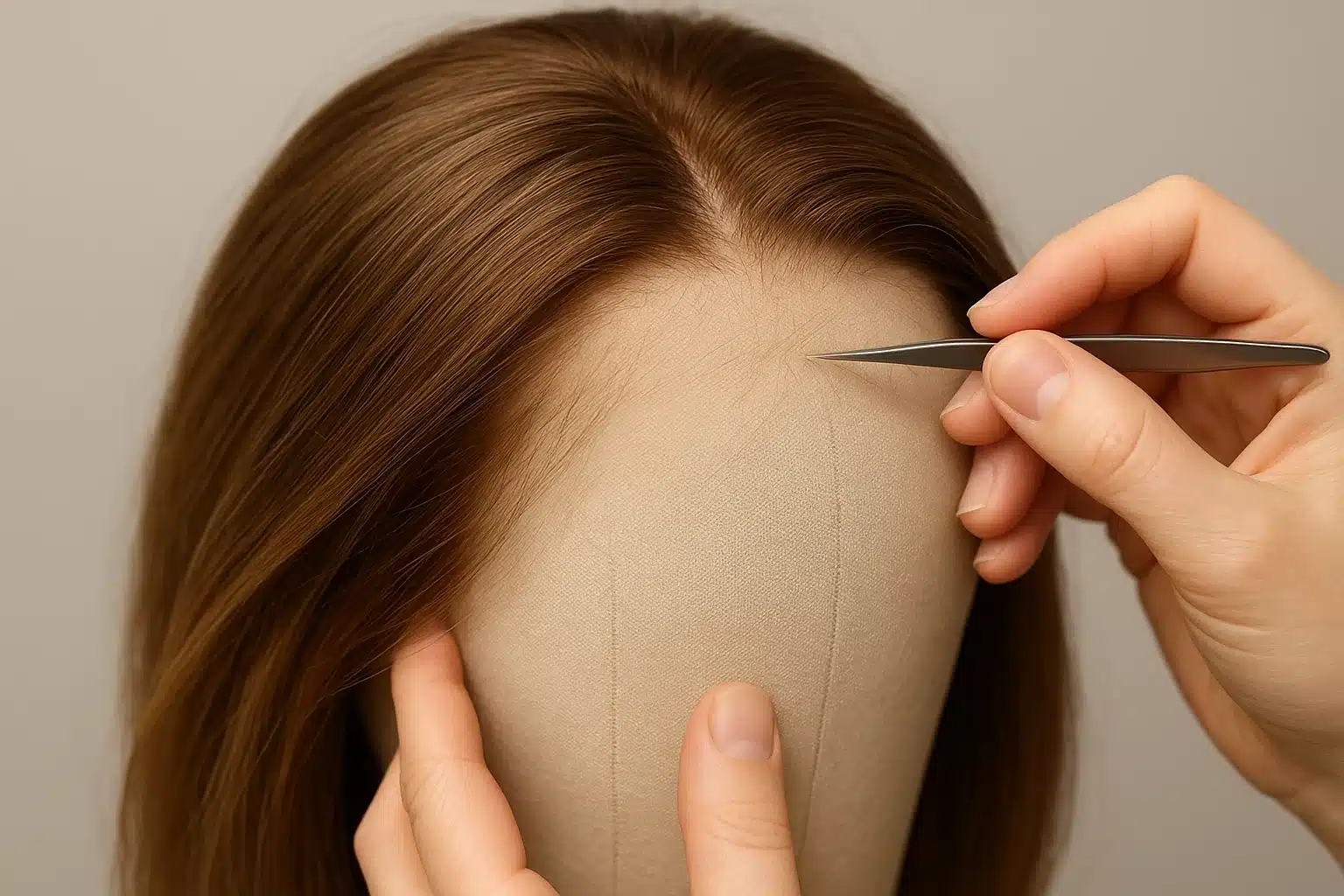
To eliminate a harsh, dense hairline, a specialist utilizes “vertical micro-plucking.” By carefully plucking alternating knots from the lace grid, they mimic the natural, wispy look of a biological hairline. Depending on the base material—whether it’s delicate Swiss lace or durable HD lace—they may also bleach the tiny knots where the hair is tied to the base, rendering the grid completely invisible against your skin.
Precision Cutting: The “Cosmetologist Fallacy”
It is a common misconception that you can take your wig to your regular hair salon for a quick trim. This is often referred to in the industry as the “cosmetologist fallacy.” Traditional hair stylists are trained to use beveling shears or razors on biological hair. If these same tools are used on a synthetic wig, the polymer fibers will permanently fray, leading to frizz and visible bald tracks.
Wig specialists utilize highly specific techniques, such as dry slide-cutting and vertical interior channel thinning. This debulks the density from the inside out, allowing the hair to move naturally without leaving blunt, visible stubble near the cap.
Cap Resizing and Tailoring
A wig that slides or buckles can ruin an otherwise perfect look. Professional tailoring involves adjusting the cap architecture. Specialists can take in excess crown fabric via tiny, strategically placed dart seams, ensuring the cap hugs your scalp’s unique geometry. They also ensure that velvet ear-tabs sit perfectly flush at your temples and that polyurethane (PU) silicone non-slip strips are positioned for maximum security.
Synthetic vs. Human Hair: The Thermal and Chemical Boundaries
Before anyone takes a styling tool to your wig, you must understand its fiber chemistry. What works flawlessly on Remy human hair will instantly melt a synthetic unit.
- Standard Synthetic Fibers: These cannot tolerate traditional heat styling. They should only be steam-reset at controlled temperatures (typically 140°F–160°F) by a professional.
- Heat-Friendly Synthetic (e.g., Tru2Life): These fibers can handle dry heat, but only within strict boundaries—usually maxing out between 240°F and 280°F.
- 100% Remy Human Hair: Just like biological hair, these systems can handle temperatures up to 350°F, provided a thermal shield is used.
The Chemistry of Color: If you want to change the color of your piece, the rules change drastically. Synthetic wigs are made from plastics (polyesters and acrylics) and cannot be bleached with developer. They require specialized synthetic fabric dyes. Conversely, human hair wigs are heavily processed at the factory; therefore, local Madison colorists will generally only use low-volume, deposit-only pigments rather than bleach, which could compromise the hair’s integrity.
The Art of Wig Repair and Restoration
Over time, everyday friction, natural body heat, and washing will take a toll on any hairpiece. Many wearers mistakenly throw away a $500 wig because of a stretched nape band or a small lace tear, not realizing that a $50 to $150 repair could grant the piece another year of life.
When to Salvage vs. When to Replace
- Highly Repairable (The Salvage Zone): Frayed lace edges can be trimmed with pinking shears in a zigzag pattern to prevent further unraveling. Small tears in the monofilament top can be patched with stabilizing tulle. If you’ve lost hair at the part line from aggressive brushing, an expert can perform “re-ventilation,” painstakingly tying new individual hairs back into the lace grid.
- Time to Retire (The Replacement Zone): If the foundation of the cap has succumbed to base rot (where the structural integrity of the cap breaks down entirely) or if synthetic fibers have become permanently scorched and crimped from friction and heat well up to the root, a total replacement is usually the most cost-effective route.
Navigating Madison’s Local Wig Service Infrastructure
Madison offers a wonderfully diverse array of professionals equipped to handle different aspects of the alternative hair journey. Knowing where to go depends entirely on your specific needs.
Clinical & Medical Hair Loss Solutions
For those navigating chemotherapy or conditions like alopecia, a compassionate, medically-informed environment is crucial.
- UW Health Eastpark Medical Center Wig Salon: Operates with a focus on compassionate oncology support, offering provisions for medical wigs and patient-centered styling in a highly sensitive environment.
- Capilia Madison: Renowned for trichological solutions and bespoke, personalized scalp sizing. They are experts in altering medical hair loss systems to accommodate sensitive scalps safely.
Boutique Styling, Custom Cuts, and Color
If you are looking for high-end styling, seamless integrations, and fashion-forward aesthetics, Madison’s boutique salons are excellent options.
- Julia Grace Salon: Located on the West Side, they are highly regarded for their maintenance packages, cranial prosthetics expertise, and custom fittings. They are also incredibly helpful with local logistics, such as navigating Wisconsin state photo ID requirements.
- Aetheria Hair Salon & Wig Boutique: Located near downtown, they specialize in expert cutting, coloring, and topper integration, seamlessly blending biological hair with supplemental hairpieces.
Textured Hair & Lace Frontal Installs
- Rockka Luxe Collection & Local Braiding Studios: For those seeking undetectable lace frontal melting, custom machine-weft construction, and protective foundation braiding, these specialists master the art of seamless lace installations for textured hair.
Navigating Insurance and State IDs in Wisconsin
Dealing with medical hair loss often comes with bureaucratic hurdles. Many Madison-based clinical salons (like UW Health and Julia Grace) can assist you with the necessary paperwork for “cranial prosthesis” claims, helping you secure insurance reimbursement.
Additionally, if you need to update your driver’s license, specialists who understand WisDOT (Wisconsin Department of Transportation) regulations can style your hair system so that it fully complies with state ID photo guidelines, ensuring your face is properly visible while keeping you comfortable and confident.
Your First-Timer’s Consultation Checklist
Ready to book a customization or repair appointment in Madison? Here is what you should bring to ensure a successful consultation:
- The Wig and the Box/Tag: The stylist needs to read the manufacturer tag to confirm the exact fiber composition (e.g., standard synthetic vs. heat-friendly).
- Reference Photos: Bring photos of how you wore your biological hair, or photos of the exact density and hairline shape you desire.
- Your Block Head (Optional but helpful): If you already store your wig on a canvas block head, bring it along so the stylist can see how you’ve been maintaining the cap shape.
Questions to ask before the first scissor cut:
- Have you worked with this specific brand and fiber before?
- Will you be using traditional thinning shears, or vertical slide-cutting?
- How much length will need to be removed to eliminate the frayed ends?
Frequently Asked Questions (FAQ)
Why does my new wig look puffy and fake at the top?
Manufactured wigs have uniformly dense hair tied into the cap to hide the base material. A process called “debulking” or interior channel thinning by a professional will remove this puffiness, creating a natural, flat silhouette.
What is the “four-finger rule” for positioning a wig?
To ensure a natural-looking hairline, place your index, middle, ring, and pinky fingers horizontally across your forehead, with your pinky resting on your brow bone. Your wig’s hairline should generally start just above your index finger.
Can a ripped HD lace front be fixed?
Yes! Small tears can be patched from underneath using a fine, stabilizing tulle and invisible thread, while missing hair along the tear can be re-ventilated (re-tied) into the lace.
Can I wash and blow-dry my synthetic wig like my bio hair?
No. Standard synthetic wigs should be washed gently with sulfate-free synthetic fiber cleansers and air-dried. Heat from a standard blow-dryer can permanently melt or scorch the polymer fibers.
Moving Forward with Confidence
Transitioning to alternative hair is a deeply personal journey, and you don’t have to navigate it alone. By understanding the mechanics behind cap architecture, fiber chemistry, and lace customization, you take control of your aesthetic.
Whether you need the compassionate clinical care found at UW Health, the precise tailoring of a boutique Madison salon, or just a little expert advice on taming a puffy crown, local professionals are waiting to help you transform your piece. Remember, your wig is simply the raw material; it’s the customization that makes it truly yours.