By Chris Clark, editor of Wig Superstore
Ellen Wille wigs come from a German brand that hair designer Ellen Wille founded in 1967, and they’re known for light-to-medium density, lace fronts with monofilament parts, and European cuts, bobs above all. Most styles come in one standard cap size, Petite/Average, which is about 21.25 inches around.
The range uses four kinds of hair: traditional synthetic, heat-friendly synthetic, Remy human hair, and blends of human hair with heat-friendly fiber. Below you’ll find what each collection, cap and fiber is like, how to measure, which style suits a first wig, how to care for and heat style it, and the honest limits. Every style, cap and fiber detail here was checked against Ellen Wille’s US website in November 2026.
What Ellen Wille Is Known For
Hair designer Ellen Wille studied in Paris and started her company in Germany in 1967. Her US distributor says she’s still involved in the design of every style.
A few things set the range apart:
- Light density: most styles are light to medium density, closer to a natural head of hair than a full, heavy wig.
- Hairlines and parts: most styles have a lace front plus a monofilament part, crown or top.
- The bob: Ellen Wille calls the bob the cut it’s best known for. Esprit Soft, Drive and Lia II are bobs, and with the pixie Tab and the shag Relax they’re the five styles it named as its bestsellers in May 2026.
- Color: each style gets its own color blend, so one color name can look different from style to style.
- Comfort caps: silicone-infused Plus caps, the soft Comfort Lace front and the new Secure Fit cap.
Ellen Wille sells through wig shops, salons and online retailers in the US and Canada. Our guide to the best wig brands shows how it compares with Jon Renau, Raquel Welch and the rest.
Ellen Wille Collections
Ellen Wille groups its wigs into collections by look and by who they’re designed for. Most collections mix traditional and heat-friendly synthetic styles, so check the fiber and cap listed for each style, not just its collection.
The Main Ellen Wille Collections
These are the wig collections on Ellen Wille’s US site, with a few styles from each:
- Hair Power: the largest collection, with the widest choice of lightweight, ready-to-wear styles, most of them traditional synthetic. Risk, Ocean and Mega Mono are here.
- Perucci: a younger, bolder line of edgy cuts and fashion colors, in both synthetic fibers. Tab and Drive are Perucci styles.
- Changes: modern, playful designs from short pixies to long styles, including Lia II and Alive Mono Part.
- Modixx: a synthetic line that brings together features of the brand’s other synthetic collections, with a few heat-friendly styles such as Aletta.
- High Power: heat-friendly synthetic only, including Relax, Melody and Heaven.
- Ellen’s Elements: a small synthetic line that includes the long, layered Level.
- Hair Society: what Ellen Wille markets as its most luxurious line, with more hand-tied cap work, designed for women with partial to total hair loss. Esprit Soft and Eclat Deluxe are here.
- Pure Power: 100% Remy human hair wigs and, since August 2026, the Prime Power blends of human hair and heat-friendly fiber.
Ellen Wille also makes Top Power toppers (hairpieces that clip onto your own hair for thinning or partial hair loss), Power Pieces (ponytails, buns, bangs and pieces to wear under hats), HAIRforMANce wigs for men, and a small children’s line, Power Kids.
Ellen Wille Fibers: Synthetic, Heat-Friendly, Human Hair or a Blend
The fiber decides how much styling a wig can take and how much upkeep it needs. Ellen Wille’s own fiber chart sums up each one:
- Traditional synthetic: comes pre-styled and keeps its shape through washing, with lasting color, little upkeep and the lowest cost. It can’t take heat or be recolored, it tangles easily, it’s warmer to wear, and it has more shine.
- Heat-friendly synthetic: takes low to moderate heat, so you can curl or straighten it, and holds the new style until you heat it again. It needs more upkeep: daily detangling and an occasional pass with heat to keep the ends smooth.
- Remy human hair: the most natural look and feel, and the coolest to wear. It reacts to humidity like your own hair, costs more, and Ellen Wille doesn’t advise coloring it.
- Human hair blends: human hair mixed with heat-friendly fiber. They resist humidity, hold their style, and tangle and shine less than synthetic, but they cost more and can’t be recolored.
If you want the least upkeep, start with traditional synthetic. If you’d like to restyle with heat, look at heat-friendly fiber or a blend, and choose human hair if you enjoy styling and want the most natural feel.
Ellen Wille Human Hair Wigs
Ellen Wille human hair wigs are made of Remy human hair and sit in the Pure Power collection. Ellen Wille says the hair is Indian and Chinese, and that Remy means the cuticle (the outer layer of each hair) is mostly intact and runs the same way from root to tip.
What to know about them:
- Caps: most have a lace front, a monofilament top and a hand-tied or partially hand-tied cap. Many use Comfort Lace, a softer double-layered lace front.
- Styles: they include Award Deluxe, Emotion Deluxe, Obsession Deluxe, Jadore Deluxe, Prestige Deluxe, Yara Mono and Zora Mono, plus three Plus cap styles with silicone in the cap.
- Petite sizes: three come in a Small cap, and they’re listed under sizing further down.
- Flex Parting: since August 2026, select styles such as Award Deluxe, Obsession Deluxe and Zora Mono can be parted in more directions.
- Styling: blow dry it on medium heat with a round brush, and heat style it dry, up to 350°F, after spraying on a heat protectant.
What is a human hair blend wig?
A human hair blend wig mixes real human hair with heat-friendly synthetic fiber. Ellen Wille’s blends, sold as Prime Power, are generally about 60% heat-friendly synthetic and 40% human hair, and aim for the look and movement of human hair with the style memory of synthetic.
Ellen Wille lists these strengths:
- The style holds through washes and won’t drop in humidity or rain.
- They tangle less and shine less than synthetic.
- The synthetic share allows colors that are hard to get in human hair, such as vibrant reds, icy platinum blondes, silvers and grays.
- You can heat style them at 300°F on dry hair, using a protectant spray first.
Since August 2026 the blends sit in the Pure Power collection. Current blend styles include Catch Mono, Elegance Mono, Encore Mono, Image Deluxe, Impulse Soft, Mood Deluxe and Promise Soft. The first Prime Power wigs, such as Adore and Advance, are now listed as discontinued.
Ellen Wille Cap Designs
The cap is the base the hair is attached to. It decides how the wig fits, how it feels on your scalp, and how natural the hairline and part look.
Ellen Wille lists each style’s cap as a front, a top and a back. Esprit Soft, for example, has an extended lace front, a monofilament part and a partially hand-tied back.
Lace Fronts, Monofilament and Hand-Tied Caps
Ellen Wille uses four main cap features, and you’ll often find two or three on the same wig:
- Lace front: a sheer lace along the front hairline, with each hair tied in by hand, so you can wear the hair off your face. Ellen Wille makes them in several widths: mini (a small section, like the left-side lace on Alive Mono Part), standard, extended and ear to ear.
- Monofilament: a fine mesh with hairs tied in by hand, which looks like scalp where the hair parts. It comes as a mono part, a mono crown or a full mono top. A few styles add a second layer: Charme Soft has a double monofilament top, and Drive has an extra mesh overlay at the crown that Ellen Wille says helps a sensitive scalp.
- Hand-tied: hair knotted by hand into the base, so it lies flatter, moves naturally and looks less dense. Some caps are 100% hand-tied, and many Hair Society and Deluxe styles are partially hand-tied.
- Wefted: rows of hair sewn onto the cap, which look fuller. Some styles, such as Appeal Mono and Miss Comfort, use enclosed wefts at the back.
What’s the difference between a lace front and a monofilament top?
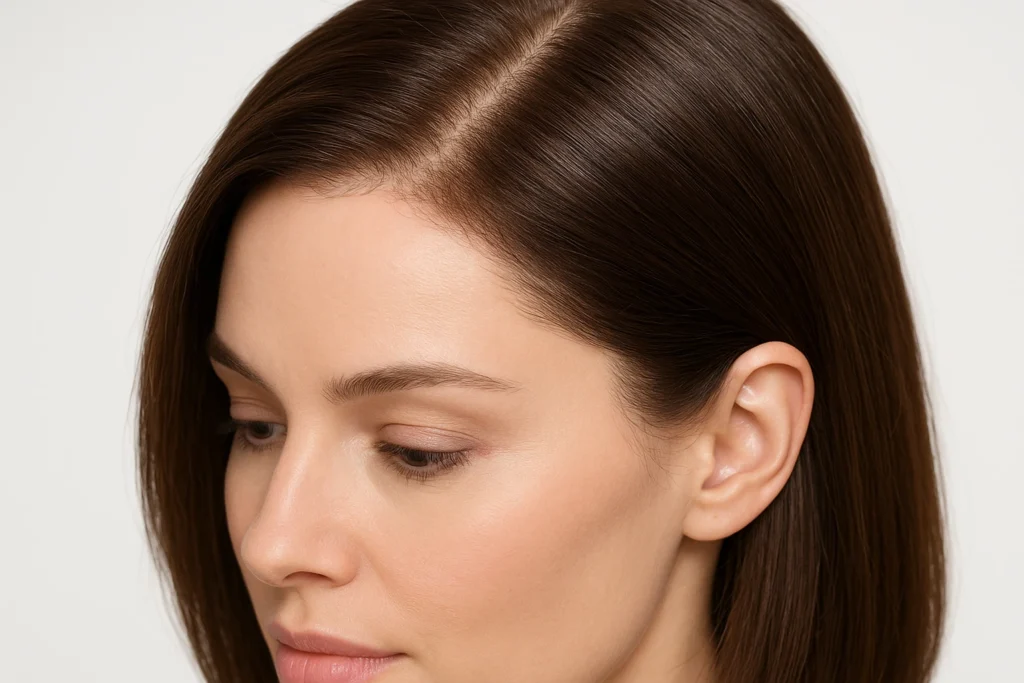
A lace front sits at your hairline, so you can wear the hair back off your face. A monofilament top sits on top of your head, so you can part the hair and see a scalp-like base under it. Many Ellen Wille wigs have both: Trinity Plus Deluxe pairs a lace front with a mono top, and Lia II pairs an extended lace front with a mono part.
What’s the difference between a mono part and a mono top?
A mono part is a strip of mesh in one place, so the part stays where it was made: on the left on Alive Mono Part, in the center on Drive. A mono top covers the whole top, so you can part the hair left, right or center, as on Mega Mono. A mono crown sits at the crown only, for natural-looking growth there, as on Level and Relax.
On human hair, the Flex Parting added in 2026 gives select styles more ways to part.
Do I need glue or tape with an Ellen Wille lace front?
No, you don’t usually need either. Ellen Wille lace fronts come ready to wear, and the hold comes from the right size, the adjustable nape straps and the bendable metal stays in the ear tabs. For extra security, Ellen Wille suggests a non-slip grip band or tape clips. Its Plus caps, which have silicone in the cap, are made to stay put without tape or adhesive.
Is a lace front durable enough to wear every day?
Yes, with gentle handling. Ellen Wille says its lace fronts are made to last the expected life of the wig, but the lace is fragile. Its care rules:
- Put the wig on, adjust it and take it off by the ear tabs, never by the lace.
- Use a plastic wide-tooth comb or a soft wig brush, not sharp or rough tools.
- If you pin the wig to a canvas block head for styling, keep the T-pins off the lace.
- Wear the right size, since a cap that doesn’t fit strains the lace.
It’s worth checking the lace for fraying every month or so.
Plus Caps, Comfort Lace and Secure Fit
Ellen Wille has three cap features for comfort and a secure fit, mostly on its human hair and newest styles:
- Plus caps: 100% hand-tied caps with silicone infused into the cap material rather than coated on top, so they grip gently and still breathe. Ellen Wille designed them for complete hair loss, to stay put without tape or adhesive. The current Plus styles are Brilliance Plus Deluxe, Trinity Plus Deluxe and Supreme Plus Deluxe.
- Comfort Lace: a double-layered lace front whose second layer is soft Swiss lace. Ellen Wille says it eases the itchy, scratchy feel a standard lace front can have. It’s on many human hair and blend styles.
- Secure Fit: new in November 2026, a cap with silicone-coated elastic rows in the back that grip the hair and scalp. It’s on three heat-friendly Hair Power styles: Elle Mono, Tess Mono Part and Demi Mono.
Some other styles add silicone at the ear tabs and nape, such as Mega Mono, or silicone strips in the cap, such as Award Deluxe and Obsession Deluxe.
Which Ellen Wille cap is best for a sensitive scalp?
For a sensitive scalp, look first at Ellen Wille’s Plus caps and Comfort Lace styles. The maker says the Plus cap’s silicone adds security and comfort for sensitive scalps, and Comfort Lace is softer against the skin at the hairline.
Other options worth trying on:
- Hair Society styles, made for women losing some or all of their hair, with more hand-tied areas.
- Risk Sensitive II, a version of the Risk pixie with a Comfort Lace front.
- A soft wig cap under the wig, which Ellen Wille suggests for comfort.
If your scalp is sore or tender during treatment, ask your care team what’s safe to wear against it.
Are Ellen Wille wigs comfortable enough to wear all day?
Most are light enough to wear all day, as long as the fit is right. Ellen Wille keeps the hair light, and it lists the weight on each style’s page: the short Risk weighs under 2 ounces.
Fiber makes a difference too. Ellen Wille’s fiber chart lists both synthetics as warmer to wear, and calls human hair breathable and cool. It describes some wefted caps, such as Drive’s micro wefting, as breathable and cool for all-day wear.
Density and Permatease
Density is the amount of hair on the cap. Ellen Wille makes most of its wigs in light to medium density, which it says looks closer to natural hair than a heavy wig does.
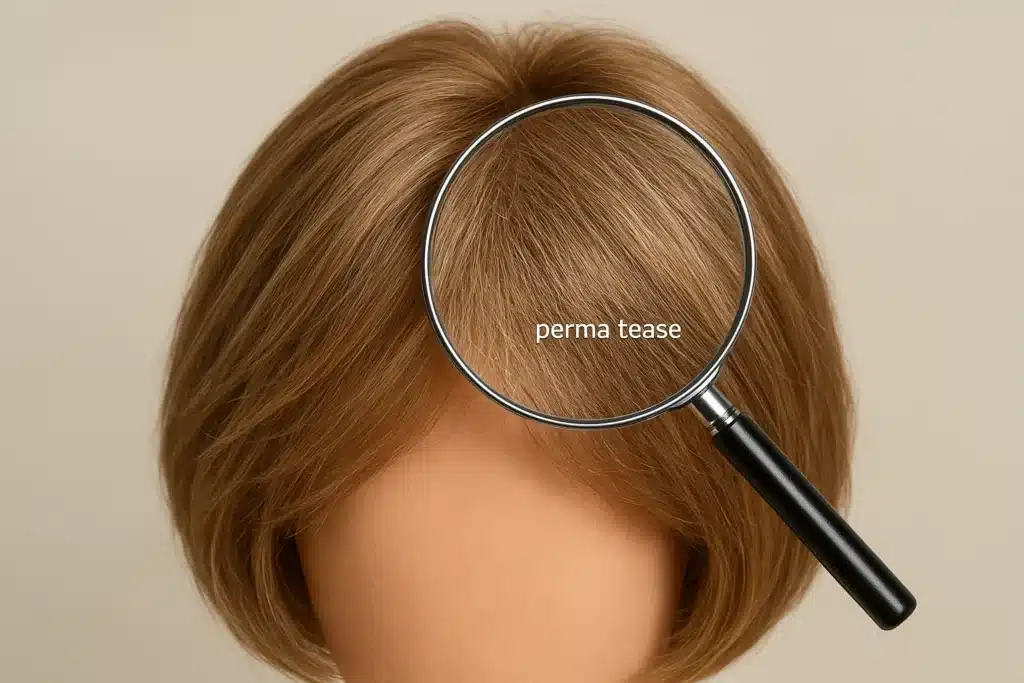
The cap changes how dense a wig looks, even when there’s the same amount of hair. Hand-tied areas look finer, because each hair is tied into the base, while wefted areas hold more hair in one place and look fuller. Ellen Wille rates density on a five-step scale:
- Light: like fine or thin natural hair.
- Light/medium: close to an average head of hair, with a little more body.
- Medium: the closest to an average head of hair.
- Medium/heavy: fuller, for styles that need body.
- Heavy: the most volume, for dramatic styles.
What is permatease in a wig?
Permatease is fine, crimped fiber placed close to the base of the cap to give a wig lift and structure. You don’t see it directly. Ellen Wille uses it to:
- add a little volume where a style needs it
- support the longer hair so the style keeps its shape
- cover the wefts for a more natural finish
- stop the wig from looking flat
It can sit at the crown, at the roots, at the nape or through whole sections. A layered cut might have it only at the crown for lift, while a short textured style may use it all over for shape.
Why does my new wig have frizzy, crimped hairs at the roots?
That’s permatease, and it’s meant to be there. It’s easy to mistake for damage, so here’s how to tell them apart:
- Permatease: short, crinkly fiber packed close to the cap, at the roots, under longer smooth hair.
- Friction frizz: rough, dry-feeling fiber at the ends and the nape, where the hair rubs on your collar, your shoulders or a car seat.
A new wig’s permatease can be flattened in the box. Hold the wig by the nape, turn it upside down and give it a good shake to bring the volume back. Then comb only the longer hair, working up from the ends, and don’t drag a brush through the roots.
Which Ellen Wille styles have more or less volume?
Ellen Wille uses four of its own styles to show how cap design and permatease change the look, from fullest to sleekest:
- Level: a mono crown and a touch of permatease near the crown give soft fullness through the back and sides.
- Destiny: a mono part, with coverage and body through the rest of the wig.
- Mega Mono: a full mono top spreads the hair more evenly, so it looks lighter and softer.
- Eclat Deluxe: a mostly hand-tied cap with little or no permatease, for a sleek shape close to the head.
If you love body and lift, look for permatease. If you’d rather have a flatter, smoother shape, a hand-tied style with little of it suits you better.
Can you get rid of permatease?
Don’t try to brush, cut or heat it out. Permatease covers the wefts, so taking it out can show the cap underneath and flatten the style for good.
If a wig feels fuller than you’d like, a stylist who works with wigs can thin or reshape it. Or choose a style built with less lift, such as a hand-tied one like Eclat Deluxe.
Will an Ellen Wille wig look like a wig?
A well-fitted one is hard to spot, though no wig is invisible in every light. What helps most is the brand’s light density, a lace front at the hairline, a monofilament part or top, and a rooted color, which has a darker root like natural regrowth.
Fit and placement matter as much as the wig. A cap that’s too big, or set too low on the forehead, gives a wig away faster than the hair does.
Which Ellen Wille wig is best for a first-time wig wearer?
For most first-time wearers, the best Ellen Wille wig is a ready-to-wear traditional synthetic style in the standard Petite/Average cap, with a lace front and a monofilament part or crown. Ellen Wille calls synthetic a popular choice for beginners because it keeps its style and needs little upkeep. Two of its bestsellers fit: the short pixie Tab and the softly waved bob Esprit Soft.
Work through four choices in this order:
- Size: measure your head first (the steps are in the sizing section below). If you’re petite, look for a style with Small in its name.
- Fiber: traditional synthetic for the least upkeep, heat-friendly synthetic or a blend if you want to restyle with heat, human hair if you enjoy styling.
- Cap: a lace front if you’ll wear your hair back, a mono top if you like to change your part, a Plus cap or Comfort Lace if your scalp is sensitive.
- Length: longer styles rub on collars and shoulders, which is where synthetic fiber tangles, so a short or chin-length style is the easiest start.
Its other bestsellers, Drive, Lia II and Relax, are heat-friendly. They suit you better once you’re happy with the daily detangling that fiber needs.
If you’re losing your hair to chemo, the Hair Society collection is designed for partial to total hair loss, and the Plus caps for complete hair loss. Ellen Wille suggests a consultation with a wig expert for a first wig.
Some insurance plans cover a wig as a cranial prosthesis (the name insurers use for a medical wig, usually with a prescription that uses those words). Coverage varies by plan, so call your insurer first. Our medical wig insurance guide has the details.
What to Check When You Try on a Wig
Start by setting the hairline in the right place. A common rule of thumb is four finger-widths above your eyebrows. If you’ve got a small face, set it a little lower, and if your own hairline sits high, a little higher.
Then check five things in a mirror:
- Pull it back: sweep the hair off your forehead and look for a hard edge at the front.
- Density: the hair at the front and temples should look a little finer than at the crown.
- The part: part the hair on top and look for a scalp-like tone underneath.
- The edge: the lace should follow the curve of a hairline, not a straight line.
- The fit: the cap should sit flat against your forehead without buckling, with the ear tabs in front of your ears.
How to Choose an Ellen Wille Color
Each Ellen Wille style has its own color blend, so a color name like Sand Multi Rooted can use different shades on two different styles. Check the numbered color code for the style you want, not just the name. Our Ellen Wille color guide covers the color families in detail.
The last word of a color name tells you how the shades are spread through the hair:
- Rooted or shaded: a darker root, like natural regrowth.
- Mix: a blend of shades for a dimensional look.
- Tipped: lighter ends, like a soft ombré.
- Lighted: lighter shades at the front to frame the face.
- Toned: a subtle root on the top of the head only.
Colors on a screen aren’t reliable, and Ellen Wille says a finished style can vary slightly from its swatch. It makes color rings: a Fashion Color Ring for its synthetic colors, a Human Hair Color Ring for human hair and the blends, and a Basic Color Ring with every numbered shade. A retailer can show you one and help you choose.
Ellen Wille Petite Wigs, Large Caps and How to Measure
Ellen Wille petite wigs have Small in the style name, and its large-cap wigs have Large. Most styles come only in the standard size, Petite/Average, so check the size before you fall for a style.
Ellen Wille gives these approximate circumferences:
- Ultra-Petite: about 20.5 inches, only in the Power Kids children’s line.
- Petite (Small): about 21 inches.
- Petite/Average (standard): about 21.25 inches.
- Average/Large: about 22.5 inches, used for the HAIRforMANce men’s wigs.
- Large: about 23 inches.
The standard size is a little under the 21.5-inch Average that Jon Renau uses. Most of its caps also stretch: Ellen Wille says hand-tied, wefted and enclosed wefted caps stretch enough to fit up to an Average/Large head, while partially hand-tied caps stretch less and suit petite to average heads best.
To measure, you’ll need a soft tape measure. If you have hair, wrap it flat under a wig cap first. Keep the tape snug, not tight, and take three measurements:
- Around: start at your front hairline, go around the back of your head just above the nape, and come back to the start.
- Ear to ear: find the point 7 inches back from the hairline, then measure across it from just in front of one ear to just in front of the other.
- Front to back: from the front hairline, over the center of your head, down to the nape.
Compare all three with Ellen Wille’s size chart. If they fall into different sizes, choose the largest.
Petite styles include Elite Small, Miley Small, Ginger Small, Foxy Small, Fenja Small, Lina Small, Amy Small Deluxe, Cara Small Deluxe, Liza Small Deluxe, Icone Small Deluxe, Charme Small Soft, Esprit Small Soft and Avenue Small Soft. Among the standard-size styles, Ellen Wille calls the Risk pixie ideal for petite to average heads. Large styles include Daily Large, Date Large, Ginger Mono Large, Girl Mono Large, Melody Large, Relax Large, Voice Large and Tempo 100 Deluxe Large.
For other makers with small and large caps, see our guide to wig brands for petite and large heads.
Is my head too small for a wig?
Probably not, but you may need a smaller size than the standard one. If Petite/Average feels loose, try a style with Small in its name, at about 21 inches around. Ellen Wille’s smallest size, Ultra-Petite at about 20.5 inches, comes only in its Power Kids children’s line, which includes the human hair Anne Nature and synthetic styles such as Emma.
Small styles aren’t only for one look. Miley Small, for example, is a shoulder-length style with a longer fringe that frames the face.
Can I get an Ellen Wille human hair wig in a petite size?
Yes. There’s a choice of three Remy human hair styles in a Small cap: Award Small Deluxe, Emotion Small Deluxe and Jadore Small Deluxe. All three have a Comfort Lace front, a mono top and a hand-tied cap, and two of them, Award Small Deluxe and Jadore Small Deluxe, were added in August 2026.
Why do my wig’s ear tabs sit too low?
Ear tabs that rest on top of your ears usually mean the cap is too big or sitting too far down. Other signs of a cap that’s too big are a baggy nape, where extra cap bunches at the neck, and having to pull the wig low onto your forehead to make it feel snug.
Try these fixes in order:
- Set the hairline about four finger-widths above your eyebrows, then check the tabs again.
- Tighten the nape straps evenly.
- Gently bend the ear-tab stays inward so the tabs hug your temples.
- If the tabs still sit low, measure again. You may need a Small style.
Which size should I choose if I’m between sizes?
Choose the larger size. Ellen Wille’s rule is to go by your largest measurement, then take in the circumference with the adjustable straps at the nape. A wefted cap, such as Ocean’s, has some stretch as well. If the wig still slips a little, a grip band under it adds hold without tape or glue.
Adjusting the Fit
Ellen Wille wigs come ready to wear, and each one has adjustable straps or tabs. Small changes can make a good fit better:
- Straps at the nape: turn the wig inside out to find them, then tighten or loosen them to change the circumference.
- Metal stays in the ear tabs: bend them gently so the tabs follow the shape of your head instead of flaring out.
- A wig cap: worn underneath, it holds your own hair flat and adds comfort and security.
- A non-slip grip band or tape clips: for extra hold if you need it.
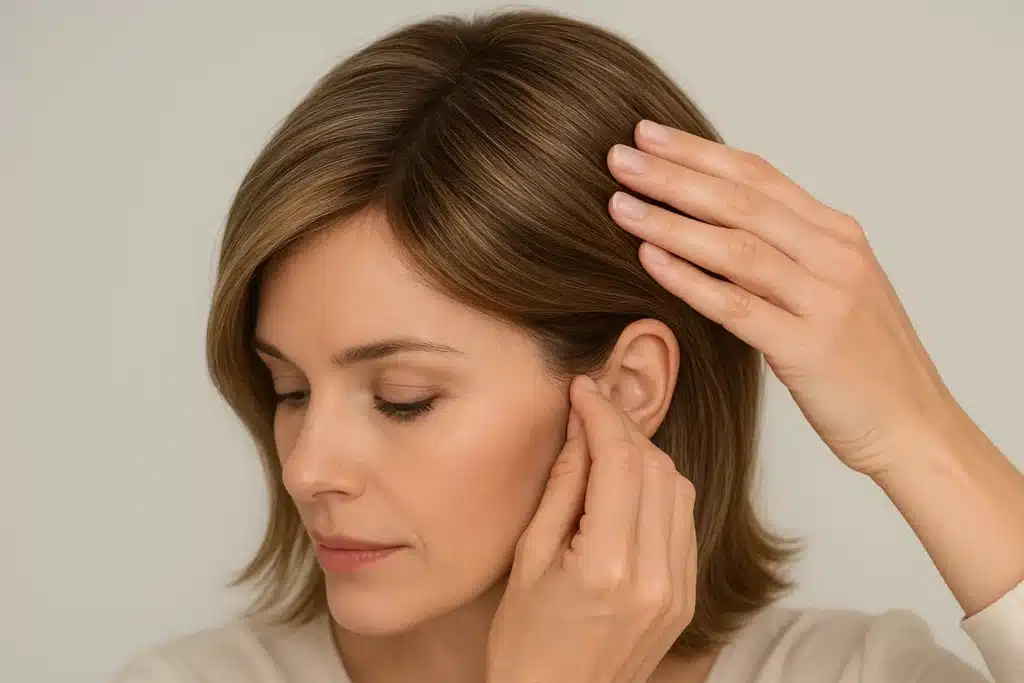
If the straps are pulled all the way in and the cap still bunches at the nape, the wig is too big, and a Small style will fit better than a cap that’s gathered up.
Will an Ellen Wille cap fit over a lot of my own hair?
Usually, once your hair’s flat. Braid it close to your head or pin curl it, put a wig cap over it, and measure with your hair wrapped. Hand-tied, wefted and enclosed wefted caps stretch the most, so if you still feel pressure, choose one of those over a partially hand-tied cap.
Why does my wig feel itchy?
Itching usually comes from the lace rubbing at the hairline or from a wig that’s loose enough to shift. Check the fit first, and adjust the straps and ear tabs so it stays still. A soft wig cap or liner underneath puts a layer between the cap and your skin.
If the lace is what bothers you, look at styles with Comfort Lace, which Ellen Wille made to ease the itchy feel of a standard lace front. If your scalp stays irritated, ask your doctor or care team.
Can I have my wig cut or restyled?
Yes, by a stylist who works with wigs. Ellen Wille recommends a stylist experienced in wig customization, and lists trimming and layering as part of keeping heat-friendly styles in shape. Many styles need little cutting: the maker says Risk needs little to no customization or thinning.
The lace front is a different matter. Ellen Wille lace fronts don’t need trimming before you wear them. If yours runs too far onto your forehead, have a professional trim it, since badly cut lace can fray.
How to Care for an Ellen Wille Wig
Wash your wig every 6 to 8 wears, under cool running water rather than soaking it in a basin. Use shampoo and conditioner made for wigs: Ellen Wille’s US distributor recommends its own BeautiMark line, which is labeled by color for each fiber, with a Synthetic Care line and a Pure Care line for human hair and blends.
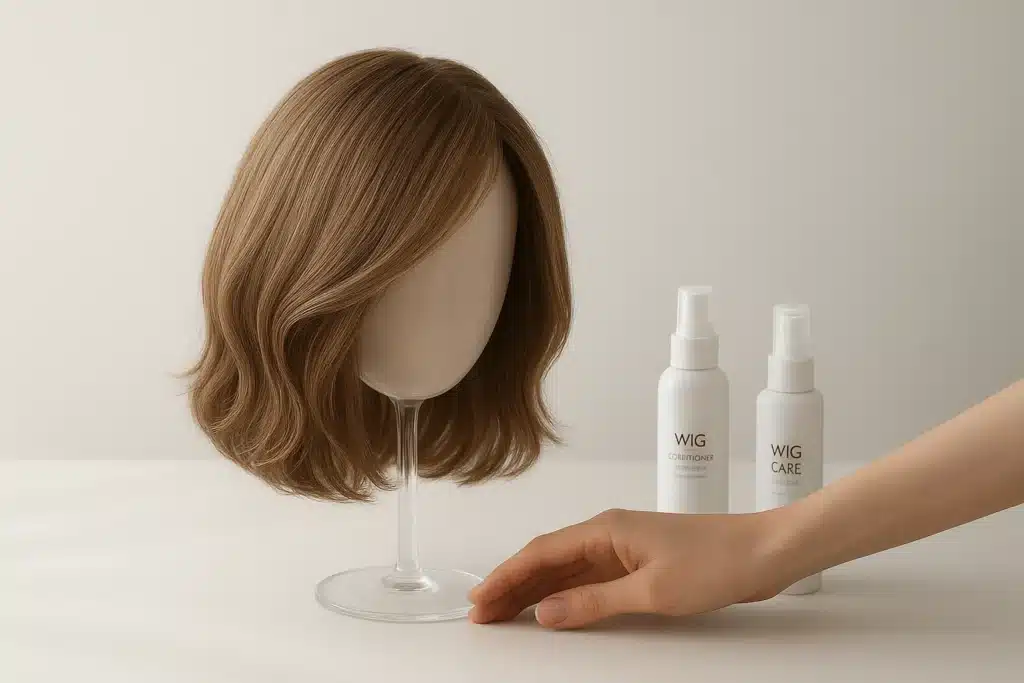
For traditional and heat-friendly synthetic:
- Comb out tangles, starting at the ends and working up.
- Wet the wig under cool, clean running water. Hot water can damage the fiber.
- Wash gently with wig shampoo, keeping the hair flowing in one direction. Don’t rub or scrub, which loosens hand-tied knots.
- Rinse well under cool running water.
- Blot out the water with a towel. Don’t twist or wring it.
- Spray on a leave-in conditioner and comb it through.
- Let it air dry on a wig stand.
Traditional synthetic springs back into its style as it dries, so there’s no need to restyle it.
Daily Care, the Nape and Storage
The nape’s where most wigs tangle first, because the hair rubs on collars, scarves and your shoulders all day. Winter scarves and high collars make it worse.
A few daily habits keep it under control:
- Detangle every day on heat-friendly fiber, with a detangler spray and a wide-tooth comb, working up from the ends.
- Keep a small comb in your bag or car for touch-ups.
- Store it on a stand in a cool, dry place, away from direct sunlight, dust and humidity.
- Rotate two wigs if you can. Ellen Wille says giving each one a rest extends its life.
Caring for Human Hair and Blend Wigs
Human hair and blends also need washing every 6 to 8 wears, with a few differences from synthetic:
- Rinse under lukewarm running water. Don’t submerge the wig, which leads to tangling.
- Shampoo in a smooth downward motion, then rinse.
- Put conditioner on the ends, leave it for 2 to 3 minutes, and rinse.
- Blot with a towel and spray on 3 to 5 pumps of heat protectant.
- Brush through with a soft paddle brush.
- Leave it to dry on a stand, or blow dry on medium heat with a round brush for a smoother finish.
Every 3 to 4 washes, deep condition: mix one part conditioner with half a part of a hair serum, work it through the mid-lengths and ends, leave it for 5 to 10 minutes, and rinse with cool water.
How do I keep the curls in a curly synthetic wig?
Handle the curls with your fingers more than a comb. Ellen Wille’s tips:
- Mist the curls with water, then detangler, before you comb, and use only a comb with wide teeth.
- Wash with your fingers spread wide, raking downward under running water, so the curl pattern holds.
- While it’s wet, comb gently and twirl the curls back into place with your fingers.
- Dry it upside down on its stand for more volume, with a hairnet to take some of the water weight off the curls.
Can I use regular shampoo on my Ellen Wille wig?
No. Ellen Wille says regular shampoos and conditioners aren’t made for wigs and can strip the hair or weaken the lace. Use a synthetic care line on synthetic and heat-friendly fiber, and a human hair line on human hair or blend wigs.
How do I take the shine off a new wig?
Washing it once with wig shampoo usually softens a new wig’s shine. Some shine is part of the fiber: Ellen Wille’s fiber chart lists it as a downside of both synthetics, and lists less shine as a plus of human hair and the blends. If shine bothers you, those are the fibers to look at.
Can I sleep in my wig?
Ellen Wille advises against it. Sleeping in a wig causes tangling, matting and extra wear, so take it off at night and put it on its stand.
How to Heat Style a Heat-Friendly Ellen Wille Wig
Heat style a heat-friendly Ellen Wille wig while it’s damp, at a low setting: its product pages list 260°F in a wet condition, its fiber guides give 260°F to 280°F, and its 2026 care advice is to keep tools under 300°F. The style sets as the fiber cools, not while it’s hot.
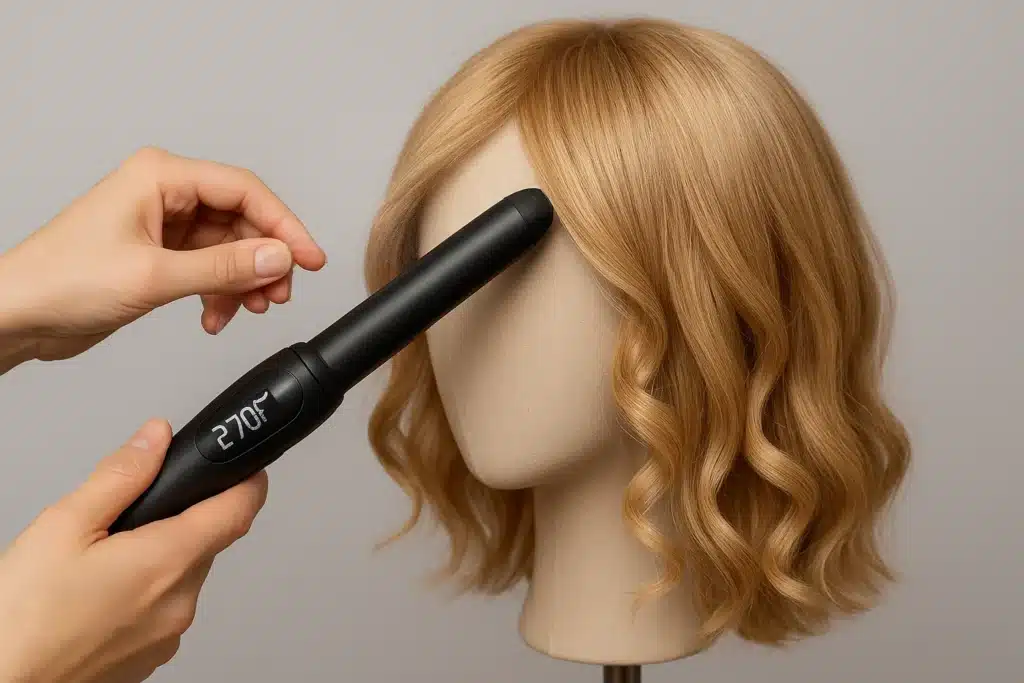
Each fiber has its own limit, and every style’s page says whether it can take heat:
- Traditional synthetic: no heat at all.
- Heat-friendly synthetic: 260°F, styled wet.
- Human hair blends: 300°F, styled dry with a heat protectant.
- Remy human hair: 350°F, styled dry with a heat protectant.
To curl or straighten heat-friendly fiber:
- Comb out tangles from the ends up.
- Divide the hair into small sections and mist each one with water.
- Use a curling iron or flat iron with a digital temperature setting, so you can set the heat, and keep it moving.
- To straighten, run a fine comb through the section and follow it with the flat iron.
- To curl, wrap the section around the iron, then catch the curl in your palm instead of letting it drop, and pin it to the head with a clip.
- Leave it until it’s completely cool and dry, then take out the clips.
Can I use heat on my Ellen Wille wig?
Only if its fiber is heat-friendly synthetic, a blend or human hair. Check the Heat Styleable line on the style’s page or tag before you plug anything in. Curling irons, flat irons and hot blow dryers will damage traditional synthetic styles such as Tab, Ocean and Alive Mono Part.
Can I blow dry my wig?
Yes for human hair: Ellen Wille recommends medium heat and a round brush. Blends take heat too, up to 300°F. For both kinds of synthetic, it says to blot the wig with a towel and let it air dry on a wig stand, then style heat-friendly fiber with an iron while it’s damp.
How do I fix rough, frizzy ends on a heat-friendly wig?
Rough, frizzy ends are friction frizz, from the fiber rubbing on itself, your clothes or a car seat, and they don’t mean the wig is ruined. Heat-friendly fiber needs heat now and then to stay smooth, and Ellen Wille’s fix is a flat iron on damp hair:
- Mist the frizzy ends with water.
- Set the flat iron to the temperature on your style’s page.
- Run it slowly through small sections of the ends.
For frizz that heat won’t fix, a stylist can trim and layer the ends.
Is a heat-set style permanent?
It stays until you heat it again. Heat-friendly fiber has style memory, so a curl or a sleek finish holds through washes, humidity and rain, and you can change it with the iron whenever you like.
How often should I heat style my wig?
When it needs it: to change the style, or when the ends start to feel rough. For everyday upkeep, a detangler spray and a wide-tooth comb are enough. Ellen Wille does say heat-friendly fiber needs heat from time to time to stay smooth, so expect to smooth the ends every so often.
Can I use regular hairspray on a heat-friendly wig?
Use one made for synthetic hair instead. Ellen Wille says to use products made for synthetic hair rather than human hair products, and the BeautiMark line its US distributor sells includes a flexible-hold hairspray for synthetic styles. Spray it from 3 to 6 inches away.
What’s New From Ellen Wille in 2026
Ellen Wille adds new styles and retires others through the year. These are its main 2026 changes, as of November 2026:
- Hair Power Secure Fit (November): Elle Mono, Tess Mono Part and Demi Mono, three heat-friendly styles on the new Secure Fit cap, plus a new shade, Pumpkin Rooted.
- Human hair (August): four new Remy styles (Jadore Deluxe, Jadore Small Deluxe, Supreme Plus Deluxe and Award Small Deluxe), the return of Prestige Deluxe, Flex Parting on select styles, an updated cap on Promise Soft, and the Prime Power blends moved into Pure Power.
- Hair Society (July): Avenue Soft, Avenue Small Soft, Miss Comfort, Romance Deluxe and Escape Soft, and a new Almond Brown color.
- Power Pieces (May): a refreshed line of ponytails, scrunchies, buns, headbands, clip-in bangs and pieces to wear under hats.
- New colors: more shades for Perucci and Hair Society styles. At the same time Perucci retired Charlotte, Cri, Echo, Stay, Sunset and Xenita Hi, and Hair Society retired Air, Aura, Call, Devine, First, Gala, Joy and Vanity.

The Honest Limits of Ellen Wille Wigs
If you’re reading Ellen Wille wigs reviews to decide, weigh them against these trade-offs, all from the maker’s own pages:
- Most styles come only in Petite/Average. In November 2026 the US site listed about 15 Small styles and 8 Large ones.
- Partially hand-tied caps, common in Hair Society, stretch less than other caps.
- Heat-friendly styles need daily detangling and regular smoothing with heat, or the ends frizz.
- Traditional synthetic can’t take heat or be recolored, tangles easily, has some shine and is warmer to wear.
- Human hair reacts to humidity, takes the most upkeep, and Ellen Wille doesn’t advise coloring it.
- Lace fronts look natural but are fragile.
- Styles are retired often, including every original Prime Power wig, so check that a style is still made before you settle on it.
- Color names don’t match from one style to the next, and screen swatches aren’t exact.
Questions About Ellen Wille Wigs
Are Ellen Wille wigs good?
Yes, for most people who want a natural, lightweight look. Ellen Wille started her company in Germany in 1967 and is known for light-to-medium density, lace fronts, monofilament parts and European cuts. The trade-offs are sizing, since most styles come only in Petite/Average, and the extra upkeep that heat-friendly fiber and human hair need.
Do Ellen Wille wigs run small?
A little. Ellen Wille’s standard size, Petite/Average, is about 21.25 inches around, slightly under Jon Renau’s 21.5-inch Average. Most hand-tied, wefted and enclosed wefted caps stretch to fit up to an Average/Large head, while partially hand-tied caps stretch less. Styles with Large in the name measure about 23 inches.
How long does an Ellen Wille wig last?
Ellen Wille says its human hair styles typically last about 12 months, depending on how often you wear them and how you care for them. It gives no figure for synthetic. Breastcancer.org puts synthetic wigs at 3 to 5 months and human hair at 9 to 12. Washing every 6 to 8 wears, as Ellen Wille advises, helps.
Can you color an Ellen Wille human hair wig?
Ellen Wille doesn’t recommend it. Its Pure Power human hair contains textile dyes, so chemical color won’t give predictable results. Choose the shade you want when you buy. Blends and synthetic styles can’t be recolored either, though the blends come in shades human hair rarely offers, such as vibrant reds and icy platinum.
Where can I buy Ellen Wille wigs?
Ellen Wille sells through wig shops, salons and online retailers across the US and Canada, and its US website has a store locator for finding one near you. For a first wig, it suggests booking a consultation with a retailer, who can help with fit, color and choosing between fibers.