We have all been there. You reach for your favorite wig—perhaps it’s that reliable bob that frames your face perfectly—only to run your fingers through the ends and feel resistance. Instead of the silky, fluid movement you fell in love with, the fibers at the nape of the neck feel dry, crunchy, and tangled. It’s a moment of panic for many wig wearers, often leading to the mistaken belief that the wig has reached the end of its life.
But here is the good news: that “crunchy” texture isn’t necessarily permanent damage, and your wig likely isn’t ready for the trash bin. It is simply experiencing a phenomenon known as “fiber friction.” Before you attempt to fix this issue, it is helpful to understand the specific construction of your piece. If you need a refresher on the unique double-monofilament or lace front features of your specific style, you might want to revisit our article on Choosing Your Amore Wig: The Complete Guide, as knowing your cap construction is vital before applying any heat or tension.
The Science of Synthetic Hair: Why Tangles Happen
To revive your wig, you first need to understand what is happening on a microscopic level. Unlike human hair, which needs moisture and oil to stay soft, synthetic hair is a plastic polymer. It doesn’t get “dry” in the traditional sense; it loses its “memory.”
The “Ribbon Effect”
Think of a gift ribbon. If you run a pair of scissors firmly along it, the ribbon curls up. This is exactly what happens to synthetic fibers. Every time your wig rubs against your collar, scarf, or even your skin, friction generates a tiny amount of heat and static. Over time, this friction physically alters the shape of the fiber, causing the straight, smooth plastic to kink and curl at the ends.
This is why washing alone often fails to fix the problem. You can clean the dirt off the fiber, but washing doesn’t smooth out those physical kinks. To truly revive an Amore wig, we need to reset the fiber’s memory.
The “Rescue vs. Routine” Matrix
Not every tangle requires a full intervention. It is important to diagnose the severity of the issue before you begin.
- Routine Refresh: The hair looks dull and has minor knots from daily wear. This requires a gentle detangle and a cold water wash.
- Deep Revival: The hair at the nape feels coarse (like straw), stands away from the neck, or mats together instantly after brushing. This requires the “Steam Reset” technique.
The Essential Toolkit
Before starting, ensure you have the proper tools. Using brushes designed for human hair can stretch and snap synthetic fibers, worsening the frizz.
- Wide-Tooth Comb: Essential for gentle detangling.
- Canvas Blockhead & T-Pins: To secure the wig (never style it while wearing it).
- Handheld Steamer: The secret weapon for erasing friction frizz.
- Synthetic-Safe Detangling Spray: To provide slip without greasiness.
Phase 1: The Dry Detangle (The Golden Rule)
There is a prevalent myth that you should wash a wig to get tangles out. This is false. Water makes a heavy wig heavier and can tighten knots. You must always detangle a synthetic wig while it is completely dry.
- Secure the Wig: Pin your Amore wig to your canvas blockhead. Be careful to place pins only in the ear tabs and the nape, avoiding the delicate monofilament top or lace front areas which can tear.
- Section the Hair: If you are working with a longer style like the Amore Kenzie, section the hair into manageable parts. For shorter bobs like the Riah, you can work side-to-side.
- Start from the Bottom: Spray a light mist of detangler. Holding the hair firmly above the knot to prevent pulling at the cap, gently comb the bottom two inches. Once clear, move up another two inches. Never drag a comb from root to tip in one go.
Phase 2: The Deep Clean
Once the wig is detangled, you need to remove the buildup. Buildup creates a sticky surface that attracts dust and causes fibers to snag on each other.
- Cool Water Only: Fill a basin with cool water and a capful of synthetic wig shampoo.
- The Soak: Submerge the wig and gently swish it. Do not scrub or wring it like laundry.
- The Rinse: Rinse with cool water until all bubbles are gone.
- Drying: Gently squeeze out excess water with a towel (do not twist) and place the wig on a wig stand to air dry. Note: Do not proceed to Phase 3 until the wig is 100% dry.
Phase 3: The “Steam Reset” (The Hero Step)
This is the “aha moment” for most wig wearers. Since the “frizz” is actually a heat-induced kink in the plastic, we use controlled heat to relax the fiber back to its original smooth state. This creates a “factory reset” for the hair strands.
The Technique
- Safety First: Ensure your wig is heat-friendly or that you are using a steamer at a safe distance. Amore wigs are crafted with premium fibers, but they are still sensitive to extreme heat.
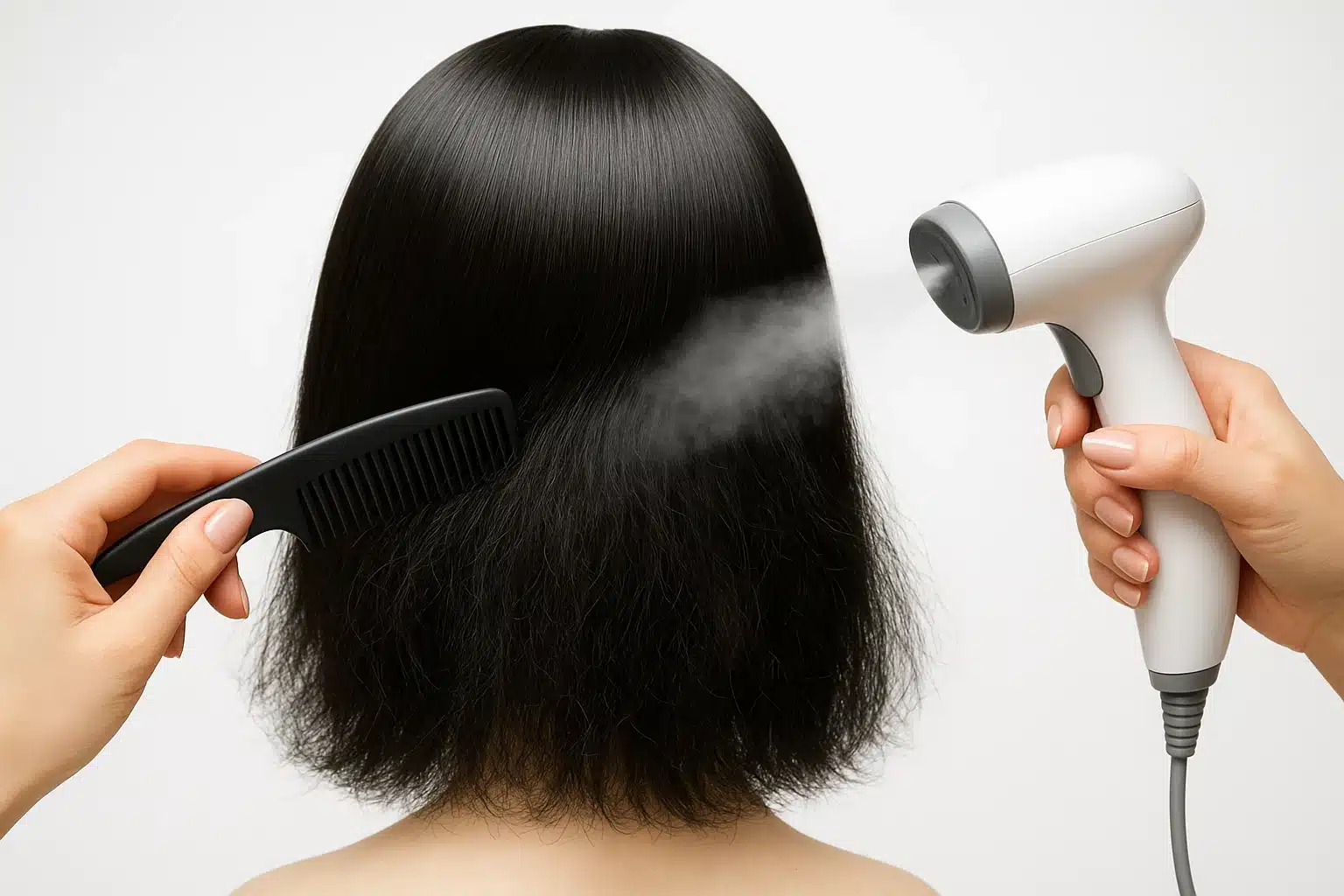
- Comb and Steam: With the wig on the blockhead, take a small section of the frizzy hair at the nape. Run your wide-tooth comb through the hair, and immediately follow the comb with the nozzle of your steamer.
- The Logic: The steam slightly softens the plastic, and the comb holds it straight while it cools. As the fiber cools down, it locks into this new, straight shape.
- Cooling is Key: Do not let go of the section immediately. Allow the fiber to cool for a few seconds in its straight position. This cooling period is when the “memory” is reset.
Professional Insight: If you are reviving a curly style, be careful not to steam out the curls entirely. Focus only on the frizzy ends at the nape.
Phase 4: Prevention and The “Satin Rule”
Now that your Amore wig has its luster and softness back, you want to keep it that way. The longevity of your wig is directly tied to what you wear.
- Watch Your Fabrics: Heavy wool, corduroy, and sequined collars act like sandpaper against synthetic fibers. If you are wearing heavy winter clothes, try to wear a silk or satin scarf around your neck to create a barrier between the wig and the rough fabric.
- Daily Maintenance: At the end of every wear, take two minutes to comb out the nape area. Preventing a tangle is infinitely easier than fixing one.
Frequently Asked Questions
Can I use fabric softener to detangle my wig?
This is a common “hack” seen online. While fabric softener can reduce static, it is not a cleaner and can leave a chemical film on the fiber that attracts more dirt later. It can also irritate your skin if it seeps into the wig cap. It is safer to use products specifically formulated for synthetic hair.
My wig has a “kink” at the ends that won’t go away. Is it ruined?
Not necessarily. If the steam method doesn’t smooth it out, the fiber may be permanently singed (often from opening an oven door or standing near a heater). In this case, a professional trim might be the best solution. Trimming just an inch off the bottom can often remove the worst damage and give the wig a fresh lease on life.
Can I use human hair serum on my Amore wig?
It is best to avoid it. Human hair serums are often too heavy and oil-based. Synthetic fibers cannot absorb oil; the product will simply sit on top of the fiber, looking greasy and attracting dust. Stick to water-soluble sprays made for synthetics.
Moving Forward
Reviving a synthetic wig is a skill that takes a little patience, but the results are incredibly rewarding. By understanding the relationship between friction, heat, and plastic polymers, you can extend the lifespan of your Amore wig significantly, keeping you looking confident and beautiful for months to come.
If you have tried the steam reset and find that your wig has simply reached the end of its journey, or if you are ready to add a new style to your rotation, we are here to help guide you toward your next perfect piece.