We’ve all seen it: that dreaded, telltale line across the forehead where a wig begins and the skin ends. If you’ve spent hours scrolling through online tutorials watching stylists achieve an effortlessly “melted” hairline, you might wonder if it’s just camera magic or a trick of the lighting. For anyone experiencing hair loss, or simply exploring the beautiful versatility of alternative hair, navigating the world of wig caps can feel like trying to learn a foreign language overnight. Words like “HD,” “Swiss,” and “Transparent” are thrown around constantly, but what do they actually mean for your daily life?
The truth is, the secret to a genuinely undetectable hairline isn’t magic—it’s textile science. The first millimeter of your wig dictates how realistic your hair will look. But while selecting the right foundational fabric is critical for reducing visibility, achieving ultimate realism also requires understanding the anatomy of a perfect wig and mastering hairline density and texture to ensure a seamless transition from your forehead to the crown. Let’s pull back the curtain on the physics of wig cap materials so you can make an empowered, educated choice for your unique journey.
The Textile Science of Lace (The Core Engine)
To understand why certain wigs look perfectly natural while others look artificial, we have to look closely at how the cap material is constructed. It all comes down to three physical factors: fiber weight (denier), weave geometry, and light transmission.
“Denier” is simply a textile term for the thickness of individual threads. Think of sheer pantyhose versus a thick pair of winter tights; the difference is the denier. Furthermore, the way these nylon fibers interact with ambient light determines whether a lace cap will seamlessly disappear into your scalp or sit on top of it like a visible mesh screen.
Let’s break down the three dominant lace types on the market today.
HD Lace (High-Definition / Royal Swiss)
- Fiber Weight: ~15 to 20 Denier (Ultra-Thin)
- Weave Pattern: Micro-Hexagonal
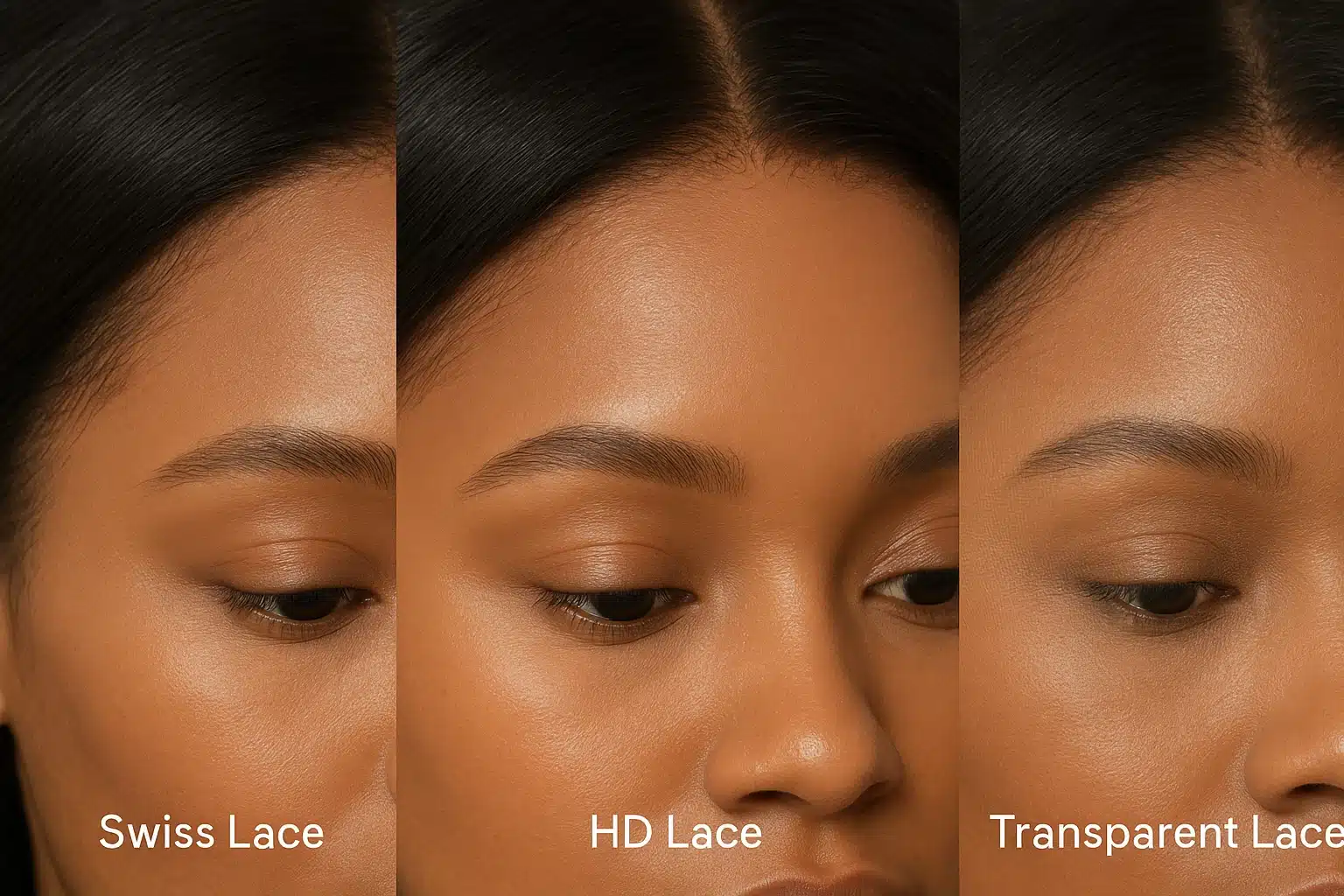
- The Reality: Woven from premium, ultra-fine Swiss nylon polymers, HD lace is the thinnest material available. Because the threads are incredibly fine, they have almost zero light refraction. Instead of bouncing light back at the camera (which creates a visible glare), the fibers absorb and transmit light, creating an instantly matte, invisible finish on any skin tone.
- The Catch: This invisibility comes at a cost to tensile strength. HD lace is highly fragile. Under daily wear, an HD lace closure might only last 2 to 6 weeks before the delicate micro-hexagonal grid begins to tear or fray.
Swiss Lace
- Fiber Weight: ~30 Denier (Fine/Medium)
- Weave Pattern: Hexagonal
- The Reality: Historically imported from specialized mills in Switzerland, standard Swiss lace is the gold standard for professional theatrical and daily-wear wigs. At 30 denier, it strikes the perfect balance between realism and structural resilience.
- The Catch: While it has a slightly higher light refraction index than HD lace, meaning it might catch the light very subtly, a quick dusting of face powder or a light tint renders it virtually undetectable. With proper care, a Swiss lace cap can last 3 to 6 months of daily wear.
Transparent Lace
- Fiber Weight: ~40+ Denier (Thick/Robust)
- Weave Pattern: Square / Rigid Grid
- The Reality: Transparent lace is standard-weight nylon that has undergone a chemical clearing process to remove all pigments, leaving the fibers completely translucent. Because the threads are thicker, this material is incredibly durable and tear-resistant, often lasting 6 to 12+ months.
- The Catch: Thicker fibers act like micro-prisms. They reflect ambient light, which leads us to one of the most common frustrations in wig wearing: the “ashy” hairline.
Solving the “Ashy Hairline” Trap: Skin Matching & Color Theory
One of the greatest “aha moments” in alternative hair education is understanding why transparent lace often looks gray or ashy, particularly on medium-to-deep skin tones.
Beginners often assume the lace itself is gray. In reality, it is a trick of the light. When clear, unpigmented nylon (Transparent Lace) is placed over a darker scalp, the dark skin acts as a high-contrast background. The thick nylon fibers reflect white light, and the human eye perceives this high-contrast reflection as a smoky, ashy cast.
You cannot fix this by gluing the lace down tighter. You have to use color theory to alter how the lace reflects light, neutralizing unwanted undertones based on the Fitzpatrick Skin Phototype Scale:
- Fitzpatrick Types I & II (Fair, Pale, Light Skin): Transparent lace naturally flatters these complexions. If the lace pulls slightly yellow over time, a micro-dose of violet toning shampoo diluted in warm water will neutralize any brassiness.
- Fitzpatrick Types III & IV (Olive, Golden, Medium Brown Skin): Medium Brown Swiss lace is ideal here. If you are tinting transparent lace yourself, look for a warm-toned tan or caramel spray. Pro-Tip: If you use the classic “tea dying” method, always use black tea! Black tea contains the red-orange tannins needed to match the warm subcutaneous tones of golden skin. Herbal teas like chamomile will not work.
- Fitzpatrick Types V & VI (Dark Brown, Deep Espresso Skin): Dark Brown Swiss lace or tinted HD lace is your best friend. To neutralize the gray cast on transparent lace, you must use a cool-toned mahogany, deep brown, or red-orange pigment. Avoid using your everyday foundation if it contains titanium dioxide (a common cosmetic whitening agent), as this will immediately reintroduce the dreaded gray line.
A Chemist’s Guide to Adhesives and Processing
Wig caps are often unintentionally damaged during customization or maintenance because of how adhesives, solvents, and bleaches physically interact with nylon.
Bleaching the Knots
To make a wig look like it’s growing directly from your scalp, the tiny knots where the hair is tied to the lace are often bleached.
- HD Lace: Because the 15-denier fibers are incredibly thin, they are highly sensitive to bleaching powder. You should never use higher than a 20 Volume developer, and it should not sit for more than 12 to 15 minutes. Over-processing will chemically dissolve the lace, causing instant, irreversible hair shedding.
- Swiss and Transparent Lace: These robust materials can comfortably handle 20 to 30 Volume developers for up to 30 minutes, maintaining their structural integrity even when lightened significantly.
Choosing Your Adhesive
- For HD Lace: Stick to water-based co-polymer adhesives (like Ghost Bond). They apply in ultra-thin layers and dry matte. Because HD lace stretches easily, you must dissolve this glue entirely with a gentle citrus solvent before removing the wig. Pulling it dry will permanently warp the delicate grid.
- For Swiss & Transparent Lace: These materials can handle heavy-duty acrylic-based glues and tapes. Their thicker grids prevent the glue from seeping through the lace and bonding to the actual hair. They are also perfect for glueless installs using water-soluble alcohol sprays or holding gels.
Maintenance: Saving a Stretched or Rippled Hairline
Even with the best care, lace can occasionally become stretched during removal, creating a wavy, rippled hairline that refuses to lay flat. Before you retire the wig, try this professional thermal reset protocol:
- Deep Clean: Remove all adhesive residue using a citrus solvent, followed by a gentle, sulfate-free shampoo to strip away remaining oils.
- Thermal Reset: Pin the wig securely to a canvas dome block head, gently pulling the wavy section flat (do not over-stretch). Place a warm, damp microfiber towel over the distorted hairline and press firmly. The heat and moisture will safely soften the nylon fibers.
- Structural Lock: Keep the damp towel pressed flat and use a blow dryer on a cool-to-medium setting over the area. As the nylon cools and dehydrates, it will “freeze” back into its original, flat geometric grid.
Frequently Asked Questions (FAQ)
How can I tell if I bought genuine HD lace or just dyed standard lace?
You can perform a simple three-step physical test. First, the Stretch Test: genuine HD lace stretches slightly in all directions due to its micro-hexagonal weave. Second, the Wet Test: when placed against your skin and lightly misted with water or alcohol, genuine HD lace will practically vanish into your skin tone. Third, the Edge Analysis: the edges of real HD lace are incredibly soft and prone to fraying, whereas cheaper dyed lace will feel slightly rigid or scratchy.
Is HD lace worth the investment for daily wear?
It depends entirely on your lifestyle and priorities. HD lace offers unmatched, flawless realism for special events, photography, or high-definition videography. However, because its lifespan is typically 2 to 6 weeks under daily glued wear, it requires a higher replacement budget. For the everyday wearer looking for longevity without sacrificing a natural look, Swiss lace offers the best return on investment.
Can I use tape on HD lace?
It is highly recommended to avoid tape on HD lace. The adhesive on wig tape is often too strong for the 15-denier ultra-fine threads. When it comes time to remove the tape, the mechanical tension required to peel it off will almost certainly tear or permanently stretch the delicate lace material.
Empowering Your Hair Journey
Choosing the right wig cap isn’t just about avoiding a fashion faux pas; it’s about reclaiming your confidence. Whether you prioritize the unmatched longevity of Transparent lace, the balanced perfection of Swiss lace, or the ultimate cinematic melt of HD lace, knowing why your hair behaves the way it does puts the power back in your hands.
Alternative hair should never feel like a compromise. By arming yourself with the right knowledge, you can ensure that the reflection looking back at you in the mirror is exactly who you want to be.