Have you ever put on a stunning new wig, only to feel like you’re wearing a helmet? It doesn’t sway when you turn your head, the roots stand at rigid attention, and no matter how much you try to style it, the hair just looks unnaturally thick. It’s a frustrating experience that can quickly drain your confidence and leave you wondering if you simply bought the wrong piece.
Most of us immediately blame the sheer amount of hair on the cap. We assume the wig needs to be thinned out, or we vow to buy a lower density piece next time. But as you’ll discover when mastering hairline density and texture, true realism is a multi-dimensional puzzle. The real culprit behind a stiff, unnatural drape usually isn’t how much hair is on the wig—it’s the actual thickness of each individual strand, a hidden metric known as denier.
By understanding the fascinating science of hair strand thickness, you can finally decode why some wigs flow like water, while others stubbornly refuse to move.
The Illusion of Bulk: Density vs. Denier
To understand wig movement, we first have to separate two terms that are constantly confused in the hair world: density and denier.
- Hair Density refers to the quantity of hair. It is the number of individual strands tied into the wig cap per square inch.
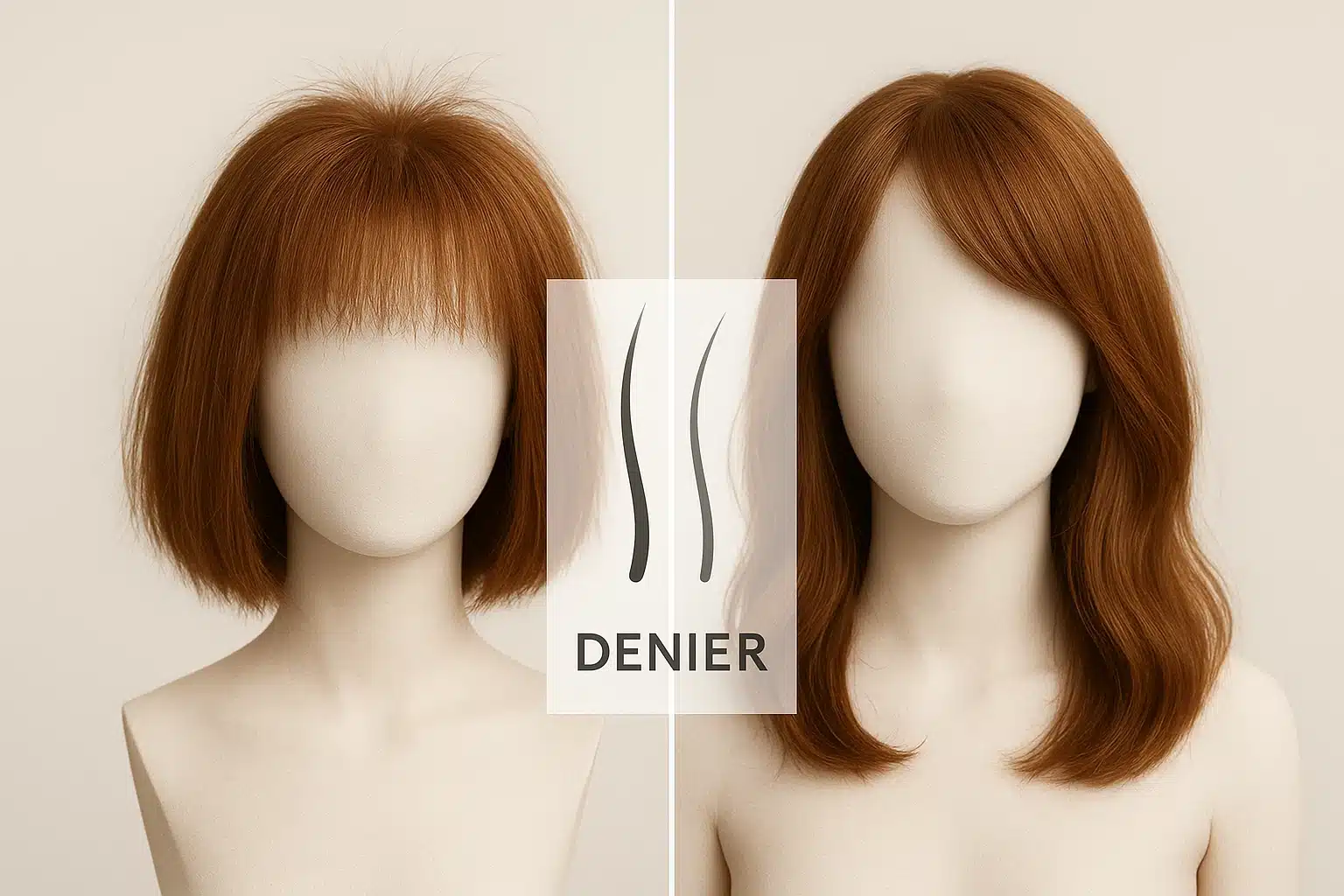
- Hair Denier (or strand thickness) refers to the diameter of each individual strand of hair.
Imagine a dense forest of thick bamboo, compared to a dense field of tall, fine grass. Both have a high “density” (lots of stalks packed closely together). However, when a breeze blows, the fine grass ripples and sways effortlessly. The thick bamboo barely budges.
When your wig looks “too thick” or moves stiffly, you are likely dealing with the bamboo effect. You don’t necessarily have too many hairs on your head; you have hairs with a high denier.
The Science of the Strand: Why Coarse Hair Misbehaves
To understand why this happens, we have to look closely at the anatomy of hair. Hair thickness is measured in microns. Truly fine hair measures around 50 microns in diameter, while coarse, high-denier hair can measure up to 120 microns.
While that difference sounds microscopic, it fundamentally changes the physics of how hair behaves.
The Bending Stiffness Equation
In structural mechanics, a hair strand behaves exactly like a cantilever beam. According to the physics of drape, a 120-micron coarse strand has sixteen times the bending resistance of a 60-micron fine strand.
Because coarse hair is naturally stiff, it requires a massive amount of kinetic energy to move. When sewn into a wig cap, these high-denier strands want to stick straight out from the root. Fine hair, lacking that heavy internal structure, responds to the slightest breeze or turn of your head, draping beautifully against your scalp.
The Missing Medulla
Furthermore, high-denier hair actually has an entirely different internal anatomy. Fine hair typically consists of two layers: an inner cortex and an outer cuticle. Coarse hair contains a third, innermost core called the medulla. This extra structural layer acts like scaffolding, making the hair rigid, robust, and highly resistant to fluid movement.
The “Stiff Wig” Trap: Why Thinning Shears Fail
When faced with a bulky, high-denier wig, the most common advice is to “take some thinning shears to it.” Unfortunately, this is where many perfectly good wigs meet a tragic end.
Thinning shears only reduce density (the number of strands). They do absolutely nothing to change the denier (the stiffness of the remaining strands).
If you take thinning shears to coarse, high-denier hair, you create hundreds of short, stiff hairs close to the scalp. Because these strands are so thick, these freshly cut short hairs act like little structural springs. They push the longer hairs outward and upward, creating an even bulkier “helmet” effect at the roots, leaving you with a stiff crown and stringy, thinned-out ends.
If a wig’s lack of movement is caused by high-denier hair, thinning it out will never give you the fluid drape you’re looking for. The only solution is selecting the right hair fiber from the start.
Mapping Hair Origins: Finding Fluid Movement
When shopping for human hair wigs, the origin of the hair tells you a lot about its natural denier.
The Human Hair Spectrum
- Slavic and European Hair: Often considered the gold standard for natural, fluid movement, this hair is naturally low-denier (fine). Because it lacks a thick medulla, it drapes flat against the head and sways with minimal effort.
- Asian and Brazilian Hair: These origins naturally produce higher-denier, coarser hair. While incredibly durable and excellent for achieving voluminous, textured styles, it possesses high bending resistance.
A quick note on processing: To make high-denier hair feel finer, some manufacturers use aggressive acid baths to strip away the outer cuticle layers. While this artificially thins the strand, it destroys the hair’s natural elasticity, leading to lifeless, stiff movement. Intact, naturally low-denier virgin hair will always offer the most realistic bounce.
The Synthetic Fiber Gap
If you wear synthetic wigs, denier is just as crucial. Standard synthetic fibers (like Kanekalon) are often extruded at high deniers (6 to 9 denier) specifically to prevent the wig from tangling. This heavy plastic weight is exactly what gives cheaper synthetics that unnatural, stiff movement.
Premium synthetic wigs, however, utilize micro-denier fibers (2 to 3 denier). These whisper-thin fibers are engineered specifically to mimic the fluid, lightweight movement of fine human hair.
At-Home Diagnostic: The Thread Test
Not sure what kind of hair you’re dealing with? Try the Thread Test.
Take a single, clean strand of hair from your wig and lay it flat on a piece of white paper. Next to it, lay a piece of standard, all-purpose sewing thread.
- If the hair strand is noticeably thinner and more translucent than the thread, you have low-denier (fine) hair.
- If the hair strand is roughly the same thickness as the thread, or feels like a distinct wire when rolled between your fingers, you have high-denier (coarse) hair.
Styling Mechanics: Denier and The Curling Conundrum
Denier doesn’t just dictate movement; it dictates how your wig holds a style. Have you ever wondered why your thick hair curls seem to drop out after just a few hours?
Coarse, high-denier hair has high “elastic recovery.” It stubbornly wants to return to its natural, straight state. It resists being deformed into a curl unless high heat is applied. Even then, the sheer physical weight of the thick strand pulls the curl down over time.
Conversely, fine-denier hair takes to heat styling incredibly easily. It will curl with a gentle breeze and low heat. However, because it lacks a rigid internal medulla, it requires styling products to hold that shape throughout the day.
Frequently Asked Questions
What is the difference between fine hair and thin hair in a wig?
“Thin” refers to the density of the wig—meaning there are fewer hairs tied to the cap, allowing you to see the scalp easily. “Fine” refers to the denier of the hair—meaning there could be thousands of hairs on the cap, but each individual strand is incredibly skinny, soft, and pliable.
Why does my wig look too thick even after I thinned it?
You likely reduced the density, but the denier of the hair remains coarse. Those thick, high-denier strands naturally stand away from the scalp due to their high bending resistance. Cutting them with thinning shears often creates short, stiff “springs” that push the remaining hair outward, making the wig look even bulkier.
Why does my thick hair texture resist curling?
Thick, high-denier hair has a robust internal structure (the medulla) that resists deformation. It requires more heat to break its structural bonds and shape it into a curl. Additionally, the physical weight of thick hair causes gravity to pull the curl loose much faster than it would on fine hair.
How do I find the best quality hair wig with fluid movement?
Look beyond the “100% human hair” label. If you want a wig that lays flat and moves fluidly, seek out low-denier hair origins (like premium Slavic or fine European hair) or specifically look for “micro-denier” synthetic fibers. Prioritize hair that retains its natural cuticle, ensuring it hasn’t been chemically stripped of its elasticity.
Your Next Steps Toward the Perfect Wig
Understanding the distinction between hair density and hair denier is your secret weapon in the wig-buying journey. It empowers you to look past generic labels and truly understand how a piece will behave once it’s out of the box and on your head.
At Wig Superstore, with almost two decades of compassionate care in the hair loss community, we believe that education is the key to finding a piece that makes you feel beautiful, confident, and completely yourself. The next time you find yourself browsing for a new style, remember to consider the strand itself. When you align your desired style with the proper hair denier, you don’t just get a wig that looks natural—you get one that moves naturally, too.