Imagine this: you’ve finally invested in a beautiful, premium wig. You take it out of the box, place it on your head, and look in the mirror—only to find that it slides backward when you move, the hairline looks unnaturally dense, or the lace doesn’t sit quite right. If you are experiencing this, take a deep breath. You haven’t made a mistake, and your investment isn’t ruined.
The truth that many first-time alternative hair wearers don’t realize is that factory-standard wigs rarely fit perfectly straight out of the box. While finding a high-quality piece is a critical first step—something you can easily navigate with our evaluation guide to the best wig stores in Washington, DC—what happens after the purchase is just as important.
Welcome to the world of wig longevity science. Whether you need to salvage an expensive unit, adjust a cap for medical-grade comfort, or simply want to elevate a factory piece into a custom masterpiece, understanding the anatomy and chemistry of wig repair is essential.
Demystifying Wig Customization: The Science Behind the Magic
To transform a wig from “something you wear” into a seamless extension of yourself, you need to understand the technical modifications professionals use. Many online tutorials make these processes look deceptively simple, but they are grounded in careful chemistry and structural mechanics.
The Chemistry of Knot Bleaching
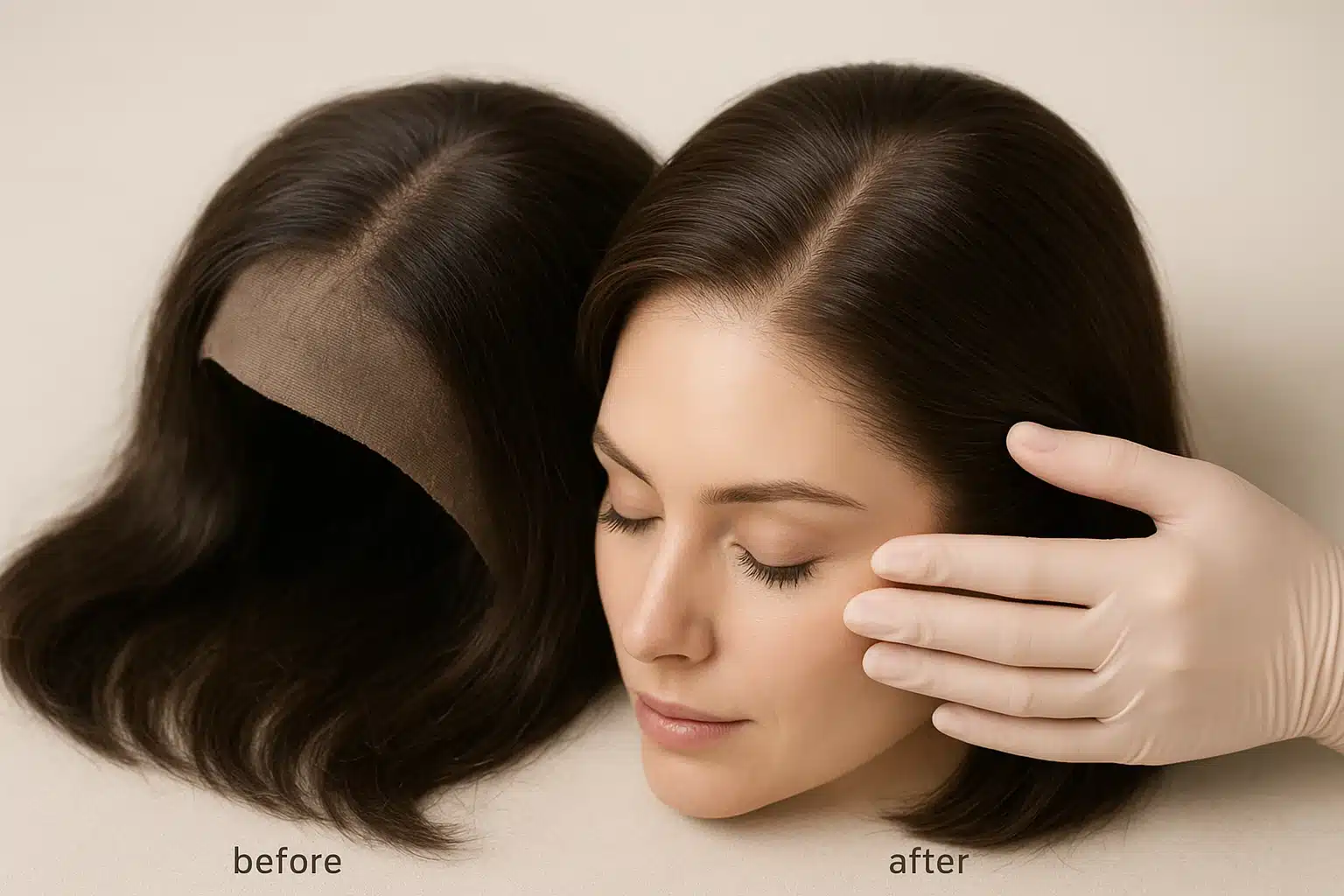
If you turn lace front wigs inside out, you will notice tiny dots where the hair is tied to the mesh. These are knots. To create the illusion of hair growing directly from your scalp, professionals bleach these knots to break down their melanin.
However, bleaching is where many beautiful pieces meet a tragic end. Beginners often use a runny bleach mixture that seeps through the lace pores, coating the actual hair roots and turning them bright orange. Worse, over-processing degrades the nylon or polyester lace mesh, leading to “lace rot” and massive shedding. A professional knows that a thick, clay-like bleach consistency (using a maximum of 20-volume developer) is mandatory to keep the chemical sitting safely on top of the lace.
The Spatial Mechanics of Hairline Plucking
Look at your natural hairline in the mirror. It isn’t a solid, dense wall of hair; it is a gradient that transitions from sparse baby hairs to full density.
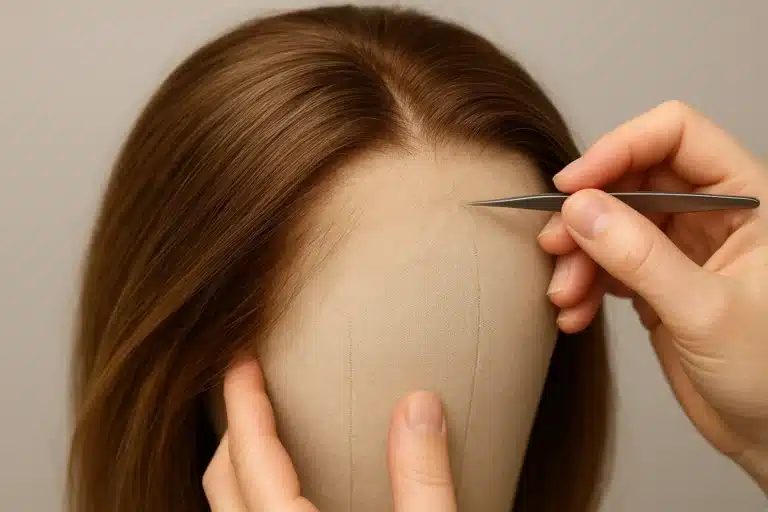
Factory wigs often come with a heavy, unnatural wall of hair at the front. To correct this, technicians perform hand-plucking. Rather than just pulling hairs out randomly, they use a staggering “zigzag” pattern, skipping rows to create a soft, graduated density that mimics nature. Plucking requires an understanding of spatial mechanics to ensure the lace isn’t torn in the process.
The Structural Mechanics of Wig Resizing
When a wig cap is too big, the common advice is to rely on tight adjustable straps, heavy clips, or elastic bands. But here is an industry secret: these are just temporary band-aids. Relying on tight clips to hold down an oversized cap creates painful friction points. Over time, this constant pulling on your natural edges can lead to traction alopecia—permanent hair loss caused by tension.
True wig fitting is a form of anatomical tailoring. Altering a cap requires an understanding of how changing one area affects the entire center of gravity.
- The Crown Zone: This is a common target for bulk reduction. Taking in the crown requires precision so the unit doesn’t buckle.
- The Temple Points & Ear Tabs: If you take in a wig at the back without measuring, the ear tabs may shift forward, resting painfully on top of your ears instead of sitting flush against your temples.
- The Nape Area: This is where structural “darts” are sewn or stretch-mesh gussets are inserted to ensure the cap hugs the back of your head securely.
The “Wig Savior” DIY Safeguard Matrix: Fix It or Take It to a Pro?
Before you pick up shears, bleach, or needles, you have to weigh the financial and chemical risks. An attempt to save a little money on a DIY tutorial can quickly turn a premium $1,500 investment into an unwearable loss.
Use this simple decision matrix before attempting any wig customization:
- Is the lace torn in the hairline?
- Yes: Stop. You need Lace Front Surgery, which requires professional ventilation (hand-knotting hair back into new lace).
- No, it’s a minor tear in the back: You may be able to perform a simple mattress stitch repair.
- Is the cap too big by more than one inch?
- Yes: Take it to a pro. This requires anatomical weft removal and garment-style alterations.
- No, it’s just slightly loose: You can safely use a velvet wig grip or carefully sew a small dart at the nape.
- Are you trying to alter premium human hair?
- Yes: Leave chemical processing to the experts. The cost of a $40-$80 professional knot-bleaching service is far cheaper than replacing ruined human hair wigs.
Verified DMV Wig Specialist Directory
The Washington, DC, Maryland, and Virginia (DMV) area is home to incredibly talented artisans. However, general online directories often lump basic retail supply stores in with specialized technical tailors. If you need hyper-specialized technical services, here is where you should look in the local area:
High Definition Hair (Shaw, Washington DC)
As an industry leader in custom medical-grade glueless wig construction, they utilize patent-pending 3D scalp replica technology. If you are looking to completely eliminate the need for toxic glues and tapes through hyper-precise head measurements, this is your destination.
Joi Wig Salon (Northern Virginia Suburban Metro)
With over 50 years serving the DMV, Joi Wig Salon is the benchmark for compassionate care. They offer private fitting rooms and specialize in the customized adaptation of ready-to-wear pieces specifically for oncology and alopecia patients.
Kustummaid Tailor Hair Studio (Brentwood, Washington DC)
Proving that alternative hair customization is a true form of tailoring, this studio focuses on advanced cap resizing, strap replacement, and structural adjustments. If your wig needs true garment-style alterations, Kustummaid is a premier choice.
Traci Lacei (Washington DC)
Exemplifying the micro-niche of premium lace customization, they are masters of the delicate work. If you need flawless knot bleaching, precision plucking, or complex hairline restructuring, their technical precision is unmatched.
Prolonging Your Investment: Next Steps
Understanding how your wig functions on an anatomical and chemical level completely changes your relationship with alternative hair. By choosing professional tailoring over temporary hacks, and precision chemistry over risky DIY bleaching, you ensure your piece looks completely natural and lasts for years.
Once your unit is beautifully tailored and customized to your exact head shape, maintaining that pristine condition is your next priority. Proper wig maintenance—including understanding moisture balance, thermal protectants, and proper washing techniques—is the final key to absolute wig longevity.
Frequently Asked Questions (FAQ)
What is the difference between human hair and synthetic wig customization?
Human hair can be chemically processed (bleached, dyed) and styled with high-heat tools, allowing for extensive customization like knot bleaching and precise thermal styling. Synthetic fibers, however, will melt under standard high heat (typically above 221°F) and cannot be bleached or dyed with traditional hair color. They require specialized steam restoration and unique synthetic-safe shears for cutting.
Can a wig cap really be made larger?
Yes, but it requires professional tailoring. To make a cap larger, a specialist will carefully cut along the cap’s existing stretch lines and insert stretch-mesh gussets (extra fabric panels) to expand the circumference without distorting the ear tabs or crown.
How do I fix bald spots on my lace wig?
Bald spots caused by shedding or over-plucking are fixed through a process called “ventilation.” A trained technician uses a specialized tiny hook to hand-knot new individual strands of hair directly back into the microscopic holes of the lace, seamlessly restoring the density.
Is it safe to bleach the knots on my wig at home?
While there are thousands of DIY tutorials online, bleaching knots at home carries a high risk of “lace rot” and hair discoloration. If the bleach consistency is too runny or left on too long, it will permanently degrade the structural integrity of the lace and cause massive shedding. For premium investments, professional knot bleaching is always recommended.