Imagine finding a beautifully crafted wig online or at a local boutique. You bring it home, carefully take it out of the box, place it on your head, and pause. Instead of seeing yourself, you just see… hair. It feels a bit too thick, the hairline looks unnaturally sharp, and the color falls somewhat flat against your skin tone. If you’ve ever had this experience, you are not alone. In fact, this is the most common—yet rarely discussed—rite of passage for anyone stepping into the world of alternative hair.
The secret that seasoned wig wearers know is that factory-made wigs are simply blank canvases. Whether you’re transitioning to alternative hair due to medical alopecia, chemotherapy, or simply for fashion and convenience, true realism requires professional customization. If you’re exploring options in the Queen City of the Ozarks, reading through the ultimate guide to the best wig stores in Springfield, MO is the perfect first step to sourcing a high-quality base piece. Once you have that foundation, the magic of custom coloring, thinning, and styling begins.
Let’s pull back the curtain on wig customization and explore exactly how local styling services transform a basic hairpiece into your dream hair.
The “Wiggy” Dilemma: Why Factory Hair Needs a Personal Touch
To understand why customization is so vital, we have to look at how wigs are made. Factory wigs are manufactured with uniform density, often ranging from 130% to 180% thickness. This is significantly thicker than the average person’s natural biological hair. Manufacturers do this intentionally to ensure the wig has enough material to be styled in various ways, but straight out of the box, this excess weight creates a bulky, unnatural silhouette.
This is where the “Factory Reset” concept comes into play. When you take a high-quality unit to a professional wig stylist, they use custom thinning shears and slide-cutting techniques to map the density to your specific face shape. By removing strategic weight around the ears and nape of the neck, the hair begins to move and drape naturally.
The Anatomy of Undetectable Customization
Creating a hyper-realistic wig is a game of millimeters. It requires a deep understanding of facial architecture and specialized techniques that go far beyond a standard haircut.
Rebuilding the Hairline
The biggest giveaway of a wig is often the hairline. Factory lace-front wigs typically feature machine-tied knots that can look like tiny dots, creating a “grid” effect against your forehead. Professional customization addresses this through two key steps:
- Knot Bleaching: A delicate chemical process that lightens the tiny knots where the hair is tied to the lace, making them blend seamlessly into your scalp tone.
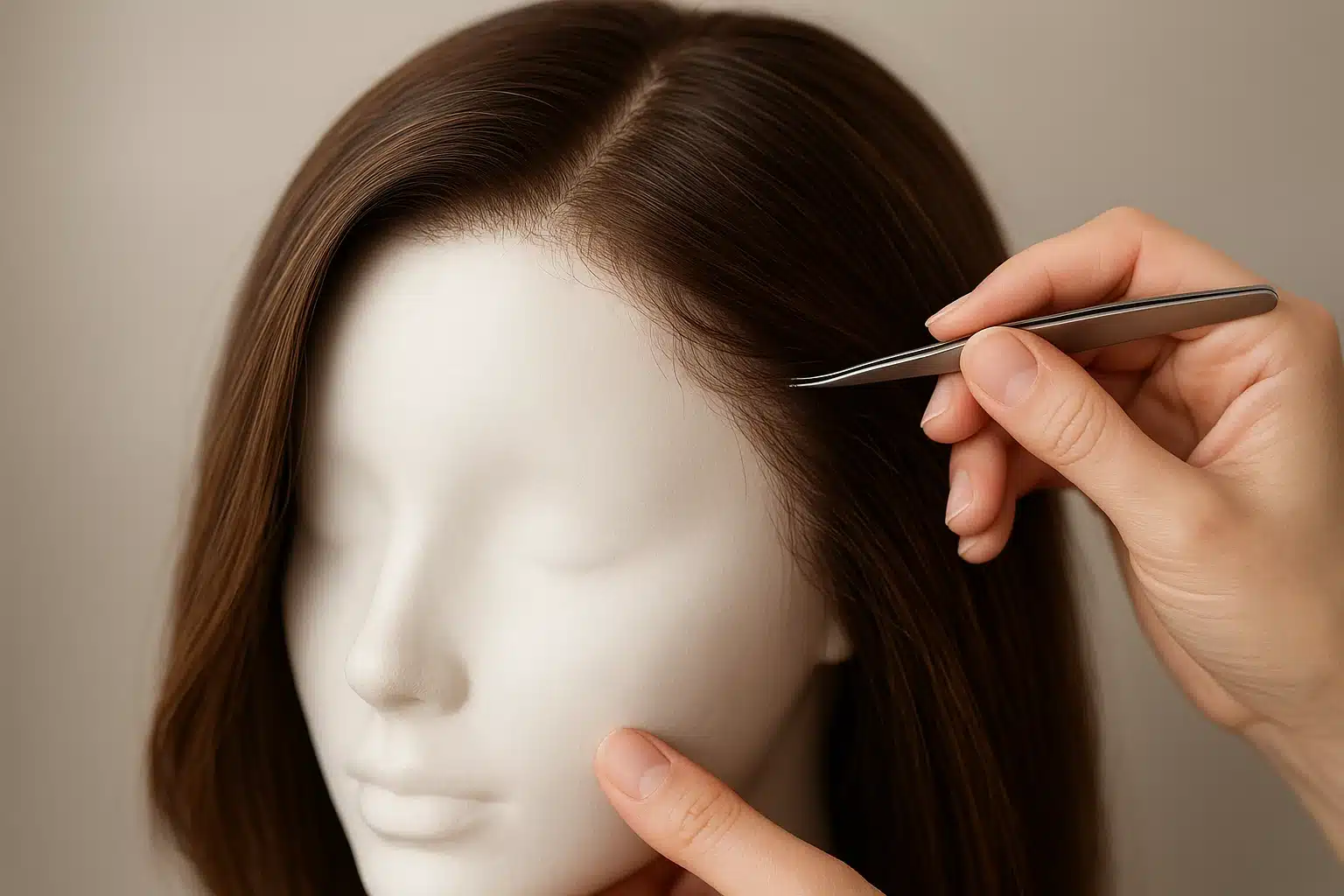
- Hairline Plucking: Using precise tweezers, a stylist will meticulously pluck single hairs from the dense, straight factory hairline to mimic the natural, perfectly imperfect graduation of biological hair. They can even carve out delicate micro-baby hairs for an ultra-realistic finish.
The “On-Head” Fitting Rule
You might assume a stylist can simply trim your wig while it sits on a mannequin block. However, true customization requires “on-head” fitting. Your face is uniquely asymmetrical, and a static foam head cannot replicate your forehead proportions or ear placement. A professional stylist will cut and shape the wig while you are wearing it, utilizing the “4-finger rule” (measuring the ideal distance from your eyebrows to your hairline) and contouring the lace precisely around your ears for maximum comfort.
The Science of Color: Human Hair vs. Synthetic Fibers
Coloring a wig is wildly different from coloring the hair growing out of a human scalp. Bringing a wig to a standard hair salon that doesn’t specialize in alternative hair can often lead to disaster. Here is the science behind why wig color formulation is an art form of its own.
The Color Lift Fallacy (Human Hair Wigs)
Most consumers assume that a 100% human hair wig can be bleached and dyed just like biological hair. This is the Color Lift Fallacy. In reality, factory human hair has already undergone intense processing—including textile acid baths, silicone coatings, and cuticle stripping. Because of this, the hair is highly porous and will lift unpredictably, often turning warm or brassy.
Instead of trying to bleach a dark factory-dyed wig to blonde (which can permanently damage the cap and fibers), professional colorists recommend starting with a light blonde canvas (often referred to as a #613 wig). From there, they can safely deposit custom root shadows, rich dimensional lowlights, and beautiful balayage tones without compromising the integrity of the hair.
Synthetic & Heat-Defiant Boundaries
If you wear synthetic or heat-defiant (HD) synthetic hair, standard salon ammonia dyes simply will not work. Because synthetic hair is made from plastic fibers, color customization requires specialized alcohol-based textile tints.
Furthermore, synthetic wigs require very specific thermal handling. While traditional biological hair can handle a 400°F flat iron, HD synthetic fibers usually have a strict thermal boundary of around 284°F (140°C). Rather than using dry heat, wig professionals often use temperature-controlled steam styling to permanently reset the fiber’s “memory”—a crucial technique for keeping your style intact against the notorious Ozarks humidity.
Your Springfield, MO Salon Game Plan
Before booking a custom styling session in Springfield, it pays to be prepared. Here is a quick checklist of what to bring and how to communicate your vision during your consultation:
- Inspiration Photos: Bring pictures of biological hair you love, but pay attention to realistic expectations regarding hair length and cap construction.
- Understand the Base: Know whether your cap is monofilament, a lace front, or a basic wefted cap. This dictates where the stylist can part the hair and how short it can be cut without showing tracks.
- The Risk Matrix: While there are plenty of tutorials on plucking and cutting online, DIY customization carries a high risk. Once lace is cut too short or density is over-thinned, the wig cannot be repaired. Trusting a licensed professional with alternative hair experience saves you from costly mistakes.
Preserving Your Custom Masterpiece
Once your wig is perfectly customized with a seamless shadow root, face-framing curtain layers, and an undetectable hairline, maintenance becomes your top priority.
To preserve the salon-quality results, wash your unit only when absolutely necessary, using sulfate-free hydration products and cool water. If you live in an area with hard water, consider using filtered water for your final rinse to prevent mineral buildup on the fibers. For heat-defiant synthetics, regular steam resets will keep the ends from frizzing, ensuring your custom look stays fresh month after month.
Frequently Asked Questions (FAQ)
What is the difference between customizing a human hair wig and a synthetic wig?
Human hair wigs offer the highest level of color customization, allowing for root melting, lowlights, and toning, though they require more daily styling. Synthetic wigs cannot be lightened and must be colored with textile tints, but their “style memory” means they hold their custom cut and shape brilliantly, even after washing.
Can any wig be customized?
Almost all wigs can be structurally customized (cut, thinned, and shaped). However, chemical customization (bleaching knots, depositing complex hair dye) should strictly be reserved for high-quality, 100% human hair units.
Why can’t I just wear my wig straight out of the box?
You certainly can, but factory wigs are made with extra density and uniform hairlines to accommodate everyone. Customization—specifically density thinning and facial framing—is what removes the “wiggy” bulk and transforms the piece into natural-looking hair that perfectly complements your unique face shape.
How often do I need to maintain a custom-colored wig?
Because the hair isn’t growing, your root shadow or balayage won’t “grow out.” However, human hair wigs can oxidize and fade over time due to sun exposure and washing. A simple color-depositing gloss treatment every 3 to 4 months can restore vibrancy and shine.
Taking the Next Step in Your Hair Journey
Stepping into the world of alternative hair is a deeply personal, empowering journey. Realizing that a wig is simply a starting point opens up a world of creative possibilities. You don’t have to settle for hair that just looks “okay.” With the right foundational knowledge, an understanding of fiber science, and the help of skilled local professionals, you can achieve a look so natural that no one will ever guess your secret.
Take your time exploring your options, research cap constructions that fit your lifestyle, and never hesitate to reach out to professionals who prioritize your comfort and confidence. Your perfect, customized hair day is closer than you think!