
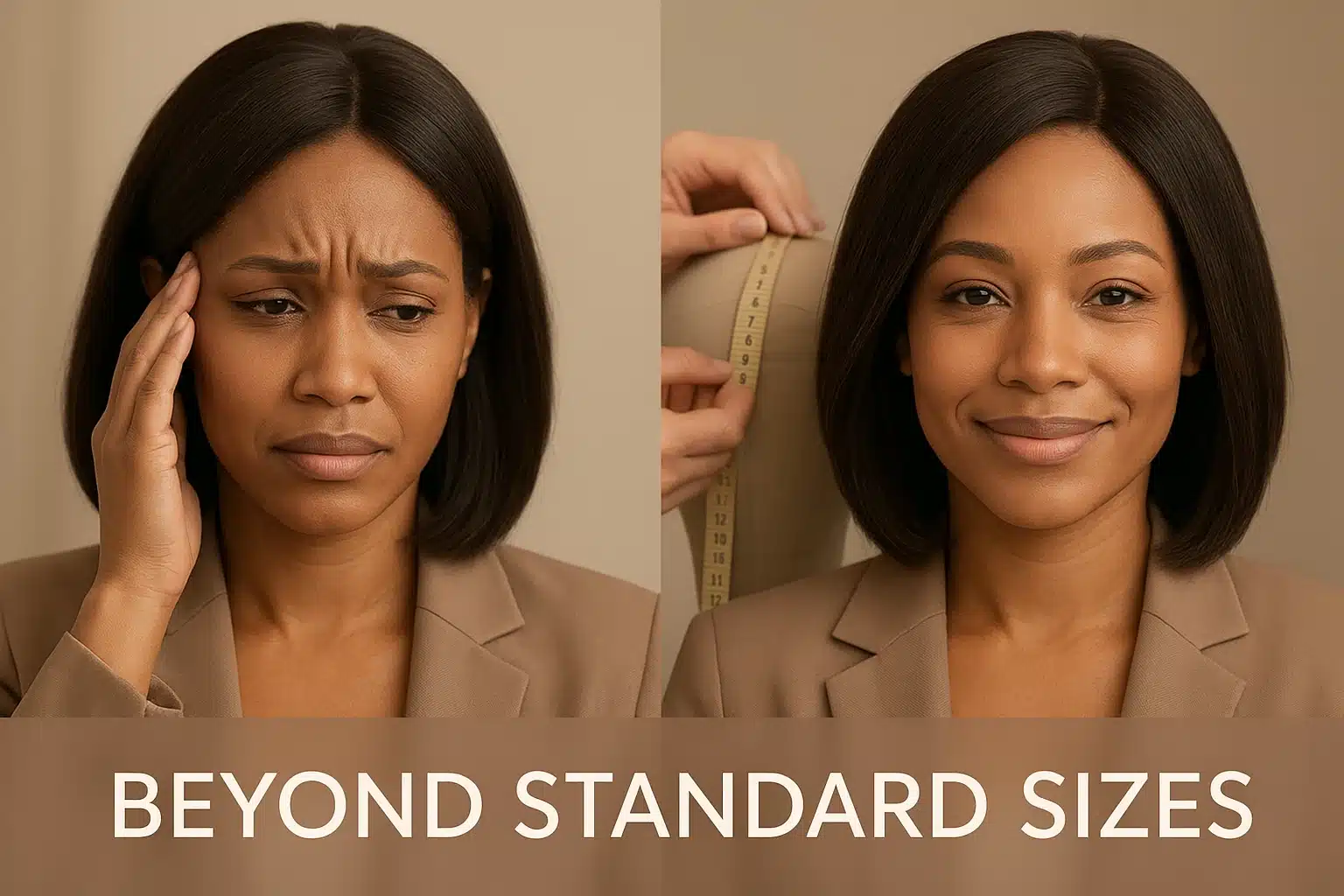
Imagine finding the perfect wig. The color is exactly what you wanted, the style frames your face beautifully, and the hair texture feels incredibly natural. But within an hour of putting it on, you develop a pounding tension headache right behind your ears. Or perhaps the front hairline keeps sliding backward, forcing you into a constant, anxious readjustment dance. If this sounds familiar, you aren’t alone. Standard off-the-rack wigs are engineered for a narrow 21.5 to 22.5-inch circumference, leaving nearly 30% of wig wearers struggling with a fit that just doesn’t work.
For residents in Nassau County seeking comfortable, specialized options, the journey to a perfect fit often begins with finding the best wig stores in Garden City NY. A complete buyer’s guide to the area reveals that true local boutiques do far more than sell standard sizes. They provide specialized custom fitting services that bridge the gap between generic manufacturer molds and the unique, three-dimensional geometry of your head.
The Illusion of “Average” Size and the Adjustable Strap Fallacy
When beginners encounter fit issues, the most common piece of advice they hear is: “Just use the adjustable straps at the nape!”
This is what industry experts call the “adjustable strap fallacy.” Those velcro or hook-and-loop straps at the back of a wig cap are designed to modulate the bottom perimeter nape tension by only about 0.5 to 1.0 inches. What they cannot do is reduce excess fabric bunching at the crown, widen the space between your temples, or change where the ear tabs sit. Over-tightening those straps often forces the front hairline backward and creates severe occipital strain at the base of your skull.
This brings us to a major “aha moment” in wig sizing: 3D skull geometry versus 2D circumference.
Wig sizes are generally treated as linear numbers. But human heads are incredibly diverse three-dimensional structures. Two women can measure an identical 22.5 inches in circumference, yet experience totally opposite fits. One might have a prominent occipital bone (the ridge at the back of the skull) that causes the wig to constantly ride up. The other might have high-set ears and a broader temporal crest, leading to severe pressure on the sides of her head and ear cartilage.
The Six-Point Measurement Standard: Why 3D Head Mapping Matters
If a single circumference measurement isn’t enough, how do professionals guarantee a flawless fit? A comprehensive wig size guide relies on anatomical head mapping using six core biometric measurements:
- Circumference: The perimeter around the hairline, above the ears, and across the nape.
- Front-to-Nape: From the center front hairline, over the apex of the skull, down to the hollow below the occipital bone.
- Ear-to-Ear Across Forehead: Along the frontal edge to ensure lace fronts lay flat.
- Ear-to-Ear Over Crown: From the top of one ear over the skull’s highest point to the opposite ear.
- Temple-to-Temple Around Back: A horizontal loop across the widest part of the back of your head.
- Nape Width: The horizontal span across the base of your neck.
Hair Bulk vs. Cranial Prosthetics
Another critical factor is what sits underneath the wig cap. Biological hair braiding patterns can add between 0.5 to 1.25 inches of bulk to your measurements. A person with thick natural hair might require a large wig cap for volume despite having an average-sized skull. Conversely, individuals experiencing medical hair loss require a much closer, non-slip mapping against sensitive skin, devoid of extra bulk.
Navigating Non-Standard Head Sizing Needs
Understanding how to choose wig cap size petite vs average—or large versus extra-large—requires looking at specific symptoms your current wigs might be causing.
Wigs for Large & Extra-Large Heads (23.0″ – 25.0″+)
Wearing a wig that is too small usually results in “forehead creep” (the hairline inching backward) and severe ear-tab pinching. For larger measurements, custom fitting involves preserving the delicate lace front integrity under high circumference tension.
Wigs for Small & Petite Heads (19.0″ – 21.25″)
A common complaint for petite wearers is “crown ballooning”—when excess cap material bubbles up at the top of the head, making the hair look unnaturally voluminous. Custom fitting for smaller heads focuses on eliminating this excess fabric without pulling the hairline out of proportion or losing a secure nape grip.
Cap Alteration Masterclass: How Professionals Tailor Your Fit
When you walk into a reputable Garden City boutique, you’re not just trying on boxes. Master tailors physically deconstruct and alter the wig cap construction to match your exact biometric numbers.
- Taking in Darts: If you have excess fabric at the crown or nape, a professional will pinch and sew diamond-shaped wedges (darts) into the wefted base, effectively shrinking the cap’s volume while keeping it completely flat against your scalp.
- Foundation Expansion: Need more room? A tailor can strategically slit closed wefts and insert stretch elastic panels (gussets) to gain 1 to 2 inches of space without compromising structural stability.
- Lace Contour Modification: Everyone’s hairline is unique. Professionals custom-trim and shape the lace front around your specific forehead and ear contours to prevent lifting.
- Perimeter Security: To prevent the lace from buckling, fitters can install velvet comfort bands, adjustable elastic tabs, and custom-placed anchor combs.
What to Expect During an In-Store Consultation
If you’ve ever had to compare specialized fitting services while traveling or relocating—perhaps experiencing the stark contrast between a premium New York boutique and standard wig shops in fresno ca—you know that high-level local expertise matters immensely.
During an in-store consultation in Garden City, your stylist won’t just ask you to pick a style. The process begins with a meticulous tracing of your head, sometimes utilizing measuring strips or plaster molds to capture your exact cranial landmarks. When you try on baseline caps, the styling, thinning, and face-framing cuts are only performed after the cap is perfectly secured and tailored to your head’s unique shape. It’s this dedication to personalized tailoring that separates a frustrating online purchase from a seamless experience at a best wig shop.
The “Pinch & Ripple” Diagnostic Checklist
Want to know if your current wig needs professional alteration? Grab a mirror and try this simple at-home diagnostic test:
- The Crown Pinch: Can you pinch more than half an inch of loose fabric at the very top of your head? If yes, your cap requires darting.
- The Ear Tab Test: Do the hard tabs on the side of the wig sit on top of your ear cartilage rather than in front of it? Your cap’s ear-to-ear width is too large.
- The Lace Ripple: Does the front lace buckle or ripple when you smile or raise your eyebrows? Your cap circumference is likely too small, stretching the lace beyond its capacity.
- The Look-Up Test: Tilt your head back to look at the ceiling. Does the back of the wig buckle outward at the nape? You may have a shorter front-to-nape measurement that requires vertical darting.
Frequently Asked Questions (FAQ)
Why is my standard wig giving me headaches right behind the ears?
This is typically caused by the cap’s ear-to-ear measurement being too narrow for your head, or from over-tightening the nape straps. This forces the rigid ear tabs directly into your temporal bone and cartilage, causing pressure headaches.
How do I measure my head for a custom wig without guessing?
You will need a flexible cloth measuring tape and a mirror. Flatten your natural hair completely (using a wrap or tight braids). Do not just measure the circumference; be sure to measure your front-to-nape length and ear-to-ear distance over the crown to get a true 3D map of your head.
Can I make a big wig smaller without sewing?
While you can use temporary fixes like wearing a silicone wig grip or velvet band to take up a small amount of extra space (about a quarter of an inch), true structural reduction to eliminate crown bubbling always requires professional sewing, such as taking in darts.
Does my natural hair thickness change my wig size?
Absolutely. Biological hair, especially when braided or cornrowed, acts as a padded foundation that can add up to 1.25 inches to your overall measurements. Always take your measurements with your hair styled exactly as it will be worn under the wig.
Next Steps in Your Journey
Understanding your unique head geometry is the critical first step to eliminating wig discomfort for good. If you are constantly fighting slipping hairlines, temple headaches, or bubbling crowns, it’s time to move beyond standard off-the-rack sizing. By consulting with specialized fitters in Garden City who understand the mechanics of cap expansion, darting, and custom structural tailoring, you can finally experience the security and confidence of a wig that truly feels like a part of you.