
Navigating medical or genetic hair loss is one of the most emotionally vulnerable experiences a person can face. Whether you are anticipating chemotherapy treatments at regional centers like OU Health Stephenson Cancer Center, managing autoimmune alopecia, or navigating trichotillomania, your hair is deeply tied to your sense of identity. When it comes time to explore hair replacement options, walking into an open-floor retail shop filled with mannequins and casual shoppers can feel completely overwhelming. You aren’t just looking for a product—you’re looking for clinical empathy, complete discretion, and a safe space to process this major life transition.
Fortunately, the landscape for finding compassionate hair loss solutions in central Oklahoma has evolved remarkably. If you are beginning your search, finding the best wig stores in Oklahoma City, OK that offer dedicated, closed-door fitting rooms can transform an intimidating medical side effect into an empowering, restorative journey. Rather than browsing a standard retail rack, discovering local wig stores equipped with private consultation suites ensures you receive the dedicated attention and privacy you deserve.
Here is what you need to know about navigating private wig consultations, choosing the right medical-grade materials, and reclaiming your confidence.
What Actually Happens Behind Closed Doors?
Many people associate wig shopping with a quick trip to a local beauty supply store. However, a medical hair loss consultation is a profoundly different, highly personalized experience. Behind closed doors—in a private, soundproofed room with flattering lighting and private mirrors—the focus shifts from fashion to restorative care.
During a discreet consultation, you are not just trying on wigs; you are being fitted for a “cranial prosthesis.” Here is what you can expect during your visit:
1. Confidential Intake and Scalp Assessment
Your consultant will begin by understanding your unique medical situation. Because treatments like chemotherapy can cause trichodynia (a condition where the scalp becomes highly tender and sensitive to touch), assessing your scalp’s current and future health is the crucial first step.
2. The 3-Point Cranial Measurement
Just like shoes, wigs come in precise sizes. Your consultant will use a three-point measurement protocol:
- Circumference: The perimeter of your hairline.
- Front-to-Nape: From the center of your forehead to the base of your neck.
- Ear-to-Ear: Across the crown of your head.A surprising fact: If you lose all your hair, your head circumference actually shrinks slightly. Precise measurements ensure your piece won’t slip or cause pressure headaches as your hair density changes.
3. Swatch Matching and Trial Fittings
Using hygienic, disposable cap liners, you’ll be able to try on different styles. The consultant will match color swatches to your biological hair (or help you explore a brand new look), taking into account your facial framing and natural hair density.
The “Aha” Moment: Why Your Wig Needs a Haircut
One of the biggest fears beginners have is, “Will it look like a wig?”
Here is the industry secret: almost all stock wigs are manufactured with 130% to 150% hair density. If you put one straight on your head, it will likely look incredibly thick and slightly unnatural. The breakthrough moment happens when a professional stylist uses texturizing shears to thin out the bulk and “cut in” the wig. By tailoring the perimeter hairline and layering the synthetic or human hair to match your biological face frame, that heavy hairpiece transforms into a seamless, natural extension of you.
The Anatomy of Comfort: Cap Construction for Sensitive Scalps
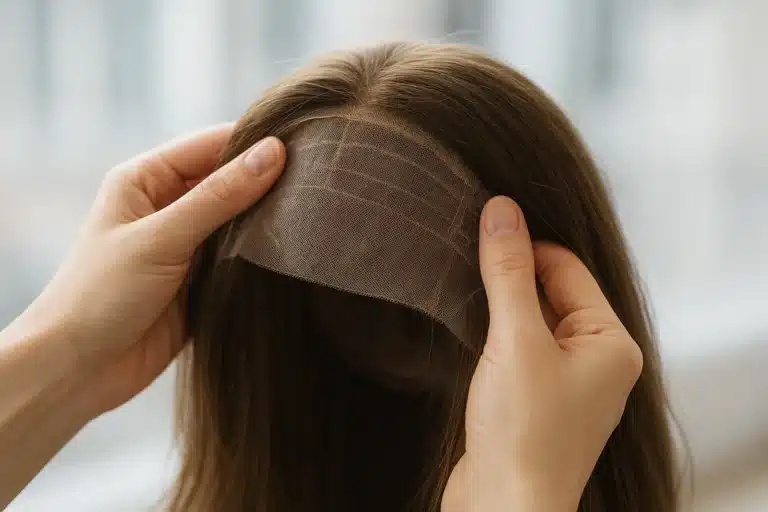
When dealing with hair loss, what’s underneath the hair matters just as much as the hair itself. Standard fashion wigs often feature “machine wefting”—rows of hair sewn onto elastic bands. While cost-effective, this material can scratch and irritate a bald or tender scalp.
For medical hair loss, consultants will guide you toward caps designed with your comfort in mind:
- 100% Hand-Tied Caps: Every single hair is individually hand-knotted into a soft, four-way stretch material. It moves naturally and feels like a soft silk scarf against the skin.
- Double Monofilament Tops: This features an extra layer of soft glass-silk that sits against the scalp, completely shielding your skin from the hair knots while creating the illusion of hair growing directly from your own scalp.
- Silicone Grip Bands: During chemotherapy or total alopecia, you’ll want to avoid harsh glues or adhesives. Medical-grade wigs often utilize polyurethane (silicone) tabs that gently grip bare skin using your body’s natural body heat, keeping the piece securely in place.
Timing is Everything: When Should You Book?
A common mistake is waiting until total hair loss occurs before booking a consultation. The most empowering approach follows a phased timeline:
- Week 1 (Before Treatment/Shedding Begins): Book your initial consultation. This allows the specialist to take a physical swatch of your biological hair color, note your natural hair texture, and capture your baseline head measurements.
- Prior to Cycle 1: Complete your trial fitting and secure your piece.
- Post-Shedding: Return to your private fitting room. Your consultant can adjust the internal cap straps or add sizing tucks to accommodate the slight reduction in your head size once your biological hair has shed.
Navigating Medical Insurance for Your Hair Replacement
One of the most valuable aspects of an expert consultation is guidance through the often-confusing world of health insurance. Many private health insurance plans and Medicare Advantage policies provide coverage for wigs needed due to medical treatments, but you have to use the right terminology.
Never submit a claim for a “wig.” The medical industry recognizes this as a cosmetic term. Instead, you must use the term Cranial Prosthesis and the specific HCPCS billing code A9282 (Wig, any type, each).
Before purchasing, ask your oncologist or dermatologist for a “Letter of Medical Necessity” (LMN). This prescription should explicitly state your diagnosis (e.g., “Cranial Prosthesis for Alopecia Secondary to Chemotherapy”). A highly qualified wig provider will provide you with an itemized receipt utilizing this exact terminology to help maximize your chances of out-of-network reimbursement.
Frequently Asked Questions (FAQ)
What is the difference between a cranial prosthesis and a cheap fashion wig?
A cranial prosthesis is a medical-grade hairpiece designed specifically for patients with severe or total hair loss. They are constructed using hypoallergenic, breathable materials (like silk and hand-tied lace) to protect sensitive scalps, whereas fashion wigs prioritize aesthetics over scalp health and long-term wearability.
Can I bring a support person to my private consultation?
Absolutely. The best private consultation suites in OKC are designed to accommodate you and a trusted family member or friend. Having a support system in the room can help ease anxiety and provide a helpful second opinion.
How do I care for my medical wig at home?
Crucial Mistake to Avoid: Never use standard drugstore shampoo on a wig. Most commercial shampoos contain sulfates that will quickly strip the moisture from processed human hair and irreparably damage synthetic fibers. Always use specialized wig care products, detangle gently with a wide-tooth comb, and dry your wig on a block stand without stretching the cap’s delicate elastic.
Should I choose Human Hair or Heat-Friendly Synthetic?
It depends on your energy levels and budget during treatment. Human hair offers unparalleled realism and longevity but requires traditional heat styling after every wash. Heat-friendly synthetic fibers feature “style memory”—meaning the curls or straight style will automatically bounce back into place after air drying, making it incredibly low-maintenance during exhausting treatment cycles.
Taking the Next Step in Your Journey
Losing your hair is a profound challenge, but finding your solution shouldn’t have to be. By understanding what to expect from a private, enclosed consultation suite, you take the power back into your own hands. You deserve an environment where you are treated with dignity, compassion, and industry expertise.
If you are beginning your search for high-quality hair replacement in the Oklahoma area, remember that you don’t have to navigate this alone. By seeking out providers who prioritize private fitting rooms, medical billing knowledge, and customized cap construction, you are taking a beautiful, proactive step toward feeling completely like yourself again.