
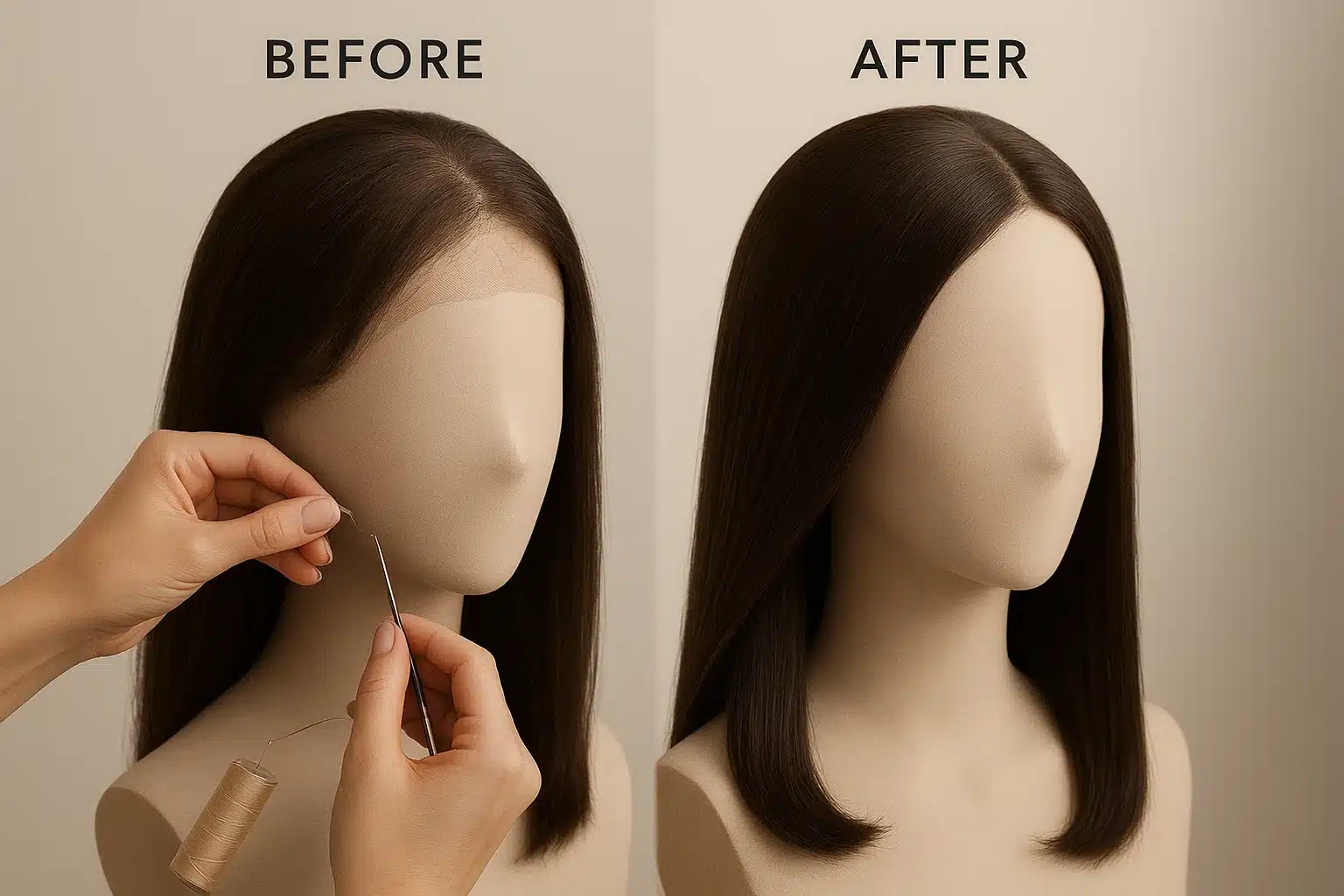
If you have ever unboxed a stunning, high-quality wig, carefully placed it on your head, and immediately felt like it was wearing you, you are not alone. Perhaps the crown poofed up into a subtle cone shape, the ear tabs pressed painfully into your cartilage, or the lace refused to lay flat against your forehead. For many wearers experiencing hair loss, this moment can be deeply frustrating. The culprit? The widespread myth that a standard “medium 22.5-inch” cap will seamlessly fit every unique human head shape out of the box.
In reality, factory wigs are manufactured for perfectly symmetrical mannequins, not the beautiful, varied contours of our actual heads. Finding a solution isn’t just about pulling the adjustable straps a little tighter. For those looking for answers in Southeast Michigan, navigating the best wig stores in Detroit MI is a crucial first step. It is the difference between simply buying a wig off a retail shelf and discovering certified specialists who understand the intricate biomechanics of custom cap alterations.
The “Brim vs. Crown” Dilemma: Why Tightening Straps Isn’t Enough
When a wig feels too large, the instinct is to tighten the adjustable elastic straps at the nape of the neck. However, this often creates a new set of problems.
Think of a wig cap like a baseball hat. Cinching the snapback on a hat only tightens the rim. If the fabric of the hat’s crown is too deep for your head, tightening the rim won’t stop the top from collapsing or puckering. Wigs work the exact same way. Pulling the nape straps alters the perimeter circumference, but it does absolutely nothing to remove excess fabric volume in the crown or the sides. This is what causes a “bubble” at the top of your head or lace that buckles around your temples.
Achieving a bespoke, undetectable fit requires an understanding of the cranial coordinate system. True customization goes far beyond a simple circumference measurement. Before making any modifications, professionals assess six specific cranial coordinates: Circumference, Forehead to Nape, Ear to Ear over the Crown, Temple to Temple over the Occiput, Ear to Ear across the Forehead, and Nape Width. If you are starting this journey at home, learning how to measure wig cap size across all these coordinates is your most powerful tool.
Diagnosing Your Cap Problem: A Simple Fit Matrix
Before you can fix an uncomfortable wig, you need to translate your physical symptoms into structural causes. Here is a diagnostic breakdown of the most common fit issues:
- Symptom: The front lace wrinkles or ripples at the temples.
- Cause: The cap’s width exceeds your actual temple-to-temple measurement.
- Symptom: The nape of the wig constantly rides up toward your crown.
- Cause: The front-to-nape measurement of the cap is too short, or the perimeter elastic has been over-cinched, pulling the unit upward.
- Symptom: The top of the wig forms a cone shape or a hollow bubble.
- Cause: There is excess vertical cap fabric in the crown that requires structural darting, not strap tightening.
- Symptom: Aching, redness, or pressure behind your ears.
- Cause: The wig’s ear tabs are positioned too low and are resting directly on your auricular cartilage instead of just above it.
The Core Disciplines of Wig Customization
Transforming an off-the-rack piece into a perfectly tailored hair system requires a blend of artistry and engineering. Depending on your specific wig cap construction, professionals use three primary techniques to achieve a flawless result.
1. Cranial Darting & Resizing
When a cap has too much surface area, a specialist will use “darting” to remove the excess without cutting away the hair. A horizontal dart at the nape can resolve a wig that is too long from front to back, while vertical darts along the occipital bone (the back of the head) reduce the overall circumference. For hand-tied lace units, this involves precise folding and hand-stitching to ensure the hair tracks (wefts) remain perfectly aligned and flat.
2. Hairline Customization & Density Reduction
Biological hair isn’t a uniform thickness. Our natural density operates on a gradient—around 80% density at our ultra-fine hairline edges, thickening to 110% at the temples, and reaching 130% to 150% in the back. Factory wigs, however, often feature a uniform 150% density everywhere. This is what creates that heavy “helmet” look. Specialists use precise razor tapering and micro-plucking to recreate a natural density gradient. They selectively thin out bulk without leaving blunt internal stubble that pushes the outer layers of hair upward.
3. Engineered Security Mechanisms
For a truly glueless experience that won’t slip during the day, the mechanics of tension must be balanced. Simply sewing an elastic band from ear to ear often pulls the frontal lace backward, causing it to lift. Instead, an adjustable elastic band must be anchored at the lower occipital contour, creating a diagonal, downward counter-tension that holds the wig flush against your scalp. Integrating velvet grip liners or polyurethane (PU) non-slip strips can also provide incredible security for sensitive scalps.
Finding the Right Specialist in Metro Detroit
While DIY videos on social media make alterations look fast and easy, blind sewing or improper thinning can permanently ruin a luxury hairpiece. If you live in Southeast Michigan, you have access to a rich landscape of specialized boutiques and medical hair loss clinics.
When evaluating Detroit-area specialists—such as Rebecca’s Wigs (specializing in medical cranial prosthetics), Jean’s Boutique & Wigs in Grosse Pointe Woods, or advanced customization studios like Amazing Weaves Plus and Salon de Weave in Southfield—it is important to ask the right questions:
- “Do you cut the wefts to resize, or do you fold and hand-stitch darts?” (Folding is vastly preferred for longevity).
- “Can you execute custom alterations on synthetic fibers, or strictly on virgin human hair wigs?”
- “Do you provide private fitting rooms for medical hair loss consultations?”
These questions will help you separate standard retail cashiers from true structural tailoring experts.
DIY vs. Professional Alterations: What to Try at Home
If you are exploring modifications, it is crucial to know your limits.
Safe Home Adjustments: Adding an internal elastic band, performing very minor lace trimming with scalloped shears, or slightly adjusting the circumference using the built-in nape hooks are generally safe tasks for beginners.
Strictly Professional Adjustments: Extensive chemical thinning (like knot bleaching), structural crown darting, lace replacement, and heavy density reduction should always be left to a pro. Whether you are relying on local Detroit experts or researching specialized wig alterations outside your immediate area, bringing in a professional for these complex tasks protects your investment and ensures your piece remains beautiful for years to come.
Frequently Asked Questions
Why does my wig cap lift in the back even when I tighten the straps?
Tightening the straps only cinches the bottom edge of the wig. If the physical distance from your front hairline to the nape of your neck is longer than the wig’s front-to-nape measurement, the wig will naturally slide backward and lift at the nape as you move your head.
What is the difference between cinching adjustable straps and sewing darts?
Adjustable straps simply pull the elastic perimeter tighter. Sewing darts involves folding and stitching the actual structural fabric of the cap to permanently remove excess volume in the crown or the sides, much like taking in a dress at the waist.
Can ready-to-wear synthetic pieces be altered, or only high-end human hair wigs?
Many synthetic wigs can be structurally altered! However, the methods differ. Machine-wefted synthetic caps have rigid vertical ribbons that require careful navigation when darting, whereas fully hand-tied caps are much more pliable. Always check with your stylist to see if they are experienced in synthetic cap architecture.
Embracing a Flawless Fit
Your hairpiece should be a source of confidence, comfort, and joy—not a source of tension headaches or constant readjustment. By understanding the biomechanics of how a cap is constructed and knowing exactly what structural modifications are possible, you are no longer limited to what comes straight out of the box. Armed with the right knowledge and the support of a skilled specialist, you can transform any high-quality wig into a piece that feels like it was made exclusively for you.