
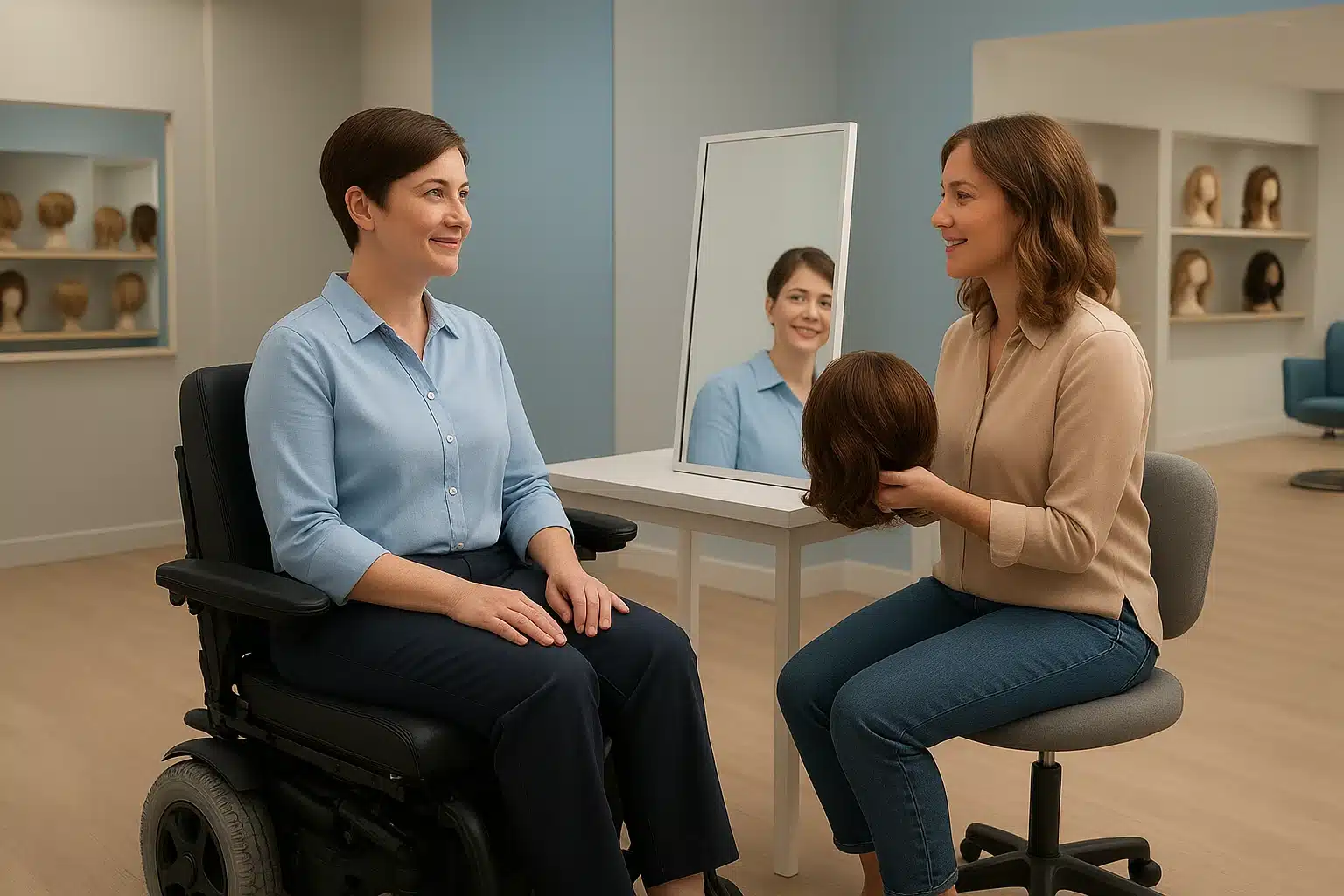
Navigating hair loss caused by oncology treatments, autoimmune alopecia, or chronic illness is an emotionally taxing transition. You’re adapting to a new reflection in the mirror, researching cap constructions, and preparing for what should be a deeply personal, restorative consultation. But for those who also use mobility aids, this experience often comes with an added layer of stress: encountering physical and architectural barriers at the salon door. A single step, a narrow hallway, or an inaccessible fitting room can turn an empowering appointment into a frustrating obstacle course.
Across the DMV area, hundreds of consumers search monthly for medical hair replacement solutions. While many rely on generic online directories to find highly rated boutiques, these resources often treat accessibility as a superficial checkbox. To build foundational context on how the regional market operates across custom boutiques and commercial suppliers, our ultimate evaluation guide to the best wig stores in Washington, DC is an excellent starting point. However, when wheelchair access, safe transfers, and fatigue management are non-negotiable, you need a different kind of roadmap—one that looks beyond the inventory and focuses entirely on inclusive, dignified experiences.
The Invisible Barriers in Medical Hair Replacement
If you’ve ever used a search engine to find “wheelchair accessible wig shops near me,” you’ve likely been served a list of local businesses with a simple “Wheelchair Accessible: Yes” tag. Unfortunately, this binary label fails the educational and practical needs of disabled consumers.
There is a vast difference between statutory compliance (the bare minimum legal standard to avoid litigation) and functional dignity (an environment thoughtfully designed so you never feel like an operational obstacle).
Many shops might have a portable ramp hidden in the back, leading to a heavy pull-door with a raised threshold lip that traps wheels. Inside, you might find tight aisles packed with display mannequins, or a “private consultation room” that is merely a partitioned corner unable to accommodate the turning radius of a power wheelchair. True accessibility goes beyond getting through the front door; it’s about what happens once you are inside.
Deconstructing Real Salon Accessibility: Beyond the Checkbox
To advocate for yourself or a loved one, it helps to understand the architectural physics of a boutique salon. Here is what functional accessibility actually looks like in a wig store.
The 36/60 Standard
In the world of inclusive design, the “36/60 Formula” is the golden rule. A continuous 36-inch clear corridor is mandatory between floor gondolas and display racks so a wheelchair or mobility scooter can pass safely. Even more critical is the 60-inch unobstructed turning diameter (or a T-shaped turnaround space) inside styling and fitting rooms. Without this 60-inch clearance, a power-chair user is forced to reverse out of a fitting room backward, stripping away the privacy and ease the room was meant to provide.
Entrance Physics and Thresholds
A ramp is only as good as its slope and its threshold. Standard ADA guidelines require a maximum 1:12 slope for ramps (one inch of rise for every 12 inches of run). Furthermore, threshold tolerances are incredibly tight. An un-beveled threshold higher than 1/4 inch, or a beveled rise over 1/2 inch, acts as a physical wall for manual wheelchairs and causes hazardous jolts to power-chair users.
The Anatomy of an Inclusive Wig Consultation Suite
Trying on cranial prostheses (medical wigs) can take anywhere from 60 to 90 minutes. For patients managing physical fatigue from chemotherapy or chronic illness, the biomechanics of the fitting space are just as important as the hair itself.
Seating Mechanics and Safe Transfers
Standard salon seating usually involves hydraulic chairs with fixed armrests. This design prevents lateral transfers, inadvertently forcing clients with limited mobility to stand. An accessibility-friendly salon will offer swing-away styling chairs, or, even better, possess the floor space and stylist training to allow you to remain seated in your own mobility device while they cut, steam, and customize your wig.
Mirrors and Seated Sightlines
Standard salon mirrors are mounted for standing stylists and clients sitting in elevated hydraulic chairs, placing eye level at around 54 to 60 inches. For a power-chair user, eye level drops to 42 to 48 inches. If a salon does not have downward-tilting mirrors or full-length glass, you are forced to crane your neck during a critical, emotionally charged consultation.
Acoustic Privacy for Medical Documentation
Medical wig consultations often involve discussing health histories and processing cranial prosthesis prescriptions with ICD-10 and HCPCS codes (like A9282 or S8095). A truly inclusive shop provides an acoustically private space where you can discuss CareFirst superbills or VA Prosthetic & Sensory Aids Service (PSAS) pathways without the rest of the retail floor overhearing your medical information.
Navigating the Washington DC Geographic Landscape
The Washington DC, Maryland, and Northern Virginia (DMV) area presents a unique geographic challenge for accessible retail.
Historic Charm vs. Modern Access
Neighborhoods like Georgetown, Capitol Hill, and Old Town Alexandria feature gorgeous commercial rowhouses constructed long before the 1990 ADA design standards. Many of these spaces operate under historic preservation exemptions, meaning they frequently feature multi-step stoops or sunken garden entrances. Conversely, modern commercial developments in Downtown DC, NoMa, CityCenter, and medical complexes near MedStar Washington Hospital Center or Inova Fairfax are much more likely to feature zero-threshold elevator access, automatic doors, and wide aisles.
Transit and MetroAccess Logistics
For transit-dependent DC residents, getting to the salon is half the battle. When vetting a store, check its proximity to WMATA Metrorail stations and verify the real-time status of the station’s elevators. If you utilize MetroAccess paratransit, you’ll need to know if the salon sits on a commercial corridor with safe, accessible curbside drop-off zones, rather than a busy red-route artery where vans cannot safely deploy a lift.
Your Self-Advocacy Toolkit: The “Dignity Audit”
To empower your search, we recommend performing a “Dignity Audit”—a quick telephone vetting script to use before booking a consultation. By asking these exact questions, you can uncover hidden barriers before you arrive:
- The Entrance: “Do you have a step-free entrance, or do you use a portable ramp? If it’s a ramp, does the door have a raised threshold?”
- The Pathways: “Are your aisles at least 36 inches wide, and are they clear of floor displays?”
- The Fitting Room: “Is your private consultation room large enough for a power wheelchair to do a full 360-degree turn (about 60 inches of clear space)?”
- The Seating: “Can I remain in my own wheelchair while the stylist customizes and cuts the wig on me?”
- The Mirrors: “Do your fitting room mirrors extend down to a seated eye level of about 40 inches, or do they tilt downward?”
Frequently Asked Questions (FAQ)
Can I try on wigs without transferring from my wheelchair?
Yes, in an appropriately spaced salon. A skilled stylist can cut, thin, and customize a lace front wig while you remain in your mobility device, provided the consultation room has the 60-inch turning radius required for them to move comfortably around you.
Are historic DC wig shops wheelchair accessible?
It varies greatly. Many shops located in historic districts like Georgetown (along M Street or Wisconsin Avenue) have grandfathered architectural barriers, such as multi-step entrances or narrow, winding floor plans. Always call ahead and use the “Dignity Audit” script to confirm their specific setup.
How do I request a cranial prosthesis prescription that my insurance will accept?
When speaking with your oncologist or dermatologist, ask them to write a prescription for a “Cranial Prosthesis” (not a “wig”) and include the appropriate ICD-10 diagnosis code for your specific type of hair loss, alongside the HCPCS billing code A9282 (or S8095, depending on your local payer like CareFirst). Bring this to an inclusive salon that understands how to provide an itemized superbill.
What should a caregiver look for when booking a wig fitting?
Caregivers should look for ground-level access, dedicated parking or safe paratransit drop-off zones, swing-away salon seating, and private rooms large enough to comfortably accommodate the wearer, their mobility device, the stylist, and the caregiver themselves without feeling claustrophobic.
Taking the Next Step
Experiencing medical hair loss is challenging enough; finding a compassionate, physically accessible space to reclaim your confidence shouldn’t add to that burden. By understanding the architectural realities of retail salons and using the 5-point Dignity Audit, you can filter out the frustrating spaces and find a boutique that honors your physical needs and emotional journey.
Take your time, make those phone calls, and remember that you deserve an environment thoughtfully designed to make you feel comfortable, safe, and beautiful.