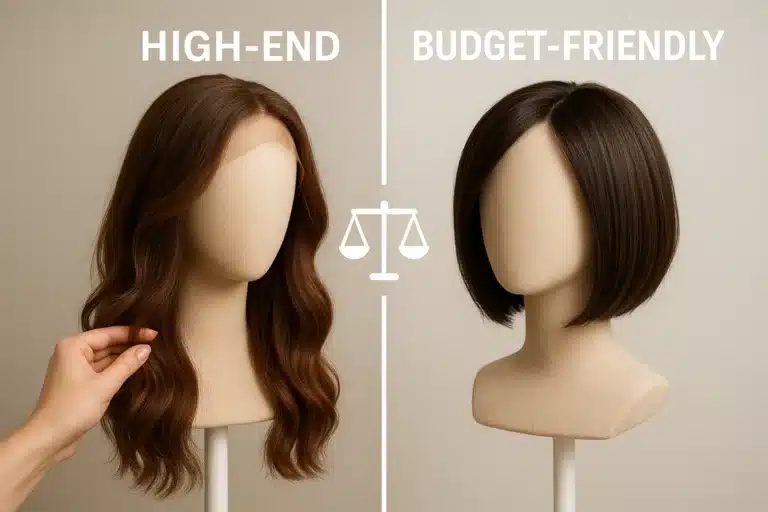
Imagine walking into a bustling beauty supply depot on Reisterstown Road. You’re surrounded by walls of mannequin heads, endless aisles of bundles, and price tags that range from a suspiciously cheap $50 to a daunting $500. You spot a beautiful unit labeled “100% Human Hair,” but a lingering question holds you back: Is this a genuine steal, or will it turn into a tangled, unwearable mess after two washes?
If you are experiencing hair loss, or simply looking to protect your natural hair while switching up your style, the search for the perfect wig can feel overwhelming. In the Baltimore market, there is a massive divide. On one end, you have high-end medical and custom boutiques charging upwards of $2,400 to $4,000 for luxury pieces. On the other, local beauty supply centers offer commercial units that leave buyers questioning their authenticity. Navigating these options shouldn’t require guesswork; in fact, referencing a comprehensive guide to the best wig stores in Baltimore, MD can provide the foundational knowledge you need to compare physical store offerings against value-focused online alternatives.
Let’s bridge the gap. You don’t necessarily need to spend a small fortune to get a beautiful, natural-looking human hair wig. You just need to know what to look for, how to test it, and how to shop smart.
The Truth About Budget Human Hair: Tiers and Traps
To find quality on a budget, you first need to understand why wigs are priced the way they are. The secret lies in the hair’s anatomy—specifically, the cuticle.
The Silicone Trap
Have you ever bought an affordable human hair wig that felt incredibly soft in the store, only for it to mat and tangle the moment you washed it at home? You likely fell victim to the “Silicone Trap.”
Lower-cost human hair wigs (often found in the $50–$150 range) frequently use Non-Remy hair. This means the hair cuticles (the microscopic scales on the outside of the hair shaft) are not aligned in the same direction. To prevent immediate tangling, manufacturers strip the cuticles with acid and dip the hair in a thick industrial silicone coating. In the store, it feels like silk. But after two or three washes, that silicone washes away, exposing the raw, scraped hair underneath, which instantly locks and mattes.
Hair Quality Tiers Demystified
- Non-Remy Hair (The Budget Trap): Collected from various sources, cuticles mixed. Heavily processed and coated in silicone. Best avoided if you want your wig to last more than a few weeks.
- Remy Hair (The Sweet Spot): The cuticles are kept intact and aligned in one direction, drastically reducing tangling. This is where you find your $150–$400 value tier. It offers a beautiful, realistic lifespan without the luxury price tag.
- Virgin/Raw Hair (The Luxury Investment): Completely unprocessed, cuticles intact, collected from single donors. This falls into the $1,000+ tier.
Cap Construction: Finding the Cost-to-Realism Sweet Spot
You don’t just pay for the hair; you pay for the labor it takes to build the wig cap. Understanding cap geometry can save you hundreds of dollars while still giving you a flawless hairline.
Lace Fronts vs. Closures
When you look at lace front wigs, you will typically see numbers like 13×4 or 13×6. This means the lace spans 13 inches across your forehead (ear to ear) and goes 4 to 6 inches deep into the crown. Because every single hair in that space must be tied by hand, they are more expensive.
If you are on a budget, look for a closure wig (like a 4×4 or 5×5). These provide a realistic, hand-tied parting space right at the top of your head, while the rest of the cap is machine-wefted. You sacrifice the ability to pull the hair completely off your face, but you save significantly on the price—and you still get a deeply natural-looking part.
The Magic of Glueless and Wefted Designs
For beginners and budget-conscious shoppers, glueless lace wigs are an absolute game-changer. Not only do they save you the recurring costs of specialty wig glues, tapes, and salon install fees, but they also protect your delicate edges from tension and adhesive damage.
Additionally, fully hand tied wigs are incredible for medical hair loss due to their supreme comfort and multi-directional parting, but they come at a premium. A fantastic compromise is a cap with a hand-tied top or lace front, paired with a machine-wefted back. This maximizes breathability and comfort without requiring you to pay for full hand-knotted labor.
The 5-Point “In-Store & Unboxing” Quality Protocol
Whether you are browsing a local shop on Erdman Avenue or unboxing an online order, use these five tactile tests to evaluate a wig’s true quality:
- The Nape Friction Test: Run your fingers firmly through the hair at the nape of the neck. If your fingers catch or the hair snags immediately, the cuticles are likely misaligned (Non-Remy).
- The Knot & Scalp Visual Check: Look closely at the lace. Are the knots (where the hair is tied to the lace) large and dark like little black dots? Budget units often skip bleaching the knots, which can make the hairline look artificial. Look for smaller, tighter knots.
- The Shedding & Weft Pull Check: Gently tug on the ends of the hair while holding the tracks. A few loose strands are normal, but if hair easily slides out of the weft in clumps, the tracks are poorly reinforced and the wig will thin out quickly.
- The Wet Reaction Test (At Home): Spray a section of the hair with a mix of water and a little clarifying shampoo. If the water beads up unnaturally or the hair instantly turns stiff and matted, you’ve exposed a heavy silicone coating.
- The Strand Burn Test: If you suspect a “100% Human Hair” unit is actually a synthetic blend, take a tiny shedding strand and safely touch it to a lighter’s flame. Human hair burns cleanly and turns to ash with a smell like burning feathers. Synthetic fibers will melt into a hard plastic bead and smell like sweet chemicals. (Note: Only perform this on a loose strand after purchase, never in the store!)
The Baltimore Regional Shopping Blueprint
If you prefer to see and feel wigs in person, Baltimore has distinct corridors tailored to different shopping experiences. Exploring various wig shops in baltimore will give you a great sense of what the local market bears:
- Reisterstown Road & Northwest Baltimore: This area is a hotspot for high-volume beauty supply depots and specialty hair providers. It’s excellent for finding budget-friendly bundles and closure pieces, though you must employ your 5-point inspection test diligently here to weed out synthetic blends.
- Erdman Avenue & East Baltimore: Known for large retail hair outlets, this area offers a wide selection of off-the-rack wigs. It’s a great place to browse diverse textures and styles.
- Central Baltimore & Federal Hill: Here, you will find more custom salons, weave boutiques, and private consultation rooms. While prices generally lean higher here, these spots are ideal if you need a stylist to bleach knots, pluck hairlines, or custom-fit a wig for medical hair loss.
Smart In-Store Strategies
When shopping locally, don’t be afraid to ask questions. Inquire about bundle-plus-closure deals, which can sometimes be cheaper for a local stylist to construct into a custom wig than buying a pre-made unit. Also, always ask if they have clearance inventory or floor samples that haven’t been heavily handled—you can sometimes score a higher-tier Remy unit for a basic beauty supply price.
Frequently Asked Questions (FAQ)
Can you get a real human hair wig for under $200, or is it a scam?
Yes and no. You can find 100% human hair for under $200, but it will likely be lower-grade (Non-Remy) or a shorter length with a basic closure cap. Be highly skeptical of ultra-long, full lace “human hair” wigs priced under $150; they are almost certainly blended with synthetic fibers.
Why does my affordable human hair wig tangle at the nape so quickly?
The nape of the neck experiences the most friction from your collars and natural head movements. If the wig uses Non-Remy hair or has a stripped cuticle layer, that friction causes the fibers to lock together like Velcro, resulting in severe matting.
Is a 13×4 lace front better than a glueless closure wig for beginners?
For true beginners on a budget, a closure wig (like a 4×4 or 5×5) is often much better. Lace fronts require more maintenance, adhesive blending, and delicate handling. A glueless closure wig can simply be thrown on, adjusted with an elastic band, and worn effortlessly, preserving both the wig’s lifespan and your peace of mind.
Next Steps for Your Hair Journey
Finding the perfect wig is deeply personal. Whether you are dealing with medical hair loss and need a compassionate solution, or you are simply tired of overpaying for hair that doesn’t last, education is your best defense.
Now that you know how to navigate cap constructions, avoid the silicone trap, and inspect hair cuticles, you can confidently explore Baltimore’s wig scene or shop online with the discerning eye of an expert. Take your time, prioritize construction that fits your lifestyle, and remember that true quality is about finding a piece that makes you feel beautiful, confident, and comfortable in your own skin.