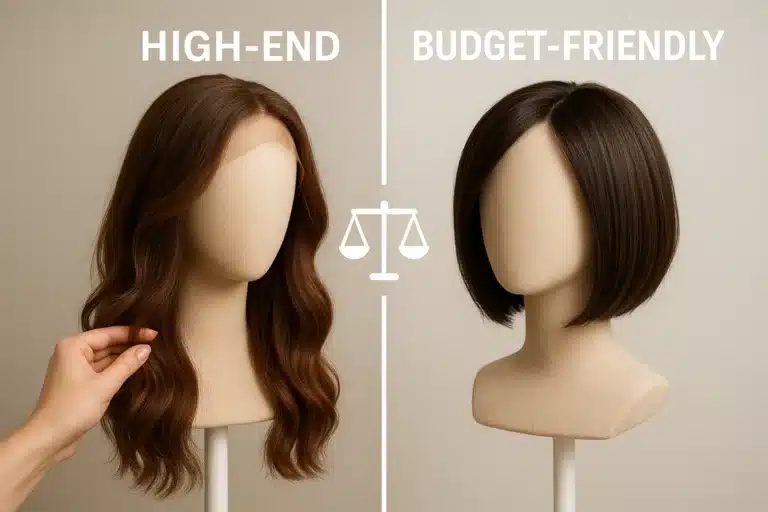
Stepping into the world of wig shopping can feel a lot like learning a new language. If you live in Southwest Missouri and find yourself navigating hair loss, thinning hair, or simply a desire for a new look, you’ve likely noticed a confusing gap in the market. On one hand, national e-commerce retailers promise budget-friendly solutions that often arrive looking unnaturally shiny or ill-fitting. On the other hand, visiting a traditional medical wig boutique can feel financially intimidating for first-time shoppers who mistakenly assume that high quality is entirely out of reach.
The good news? You don’t have to choose between draining your savings and settling for an unnatural appearance. Bridging this gap is entirely possible when you know what to look for regarding cap construction, fiber durability, and local salon integration. By understanding the regional landscape and utilizing the right resources, budget-conscious shoppers in the Ozarks can find beautiful, realistic options. For a complete local shopping directory, explore our resource on the best wig stores in Springfield, MO, which highlights premier styling boutiques across the region.
The Value Equation: Demystifying Wig Pricing in the Ozarks
When you’re new to alternative hair, the pricing spectrum can be jarring. It’s tempting to gamble on a $30 “miracle” wig you saw online, but these ultra-cheap units frequently come with hidden costs: improper cap fits, unwearable hairline constructions, and fibers that tangle beyond repair after just a few wears. Conversely, a $1,500 luxury unit isn’t always strictly necessary for daily wear.
The secret lies in the “sweet spot” of the $80 to $250 range. To understand this, we have to look at the true cost of ownership over a 12-month period.
An affordable synthetic unit might cost $120 and last three to six months with daily wear, meaning you might spend about $240 to $480 a year. Meanwhile, a premium human hair unit might cost $900 but last up to two years. When you’re searching for natural looking wigs, calculating this cost-per-wear helps you decide whether you want a low-maintenance, frequent-replacement synthetic, or a higher-investment, long-lasting human hair piece.
Navigating the Springfield Retail Landscape
Southwest Missouri boasts a unique blend of high-touch retail boutiques and incredible community support systems. Understanding what each local hub specializes in can save you both time and money.
- Celebrity Hair Solutions: Known for a massive local showroom display featuring thousands of units. This is a fantastic starting point if you want to see a wide variety of brand orientations and senior styling options in person.
- Brigitte’s Wig Boutique: Highly regarded for its compassionate, medical-focused care. They excel in guiding chemotherapy patients and those with sensitive scalps, offering in-house tailoring to ensure a perfect fit.
- L.A. Wigs: If you are a beginner who feels overwhelmed, their high-touch personal fitting and lifestyle adaptation make the onboarding process incredibly empathetic and accessible.
- The Shelly Sachs Wig Room (GYN Cancers Alliance): Located on South Fort Ave, this is a vital local non-profit benchmark. They provide free and accessible options for gynecological and cancer patients, showcasing the deeply supportive nature of the Ozarks community.
The Fiber & Cap Decoder: What Actually Matters for Realism
The price of a wig is primarily dictated by two things: what the hair is made of, and how the cap is constructed.
Decoding Cap Construction
The foundation of any wig is its cap. Here is how they impact both cost and realism:
- Basic Machine-Wefted Cap ($40–$100): These are the most budget-friendly. They offer excellent volume and durability, though they usually require a style with bangs to conceal the factory edge at the hairline.
- Lace Front ($90–$250): This is where realism begins. A lace front provides an almost completely undetectable, natural-looking hairline, allowing you to pull the hair off your face.
- Monofilament Part/Crown ($150–$350): The fibers are hand-tied into a sheer material that mimics genuine scalp growth. This allows you to part the hair in multiple directions naturally.
- 100% Hand-Tied ($300–$800+): Offering maximum scalp comfort and natural movement, these are ideal for sensitive scalps or medical hair loss, though they require a larger upfront investment.
Choosing Your Fiber
- Standard Synthetic (Modacrylic/Kanekalon): Offers incredible “style memory” (it bounces right back after a wash) and requires the lowest maintenance, but it cannot be styled with heat.
- Heat-Friendly Synthetic (HD Fiber): Can be restyled with low heat (usually up to 280°F–320°F). It offers high realism but requires careful friction management, especially at the nape of the neck where it rubs against clothing.
- Human Hair Blends: Typically a 50/50 or 70/30 mix of synthetic and human hair. They retain the structural memory of synthetic hair while offering the natural thermal movement of human hair at a fraction of the cost.
- 100% Virgin/Remy Human Hair: Offers total styling autonomy and chemical coloring capabilities. It requires the highest initial capital outlay and needs to be styled just like biological hair.
(Note: If you aren’t experiencing full hair loss, partial coverage options like hair toppers can be an incredibly budget-friendly way to add volume and coverage precisely where you need it without buying a full wig.)
The “Make It Look High-End” Playbook
One of the biggest hurdles beginners face is the “Density and Shine” fallacy. Sub-$100 wigs often arrive from the factory with an unnatural luster and overly thick density. You don’t necessarily need a more expensive wig; you just need to know how to customize the one you have.
DIY Customization Tricks
- Matte the Shine: Use a high-quality dry shampoo lightly sprayed throughout the fibers to instantly dull the artificial factory shine of a brand-new synthetic wig.
- Pluck the Part: Use precision tweezers to carefully pluck a few hairs from the parting line. Widening the part slightly makes it look much more like a natural human scalp.
- Steam Straightening: For heat-friendly synthetics, a handheld garment steamer paired with a fine-tooth comb can smooth out unnatural bumps and reset the style safely.
The Power of Salon Integration
Never underestimate the value of a local stylist. Taking your budget-friendly wig to an affordable hair salon in Springfield for precision thinning, point-cutting, and nape adjustments can make a $100 wig look like a custom $500 piece. Learning the principles behind professional wig customization empowers you to communicate exactly what you need to your local stylist to seamlessly blend synthetic bangs or soften harsh hairlines.
Maximizing Your Investment: A 12-Month Care Protocol
The true secret to affordable wig wearing isn’t just buying right—it’s maintaining right. You can easily extend the life of an affordable synthetic unit from three months to a full year by following a strict care protocol.
Always use sulfate-free synthetic shampoos designed specifically for alternative hair. Standard drugstore shampoos will strip the fibers and degrade the cap. Invest in a wide-tooth bamboo comb or a specialized wig brush to prevent stretching the fibers, and detangle starting from the ends, working your way up to the roots. Finally, wash your wig only when necessary—typically every 6 to 8 wears—to preserve the cap’s integrity and the fiber’s factory style.
Frequently Asked Questions (FAQ)
What is the baseline cost for a natural-looking wig?
For a synthetic wig that features a realistic lace front and natural density, you should expect to spend between $80 and $250. Units priced below this often lack scalp-like parting features and carry a heavy, artificial shine.
Where can I physically try on wigs in Springfield, MO before committing?
Springfield is home to several excellent brick-and-mortar showrooms, including Celebrity Hair Solutions for a massive brand variety, Brigitte’s Wig Boutique for compassionate medical fittings, and L.A. Wigs for high-touch, empathetic beginner onboarding.
Can a local Springfield hair salon trim and thin an affordable wig?
Yes! Many skilled local stylists can trim bangs, point-cut heavy ends, and thin out bulky factory density. Always call ahead to ensure the stylist is comfortable and experienced working with synthetic fibers, as they require different cutting techniques than biological hair.
How can medical patients in the Ozarks leverage local support?
If you are facing medical hair loss, local non-profits like the Shelly Sachs Wig Room (run by the GYN Cancers Alliance) offer phenomenal free and accessible options. Additionally, many insurance policies offer full or partial reimbursement for “cranial prostheses” if accompanied by a doctor’s prescription.
How do heat-friendly synthetic fibers differ from traditional synthetic?
Heat-friendly (HD) fibers can be curled or straightened using low heat, offering more versatility. However, they are more prone to tangling and “clumping” from friction at the nape of the neck, requiring more frequent detangling and steaming maintenance than traditional wash-and-wear synthetic fibers.
Continuing Your Hair Journey
Finding the perfect wig on a budget is less about compromising on quality and more about becoming an educated consumer. By understanding cap construction, knowing how to manage fiber lifespans, and leveraging the incredible retail and styling resources available right here in Springfield, you can reclaim your confidence without breaking the bank.
Take your time exploring local boutiques, ask questions about density and cap styles, and remember that alternative hair is a deeply personal journey—one that is meant to make you feel beautiful, comfortable, and completely yourself.