Imagine walking out of a boutique feeling like a million bucks, only to realize a few weeks later that the nape of your beautiful new wig has turned into a scratchy, tangled mess. If you’ve ever worn a wig during sweater season, you know exactly what I’m talking about. The friction from your favorite coat collar is a known nuisance in the hair-wearing community. But there is a brilliant solution that bridges the gap between affordable synthetics and high-maintenance human hair: heat-friendly synthetic wigs.
Finding these specialized pieces locally, however, can feel like a scavenger hunt. Not all beauty supplies carry genuine heat-resistant fibers, and even when they do, the packaging can be incredibly confusing. That’s why understanding exactly what to look for is just as important as knowing where to shop. If you’re navigating the East Bay retail landscape, discovering the best wig stores in Oakland, CA can save you time, money, and a lot of frustration, giving you access to high-heat synthetic collections right in your neighborhood.
Let’s demystify the science of heat-friendly hair and map out exactly how to shop for it in Oakland.
The “Aha” Moment: What Makes a Wig Heat-Friendly?
To understand why some synthetic wigs can take the heat while others turn into a melted mess, we have to talk about a little bit of material science. Don’t worry—no lab coat required!
Standard synthetic wigs are typically made from modacrylic fibers. They look great out of the box, but their “glass transition temperature” (the point where the material starts to soften and melt) is quite low—usually around 180°F to 220°F. If you touch a curling iron to them, they will literally melt onto the barrel.
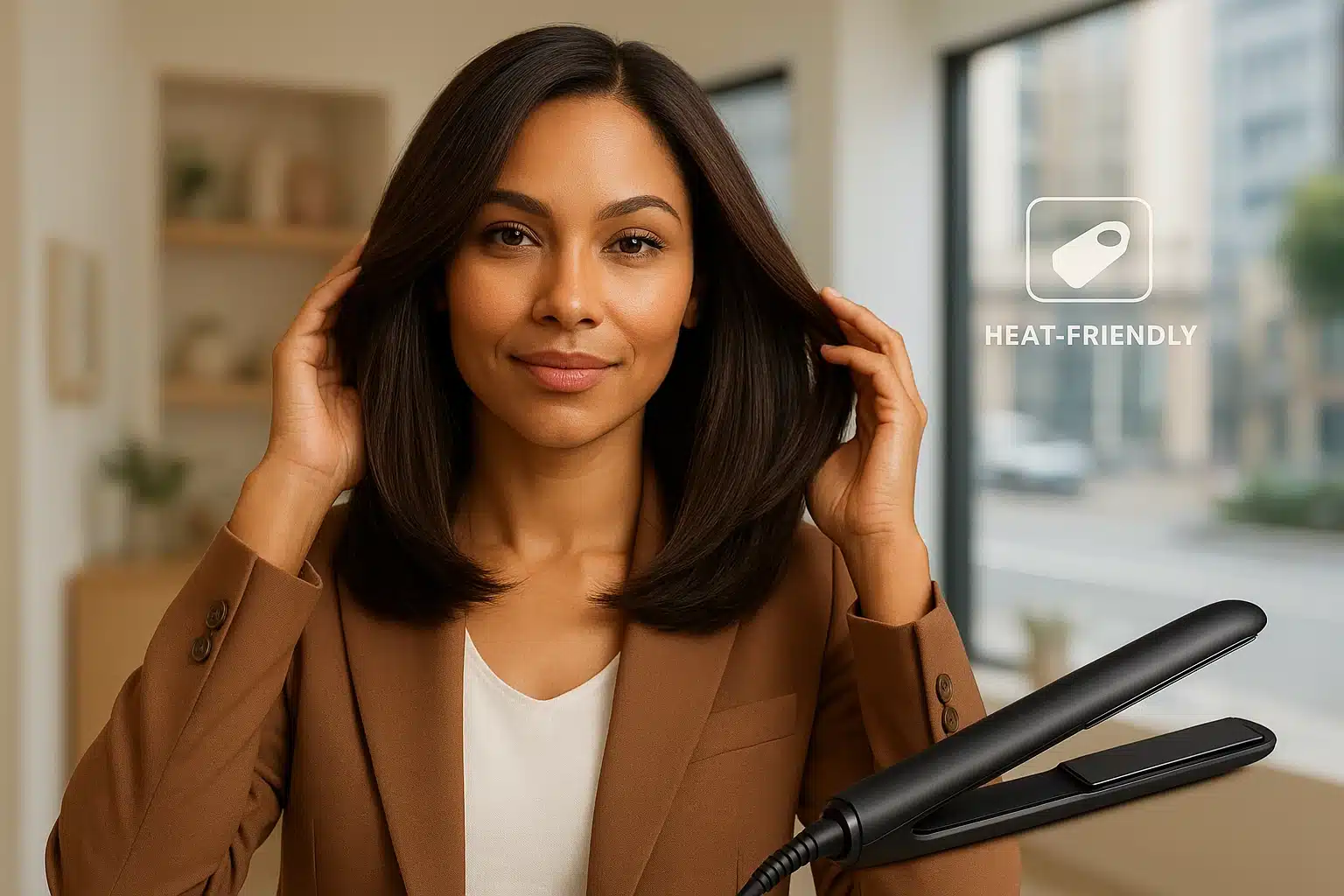
Heat-friendly synthetic wigs, on the other hand, are made from advanced thermoplastic polyester blends (often branded as Kanekalon Futura, Jon Renau HD, or Raquel Welch Tru2Life). These innovative polymers are designed to restructure safely at higher temperatures, usually between 250°F and 300°F. This gives you the ultimate freedom: the built-in style memory of a synthetic wig, with the versatile styling options of human hair.
The Friction Paradox: Why Heat is Actually Your Friend
Here is the biggest misconception in the wig world: beginners assume that applying heat to a synthetic wig will damage it and cause frizz. The reality? Lack of heat maintenance is actually what leaves synthetic friction damage permanent.
As you wear your wig, micro-friction from your shoulders, chair backs, and coat collars causes the synthetic fiber ends to fray. If left alone, these frayed ends tangle and mat.
Here is the magic trick: using a flat iron on a low, controlled heat setting (around 260°F to 275°F) acts like a literal clothing iron. The heat realigns and reseals the frayed polymers, smoothing the hair out perfectly. Far from destroying your heat-friendly wig, a flat iron is the exact tool you need to rescue it.
Master the “Palm Drop”: The Mechanical Cool-Down Principle
If you’ve ever tried to curl a heat-friendly synthetic wig, watched the curl fall completely flat, and thought, “What am I doing wrong?”—you are not alone.
Human hair sets its shape as hydrogen bonds dry. Synthetic hair is completely different. Its shape is dictated by temperature. When you wrap heat-friendly synthetic hair around a 275°F curling wand, the heat softens the polymer chains. But here is the crucial mechanical rule: synthetic fiber memory is locked during cooling, not heating.
If you release a hot curl from the wand, gravity immediately pulls those softened polymer chains straight while they cool in the air, ruining the curl.
The Fix: You must use the “Palm Drop” technique. When you slide the hair off the curling wand, catch the warm curl in the palm of your hand or pin it to your wig block with an alligator clip. Let it sit for 3 to 5 minutes until it is completely cool to the touch. Once cooled, that curl is locked in until you apply heat to it again!
The Temperature Safe-Zone Index
When styling, always use a digital hot tool with an exact temperature readout, avoiding tools that only have “High/Low” switches.
- Under 220°F: No setting action. The fiber won’t restructure.
- 250°F – 280°F: The Optimal Restructuring Zone. Perfect for styling and smoothing frizz.
- 300°F – 320°F: The Danger Zone. Extreme caution required; best left to professionals.
- Over 350°F: Catastrophic fiber singeing.
Navigating the Oakland Retail Landscape
Oakland offers a diverse array of shopping options for wig wearers, but knowing which neighborhoods cater to which needs will save you a lot of transit time.
Telegraph Avenue & West Grand
If you are hopping off the MacArthur BART, the Telegraph Avenue corridor is dense with beauty supply warehouses (like Beauty Supply Warehouse, Young’s Wigs, and Glamor Beauty). These large-scale shops are excellent for budget-friendly, multi-brand purchasing. You will easily find popular commercial heat-safe lines here, such as Outre’s Melted Hairline and Sensationnel’s high-heat collections.
Grand Lake & Boutique Settings
For those seeking medical or cranial prosthesis boutiques, the areas around Grand Lake, Lakeshore, and the Piedmont border offer a different experience. These environments prioritize empathy and one-on-one consultations—a core value we deeply understand as a brand dedicated to compassionate customer care. In these boutique settings, you are more likely to find premium proprietary fibers like Jon Renau HD or Ellen Wille collections.
Your In-Store Survival Guide: Reading the Tags
When you are browsing physical stores in Oakland, the packaging can sometimes be misleading. Here is how to protect yourself before making a purchase:
- Beware of “Flame Retardant”: This is the most common trap! “Flame retardant” simply means the wig won’t burst into flames if exposed to a spark. It is likely standard modacrylic and will still melt if you touch it with a curling iron.
- Look for the Right Keywords: You want to see tags explicitly stating: High-Heat Resistant, Futura, HD Fiber, Tru2Life, or Safe up to 300°F.
- Check the Cap Construction: While inspecting the fiber, look inside the wig. Does it have breathable wefting? Is there a velvet nape to prevent irritation on sensitive scalps?
- Feel the Fiber: Run your fingers through the display model. Genuine heat-friendly fiber often feels slightly more denier (thicker) than ultra-shiny traditional synthetics, closely mimicking the natural texture of human hair.
Frequently Asked Questions (FAQ)
Will a flat iron or curling wand actually melt a synthetic wig?
If it is a traditional synthetic wig, yes, it will melt instantly. If it is a verified heat-friendly synthetic wig, it will not melt as long as you keep your digital hot tool set between 250°F and 280°F.
Why did the nape of my synthetic wig become scratchy and frizzy after two weeks of wear?
This is caused by micro-friction against your clothing, particularly high collars. It is completely normal! You can easily fix this by using a flat iron at 270°F to smooth and reseal the frayed fibers back to their original silky state.
How do I wash a heat-friendly synthetic wig?
Always use cold water. Hot water can inadvertently relax the baked-in style of the wig. Use a surfactant cleanser formulated specifically for synthetic fibers, and avoid heavy human-hair oils, which will just sit on top of the plastic fibers and attract dust.
What questions should I ask an Oakland wig specialist during an in-store cap fitting?
Ask them to verify if the piece is true heat-friendly fiber or just flame retardant. Furthermore, ask about the cap construction (monofilament, lace front, or basic cap) to ensure it aligns with your scalp sensitivity needs and daily lifestyle.
Your Next Steps in the Hair Journey
Finding the perfect wig is an incredibly personal journey, especially if you are navigating the emotional waters of hair loss. Whether you are exploring the bustling aisles of Telegraph Avenue or browsing curated collections online from the comfort of your home, education is your best accessory.
By understanding the unique properties of heat-friendly synthetic fibers, you empower yourself to make confident choices, knowing exactly how to style, maintain, and extend the life of your hair. Remember, you don’t just want a wig that looks good on the mannequin—you deserve a piece that makes you feel beautiful, comfortable, and unequivocally yourself every single day.