
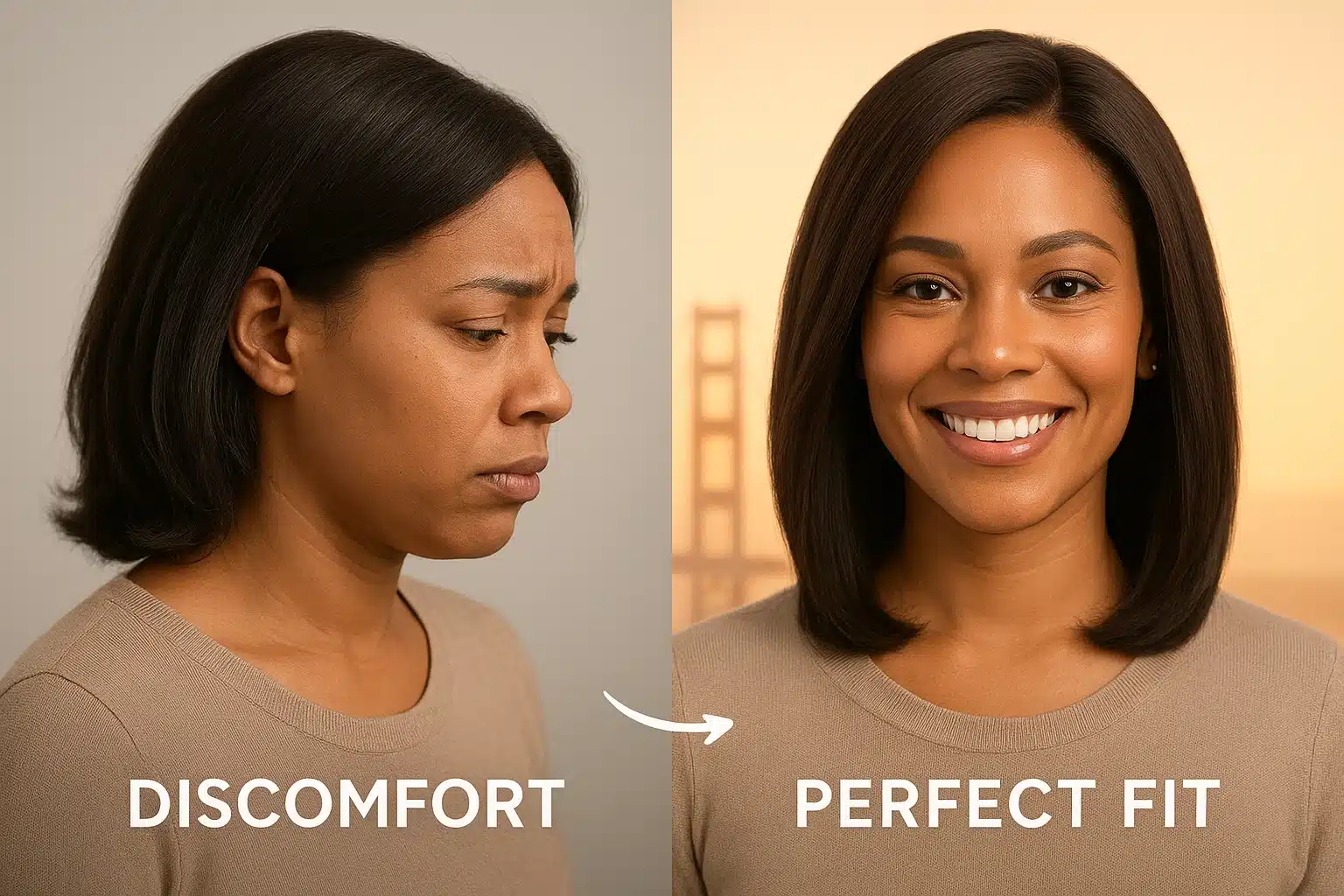
If you wear wigs, you likely know the 45-minute mark.
It’s that distinct moment when a dull ache begins to form at your temples, or when you realize you’ve subconsciously adjusted your hairline three times since leaving the house. Perhaps the ear tabs are digging uncomfortably into your cartilage, or the crown of the wig is “tenting” like a bubble on top of your head.
If this sounds familiar, you aren’t doing anything wrong, and you certainly aren’t alone. You are likely experiencing the hidden reality of the wig industry: the “one-size-fits-all” myth.
Standard, off-the-rack wigs are manufactured almost exclusively for an “Average” cap circumference (between 21.5″ and 22.5″). This industry compromise leaves an estimated 25 to 30 percent of wig wearers—those needing Petite caps (under 21.5″) or Large/Extra-Large caps (over 22.5″)—isolated in a cycle of painful slippage, severe tension headaches, and wasted online purchases.
For San Francisco residents, the search for a well-fitting wig can feel particularly daunting. While local search directories often lump costume shops and synthetic beauty supply stores together, finding a specialist who understands true cranial geometry is a different story.
Let’s unpack the science of why standard wigs fail non-standard heads, how to measure your unique cranial geometry, and exactly where to find specialized wig fittings in the San Francisco Bay Area.
The Hidden Fit Crisis and the “Adjustable Strap Trap”
One of the most common pieces of advice given to wig wearers struggling with fit is to “just use the adjustable straps.” We call this the adjustable strap trap.
While almost all wigs feature elastic adjusters at the nape of the neck, these straps are only designed to alter the bottom circumference by about half an inch to an inch. They cannot change the crown depth, the distance between your temples, or the curvature of the ear tabs.
Trying to make an average wig fit a non-standard head with straps is like trying to put an extra-wide foot into a narrow sneaker by just loosening the shoelaces. The volume of the shoe hasn’t changed.
Here is what happens when you rely on straps to fix a fundamental sizing issue:
- When an Average Wig is Too Small (Tension Failure): Loosening the straps fails to create depth. The hairline creeps backward, the ear tabs sit on top of your ear cartilage rather than flush against your temples, and the nape rides up into the hollow of your neck. The result? A chronic tension headache.
- When an Average Wig is Too Large (Excess Fabric Failure): Tightening the straps on an oversized wig causes the nape elastic to pucker and bulge. The crown forms a “bubble head” effect, the lace ripples along the front hairline, and the ear tabs fold over your ears, often pushing your glasses outward.
Cranial Geometry: Measuring Beyond Circumference
Most online sizing charts reduce your head to a single, two-dimensional measurement: circumference. But your head is three-dimensional. A wearer with a 21.5″ circumference and a flat occipital bone at the back of their head requires completely different cap geometry than someone with a 21.5″ circumference and a prominent brow ridge.
To truly understand your size, professionals look at six distinct anatomical markers. Grab a soft measuring tape and measure these points to build your unique sizing profile:
- Circumference: Around the hairline, behind the ears, and around the nape. (Petite: 20–21.5″ | Average: 21.5–22.5″ | Large: 22.5–23.5″ | Extra-Large: 23.5–24.5″+)
- Front Hairline to Nape: Over the top of the head from the front center hairline to the nape of the neck.
- Ear-to-Ear Across Forehead: From the front of one ear, horizontally across the forehead, to the other ear.
- Ear-to-Ear Over Crown: From the top of one ear cartilage, directly over the crown, to the top of the other ear.
- Temple-to-Temple: Around the back of the head.
- Nape Width: Across the lowest point of the hairline at the back of the neck.
If your measurements lean heavily into the Petite or Large categories, standard caps will almost always require professional intervention.
Cap Tailoring: How Professionals Fix the Unfixable
When you have a unique head size, finding the right base is step one. Step two is often professional tailoring. Just like a high-quality suit, a high-quality wig can be physically altered by a skilled stylist.
For Petite Heads: Professionals can reduce excess fabric by creating “darts”—strategically sewing and tucking open wefts so the cap lies flat against the scalp. They can also trim oversized ear tabs that irritate the ears and install silicone anti-slip perimeters to guarantee security without tension.
For Large and Extra-Large Heads: Stylists can relieve tension by slashing vertical stretch panels and inserting breathable lace “gussets” to expand the cap’s volume. They can also extend nape bands and remove bulk wefts to ensure the wig fits deeply and securely without riding up.
Navigating San Francisco’s Specialized Wig Ecosystem
San Francisco is home to a diverse array of hair-loss specialists, but it’s vital to know which studios handle daily-wear medical and extended-size wigs versus theatrical costume pieces (which excel in stage padding but are often too heavy for daily, sensitive-scalp wear).
Here is your localized guide to specialized wig providers in the Bay Area:
Hansen Fontana (Union Square)
Located on Sutter Street, Hansen Fontana is a cornerstone for medical cranial prostheses. If your need for a large or petite cap stems from alopecia, chemotherapy, or sensitive scalp conditions, this is a prime destination. They specialize in clinical, private consultations, custom-ordered base sizes, and can often assist with navigating insurance billing for cranial prostheses.
David Carver-Ford’s San Francisco Wig Studio (Mission District)
For those seeking a highly personalized, custom couture experience, this studio offers specialized salon-level tailoring. They excel in custom styling, physical cap shaping, and re-engineering high-quality human hair pieces to flawlessly match your specific cranial geometry.
Wig Works & Extensions (San Carlos / SF Peninsula)
If you are willing to travel slightly south of the city, this Bay Area showroom offers a broad alternative hair selection and extended sizing consultation models, providing a comfortable environment to discuss non-standard cap requirements.
Styling for the San Francisco Climate
Finding the right size is only half the battle in the Bay Area. Navigating the damp marine layer, Karl the Fog, and coastal winds requires a secure cap. If you wear an extended size, you cannot rely on default factory tension to keep your wig in place against a strong Bay breeze. Discuss climate-specific securement systems—like polyurethane tabs, velvet perimeters, and silicone grips—during your consultation.
The San Francisco Pre-Appointment Screening Checklist
A crucial reality of the wig industry is that very few physical stores hold dozens of Large or Ultra-Petite units on display. Most specialize in custom-ordering the right size after an in-depth consultation.
Before booking an appointment and traveling across the city, ask these five mandatory questions over the phone to avoid a wasted trip:
- “Do you carry physical stock of petite/large caps I can try on, or do you primarily custom-order them after measuring?”
- “Do you perform in-house cap alterations, like darting or adding gussets, if an extended size needs tailoring?”
- “Are your consultations held in a private room?”
- “Do you have experience fitting caps for complete hair loss versus thick biological hair?”
- “If I am purchasing this due to medical hair loss, can you provide an itemized receipt for a ‘cranial prosthesis’ for my health insurance?”
Frequently Asked Questions (FAQ)
Do I measure my head differently if I have hair vs. complete hair loss?
Yes. If you have biological hair, you must prep your hair exactly as you intend to wear it under the wig (e.g., tight flat braids or a slicked-back low bun) before measuring. Thick hair can add up to an inch to your circumference and crown measurements.
Why does my wig bubble at the crown?
The “bubble crown” effect happens when the cap’s front-to-nape measurement is longer than your actual head. Because the fabric has nowhere to go, it tents up at the top. This is a common symptom of a petite head swimming in an average-sized cap.
Can I just use a wig grip to make a large wig fit my petite head?
While velvet wig grips are fantastic for reducing friction and slippage, they add bulk, not structural integrity. A grip will stop a poorly fitting wig from sliding to a degree, but it will not fix rippling lace, puckered elastic, or ear tabs that sit incorrectly on your face.
Are all wig brands sized exactly the same?
No. Just like clothing brands, wig manufacturers have different sizing blocks. An “Average” in one brand might run noticeably larger or smaller than an “Average” in another. This is why understanding your exact measurements in inches and centimeters is far more reliable than relying on the label.
Taking the Next Step in Your Journey
Finding a wig that feels like a natural extension of yourself shouldn’t be a painful or frustrating process. By understanding your unique cranial geometry, recognizing the limitations of adjustable straps, and seeking out specialized professionals right here in San Francisco, you take control of your comfort and confidence.
At Wig Superstore, we believe that education is the foundation of a beautiful, comfortable hair-loss solution. With nearly two decades of industry expertise, we are fiercely dedicated to compassionate customer care and connecting you with the highest quality products on the market.
Take your measurements, use the screening checklist to book a thoughtful consultation with a local specialist, and step out into the San Francisco breeze with absolute confidence.