Imagine stepping into a beautiful boutique. You are surrounded by pristine mannequins displaying flawless, perfectly styled hair. Under the soft glow of the showroom lights, every option looks like a million bucks. But there is a well-kept secret in the world of alternative hair: the quality of the hair fiber might be what catches your eye from across the room, but the internal cap construction is what dictates whether you will happily wear that wig all day or desperately want to rip it off by noon.
When you are exploring your options and browsing local showrooms across Mecklenburg County, it is incredibly helpful to consult the ultimate guide to the best wig stores in Charlotte NC. Finding a reputable brick-and-mortar shop that carries certified inventory and offers compassionate, private fitting consultations is your first step. Once you are in the chair, however, you need to know exactly what to look for, touch, and stretch before making an investment.
Let’s bridge the gap between technical industry jargon and what you actually feel when you run your hands through a high-quality wig.
The Foundation: Demystifying Wig Cap Anatomy
To choose the best natural-looking wig, you have to look under the hood. The base of the wig, known as the cap, is the architectural foundation of your hairpiece. Here is what you need to know about the four primary constructions.
Basic / Open-Wefted Caps (The “Capless” Design)
When you hear the term “capless,” it doesn’t mean the wig is magically floating without a foundation. It simply refers to machine-sewn tracks of hair (wefts) attached to elastic ribbons with open spaces between them.
- The Permatease Factor: Open-wefted wigs often utilize something called “permatease”—a densely crimped layer of short fibers at the root. While some shoppers mistake this for frizz or a manufacturing defect, it is actually a brilliant piece of engineering. Permatease hides the machine wefts from view and provides permanent, built-in crown lift that never falls flat, even on humid days.
- Best For: Budget-conscious shoppers, anyone seeking built-in volume without teasing, and commuters who need maximum cross-ventilation during hot Carolina summers.
Monofilament (Single vs. Double)
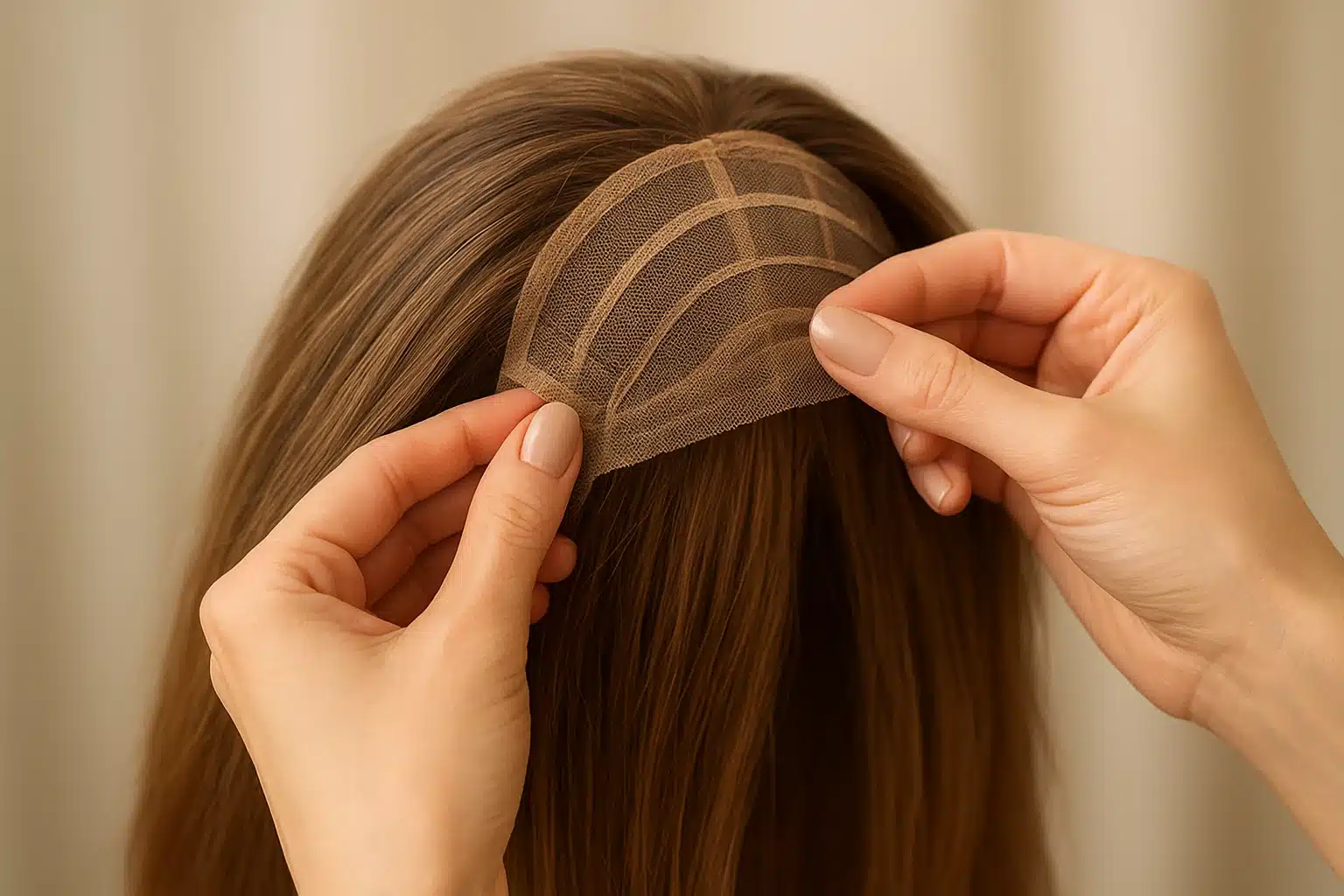
Monofilament refers to a sheer, transparent micro-mesh base where individual hairs are meticulously tied by hand. Because the mesh is transparent, your own scalp color shows through, creating the illusion that hair is growing directly out of your head.
- Single Monofilament: Offers raw, beautiful transparency. However, on sensitive scalps, the tiny scratchy knots on the underside of the mesh can sometimes cause friction.
- Double Monofilament: Introduces a second, ultra-smooth layer of silk or chiffon that buffers the knot ends away from your bare skin. If you are experiencing medical hair loss or have a sensitive scalp, the “Fingertip Underside Rub” on a double monofilament cap will feel like absolute luxury.
Lace Front (The Invisible Hairline)
A lace front wig features a hand-knotted sheer perimeter at the forehead, creating a seamless, natural transition where the hair meets your skin. This allows you to wear the hair pulled back off your face.
- Lace Materials: French lace is incredibly durable and perfect for daily wear, whereas HD (High-Definition) or Swiss lace is thinner and practically invisible, though slightly more fragile.
- The Knotting: High-quality lace fronts utilize micro-knotting or bleached knots to eliminate the “black pepper” speckling effect along the hairline, giving you a truly undetectable finish. Furthermore, reputable brands will pre-pluck the hairline so it has a graduated, natural density rather than looking like a solid wall of hair.
100% Hand-Tied Caps
This is the pinnacle of wig craftsmanship. Every single strand of hair is individually knotted onto a 4-way stretch elastic mesh base.
- The Experience: There are zero rigid machine wefts. A hand-tied cap conforms to the unique shape of your head like a second skin, eliminating pressure points above the occipital bone (the back of the head).
- Fiber Weight: Keep in mind that human hair is heavier than synthetic fiber. Human hair places more stress on these delicate hand-tied foundations, meaning you must be exceptionally gentle when detangling to avoid popping the microscopic knots.
The 5-Point Boutique Inspection Protocol
Knowing the terminology is great, but how do you test a wig in a store without damaging the inventory? Next time you are in a fitting room, use this 5-point physical diagnostic test.
1. The Elastic Recoil & Weft-Tension Test
Gently pull the side-to-side open tracks at the back of the wig. You are looking for a strong, snappy return. If the elastic feels gummy, stretches too easily, or if you hear thread creaking, the structural integrity of the cap may break down prematurely with daily wear.
2. The Lace-to-Light Transparency Test
Boutique lighting can be incredibly deceptive, often washing out colors. Hold the lace front up to natural daylight from a window, or at least directly into a showroom lamp. Evaluate whether the mesh blends with your skin’s natural undertones or if it appears chalky, gray, or overly yellow.
3. The Root & Knot Friction Inspection
Run the pads of your index fingers across the underside of the monofilament top and the lace front. You are feeling for abrasive, needle-sharp knot tails. If the underside feels rough against your fingertips, it will feel like sandpaper on a sensitive or bare scalp after eight hours of wear.
4. The Ear-Tab Steel Stay Alignment Check
Locate the internal bendable stays (small structural wires) within both ear tabs. Verify that they are symmetrically placed. Gently press them to ensure they hold an inward contour; this is what keeps the sideburns flush against your temples, preventing the wig from flapping open on windy days.
5. The Permatease Differentiation Test
Part the fibers at the crown of an open-wefted wig. You should see a dense, uniform, purposefully crimped texture. This is intentional permatease. If the roots look melted, jagged, or wildly uneven, you may be looking at heat damage or poor factory assembly.
Regional Reality: Choosing a Wig for Charlotte’s Climate
When you live in the Piedmont region, you know the reality of the “Carolina Greenhouse” effect. Summer temperatures routinely soar above 88°F, accompanied by high dew points that make the air feel thick and heavy.
Your climate should directly influence your cap choice. Dense silk-top caps or thick polyurethane strips can trap perspiration on humid days, leading to uncomfortable scalp chafing.
During the peak of summer, you might find that an open-wefted cap provides the best cross-ventilation, keeping your head cool. If you prefer the comfort of a 100% hand-tied cap, consider pairing it with sweat mitigation accessories. Bamboo cap liners are naturally antibacterial and wick moisture away from the scalp, while silicone wig grips provide a breathable, anti-friction barrier that keeps your wig secure without relying on tight, heat-trapping elastics.
Frequently Asked Questions (FAQ)
What is the difference between a single and double monofilament cap?
A single monofilament cap uses one layer of transparent mesh, meaning the tiny knots tying the hair to the cap are exposed on the underside. A double monofilament cap adds a soft, silky second layer underneath to protect sensitive scalps from feeling those knots.
Does “capless” mean the wig does not have a cap?
No, “capless” is an industry term for an open-wefted wig. It still has a structural foundation, but instead of a solid piece of fabric, it uses horizontal rows of hair (wefts) sewn to elastic ribbons, leaving open spaces for maximum airflow.
Why do two wigs that look identical online have vastly different prices?
The price difference almost always comes down to the cap construction and labor. A machine-sewn, open-wefted wig can be assembled quickly. A 100% hand-tied wig requires an artisan to individually tie thousands of hairs to a mesh base—a process that can take 30 to 40 hours per wig.
Are hand-tied wigs indestructible because they cost more?
This is a common myth. While 100% hand-tied caps represent premium comfort and natural movement, they are actually more delicate than machine-sewn wefts. The individual hand knots require gentle brushing and careful washing to prevent the hair from shedding or pulling through the delicate mesh.
What makes a natural-looking wig look real at the hairline?
A flawless hairline is achieved through a high-quality lace front paired with expertly bleached knots and graduated pre-plucking. This mimics biological hair growth, which naturally starts fine and sparse at the front and gradually gets thicker toward the crown.
Your Next Steps in the Wig Journey
Navigating the world of alternative hair can feel overwhelming at first. But by understanding the anatomy of a wig cap and knowing exactly how to inspect it, you instantly transform from a tentative shopper into an empowered buyer.
Remember, there is no single “best” wig cap—there is only the cap that best fits your lifestyle, your climate, and your scalp’s unique needs. Armed with this knowledge, you are now ready to walk into any showroom, speak confidently with a consultant, and find a piece that doesn’t just look beautiful on the mannequin, but feels like an extension of you.