Finding a high-quality wig is a deeply personal journey, but when you’re searching for textured hairpieces—specifically those catering to African American hair types—the process requires a much more specialized approach. For Black consumers navigating the Central Coast retail landscape, stepping into a general beauty supply store can often lead to frustration. Standard directories will happily point you toward local salons and costume shops, but they rarely tell you whether a store actually carries 4C kinky coily units, HD lace fronts, or glueless caps designed for protective styling.
If you want to successfully select the best wig stores in Santa Cruz, CA, you need a roadmap that bridges the gap between deep cultural hair knowledge and our local geography. Whether you are dealing with medical hair loss, transitioning your natural hair, or simply looking to change up your aesthetic, understanding the nuances of texture matching, cap construction, and local customization options will transform your shopping experience from stressful to empowering. Let’s explore how to navigate this unique coastal landscape.
The Santa Cruz Challenge: Why Textured Hair Shopping is Different
If you live in or around Santa Cruz, you already know that our local retail scene is wonderfully unique, but it can present distinct challenges for those seeking textured wigs. When you search online aggregators like Yelp or YellowPages for local beauty supplies, the results often lack the technical depth required by Black consumers.
It is incredibly difficult to discern online if a shop in Capitola or Downtown Santa Cruz specializes in authentic afro-kinky human hair, or if they only stock silky synthetic straight wigs. This gaps-in-care environment forces many local buyers to choose between ordering blindly online or settling for limited brick-and-mortar stock. However, by learning a few foundational mechanics about hair textures and cap construction, you can easily take control of your purchasing journey.
Decoding Curl Patterns and Textured Fibers
To find a hairpiece that feels like you, you must first understand the language of texture. Not all curls are created equal, and knowing the difference will save you time and money.
The Texture Matching Spectrum
When shopping for African American wig styles, you will encounter a specific grading system for fibers. Here is how they break down:
- Yaki Straight: This texture mimics the look and feel of Black hair that has been chemically relaxed or freshly flat-ironed. It has a slight micro-kink that gives it a beautiful, natural volume.
- Kinky Straight: Think of a fresh, beautiful blowout on natural hair. It offers gorgeous thickness and a textured, matte finish that doesn’t look overly shiny or artificial.
- Kinky Curly (Type 3C–4A): These are defined, bouncy corkscrews. They offer incredible volume and a highly defined curl pattern.
- Afro Kinky (Type 4B–4C): Characterized by dense, tightly packed coils, this texture perfectly replicates natural Afro hair.
The Shrinkage Reality
Here is a major “aha moment” for many first-time buyers: shrinkage applies to textured wigs, too. A 14-inch straight wig will rest elegantly on your shoulders. However, a 14-inch 4C kinky wig might only hang like a 10-inch unit because the tightness of the coils draws the hair upwards. Always factor in curl shrinkage when deciding on the length of your unit!
Cap Mechanics and the Art of the Invisible Hairline
The secret to a wig that looks like it’s growing directly from your scalp lies in the cap construction and how the lace interacts with your skin tone.
Lace Optics & Skin Matching
Many beginners make the mistake of buying standard transparent lace. The problem? On melanin-rich skin, transparent lace often appears chalky or grey, completely giving away the fact that you are wearing a wig.
To achieve a flawless “melt,” look for HD (High Definition) lace or Swiss lace. These materials are incredibly fine and delicate, disappearing seamlessly into the skin. Furthermore, you can use specialized lace tint sprays or fabric dyes to customize the lace to match your exact undertone—whether you have deep ebony skin or warm brown undertones.
Anatomical Fitting Mechanics
Even the most expensive, high-quality wig will look unnatural if it isn’t fitted properly. Use these two professional techniques when trying on your unit:
- The Four-Finger Rule: To find where your wig’s hairline should sit, place four fingers flat across your forehead, sitting just above your eyebrows. The top of your index finger marks your natural hairline. Placing a wig lower than this creates a cramped, unnatural look.
- Three-Point Anatomical Alignment: Ensure your wig is perfectly balanced by checking three points: the front hairline (using the four-finger rule), the ear tabs (which should sit perfectly flat against your temples without curling inward), and the nape of your neck (which should feel secure but not painfully tight).
Navigating the Elements: Coastal Climate Adaptability
Santa Cruz is famous for its beautiful coastal marine layer and frequent fog. But what does that mean for your wig?
If you invest in a human hair textured wig, remember that it will react to the Santa Cruz humidity exactly like biological natural hair. The ocean air will cause it to expand, frizz, and require regular moisturizing and detangling.
Conversely, synthetic fibers (including heat-defiant synthetics) have “style memory.” A synthetic 4C coil or Yaki straight wig will hold its texture and resist frizzing beautifully, even on the foggiest mornings on the Westside. Choosing between human hair and synthetic often comes down to how much maintenance you want to do in our local climate.
The “Hybrid Purchasing Strategy” for Central Coast Shoppers
Because local Santa Cruz and Monterey Bay stores may not always carry a diverse range of 4C glueless HD lace units, many savvy locals use the Hybrid Shopping Model.
This strategy involves utilizing reputable online specialty retailers—where inventory for textured hair is limitless and quality can be deeply vetted—and then utilizing local Santa Cruz or San Jose salons for professional customization.
The Local Shop Call-Ahead ScriptIf you do decide to explore local brick-and-mortar stores, save yourself a trip by asking these specific questions over the phone:
- “Do you carry units specifically with 4A to 4C curl patterns, or primarily straight and body wave?”
- “Do you stock HD lace fronts, or just standard transparent lace?”
- “Do you have stylists on staff who can do a protective braid-down and properly bleach the knots on a textured unit?”
Navigating Medical Hair Loss (Cranial Prostheses)
For those experiencing hair loss due to alopecia or oncology treatments, a wig is not just an accessory; it is a medical necessity known as a Cranial Prosthesis.
If you are a patient in Santa Cruz County, you may be eligible for financial tax-deduction options and insurance reimbursement. To navigate this, ask your dermatologist or oncologist to write a prescription specifically for a “Cranial Prosthesis” (not a “wig”). Ensure they use the proper medical coding, such as CPT code 99199 or HCPCS code A9282. Many high-quality wig providers can provide you with an itemized invoice that you can submit to your insurance company for full or partial reimbursement.
Frequently Asked Questions (FAQ)
What is the difference between a glueless cap and a traditional lace front?
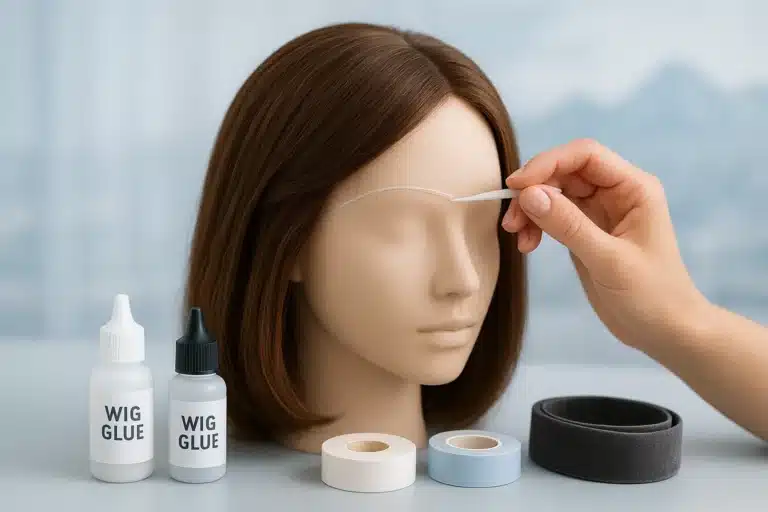
A traditional lace front often requires wig glue, gel, or tape to lay the hairline completely flat against the skin. A glueless cap is constructed with adjustable straps, combs, and sometimes specialized silicone bands that allow the wig to sit securely on your head without the need for adhesives—making it a perfect protective style that you can easily remove at night.
Can I tint my wig lace at home?
Absolutely! Many wig wearers use DIY lace tinting sprays, which are easily found online or at select beauty supplies. You simply spray the underside of the lace (being careful not to get it on the hair fibers) and use a blow dryer to set the color, allowing it to perfectly match your skin tone.
How do I prevent my synthetic textured wig from tangling at the nape?
Friction from collars, scarves, and winter coats causes the nape of synthetic wigs to tangle. Combat this by using a wide-tooth comb gently at the end of each day and lightly misting the nape with a synthetic-safe leave-in conditioner or detangling spray.
Continuing Your Journey
Navigating the world of textured wigs doesn’t have to be overwhelming. By understanding your preferred curl pattern, mastering the four-finger rule for a natural fit, and recognizing how our local coastal climate affects your hairpiece, you are well on your way to finding a style that makes you feel confident and beautiful.
Take your time exploring your options, don’t be afraid to utilize the hybrid shopping method to get exactly what you want, and remember that a high-quality wig is a wonderful investment in your personal well-being and self-expression.