
You’ve invested significant time and money into finding the perfect wig. Maybe you even found your dream unit after researching the best wig stores in Newark, NJ. But months later, a harsh reality sets in: the delicate lace is beginning to tear, the part line is thinning out, and the hair feels unusually dry and brittle at the nape of your neck.
Welcome to the post-purchase crisis almost every wig wearer eventually faces. It’s a heart-dropping moment, but before you toss that expensive unit into the trash, take a breath. Understanding the crucial differences between safe at-home maintenance and complex professional bench repairs can easily extend your wig’s lifespan by 12 to 36 months.
Whether you’re navigating the bustling streets of Downtown Newark or the quieter suburbs of Essex County, this guide will help you triage your wig’s damage, decode the mysteries of wig repair, and find the right local solutions to bring your favorite unit back to life.
Foundational Knowledge: What Actually Causes Wig Damage?
To fix a wig, you first have to understand why it’s breaking down. The most common mistake wig wearers make is confusing a structural problem with a cosmetic one.
Structural Base Failure (Lace, Cap, and Knots)
Your wig’s base is a marvel of architecture, but it’s fragile. Structural failure usually looks like:
- Lace Tearing: This often happens due to improper tension during removal, aggressive comb angles, or trimming the lace too close to the knots.
- Shedding and Balding: Aha moment! Did you know that applying conditioner or oils directly onto the lace causes shedding? Oils lubricate the tiny knots holding the hair to the lace, causing them to slip and shed. Over-bleaching knots with 30 or 40 volume developer also chemically burns the hair at the root, leading to rapid balding.
- Cap Stretching: Frequently placing your wig on a mannequin head that is larger than your actual head size, or aggressively pinning it down with T-pins, can permanently stretch the elastic and tear the cap seams.
Fiber Degradation: Human Hair vs. Synthetic
Biological hair growing from your scalp is constantly nourished by sebum (natural oils) from your sebaceous glands. Wig hair, however, is cut off from this moisture source.
- Human Hair Wigs: Because they lack natural sebum, human hair wigs rely entirely on the moisture you provide. Over time, silicone-heavy products build up, suffocating the hair shaft and causing severe dryness and tangling.
- Synthetic Fibers: Synthetic wigs are made from thermoplastic polymers (like kanekalon). They cannot absorb conditioning oils. When a synthetic wig gets frizzy at the nape of the neck, it’s not dry—it’s experiencing friction damage. The plastic fibers are essentially bending and fraying from rubbing against your clothes.
Step-by-Step Restoration Protocols
Once you diagnose the issue, you can determine if it’s a DIY fix or a job for a professional.
Safe At-Home Revival for Human Hair
If your human hair wig is structurally sound but looks dull and feels crunchy, you can perform a reset:
- Clarify: Wash the wig with a clarifying shampoo to strip away calcified hard water minerals and built-up silicones.
- Acidic Deep Conditioning: Apply a deep conditioner with a pH between 4.5 and 5.5 to seal the cuticles. Remember the knot safety rule: apply from the mid-shaft to the ends only!
- Curly Wig Protocol: For curly human hair wigs, avoid brushing them when dry, which snaps the hair. Detangle only when soaking wet and saturated with conditioner, using a wide-tooth comb to encourage curl clumping and definition.
The Do-Not-Do List for Alternative Hair
The internet is full of “hacks” that will instantly ruin a high-quality wig. Here is what you should never do:
- Never use fabric softener on synthetic wigs: Despite popular TikTok advice, fabric softener leaves a heavy chemical film on the fibers that attracts dust and ruins the wig’s movement.
- Never boil synthetic wigs without temperature control: Boiling water can easily exceed the heat threshold of standard synthetic fibers (usually 160°F–180°F), melting the plastic instantly.
- Never root-condition: Keep heavy masks and oils far away from hand-tied lace knots.
Advanced Professional Bench Services Explained
When your wig has structural damage—like a bald spot or a ripped hairline—at-home hacks won’t cut it. You need professional “bench services.” But what exactly goes on behind the scenes at a wig repair shop?
Demystifying Wig Ventilation
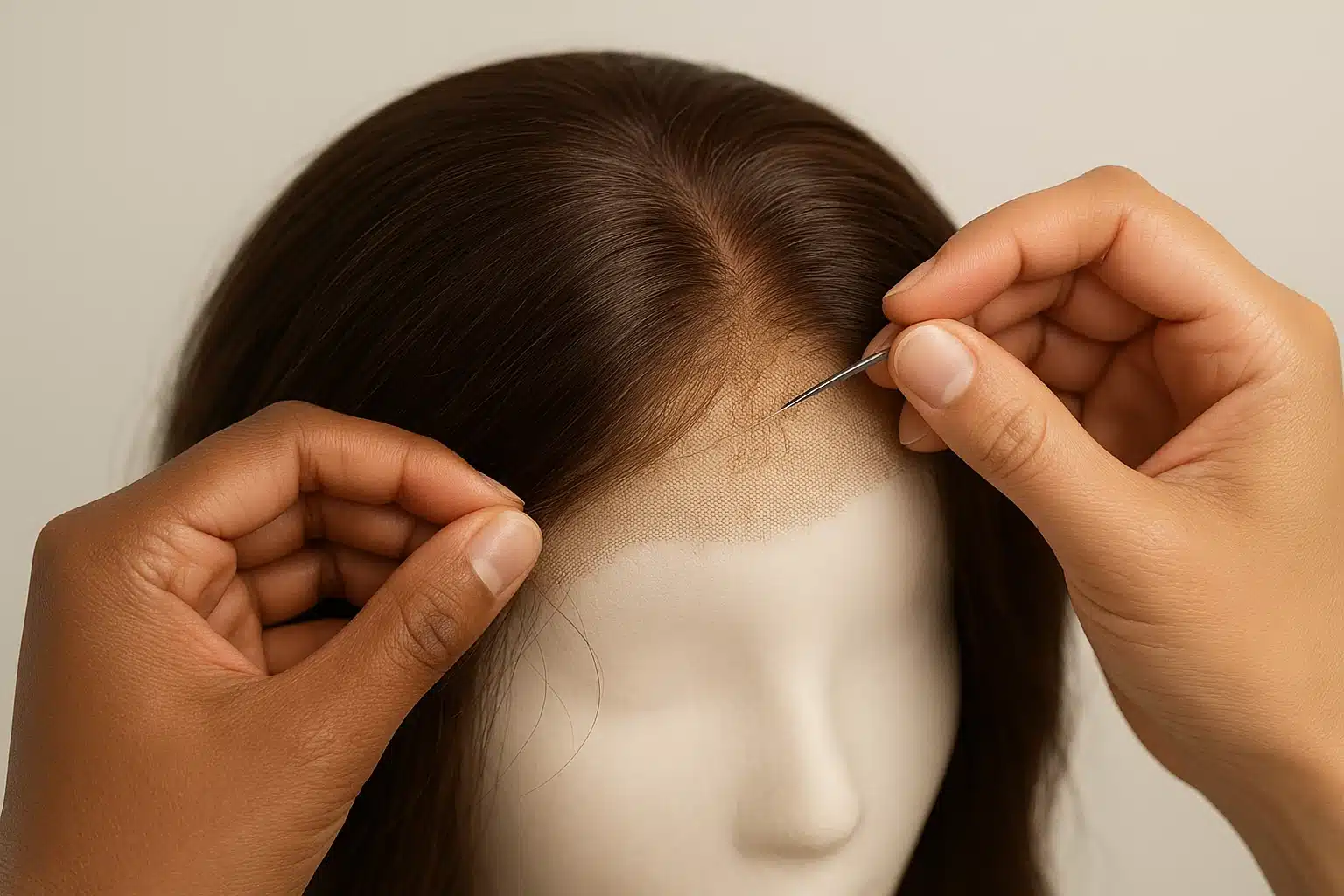
When searchers look for solutions to a balding part line, they are often confused by the term “ventilation.” Wig ventilation is the highly skilled art of hand-tying individual strands of hair to the lace base using a tiny, specialized hook needle. A professional technician can color-match replacement hair and meticulously knot it back into the bald spots, restoring the wig’s original density.
Lace Patching, Hairline Rebuilding & Cap Resizing
If you accidentally tear the delicate Swiss lace at the front of your wig, don’t throw it away. Professional bench artisans can seamlessly sew a new piece of lace into the damaged area (lace patching) and ventilate new hair into it. They can also take in stretched elastic bands to ensure your wig fits snugly and securely again.
Knot Bleaching Repair & Color Restoration
Sometimes knots are over-bleached in an attempt to make the hairline look natural, resulting in brittle roots that snap off. Professionals can perform corrective color services to restore the root integrity and revive oxidized, faded hair colors without further damaging the fragile base.
Newark & Essex County Local Provider Guide
One of the biggest frustrations for wig wearers in Northern New Jersey is searching for “wig repair” and only finding generic styling salons. While many salons can wash and curl a wig, structural repair requires a specialized skill set.
Here is what you need to know about the local landscape in Newark and Essex County:
Regional Service Hubs
Newark is home to vibrant beauty corridors. Establishments along Market Street, Bergen Street, and Goodwin Ave (such as C&C Beauty Place or Tommy’s Wig) are excellent starting points for routine maintenance, drop-and-go wash services, and basic styling.
If you require advanced bench work—like hook-needle ventilation or complex lace rebuilding—you may need to look toward specialized regional hubs in South Orange (home to luxury hair boutiques like Indique), East Orange, or Clark (where shops like Wigs Naturally operate). Many independent specialists, like Slaybychey, also offer tailored maintenance regimens.
Pricing and Turnaround Expectations
- Routine Maintenance (Wash, Deep Condition, Style): Expect to pay between $45 and $85. Turnaround is typically 2 to 4 days.
- Minor Structural Repairs (Cap resizing, small lace patches): Prices range from $75 to $150.
- Advanced Restoration (Re-ventilating bald spots, hairline rebuilds): This is highly skilled labor. Prices generally start at $150 and can exceed $250+ depending on the size of the repair. Turnaround can take 2 to 4 weeks.
The Triage Decision Matrix: Repair, Revamp, or Replace?
How do you know when it’s time to invest in a repair versus purchasing a new unit? Use these 5 clear checkpoints for unit retirement:
- Lifespan Reality Check: Synthetic wigs generally last 4–6 months with daily wear. If a synthetic wig is past this window and heavily frayed, replace it. Human hair wigs can last 1–3 years; they are prime candidates for repair.
- Base Integrity: If the lace has one or two small tears, patch it. If the entire foundation is shredded or the silk top is completely separating from the cap, it’s time to retire the unit.
- Fiber Health: If human hair has been chemically fried (e.g., heavily over-processed with bleach) to the point where it feels like gummy noodles when wet, it cannot be structurally saved.
- Cap Sizing: If the cap has permanently lost all elasticity and cannot be taken in without warping the shape of the wig, replacement is necessary.
- The Cost-Benefit Ratio: If a ventilation repair costs $300, but the wig originally cost $350, your money is better spent on a fresh, high-quality replacement. If the wig cost $1,500, a $300 repair is a brilliant investment.
Comprehensive FAQ & Maintenance Checklist
Can a ripped lace front or bald spot on a human hair wig be fixed?
Yes. A skilled professional can patch torn lace and use a ventilating needle to hand-tie new hair into balding areas, completely hiding the damage.
Why is my human hair wig dry, crunchy, and shedding after washing?
Unlike biological hair, wigs do not produce natural oils. If you are using shampoos with heavy sulfates or failing to use an acidic deep conditioner, the hair will dry out. If it is shedding, you likely applied conditioner directly to the delicate knots at the base, causing them to slip.
What is the difference between repairing a damaged human hair wig vs. a synthetic wig?
Human hair repair focuses on moisture replenishment (lipid replacement) and structural base fixing. Synthetic wig repair focuses on heat manipulation—using low-temperature steam (under 160°F) to smooth out friction kinks in the plastic fibers.
How do I safely restore the curl pattern on a damaged curly wig?
Never brush a curly wig while it is dry. Saturate the hair with water and a high-slip conditioner, detangle gently with a wide-tooth comb from ends to roots, and allow it to air dry so the curls can naturally clump back together.
Where can I get my wig repaired in Newark?
Essex County boasts a variety of options, from quick maintenance hubs on Market Street and Bergen Street in Newark to specialized luxury bench repair artisans in South Orange and greater Northern NJ. Always call ahead to confirm if a salon does structural repair (ventilation and sewing) or just cosmetic maintenance (washing and styling).
***
Taking care of alternative hair is a journey. By understanding the mechanics of your wig, respecting its delicate foundation, and knowing exactly when to call in the local Newark professionals, you can protect your investment and step out with confidence every single day.






