
By Chris Clark, editor of Wig Superstore
For wigs in Atlanta, start with the specialists who fit you in private: Rebecca Walden Wig Studio works only with medical hair loss, Svelte Wigs and Hair Pourne sell glueless human hair wigs (held on without adhesive) and help with insurance paperwork, and the Radiance Boutique at Winship fits wigs for people with cancer. For human hair by the bundle, extensions and textured hair, Indique Hair, BUW and Temple Hair Wear sell their own hair.
Below is every store we’ve confirmed is open in Atlanta and its nearby suburbs as of November 2026, with what each one carries and does. After the list come medical wigs and insurance, buying a first wig, custom cutting and color, human hair and lace, textured hair, wigs on a budget, and repair and care.

Wig Shops in Atlanta by What You Need
Where to start depends on what you’re shopping for. Each store has its own entry in the list below.

- Medical wigs and insurance paperwork: Rebecca Walden Wig Studio, Radiance Boutique at Winship, Svelte Wigs, Hair Pourne
- Medical wigs just outside the city: LNY Wig Boutique (Alpharetta), The Wig Dr. (Marietta)
- Wigs for children with hair loss: Rebecca Walden, Radiance Boutique, The Wig Dr. (ultra-petite sizes)
- Men’s hair systems and wigs: LNY (bonded hair systems), The Wig Dr., and Radiance Boutique for men with cancer
- Big-brand wigs such as Jon Renau and Raquel Welch: LNY
- Toppers for thinning hair (partial pieces that add hair on top of your own): LNY, The Wig Dr.
- A private fitting for a first wig: Hair Pourne (free consultations), Svelte Wigs, Rebecca Walden
- Glueless wigs: Svelte Wigs, Hair Pourne, BUW
- Human hair bundles, closures and frontals: BUW, Indique Hair, Temple Hair Wear
- Hair extensions: Indique Hair (clip-in, tape-in and sew-in), BUW, Temple Hair Wear
- Textured hair, from kinky straight to coil curl: Indique Hair, Beauty Exchange
- Washing, restyling and alterations: LNY, The Wig Dr., and Svelte Wigs for the wigs it sells
- Wigs on a budget: Beauty Exchange, BUW, Temple Hair Wear
Wig Stores in Atlanta
These are the wig stores in Atlanta that we confirmed are open, plus two specialists a short drive away in Alpharetta and Marietta, with the wig specialists first and the human hair and beauty supply stores after them. Hours change often, so call ahead before you go.
Rebecca Walden Wig Studio
4920 Roswell Rd, Suite 105, Atlanta, GA 30342

A wig studio on Roswell Road near Sandy Springs, inside Sola Salons on the second floor of Fountain Oaks Shopping Center. It works only with women and children with medical hair loss, from cancer treatment to alopecia, and Rebecca Walden chooses and styles synthetic and human hair wigs for each client. It’s by appointment only.
Radiance Boutique at Winship
36 Linden Ave NE, Atlanta, GA 30308
Emory’s boutique for people with cancer, on the lobby level of the Winship Cancer Institute at Emory Midtown. It sells human hair and synthetic wigs, wig care products, and scarves, hats and turbans, along with mastectomy and compression products, and its certified fitters give private consultations to women, men and children. It accepts Medicare and is in network with most insurers, so ask whether your plan covers a wig there. Booking is encouraged, and it takes walk-ins when it can.
Svelte Wigs by Shadae Renee
2030 Main St NW, #302, Atlanta, GA 30318
A private studio for glueless human hair wigs with HD lace (a very thin, sheer lace that blends into the skin at the hairline), run by Shadae Renee, whose site describes her as a cranial prosthesis specialist. At a one-on-one fitting, which the studio says takes about 45 minutes, you’re measured, try lengths, textures and colors, and can have the wig installed, with the lace cut and a lesson in wearing it. Wigs in stock at the studio can go home the same day. It’s by appointment only.
Hair Pourne
1016 Howell Mill Rd, Atlanta, GA 30318

A boutique on the ground floor of the 1016 Lofts building, on the 11th Street side off Howell Mill Road. It sells ready-to-wear, glueless wigs in 100% human hair with HD lace, and its site shows which ones are in the store to pick up. Its free one-on-one consultations are aimed at people with hair loss and first-time wig buyers, and it helps with insurance claims, sometimes billing your insurer directly.
LNY Wig Boutique and Salon, Alpharetta
11775 Northfall Ln, Suite 105, Alpharetta, GA 30009
A wig boutique and salon in Alpharetta, north of the city, with more than 1,500 human hair and synthetic wigs and hairpieces in stock, by its own count. It carries Jon Renau, Raquel Welch, Ellen Wille, Gabor, Envy, Estetica and other brands, makes custom wigs, toppers and hairpieces, and trims a new piece for free when you buy it. For men it sells full wigs and fits bonded hair systems, with the cleaning and re-bonding they need. Consultations are free if you’re losing hair to alopecia or chemotherapy, and booking is recommended but not required.
The Wig Dr., Marietta
4939 Lower Roswell Rd, Suite B202, Marietta, GA 30068

A wig and mastectomy boutique in East Cobb’s Parkaire Medical Center, run by Dr. Erica Gamble. It sells human hair, synthetic and blended wigs and toppers for women, men and children, including ultra-petite children’s wigs and hats with hair, for hair loss from chemotherapy, alopecia and other conditions. Its certified fitters also fit mastectomy bras, breast forms and compression garments. Hair loss consultations are by appointment, in the store or online.
BUW Human Hair Factory Store
349 Decatur St SE, Suite F, Atlanta, GA 30312

It’s the Atlanta branch of a chain of factory stores that sells its own human hair, with other stores in Houston, Dallas, Chicago, Philadelphia, New York and Miami. It stocks bundles for sew-ins, quick weaves and leave-outs, lace closures and frontals (lace pieces that finish the part or hairline), and ready-to-wear wigs, including HD lace styles and glueless wigs with an adjustable band. It suits shoppers who know what they want and are watching the price, and you can order online and pick up in the store.
Indique Hair
1039 Grant St SE, The Beacon, Suite B30, Atlanta, GA 30315

Indique’s Atlanta boutique, in The Beacon shopping complex, has sold the brand’s own virgin and raw hair for more than 12 years. It carries clip-in and tape-in extensions, wefts for sew-ins, ponytails, closures, frontals and wigs, in textures from straight to kinky straight and coil curl, plus gray hair. Staff give one-on-one advice and go over care for your texture, and online orders can be picked up the same day. It doesn’t install hair, but it can recommend local stylists who do.
Temple Hair Wear
2905 Campbellton Rd SW, #D1, Atlanta, GA 30311

It’s a supplier of raw Indian hair that sells bundles in straight, wavy and curly textures, extensions, closures and frontals, and takes wig orders by phone. It washes and conditions its hair before it goes out, gives reward points, and lets stylists subscribe to buy hair for less. Its second store is at 7193 Douglas Blvd, #201, in Douglasville.
Beauty Exchange Beauty Supply
645 Cascade Ave SW, Atlanta, GA 30310

A beauty supply store, part of a chain, with ready-to-wear lace front wigs, braiding hair, and human hair and synthetic bundles. The chain’s online shop carries wigs from Outre, Sensationnel and FreeTress and posts its in-store sales. It suits shoppers who want a wig they can wear out of the store.
Medical Wigs and Insurance in Atlanta
If you’re losing your hair to chemotherapy, alopecia or another medical condition, your health plan may pay for part of a wig. Insurers call a medical wig a cranial prosthesis, and most want a prescription that uses those words, or “hair prosthesis,” rather than “wig.”

Do these four things before you buy:
- Call your insurer. Ask whether your plan covers a cranial prosthesis, how much it pays, what paperwork it needs, whether it counts under the durable medical equipment benefit (the part of a plan that pays for medical equipment), and which billing code it wants on the receipt.
- Get the prescription from the doctor treating your hair loss, usually your oncologist or dermatologist. It should say “cranial prosthesis” or “hair prosthesis” and include your diagnosis code. Svelte Wigs also asks for the billing code A9282 on it, so check which code your insurer uses.
- Ask the store for the right paperwork. Usually you pay first and file the claim yourself. Svelte Wigs works out of network and emails you a superbill (an itemized receipt made for insurance claims); it works with every insurer except Medicaid. Hair Pourne provides the paperwork for a claim and in some cases bills your insurer directly. Radiance Boutique is in network with most insurers, so ask whether it can bill yours.
- Send the claim and keep copies of the prescription, the receipt and the claim form.
Coverage varies from plan to plan, and no store can promise what yours will pay. Most Medicare plans don’t cover a wig for hair loss from chemo (if you have a Medicare Advantage plan, ask it directly), and Tricare covers one wig per lifetime with a prescription for hair loss from cancer treatment. If you pay some or all of the cost yourself, keep the receipt: it may count as a medical expense on your taxes, and a flexible spending or health savings account may pay for a medical wig with a diagnosis and a letter of medical necessity from your doctor. Our guide to medical wig insurance and financing goes through coverage and other ways to pay.
What should a medical wig shop offer?
A shop that’s used to medical hair loss does a few things a fashion wig store may not:
- A private room. You shouldn’t have to take off a scarf or try on wigs on an open sales floor. Rebecca Walden’s studio and Svelte Wigs see one client at a time, and Hair Pourne and Radiance Boutique offer private consultations. LNY gives free consultations to anyone losing hair to alopecia or chemotherapy, and The Wig Dr. sees hair loss clients by appointment.
- A chance to feel the cap. A good fitter asks you to touch the inside of the cap before you look at styles, and talks about how it will feel on your skin as well as the color and cut.
- Help keeping it on. For children and active adults, ask about silicone grips inside the cap, adjustable straps and a wig grip band.
- A visit before your hair goes, so the fitter can see and match your own color, texture and thickness.
When should I start shopping for a wig before chemo?
Before treatment starts, if you can. You’ll have more energy, and time to get used to the wig while you still have your own hair. Take a couple of photos of your hair so the fitter can match its color, length and style.
Your care team can tell you when hair loss is likely to start. Some people cut their hair short first, so losing it is less of a shock and the wig is easier to fit.
What makes a wig “medical grade”?
Stores use the term for wigs made to sit comfortably on a bare or tender scalp, rather than on top of a full head of hair. The cap is what matters:
- Hand-tied caps have every hair knotted by hand into soft, stretchy material. They’re the most comfortable cap and good for a sensitive scalp, by breastcancer.org’s ratings, but they can feel warmer.
- Monofilament tops (a thin mesh that looks like scalp where the hair parts) are softer on the scalp than a basic cap and let you part the hair where you like. A double monofilament top adds a second soft layer.
- Basic wefted caps, with rows of hair sewn onto strips of stretchy material, are the coolest, because air reaches your scalp between the rows. They suit you if heat bothers you more than texture.
A lace front and a monofilament top are what make a medical wig look natural up close.
How do I keep a wig on with no hair?
A good fit does most of the work, so a medical wig rarely needs tape or glue. Most caps have adjustable straps at the nape, and some have silicone strips inside that grip the skin. A thin wig cap underneath keeps the wig secure, soaks up sweat and protects your scalp, and a wig band, worn like a soft headband, helps hold it in place.
Is human hair or synthetic better during treatment?
Neither is better for everyone. Human hair moves most like your own but needs washing and styling the way your own hair did. Synthetic fiber holds its style after washing, which many people find easier when treatment leaves them tired.
Buying Your First Wig in Atlanta
A first wig is easiest to buy in person, from someone who measures your head, has you try different caps and fibers, and shows you how to put it on. Rebecca Walden and Svelte Wigs fit clients one-on-one by appointment, Hair Pourne’s free consultations are aimed at first-time buyers, and Indique Hair gives one-on-one advice in its boutique. The Wig Dr. also offers virtual consultations if you’d rather start from home.
Specialist studio or beauty supply store?
Atlanta has plenty of both, and they suit different shoppers:
- A specialist studio or boutique usually works by appointment or has a private fitting area, and its staff often include licensed cosmetologists who know cap construction and can cut and style the wig for you. You’re paying for that time and know-how.
- A beauty supply store has rows of ready-to-wear wigs you can see, touch and wear that day, often for less. Staff may not be trained in medical hair loss or cap construction, so you’ll need to know what you’re looking for.
Either way, a good store can tell you about the brands or hair it sells, measures you and explains cap construction, gives you privacy if you want it, and can trim, color or style the wig, or point you to someone who will.
How do I get ready for a fitting?
A little preparation makes the try-on more accurate:
- Flatten your own hair. If you have hair, braid it flat or pin it in a low, tight bun, and bring a nylon wig cap. The wig then sits the way it will every day, and the measurements come out right.
- Skip heavy makeup. Foundation and bronzer rub off onto the lace of the wigs you try on.
- Bring photos of your own hair, or of the cut and color you’d like.
- Think about your days. Tell the fitter whether you work out, swim or spend afternoons outdoors, since that changes which cap, fiber and way of holding the wig on will suit you.
How do I know what size wig I need?
Measure your head with a soft cloth tape in three places, as Jon Renau’s sizing guide describes:
- Around: start at the front hairline, follow it behind your ears to the nape, and come back to where you started.
- Ear to ear: from the top of one ear, over a point about 7 inches back from the hairline, to the top of the other.
- Front to back: from your front hairline straight back to the nape.
Most makers sell petite, average and large caps, and Jon Renau advises choosing the cap size that fits your largest measurement. Any good wig store will measure you, and if standard caps don’t fit, see our guide to wig brands for petite and large heads.
Where should a wig sit on my forehead?
Higher than most beginners put it. Lay four fingers flat across your forehead, little finger just above your eyebrows: the front edge of the wig usually belongs at the top of your index finger. Too low shortens your forehead and gives the wig away.
How do I check a wig’s quality in the store?
Before you buy, try these checks:
- Shedding: run your fingers through the hair from the ends toward the roots a few times. A couple of loose strands are normal; if your fingers catch, or come away with a clump, put it back.
- Shine: hold it under the store lights. Hair that shines like a doll’s is low-grade synthetic; you want the softer sheen of healthy hair.
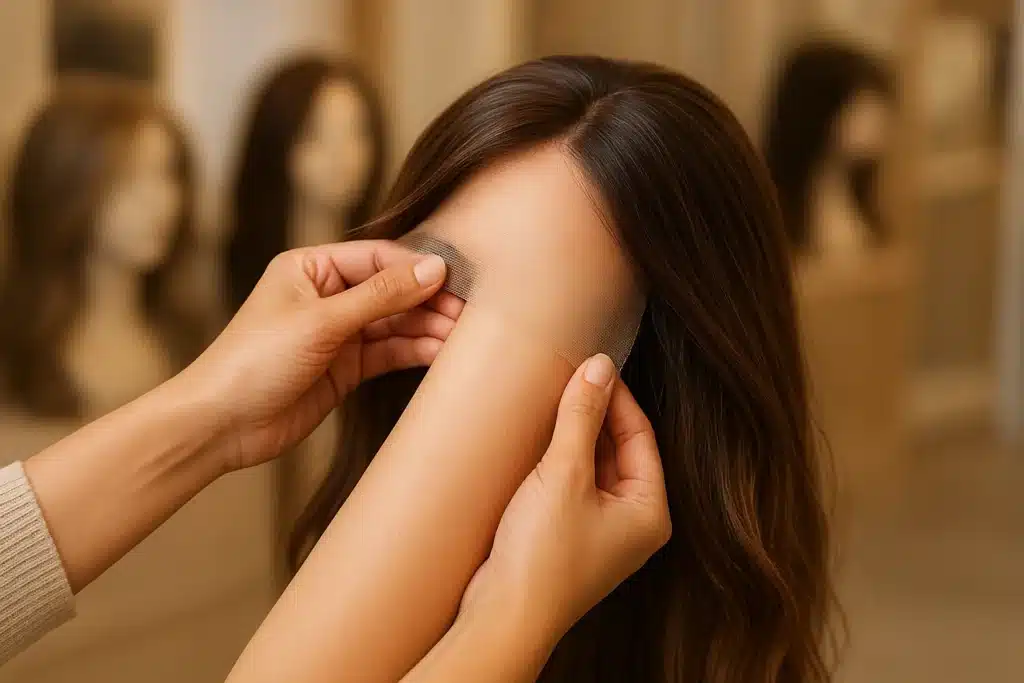
- Lace: lay the lace on the inside of your forearm rather than holding it up to the light. Good lace almost disappears against skin; if you can see a clear grid, it will need makeup or tinting to look natural. Ask whether it’s Swiss lace or HD lace (both are explained under human hair wigs below).
- Knots: look at the hairline where each hair is tied to the lace. Small knots, or knots bleached lighter, look like hair growing from skin, while big dark dots look like poppy seeds. The most natural hairlines use single knots, one hair per hole, at the very front.
- Cuticle: on human hair, slide your fingers from the ends toward the root. Hair with its cuticle in place feels slightly rough going that way. Hair that feels slick in both directions has probably been stripped and coated in silicone, and will tangle once the coating washes out.
- Density: part the hair in a few places, including the crown. If you can see the stitched rows of hair without trying, it’s too thin.
- Cap stretch: hold the ear tabs and stretch the cap gently. It should spring back; a stiff, crunchy cap will be uncomfortable all day.
What should I ask before I buy?
Three questions tell you a lot about the wig and the store:
- Where does this hair come from, and what has been done to it?
- Is the wig ready to wear, or will it need plucking, knot bleaching or cutting to look natural?
- What’s the return or exchange policy? Many stores won’t take back a wig that’s been worn or cut, for hygiene reasons. Indique Hair, for one, exchanges only unworn, unopened hair within seven days and gives no refunds once a package is opened, and LNY doesn’t take back any wig once it has left the store.
Custom Fitting, Cutting and Coloring
Most wigs need some work before they look like your own hair. Many come fuller than natural hair, with a hairline that’s too thick and even, and a stylist who works on wigs can thin the hair, cut in layers or bangs, and soften the hairline so it looks like it grows from your scalp.

Cutting a wig isn’t like cutting the hair on your head, because it never grows back. Ask a stylist whether they cut wigs often and how they take out bulk, and look at photos of their work a week or two after the wig went on, not just on the day, to see whether the lace still lies flat and the hair is still smooth.
In Atlanta, Svelte Wigs fits and installs the glueless wigs it sells, cutting the lace and showing you how to wear them. LNY trims a new wig for free at the time of sale and makes custom wigs and toppers. For hair from Indique, which doesn’t install, ask its staff for a local stylist.
How do I make a lace front wig look natural?
A lace front has a strip of sheer lace along the hairline with each hair tied in by hand. Three things make it look real:
- The melt. “Melting” the lace means making it disappear into your skin: the stylist trims the lace close to your hairline and blends it with a lace tint or an adhesive matched to your skin tone.
- A softer hairline. A real hairline starts thin and wispy and thickens further back. Stylists copy that by thinning hairs or knots at the front, often called plucking. Jon Renau advises against plucking a lace front yourself, because the lace can tear, and suggests leaving it to a professional. A wig sold as pre-plucked has had this done by the maker, which saves time on a first wig.
- Bleached knots. Knot bleaching lightens the tiny dark dots where each hair is tied to the lace, so they look like roots. It’s done on delicate lace, so leave it to a stylist.
A glued lace front needs regular visits to clean the lace and put the adhesive back on. A glueless wig you take off at night needs only an occasional wash and restyle.
Why does my wig look like a helmet?
Usually the hair is too thick at the hairline, or the cap is too small. Look for graduated density, thinner at the hairline and fuller toward the back, and have your cap size checked.
Can a synthetic wig be customized?
Yes. A stylist can thin, trim and shape a synthetic wig so it looks natural. Standard synthetic fiber can’t be heat-styled, though, unless the label says it’s heat-friendly.
Can I color a wig?
It depends on the fiber:
- Human hair can usually be colored darker by a professional. Lightening it is riskier, because the hair has already been processed and gets none of the oil your scalp gives your own hair, so it can’t repair itself. Virgin hair, never dyed or chemically treated, takes color best. Leave it to a colorist who works on wigs.
- Synthetic fiber can’t take box dye or salon color: the color slides off or stains the lace. Home methods with fabric dye are unpredictable, so buy the shade you want.
Can I learn to customize a wig from online videos?
You can, but go slowly. The most common mistake is plucking too much along the part, which leaves a thin, bald-looking patch that can’t be undone. Many people have a stylist do the first cut and hairline, then handle the daily styling themselves.
What about hair systems for men?
A men’s hair system is a thin base with hair tied or injected into it, bonded to your scalp with tape or adhesive and worn for days or weeks at a time. The hairline makes or breaks it: look for single knots at the front and density that builds from fine to full, so it looks like hair growing from skin.
LNY in Alpharetta fits bonded systems matched to your hairline and density, with adhesion methods it says last from several days to over a month, and does the cleaning, re-bonding and styling between visits. LNY and The Wig Dr. also sell full wigs for men.
Human Hair Wigs in Atlanta
Human hair wigs in Atlanta come from two kinds of shop. Hair Pourne and Svelte Wigs sell glueless wigs in human hair with HD lace and fit them for you, while Indique Hair, BUW and Temple Hair Wear sell their own hair as wigs, bundles and extensions. Just outside the city, LNY and The Wig Dr. stock human hair wigs from several makers alongside synthetic ones. For the high-end makers, see our guide to luxury human hair wigs.

Human hair looks and moves most like your own, and you can heat-style and color it. In return it needs more care than synthetic, which comes styled, holds its shape and costs less.
Atlanta’s humid summers make a difference. Human hair takes in moisture the way your own hair does, so it frizzes, tangles and loses its curl, and Indique suggests a light anti-frizz serum or leave-in conditioner. Traditional synthetic fiber holds its style through washing and weather, so it’s the easier choice for a wig you can shake out and wear. Heat-friendly synthetic sits in between, since it can take some heat from styling tools.
Remy, virgin and raw: what’s the difference?
These are the labels you’ll see on human hair:
- Remy: hair sorted so every strand runs root to tip the same way, with its cuticle (the outer layer) in place, so it tangles less. The sorting is slow work, which is why Remy costs more.
- Non-Remy: hair from mixed sources that can’t be lined up, so part of the cuticle is stripped and the hair is usually coated to feel smooth in the store. It tends to tangle once the coating washes out.
- Virgin: hair that has never been dyed, bleached, permed or chemically treated.
- Raw: a seller’s term for hair sold with no processing at all, not even steaming to set a curl. Sellers use “raw” and “virgin” in different ways, so ask what has been done to the hair.
How long does a human hair wig last?
About nine months to a year of daily wear, according to breastcancer.org, and longer if you wear it less often. A synthetic wig lasts three to five months of daily wear by breastcancer.org’s figures, and up to six to nine months by Jon Renau’s. Gentle washing, combing from the ends up and low heat help either one last.
How hot can I style a human hair wig?
Jon Renau recommends styling tools set no higher than 350°F, with a heat protectant spray, since the hair gets no oil from a scalp to help it recover. Heat-friendly synthetic can also take up to 350°F, though Jon Renau suggests 270 to 280°F. Standard synthetic can’t take heat at all.
Lace Fronts, Closures, Frontals and 360 Lace
These names say how much of the wig has lace. The more lace, the more ways you can wear the hair, and the higher the price:
- Lace front: lace along the front hairline only, so you can wear the hair back off your face.
- Closure: a small square of lace on top, where the hair parts.
- Frontal: lace across the whole front, ear to ear, so you can part the hair anywhere along the front.
- 360 lace: lace all the way around the edge, so you can pull the hair up into a high ponytail or updo without showing the rows of hair at the nape.
- Full lace: lace over the whole cap.
Lace also comes in two kinds. Swiss lace is soft and sturdier, for everyday wear. HD lace is thinner and more see-through, so it blends best against skin, especially for styles worn off the face, and it needs less makeup and glue to look natural, which helps a beginner. It also tears more easily. For what each type costs, see what to know about lace front wig costs.
U-Part Wigs and Hat Wigs
A U-part wig has an opening on top where you leave out a section of your own hair to blend over it, so the part is really yours. With no lace or hand-tied part, it usually costs less, but you need enough of your own hair, in a matching texture.
A hat wig has hair attached to a hat or soft cap, for a quick look with no lace to glue or hairline to style, handy for errands or the gym.
What does density mean?
Density is how much hair is on the cap, sold as a percentage such as 130%, 150% or 180%. Lower numbers look closer to a typical head of hair and higher ones fuller, and long wigs often come denser so the ends don’t look thin. If a wig is too full for you, a stylist can thin it.
How do I care for a blonde human hair wig?
Platinum shades such as 613 are bleached to get that light, so the hair is more porous and fragile than darker hair. Use color-safe, sulfate-free products and go easy on heat.
Wigs for Textured and Natural Hair
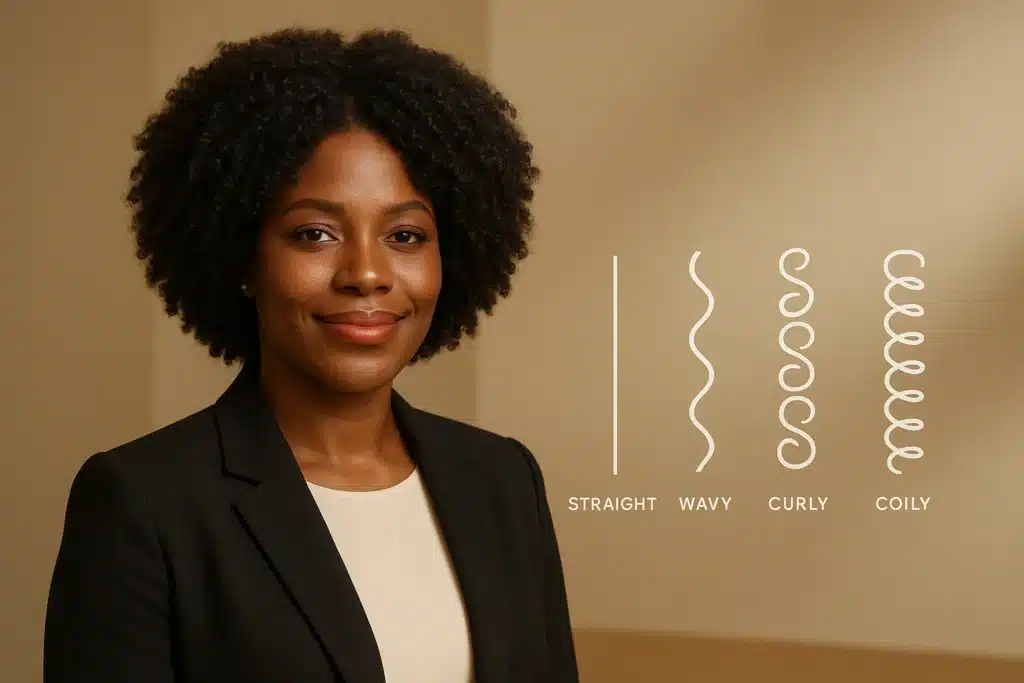
To match a wig to your own curl pattern, or to the one you want, it helps to name it. “Curly” can mean anything from a loose wave to a tight coil, so stylists and wig sellers use a number-and-letter scale:
- 3A and 3B: loose, loopy curls as wide as sidewalk chalk or a thick marker.
- 3C: tight corkscrews the width of a pencil.
- 4A and 4B: dense coils about the width of a straw or knitting needle, often in an S or Z shape.
- 4C: the tightest coils, like the spring in a ballpoint pen.
You’ll also see two textures named for relaxed and natural hair:
- Yaki copies relaxed or blow-dried hair: it has a slight crimp but falls mostly straight.
- Kinky copies natural hair in its own state, with the volume built in. In a humid Atlanta summer, a little frizz makes a kinky wig look more real, while it spoils a silky straight one.
Coily hair shrinks, so a textured wig looks much shorter than the length on its label, which is measured with the hair pulled straight. Buy by that stretched length, and ask the store to show you how long the style looks when it isn’t stretched.
If you’re covering thinning at the edges and want to wear the hair off your face, look for single knots and graduated density at the hairline, which copy the way hair grows there.
In Atlanta, Indique Hair sells its own hair in textures from straight to kinky straight and coil curl, as wigs, extensions, closures and ponytails. BUW and Temple Hair Wear sell human hair in straight, wavy and curly textures, and Beauty Exchange’s shop carries Outre, Sensationnel and FreeTress wigs.
How do I care for a curly or kinky wig?
Treat it more like natural hair than like a straight wig:
- Detangle gently. Use your fingers, or a wide-tooth comb only when the hair is wet and coated in conditioner. A fine-tooth comb on a dry kinky wig breaks up the curls and causes shedding.
- Use sulfate-free products and avoid heavy alcohols. Textured human hair needs moisture, like your own.
- Fluff with your fingers. On a 4B or 4C afro wig, lift the crown with your fingers for volume. On looser curls, fluff less so they keep their shape.
- Feel it when you buy it. Good textured hair feels soft but has a little grip; if it feels like plastic doll hair, it’s low-grade fiber.
How do I stop a curly wig from tangling at the nape?
Tangling at the nape comes from friction and sweat. Mist the nape lightly with water and a leave-in conditioner, and take the wig off at night and keep it on a stand rather than sleeping in it. Indique also suggests a silk or satin scarf or pillowcase to cut the friction.
Wigs on a Budget in Atlanta
A good everyday wig doesn’t have to come from a specialist studio. Ready-to-wear synthetic wigs cost the least, and in Atlanta the cheaper routes to real hair are factory stores and hair suppliers:
- Beauty Exchange on Cascade Avenue has ready-to-wear lace front wigs, braiding hair and bundles, and posts its in-store sales on its website.
- BUW sells human hair bundles, closures and ready-made lace wigs at its Decatur Street factory store.
- Temple Hair Wear gives reward points on its raw hair, and stylists can subscribe for lower prices.

At a busy beauty supply store you may be left to browse on your own, so bring your own know-how and use the checks under “How do I check a wig’s quality in the store?” above before you pay.
Are human hair blends worth it?
For many budget shoppers, yes. A blend mixes human hair with heat-friendly synthetic fiber: the human hair cuts the plastic-looking shine, and the synthetic holds the style, so it needs less styling and costs less than 100% human hair. Most can take low heat, but check the label, and don’t bleach or dye one. The Wig Dr. carries blended wigs and toppers.
How can I make a cheap wig look more natural?
A few small changes help a budget wig:
- Mist a little dry shampoo on a synthetic wig that’s too shiny and brush it through for a more matte finish.
- Wear it at the right height, using the four-finger rule above.
- Choose a small lace area, such as a closure, or a U-part wig, both of which cost less than a frontal.
- Buy it pre-plucked, so the hairline is already softened.
Can I pay for a wig in installments?
At some stores. Indique Hair takes several pay-later services on online orders you pick up in its Atlanta store, and Beauty Exchange’s online shop takes Afterpay and Shop Pay Installments. Most stores won’t take a wig back once it’s been worn or the lace is cut, so check it carefully first.
Wig Repair and Care in Atlanta
Atlanta’s humidity is hard on wigs. Human hair swells in damp air, so it frizzes and tangles, especially at the nape where you sweat. Synthetic fiber rubs against damp skin and collars, and that friction frizzes the ends.
Before you fix a wig, work out how much it needs:
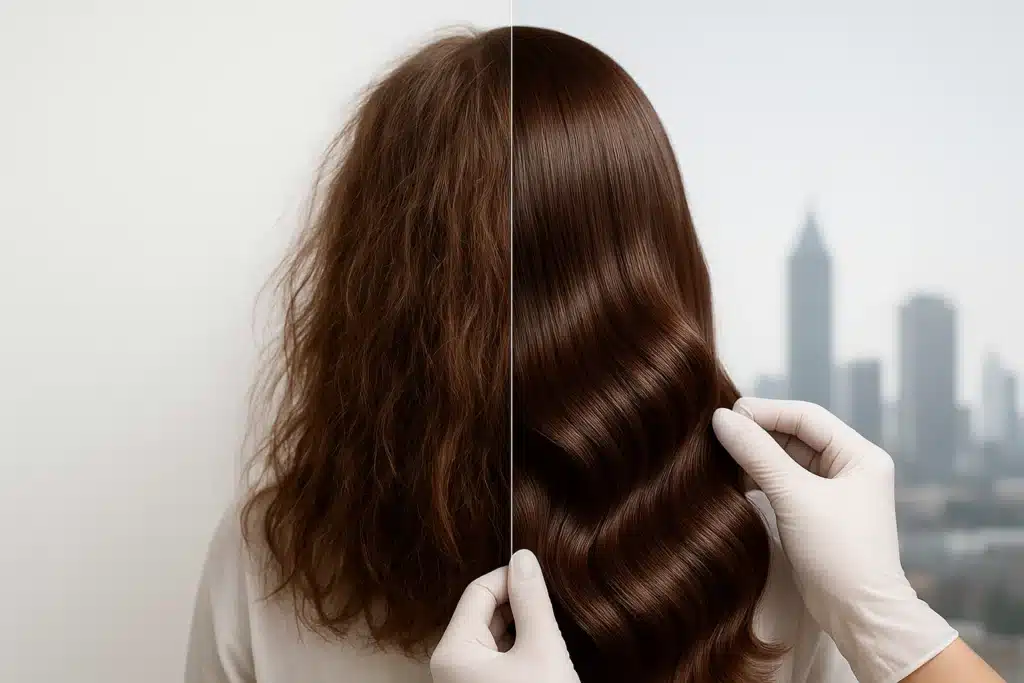
- A refresh: small tangles, a dull look or a stale smell. A wash, a deep condition and a restyle usually do it.
- A revamp: frizz at the nape, dropped curls, or product buildup that makes the hair heavy and dull. A clarifying wash and a trim of the frayed ends help, and on traditional synthetic, which can’t take dry heat, Jon Renau suggests a steamer to smooth the friction frizz.
- A repair: torn lace, bald spots, broken straps, or matting you can’t comb out. That’s work for a specialist.
Specialists fix a wig in a few ways. Lace patching sews a small piece of matching lace over a tear with fine thread. Ventilating ties new hairs into the lace one at a time with a tiny hooked needle, to fill a thin part or hairline; it takes time, so ask the price, but it can save a good wig. A cap that’s too loose or tight can be taken in or resized.
In Atlanta, Svelte Wigs refreshes its wigs in the studio or by mail, and does fit adjustments and closure and frontal replacements on wigs bought from it. Nearby, LNY washes and restyles wigs you drop off, usually within two business days by its own estimate, and The Wig Dr. washes and blow-dries human hair and blended wigs. Before you book any repair, ask whether the shop works on wigs bought elsewhere and ask to see before-and-after photos of repairs like yours. Some repairs may need to go back to the maker.
You can usually handle these yourself:
- washing and conditioning
- small tangles at the ends
- recurling a heat-friendly synthetic wig with a low-heat tool
Take it to a professional when:
- the lace is torn: gluing it at home often leaves a crusty patch that ruins the wig
- the hair is badly matted: if you can’t run your fingers through it, hard brushing will rip hair out of the wefts
- you want to change the color of human hair: home dye can come out patchy and dry the hair out
- the cap needs resizing, which takes careful sewing so the wig lies flat
How often should I wash my wig?
Every six to eight wears, Jon Renau recommends, or every eight to ten by breastcancer.org’s advice, and more often if you use a lot of product or sweat a lot. Washing after every wear wears out the cap and loosens the knots. These habits keep a wig in good shape:
- Use shampoo and conditioner made for wigs and matched to the fiber; regular products can damage synthetic fiber. Our article on whether you can wash a wig with regular shampoo explains more.
- Rinse it under running water rather than soaking it, which loosens the knots.
- Comb from the ends up with a wide-tooth comb, gently, since hand-tied knots are delicate.
- Dry and store it on a wig stand, out of the sun and away from heat, damp and dust.
- Keep standard synthetic away from heat: hot tools, hair dryers, ovens, grills and open flames can melt it.
- Skip oily products made for hair that grows from a scalp: they loosen knots and attract dirt.
- If you wear a wig every day, rotate two so each lasts longer.
- In winter, wear a silk or satin scarf between the wig and a wool coat or scarf to cut friction.
- Give human hair a deep conditioning treatment now and then, to put back moisture it can’t get from a scalp; Jon Renau says to keep keratin or protein treatments to one to four times a year.
Wig stand or canvas head?
A wig stand, usually light plastic, is for drying and storing a wig so it keeps its shape. A canvas block head is heavier and padded, so you can pin the wig to it with T-pins while you style, curl or detangle. A thick curly wig will tip over a plastic stand, so style it on a block head.
Can I sleep in my wig?
It’s better not to. Pillow friction tangles and mats the hair, wears the lace and loosens the knots, and taking it off gives your scalp a rest. If you must, wear a silk bonnet and sleep on a silk pillowcase.
Is it worth repairing a wig?
It depends on what the repair costs against the price of the wig. A cheap synthetic wig is often better replaced, while a costly human hair wig, or a style you love that’s no longer made, is usually worth fixing. Ask for a price first.
Can a headband wig be fixed if the band stretches?
Yes. A specialist can open the seams and sew in new elastic, which brings back the snug fit without touching the hair.
Buying a Wig Online or in an Atlanta Store
Buying in a store lets you see and feel the hair up close, try the cap on, and have the wig custom fitted, colored and styled. That matters most for a first wig, a medical wig or a wig you’ll wear every day.
Shopping online, on wig sites or platforms like eBay and Etsy, gives you more choice and more privacy, and once you know your brand, cap size and color, it can cost less. Check the return policy before you order. Several Atlanta stores let you order online and pick up in person, including BUW, Indique Hair and Hair Pourne. For more on choosing a store wherever you live, see our tips for picking the best wig stores near you.
Questions About Buying Wigs in Atlanta
Do I need an appointment at a wig shop in Atlanta?
For the specialists, yes. Rebecca Walden Wig Studio and Svelte Wigs see clients by appointment only, Hair Pourne books free in-store consultations, and the Radiance Boutique at Winship encourages booking but takes walk-ins when it can. Booking matters most for a first or medical wig, because a proper fitting takes time. Hours change, so call first.
Can a wig store in Atlanta bill my insurance for a medical wig?
Usually you pay first and claim it back. Ask your doctor for a prescription for a cranial prosthesis, the name insurers use for a medical wig. Svelte Wigs gives you a superbill (an itemized receipt for insurers), Hair Pourne sometimes bills insurers directly, and Radiance Boutique is in network with most insurers. Coverage varies, so call your insurer first.
Where can I buy a human hair wig in Atlanta?
Hair Pourne, off Howell Mill Road, and Svelte Wigs, on Main Street NW, sell glueless human hair wigs with HD lace and fit them for you. Indique Hair at The Beacon sells wigs in its own virgin hair, and BUW’s Decatur Street factory store sells ready-made lace wigs. Human hair takes heat and color but needs more care.
Where can I buy hair extensions in Atlanta?
Indique Hair at The Beacon sells clip-in and tape-in extensions, wefts and ponytails in its own hair, from straight to coil curl. BUW and Temple Hair Wear sell human hair bundles, closures and frontals, and Beauty Exchange stocks bundles and braiding hair. Indique doesn’t install hair, but its staff can recommend Atlanta stylists who do.