Have you ever bought a beautiful wig, only to end up with a throbbing tension headache after just two hours of wear? Or perhaps you’ve looked in the mirror and noticed a loose, baggy bubble of fabric pooling at the top of your head? If you’ve ever felt like no matter what you do, your wig simply won’t stay put without squeezing your temples or riding up in the back, you are not alone. You aren’t doing anything wrong—you’re just experiencing the reality of non-standard head sizing in a retail world built around “average.”
Most online guides treat finding the right wig like buying a one-size-fits-all hat, completely ignoring the complex geometry of your unique head. For residents in the South Sound region looking for specialized sizing, understanding the anatomy of a wig cap is the crucial first step toward finding all-day comfort. Whether you need a petite cap for medical hair loss or a larger fit to accommodate natural bio-hair density, knowing how to navigate the best wig stores in Tacoma WA will save you from endless return shipping fees and frustrating guesswork.
The “Average Size” Myth and The Strap Fallacy
Walk into almost any local beauty retailer, and you’ll find shelves dominated by the “Average” cap size—designed for a circumference of 21.5 to 22.5 inches. If your measurements fall outside of this narrow bell curve, standard retail shopping can quickly become a cycle of ill-fitting caps and sensory frustration.
The biggest misconception in the wig industry is what we call “The Strap Fallacy.” Nearly every beginner guide advises that if a wig is too big, you should just pull the adjustable velcro or bra-hook straps tighter at the nape of the neck.
Unfortunately, this doesn’t actually change the size of the wig. Adjusting the straps only alters the tension around the bottom rim by about half an inch to an inch. It does absolutely nothing to change the vertical depth or the ear-to-ear architecture of the cap. When you over-tighten a standard cap on a petite head, it creates an uneven ring of tension while leaving excess fabric rising up at the crown like a dome. Conversely, forcing an average cap onto a larger head causes severe temple pinching and pushes the wig backward.
The 3-Dimensional Anatomy of Proper Wig Fit
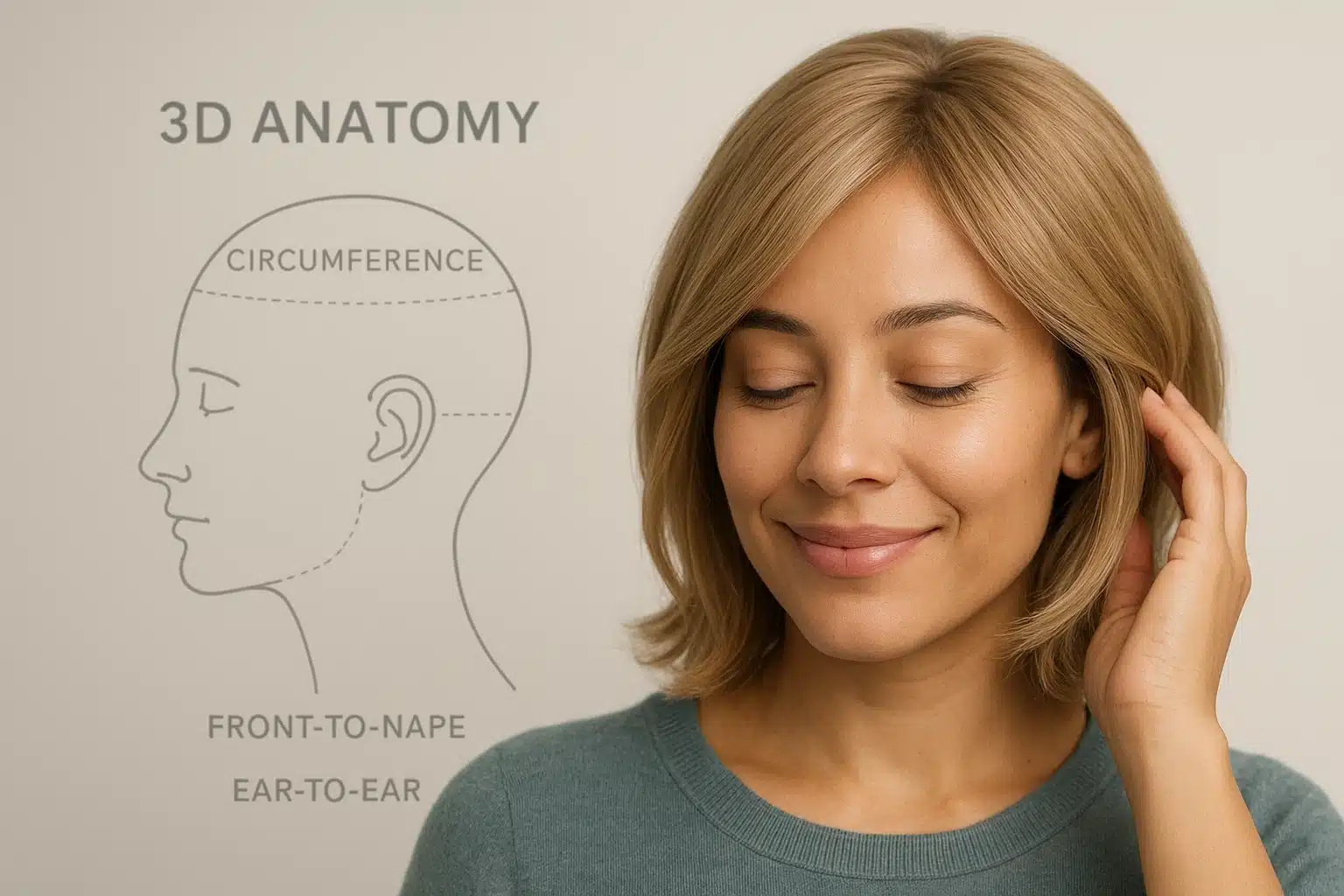
To truly find a comfortable fit, you have to look beyond a single circumference measurement. A properly fitting wig is an engineering marvel that balances three distinct dimensions:
- Circumference: Measured from your front hairline, down behind the ears, around the nape of the neck, and back to the front.
- Front-to-Nape (Depth): Measured from your front hairline, straight back over the crown, down to the occipital depression (the hollow right above the nape of your neck).
- Ear-to-Ear Over the Crown: Measured from the top of one ear, over the apex of your skull (about 7 inches back from the front hairline), to the top of the opposite ear.
When determining your size, especially when shopping for investment pieces like premium human hair wigs, you also must account for “bio-hair bulk.” Your biological hair, depending on how it’s flat-wrapped or cornrowed beneath your wig cap, can add up to 1.5 inches to your measurements. Always measure your head exactly how your hair will be styled underneath.
The Standard Cap Sizing Taxonomy
Use this general matrix as your baseline when taking your measurements with a soft tailor’s tape:
- Ultra Petite / Mini: Circumference 19.5″–20.5″ | Front-to-Nape 12″–12.5″ | Ear-to-Ear 10″–10.5″
- Petite: Circumference 20.5″–21.5″ | Front-to-Nape 13″–13.5″ | Ear-to-Ear 11″–11.5″
- Average: Circumference 21.5″–22.5″ | Front-to-Nape 14″–14.5″ | Ear-to-Ear 12″–12.5″
- Large: Circumference 22.75″–23.75″ | Front-to-Nape 15″–15.5″ | Ear-to-Ear 12.5″–13″
- Extra Large / Custom: Circumference 24″+ | Front-to-Nape 15.75″+ | Ear-to-Ear 13.5″+
Diagnosing Your Unique Fit Challenges
The Petite Dilemma
If you have a petite head, an average-sized cap will betray you in three specific ways: the crown will bag or bunch up, the ear tabs will press uncomfortably down onto your ear cartilage, and the nape will ride up when you turn your head.
The Solution: Look for brands engineered specifically for smaller profiles. European brands like Ellen Wille are known in the industry for running slightly more compact and contouring tightly to the scalp.
The Large and Extra-Large Challenge
Many shoppers mistakenly assume a larger head just needs a wider circumference. In reality, large heads almost always require deeper vertical clearance (a front-to-nape measurement over 15 inches). Without that depth, the cap will relentlessly slide backward, exposing your natural hairline at the forehead.
The Solution: Overstretching an average cap’s open wefts will only distort the hair fiber direction and expose the cap’s inner netting. Instead, seek out brands that offer true extended sizing, such as Jon Renau’s Large caps or Estetica’s Large collections.
The Ultimate Diagnostic: The Ear Tab Alignment Test
No matter what the tag says, the ear tabs will tell you the truth about a wig’s geometry. If the bendable wire inside the ear tab folds awkwardly over the top curve of your ear, the cap is too deep for you. If the wire floats an inch or more above your ear, exposing your natural sideburns, the cap lacks the necessary depth.
Finding the Right Fit Locally in Pierce County
Reading about sizing is helpful, but nothing replaces the tactile experience of trying on caps in person. Tacoma and the broader Pierce County area host a supportive, specialized fitting ecosystem for those outside the standard bell curve.
When navigating the local salon scene, look for locations that offer specific capabilities rather than just retail shelves:
- Upscale Hair Salon & Wigs: Known for private consultations, making them an excellent resource for medical cranial prosthesis sizing and privacy.
- Lori’s Fashion Wigs: A staple for established styling and in-depth fit assessments.
- Glamo Lush Beauty Bar & DC Hair Bar: Standout options when you need bespoke wig creation or custom installs for unique head shapes.
Your Pre-Appointment Tacoma Fit Checklist:Before driving across town, call the salon and ask:
- “Do you currently stock floor samples in Petite or Large sizes that I can physically try on?”
- “Do you offer in-house cap alterations (taking in wefts or adding elastic bridges)?”
- “What is your restocking fee policy if we need to special-order a non-standard size from a manufacturer?”
Customizations: When Off-the-Rack Fails
Sometimes, your circumference and your cap depth fall into two entirely different size categories. This is incredibly common. When this happens, custom alterations are your best path forward.
- Taking in a Petite Cap: If a cap is too deep but fits perfectly around the circumference, a skilled stylist can pinch and sew vertical darts along the wefts behind the ears to remove the “crown bubble.”
- Expanding a Large Cap: If a wig is too tight horizontally but fits your depth, the elastic band at the nape can be slit and expanded by inserting matching elastic bridges.
- Cosplay & Rigid Caps: Cosplay wigs are notorious for running small. They often require cutting the inner crown ribbons or installing ventilated wig grips to handle larger circumferences comfortably.
Maintaining these customized caps requires specialized wig care to ensure the newly stitched elastic maintains its stretch memory over time. While this guide focuses heavily on the Pacific Northwest, these universal tailoring principles apply whether you’re navigating shops in Tacoma or searching for high-quality wigs raleigh nc.
Frequently Asked Questions About Wig Sizing
Why does my wig give me a headache after a few hours?
Tension headaches are the primary symptom of a cap circumference that is too small, or a front-to-nape measurement that lacks the necessary depth. When a wig is too short front-to-back, it acts like a tight rubber band pulling directly against your frontal bone and the occipital ridge at the base of your skull.
How do I measure my head correctly at home?
Always use a soft, flexible tailor’s measuring tape (never a metal retractable tape). Measure your hair exactly how it will be prepped under the wig. When measuring for lace front wigs, rely on your natural hairline, not the “four-finger rule” (measuring four fingers above the eyebrows), which can cause you to set the lace improperly and distort the fit.
Should I just buy a custom wig?
If your measurements vary wildly (for example, a petite circumference but a large depth), or if you are seeking a medical cranial prosthesis, a custom hand-ventilated unit may actually be more cost-effective than repeatedly paying restocking fees on commercial units that will never fit properly.
Taking the Next Step
Discovering your true cap size is a “lightbulb” moment that transforms wig wearing from a painful chore into an effortless part of your daily routine. By understanding the mechanical relationship between cap depth and circumference, you can move past the limitations of the “average” size. Take your measurements, advocate for your comfort, and visit a specialized local professional to experience how an impeccably fitted wig should truly feel.