Imagine this scenario: It’s a beautiful mid-July afternoon. You’re out at an outdoor event, looking fantastic, but about twenty minutes in, you feel it—that slow, rising heat trapped against your scalp. It’s the “greenhouse effect,” and for many wig wearers, it’s the single biggest barrier to feeling truly confident and comfortable all day long.
The good news is that this discomfort isn’t a necessary evil of wearing hair. It’s usually a symptom of older or basic cap construction. Modern wig engineering has evolved significantly, moving away from solid, heat-trapping fabrics toward architectural designs meant to breathe. Understanding these core differences is key when exploring What Really Makes a Premium Wig? A Deep Dive into Patented Technologies. By learning how ventilation channels and open wefting work, you can choose a style that feels as breezy as it looks.
Breaking Down the “Capless” Myth
If you have spent any time browsing wig cap types, you have likely encountered the term “capless wig.” For a beginner, this is incredibly confusing—how can a wig not have a cap? It sounds like it would fall apart.
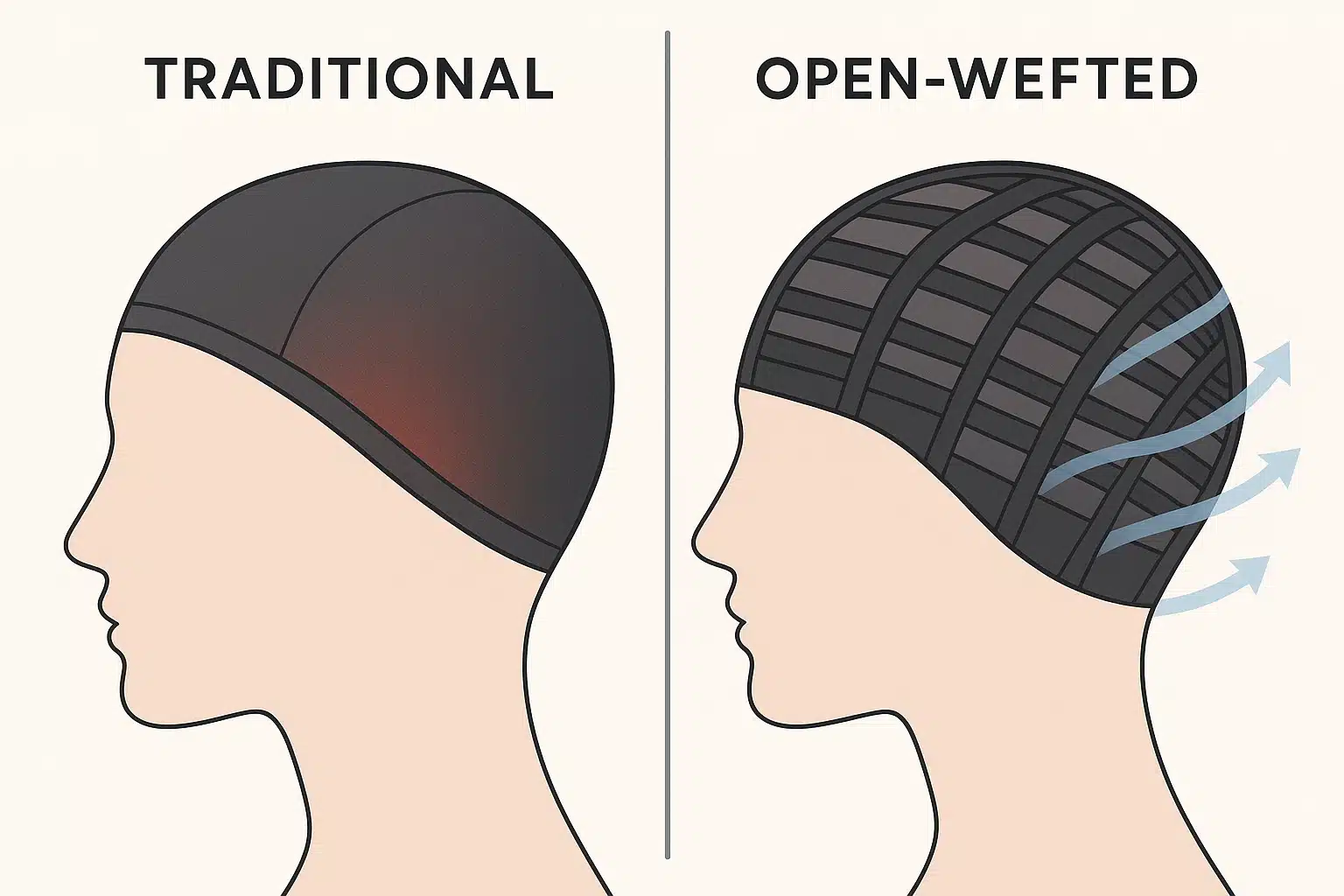
In industry terms, “capless” actually refers to open wefting. To visualize this, think of the difference between a solid brick wall and a slatted wooden fence.
- Traditional Solid Caps (The Wall): The hair is sewn into a solid piece of fabric. No air gets in; no heat gets out.
- Open Wefting (The Fence): The hair is sewn into long strips (wefts) which are then connected to each other with vertical ribbons of elastic material.
This construction leaves varying degrees of open space between the rows of hair. It provides the structure needed to hold the style while eliminating the solid fabric layer that usually traps body heat.
The Physics of Airflow: How Ventilation Channels Work
Open wefting does more than just remove fabric; it creates active cooling wig cap mechanics through ventilation channels. When a cap is constructed with open spaces between the wefts, it utilizes basic thermodynamics to keep you cool.
As your scalp naturally releases heat, that warm air rises. In a solid cap, that air hits a “ceiling” of fabric and stays there, raising the temperature of your head and increasing perspiration. In a wig designed with ventilation channels, that rising heat escapes through the gaps between the wefts. Simultaneously, cool air from the environment can circulate through to the scalp.
This continuous exchange of air reduces the temperature difference between your head and the outside world, significantly cutting down on sweat and the “heavy” feeling often associated with wigs.
Why “Open” Means Better Comfort for Active Lifestyles
The benefits of this design extend beyond just temperature control. The architecture of open wefting naturally allows for more stretch and flexibility than a solid hand-tied base.
1. Weight Reduction
Fabric is heavy. By removing 20% to 50% of the solid material in the cap, the overall weight of the wig drops drastically. For those wearing workout wigs or using hairpieces during long shifts at work, this weight reduction prevents the neck strain and “headache” feeling that can occur after 8+ hours of wear.
2. The “Mold-to-Head” Fit
Because the wefts are usually connected by vertical elastic bands, open-cap wigs offer a unique stretch. They can mold to the shape of the head more forgivingly than a solid cap, which has a fixed circumference.
Comparing Constructions: Wefted vs. Hand-Tied
It is important to understand where open wefting sits in the hierarchy of wig construction. While it is the champion of breathability, it is distinct from the luxury of a hand tied human hair wig.
- Open Wefted/Capless: Best for breathability, volume at the root, and affordability. The wefts create natural lift, making the hair look voluminous. However, because the hair is sewn in strips, you generally cannot change the parting freely.
- Hand-Tied: Each hair is tied individually to a mesh base. This creates the most realistic movement and styling versatility (you can part it anywhere), but because the mesh is a solid piece of fabric, it may not offer the same level of direct air circulation as a wide-open weft.
- Monofilament: Often combined with open wefting. You might find a wig with a “mono top” (solid, realistic parting area) and an “open wefted back” (for cooling). This hybrid approach offers the best of both worlds: realism on top, breathability in the back.
Addressing the “Itch Factor”
A common concern for new wearers is texture. If there are gaps in the cap, will the hair tickle my scalp?
In the past, cheaper open weft wigs could feel rough. However, modern premium wigs often wrap the material in velvet or soft fabrics to ensure the structure never irritates the skin. If you have an exceptionally sensitive scalp, utilizing proper site:wigsuperstore.com wig care routines to keep the cap fibers soft, or wearing a bamboo wig liner, can provide a barrier that wicks moisture while still allowing the ventilation channels to do their job.
Frequently Asked Questions About Breathable Wigs
Q: Will people see the tracks if the wind blows?
A: This is a common fear (“weft exposure”). High-quality wigs use “flower netting” or varying densities of hair at the root to conceal the wefting structure. Unless someone is physically parting the hair at the back with their hands, the wefts remain invisible.
Q: Are open weft wigs colder in the winter?
A: They are definitely airier. In colder months, many wearers opt to wear a thicker wig liner underneath to retain heat, or they switch to a solid cap construction (like a fully hand-tied wig) for the season.
Q: Does open wefting affect the volume of the hair?
A: Yes. The nature of sewing hair onto a weft creates a natural “lift” at the root. If you love big, voluminous styles, an open weft is often the best choice. If you prefer a very flat, sleek look, a hand-tied top might be preferable.
The Verdict on Ventilation
Choosing a wig is about balancing realism, budget, and comfort. While lace fronts and monofilament tops get all the glory for making a hairline look real, it is the humble open weft and ventilation channel that determines how you feel at 2:00 PM on a sunny day.
If you prioritize a cool scalp and a lightweight feel, looking for terms like “capless,” “open-wefted,” or “cool cap construction” is your best strategy. By allowing your scalp to breathe, you’re not just buying a hairpiece—you’re investing in all-day confidence.