You know that specific moment—you turn your head to check your blind spot while driving, or perhaps you look down to check your phone, and instead of a silky, fluid swish of hair, you feel a slight resistance. A snag. It is the universal “uh-oh” moment for wig wearers, often signaling that the fibers at the nape of the neck have begun to rebel.
Whether you are new to the world of alternative hair or have been wearing pieces for years, encountering friction frizz or sudden shedding can feel disheartening. It often leads to the worry that you’ve purchased a defective unit. However, understanding the science behind your fibers is the first step to longevity. Before diving into repairs, it is incredibly helpful to take a comprehensive look at the Revlon Orchid Collection to understand how specific cap constructions and fiber blends—like the TruLife heat-friendly synthetic—are engineered, as this foundation influences how you should approach maintenance.
The “Why” Behind the Frizz: Anatomy of a Fiber Failure
To fix a wig, you first have to understand what is breaking it. Many beginners assume that when a synthetic wig becomes frizzy or “crunchy” at the ends, the fiber has simply dried out. They pile on conditioning sprays, hoping to re-hydrate the hair.
But synthetic hair is plastic; it doesn’t get “thirsty.”
The culprit is almost always mechanical friction. When you wear a wig, the fibers at the nape of your neck constantly rub against your collar, your scarf, or even your skin. This friction generates a microscopic amount of heat—just enough to warp the surface of the fiber. Over hundreds of hours of wear, that smooth, round fiber becomes jagged and kinked. This is why the hair clumps together; the jagged edges are acting like Velcro, latching onto neighboring strands.
Understanding Your Material: TruLife vs. Standard Synthetic
Rene of Revlon wigs often utilize TruLife Color technology. These are heat-friendly synthetic fibers.
- Standard Synthetic: Has a “baked-in” style memory. It holds its curl through rain and humidity but cannot be heat-styled.
- TruLife (Heat-Friendly): Can be styled with heat, but more importantly, it requires heat for maintenance. Because the fiber is designed to be pliable when hot, it is actually more susceptible to friction frizz than standard synthetics. However, it also has the unique ability to be “healed.”
Troubleshooting 101: The Shedding Scare
One of the most common panic moments occurs during brushing when you see a clump of hair in the teeth of the comb. Is the wig falling apart?
The Difference Between Shedding and Breakage
True shedding happens when the knot on the cap comes loose. Breakage happens when the fiber snaps mid-strand.
- Check the comb: Look closely at the fallen hair. If you see a tiny, hooked root at one end, that is shedding. If it is a clean straight line on both ends, that is breakage.
Breakage is usually a symptom of aggressive styling. To prevent this, proper wig maintenance is essential. You must adopt the “Bottom-Up” rule: always start combing the bottom two inches of the hair to clear tangles, then move up a few inches, gradually working your way to the root. If you rake a comb from root to tip immediately, you will tighten any knots and snap the fiber.
The Tangling Triage: Detangling Without Damage
If you are dealing with a Rene of Revlon wig that has already started to mat at the nape, step away from the brush. Forcing a brush through matted synthetic hair stretches the fiber, causing it to coil tightly like a ribbon scraped with scissors.
The 10-Inch Spray Rule
When using a detangler or wig conditioner, distance matters. Spraying too close can saturate the knot, making it heavy and harder to loosen. Hold your bottle 10 to 12 inches away and mist the area lightly. Use your fingers to gently separate the largest knots before introducing a wide-tooth comb.
The “Heat Reset”: How to Defrizz Synthetic Wigs
This is the “aha moment” for most TruLife wig wearers. If your heat-friendly wig feels dry and straw-like, no amount of spray will fix it. You need to reset the surface of the fiber using heat.
Think of it like ironing a wrinkled shirt. You can’t smooth the wrinkles by just spraying water on them; you need the heat of the iron to press the fabric back into shape.
- Cleanse: Ensure the wig is clean and dry.
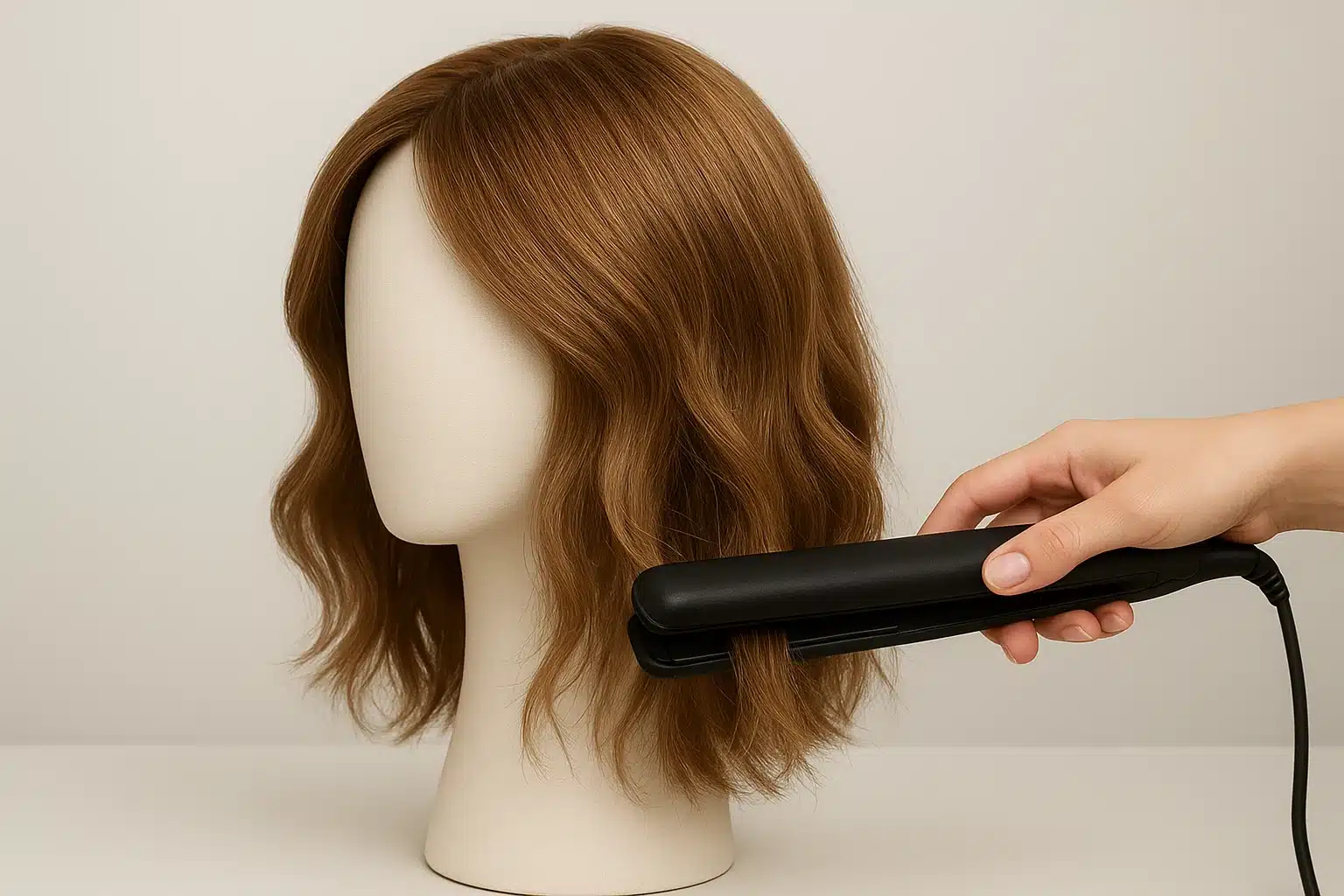
- Protect: Pin the wig to a canvas block head.
- The Magic Number: Set a flat iron or heated styling tool to 270°F – 280°F (132°C – 138°C). Do not exceed 300°F.
- The Glide: Take small, 1-inch sections of the frizzy hair. Spray with a heat protectant. Slowly glide the iron through the fiber.
- Cool Down: Allow the fiber to cool completely before touching it.
The heat smooths down the jagged edges caused by friction. This is the only way to truly defrizz synthetic wig fibers effectively. For TruLife fibers, performing this “heat reset” every 6-8 wears can double the lifespan of the wig.
Reviving the Real: Human Hair Solutions
If you have invested in a Rene of Revlon human hair piece, the rules change completely. Human hair wigs do not have the benefit of natural scalp oils traveling down the shaft to keep them moisturized.
When human hair wigs tangle or frizz, it is genuinely a moisture issue. The focus here should be on deep conditioning treatments that replenish the cuticle. However, be wary of applying conditioner to the roots, as this can loosen the hand-tied knots. If you are struggling with a piece that seems past its prime, learning how to restore a human hair wig involves specific deep-conditioning baths and controlled blow-drying techniques that differ significantly from synthetic care.
FAQ: Common Beginner Questions
Q: Can I use a steamer on my Revlon wig?
A: Yes! Steaming is an excellent way to detangle standard synthetic wigs without direct heat. The steam relaxes the fiber, allowing it to drop back into its original shape.
Q: Why does my wig tangle more in the winter?
A: Heavier clothing creates more friction. Wool coats, scarves, and high collars are the enemies of nape hair. Try sewing a small track of silk or satin onto the collar of your coat where the wig hits to reduce drag.
Q: Can I use regular hairspray on my wig?
A: It is not recommended. Standard hairspray contains alcohols that degrade synthetic fibers over time, turning them white and brittle. Always use water-soluble products formulated for wigs.
The Path to Wig Longevity
Experiencing tangles or shedding doesn’t mean you’ve made a bad investment; it simply means your wig is being loved and worn. By shifting your mindset from “fixing” to “maintaining,” you take control of your style.
Remember that every fiber has a lifespan, but understanding the physics of friction and the restorative power of controlled heat can keep your Rene of Revlon wig looking salon-fresh for months longer than expected. If you are ready to explore tools or need more specific care guides, our library of resources is open to help you navigate your journey.