If you’ve ever felt that familiar, fiery itch start to creep across your hairline halfway through the day, you know exactly how frustrating it can be. For many of us, navigating hair loss is challenging enough without the added stress of discovering that the very products meant to secure our confidence are causing intense physical discomfort.
Finding the perfect attachment method is the true cornerstone of wig-wearing confidence. Often, users begin their journey by exploring wig security methods for sensitive skin before making a vital realization: the chemical composition of your adhesive is what truly dictates your comfort. If you are a medical hair loss patient experiencing thinning skin due to chemotherapy or alopecia, standard industry advice simply won’t cut it.
Welcome to the “Scalp First” methodology. We’re going to peel back the label on standard wig adhesives, translate the complex chemistry into plain English, and equip you with a safe-wear blueprint that lets you live your life—yes, even swimming—without compromising your skin’s integrity.
Decoding Your Discomfort: Allergy vs. Sensitivity
Before we can find the right solution, we need to understand the problem. Many wig wearers mistakenly group all scalp irritation under the umbrella term of an “allergy,” but treating a sensitivity like an allergy (and vice versa) can leave you spinning your wheels.
The Sensitivity Spectrum
Let’s figure out where your scalp falls on the spectrum:
- Sensitivity (Irritation): This is usually a physical reaction. Symptoms include mild redness, stinging when sweat hits the area, or a heat rash. It’s often caused by trapped moisture, friction, or the stripping of natural oils.
- Allergy (Contact Dermatitis): This is an immune response. Symptoms include severe itching, raised bumps, blistering, or swelling that extends beyond the exact line where the adhesive was applied.
If you’re dealing with a true allergy, you are likely reacting to a specific chemical. The most common culprit? Acrylates, specifically 2-ethylhexyl acrylate. If you don’t know what you are reacting to, searching for a generic hypoallergenic wig glue can still result in frustration if that formula contains the hidden ingredient triggering your immune system.
The Chemistry of Comfort: Choosing Your Adhesive Base
Understanding the base of your adhesive is your biggest superpower. Here is how the most common options break down for sensitive scalps:
Water-Based Adhesives
These are generally the gold standard for sensitive skin. Because they use water as a solvent, they cure (dry) as the water evaporates. They are usually odor-free, non-toxic, and incredibly gentle.
- The Catch: They can take longer to dry and might break down faster if you sweat heavily.
Silicone-Based Adhesives
If you need serious longevity or live a highly active lifestyle, medical-grade silicone adhesives and tapes are fantastic. They offer a strong bond and are inherently inert, meaning they are far less likely to cause an allergic reaction than acrylic-based glues.
- The Catch: They require specific solvents for removal, which brings us to a major “aha” moment for many wig wearers.
The Plot Twist: Is It the Glue, or the Remover?
Here is a secret that rarely gets talked about: it’s frequently the remover, not the adhesive, causing your flare-up. Heavy, alcohol-laden solvents strip the skin’s moisture barrier, leaving your scalp raw. When you apply a fresh layer of wig glue for sensitive skin directly over that compromised barrier, the skin reacts violently. Switching to an alcohol-free, citrus-based, or oil-based solvent can often solve what you thought was a glue allergy overnight.
The “Barrier Strategy”: Your First Line of Defense
If you take only one concept away from this guide, let it be this: Scalp protectors are not just grip enhancers; they are physical chemical barriers.
Many wearers skip the scalp protector, thinking it’s just an optional step for a longer hold. In reality, a high-quality, medical-grade scalp protector acts as a liquid shield. It forms a microscopic polymer barrier between your skin and the adhesive, preventing harmful chemicals from seeping into the pores of a sensitive or medically-thinned scalp.
The 1-3 Day “Safe-Cycle” Method
If you browse wig forums, you’ll see people boasting about achieving “four weeks of hold.” For a sensitive scalp, this is a recipe for disaster.
When you leave adhesive on for weeks at a time, you trap sweat, sebum (oils), and dead skin cells against the scalp. This creates a perfect storm for “occlusion-related dermatitis.”
Instead, we recommend the 1-3 Day “Safe-Cycle” Method. By committing to shorter wear times (1 to 3 days maximum), you allow your skin to breathe. Rotating in “glueless days”—perhaps wearing a comfortable wig grip or a soft sleep cap at night—gives your skin’s acid mantle time to recover and rebuild.
Active Lifestyles: Securing Your Wig While Swimming
Having a sensitive scalp shouldn’t sentence you to the sidelines at pool parties or beach vacations. However, combining chlorine, adhesives, and a delicate scalp requires a strategic approach.
When looking for the best wig glue for swimming, you need a waterproof silicone-based adhesive paired with a heavy-duty scalp protector. But the real magic happens after the swim.
The Post-Swim Detox:Chlorine and saltwater can degrade adhesives, turning them into a gooey, irritating mess. After swimming, do not just leave the wig on.
- Remove the unit carefully using an oil-based, skin-safe solvent.
- Cleanse your scalp gently to remove all chemical residue.
- Apply a scalp rescuing detoxifying masque. Look for soothing ingredients like aloe, chamomile, or colloidal oatmeal to instantly neutralize pH imbalances and calm the skin before your next application.
The Safe-Bond Blueprint: A Step-by-Step Routine
Ready to put this knowledge into practice? Follow this checklist to ensure a comfortable, secure hold every time.
Step 1: The 24-Hour Patch Test Protocol
Never skip the patch test. Apply a small dot of your chosen adhesive (and the remover you plan to use) behind your ear or on the inside of your elbow. Cover it with a regular bandage and leave it for 24 hours. If it’s red, itchy, or raised when you remove the bandage, that product is not for you.
Step 2: Prep and Protect
Wash your scalp with a gentle, sulfate-free cleanser. Ensure it is 100% dry. Apply your liquid scalp protector and let it dry completely until it feels smooth, not tacky.
Step 3: Thin, Patient Layers
If you are using liquid glue, apply it in incredibly thin layers. A thick glob of glue won’t cure properly, leaving wet chemicals trapped against your skin. Let each layer dry clear before adding the next.
Step 4: Gentle Removal
When it’s time to take your wig off, let the solvent do the work. Spray it on, wait a full three to five minutes, and let the adhesive melt. If you are pulling or tugging, you are causing micro-tears in your skin, which will guarantee irritation the next time you apply glue.
Frequently Asked Questions (FAQ)
Why does my wig glue itch intensely right after I apply it?
If the itch is immediate and intense, you are likely having an allergic reaction to a specific ingredient (often acrylates or latex) in the adhesive. Remove it immediately with a gentle solvent and wash the area with mild soap.
Can I use wig tape on a totally bald head?
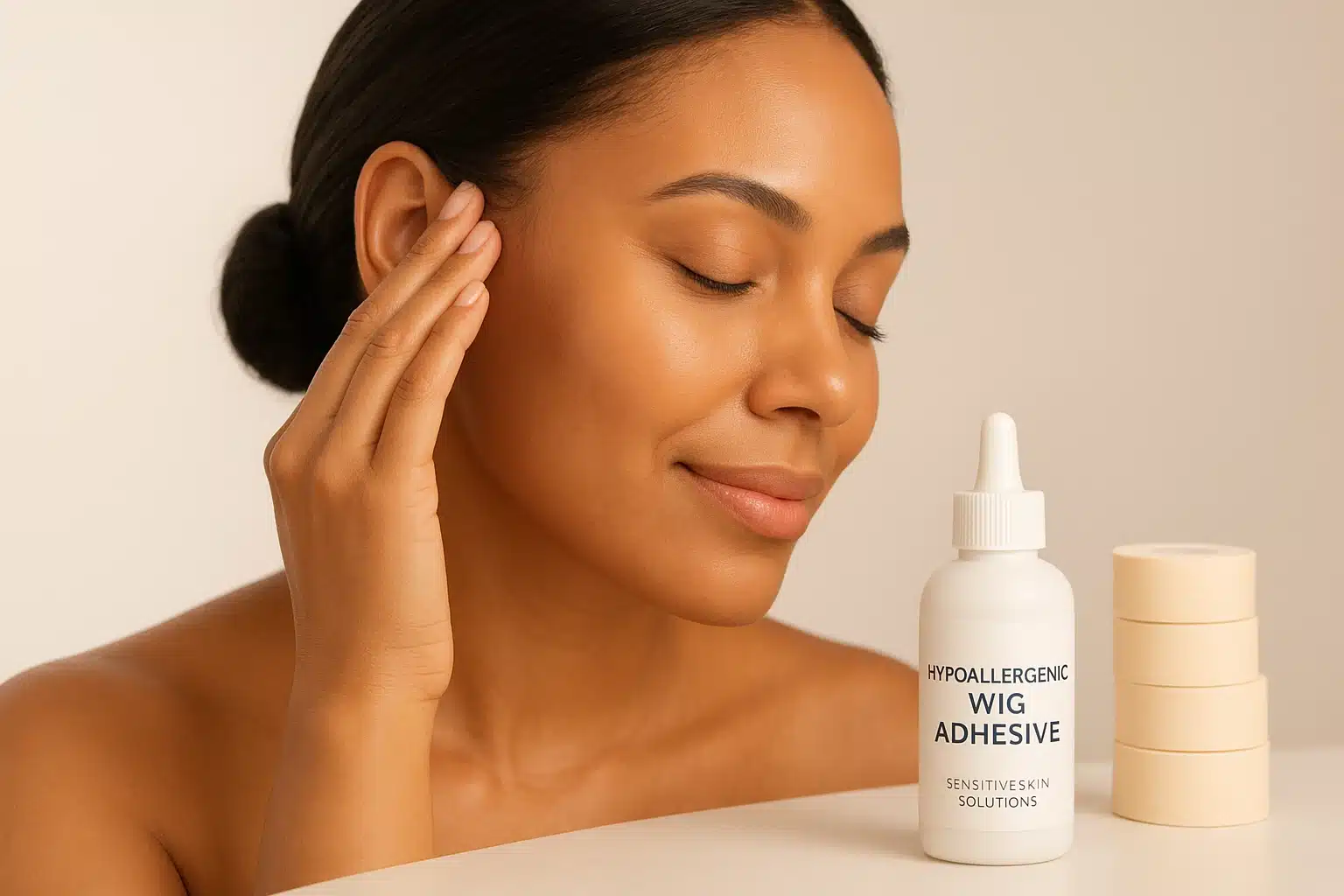
Yes! In fact, many medical hair loss patients prefer double-sided medical tape over liquid adhesives. Tapes are generally less messy and contain fewer volatile solvents. Just ensure you are using a tape specifically marked as medical-grade and hypoallergenic, like those made with a silicone base.
Is there a truly latex-free hair bonding glue?
Absolutely. The industry has made massive strides in recent years. Look specifically for water-based acrylics or silicone adhesives that loudly advertise being 100% latex-free and toxic-free. Always double-check the ingredient list for formaldehyde and toluene as well, as these are known irritants.
Your Next Steps to Comfort and Confidence
Navigating wig security with a sensitive scalp requires patience, but you don’t have to figure it out through trial and error alone. By adopting a “Scalp First” mindset, utilizing protective barriers, and understanding the chemistry of your products, you can achieve a flawless, secure hold that feels as good as it looks.
If you’re ready to transition away from irritating formulas, take the time to audit your current routine. Check your adhesive’s ingredients, invest in a high-quality scalp protector, and remember that taking breaks is the best gift you can give your skin. Your comfort should never be the price you pay for your confidence.