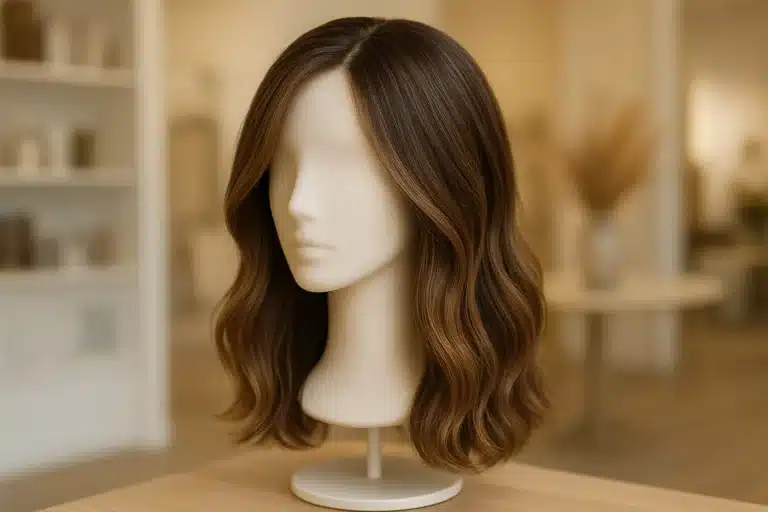
Imagine walking into a high-end salon or browsing an online boutique, captivated by a gorgeous, flowing human hair wig labeled “100% Brazilian Virgin Hair.” You invest in it, expecting it to last for years and to feel as natural as your own hair. But what if the “Brazilian” label is a myth, and the hair’s actual origin story is far darker than you realize?
For anyone navigating the complex and deeply personal world of hair loss, finding clarity is key. Whether you’re exploring options due to natural thinning, medical treatments, or even exploring the sudden shedding some have noted in “hair loss covid booster” discussions, you deserve total transparency. Delving into the ethical sourcing and sustainability behind quality human hair wigs is the first step toward making a purchase that truly aligns with your conscience. Today, we’re moving beyond the simple question of “which hair lasts longer” to uncover how the processing methods used on your wig directly reflect the treatment of the original donor.
The Vocabulary of Ethics: Decoding Hair Terminology
To understand the ethical supply chain, we first need to speak the language. The “Virgin vs. Processed” debate is often clouded by industry jargon designed to confuse consumers. Here is what those terms actually mean:
- Raw Hair: The purest form of human hair available. It has never been chemically altered, dyed, or even steam-processed for texture. It is exactly as it grew on the donor’s head.
- Virgin Hair: Hair that has never been chemically processed (no dyes, perms, or bleaches). However, unlike raw hair, virgin hair may be steamed to achieve a uniform curl or wave pattern.
- Remy Hair: This term refers to how the hair is collected, not its chemical history. Remy hair is bundled with all the cuticles (the microscopic scales on the hair shaft) facing the same direction. This requires the hair to be tied into a ponytail before being cut.
- Non-Remy / “Floor Hair”: Hair gathered from the floors of salons, temples, or homes. Because it is swept up in a pile, the cuticles face in all different directions, causing massive tangling.
The Quality-Ethics Connection: Why the Cuticle Matters
There is a direct correlation between how long your wig lasts and how ethically it was sourced.
High-quality wigs rely on cuticle integrity. When hair is ethically collected from a single consenting donor (often tied in a ponytail before cutting), the cuticles remain intact and aligned. This natural alignment prevents tangling and reflects light beautifully, giving the hair its natural luster.
Conversely, when hair is non-Remy “floor hair,” the chaotic alignment of the cuticles creates a nightmare of friction. To make this cheap hair sellable, manufacturers must turn to harsh chemical processing.
The “Processed” Secret: The Acid and Silicone Cycle
If you’ve ever bought a seemingly perfect human hair wig that suddenly turned into a matted bird’s nest after three washes, you’ve experienced the “Acid Bath.”
Here is the hidden journey of processed multi-donor hair:
- The Acid Strip: To prevent “floor hair” from tangling, manufacturers soak the hair in highly corrosive acid baths to completely burn off the natural cuticles.
- The Silicone Coating: Because acid-stripped hair looks dull, dry, and brittle, it is then heavily coated in industrial silicones. This gives the hair an artificial, mirror-like shine and a silky feel in the package.
- The Wash-Out: After a few washes at home, the silicone washes down your drain. Without the silicone to protect it, the damaged, cuticle-less hair begins to mat, dry out, and tangle uncontrollably.
Beyond the frustration of a ruined wig, this process has real health and environmental costs. The chemical runoff from these acid baths poses severe environmental hazards in the manufacturing regions. Furthermore, for wig wearers with sensitive scalps or conditions like seborrheic dermatitis, the chemical residues and heavy silicones trapped in processed hair can trigger severe itching and allergic reactions.
The “Marketing Ethnicity” Lie
One of the best-kept secrets in the hair industry is the use of “marketing ethnicities.” Most consumers don’t know that “Malaysian virgin hair,” “Peruvian wavy,” or “Mongolian straight” are rarely sourced from those countries.
The reality is that nearly 90% of the world’s human hair supply originates from India and China. So why the exotic labels? Marketers use these geographic names to describe the texture of the hair, not its origin. For example, thick, heavily processed Chinese hair is often marketed as “Brazilian” to justify a higher price point.
The hair trade is a massive global commodity market. Understanding this helps you realize that whether you are looking for premium hair replacement systems in Ireland or custom pieces manufactured in Bangalore or Sri Lanka, the underlying sourcing principles remain exactly the same.
Traceability Tiers: From Exploitation to Empowerment
To navigate this market, it helps to understand the “Traceability Tiers” of hair sourcing. Consider this a 1-to-5 scale of sourcing ethics:
Tier 1: Single Donor / Fair Trade (The Gold Standard)
Hair is purchased directly from individuals at fair market value, often through specialized salons. The donor consents, is compensated well, and the hair is cut in a single, cuticle-aligned ponytail.
Tier 2: Temple Donations (High Traceability)
Common in India, where individuals voluntarily shave their heads as a religious offering. The temples auction this hair to fund community projects, schools, and local infrastructure. When managed transparently, this is a highly ethical, community-supporting source.
Tier 3: Multi-Donor / Aggregated Remy (Moderate Traceability)
Hair collectors travel to villages purchasing small amounts of hair from various women. While the women are paid, the pricing isn’t always fair trade, and the hair is mixed, though still cut to maintain cuticle alignment.
Tier 4: Trace Unknown / “Floor Hair” (Low Traceability)
Hair swept from salon floors or gathered from hairbrushes. There is no consent for the sale, no direct compensation to the original grower, and the hair requires heavy chemical processing to be usable.
Tier 5: Exploitative Sourcing (Zero Traceability)
The dark side of the trade, involving hair stolen or forcibly taken from vulnerable populations. Without transparent sourcing chains, consumers risk inadvertently supporting these practices.
Actionable Identification: 5 Ways to Test Your Hair at Home
How can you tell if the hair you’ve purchased is truly virgin, or if it’s hiding behind an acid bath and silicone shield? Here are five tactile tests you can perform:
- The Slip Test: Run your fingers up and down a single strand of hair. If it’s true virgin hair with an intact cuticle, it will feel smooth going down, but you will feel slight resistance or friction moving up toward the root. If it feels perfectly smooth in both directions, the cuticle has been stripped off.
- The Wash Test: Wash the hair with a clarifying shampoo. If the water turns murky brown or the hair instantly loses its silky texture and becomes stiff, you’ve just washed away the silicone coating on processed hair.
- The Burn Test: Snip a tiny strand and safely light it with a match. Human hair will burn quickly, smell like burnt feathers, and leave a crumbling ash. Synthetic blends (often secretly mixed into cheap “human hair” bundles) will melt into a hard plastic bead and smell like burning chemicals.
- The Bleach Test: True virgin hair will lift and lighten predictably when bleach is applied. Processed hair, which often contains hidden textile dyes to make the color uniform, will struggle to lift or will turn unpredictable colors.
- The Longevity Calculator: Look at the cost per wear. A $400 ethically sourced virgin wig worn for 2 years costs about $0.54 per day. An $80 processed wig that needs replacing every two months costs $1.33 per day. True quality is an investment that pays off over time.
The Ethical Checklist: Questions for Your Supplier
The next time you are shopping for a wig or hairpiece, become a conscious consumer by asking your vendor these specific questions:
- “Can you trace this hair back to its country of origin?” (If they say “Brazil” or “Malaysia” without context, be skeptical).
- “Is this hair raw, virgin, or processed?”
- “Has this hair been acid-washed or silicone-coated?”
- “Are the cuticles intact and aligned in the same direction?”
- “Do you guarantee this is single-donor or ethically collected temple hair?”
Honest, high-quality vendors will be thrilled to answer these questions because they are proud of their transparent supply chains.
Frequently Asked Questions (FAQ)
What is the difference between virgin and Remy hair?
Virgin hair refers to hair that has never been chemically processed (dyed, bleached, or permed). Remy hair refers to the collection method, ensuring all cuticles are facing the same direction. Hair can be Remy but not virgin (if it was dyed after being cut), and technically hair can be virgin but not Remy (though rare, if virgin hair is swept off a floor).
Why is virgin hair so expensive?
You are paying for rarity, longevity, and ethical labor. Single-donor hair requires finding someone willing to grow their hair out for years without dyeing it, compensating them fairly, and manually processing the hair without cheap chemical shortcuts.
Is “Brazilian” hair actually from Brazil?
Almost never. “Brazilian” is an industry marketing term used to describe hair that is thick, full, and holds a curl well. The vast majority of this hair actually originates from rural China or India.
How do I support fair trade for donors?
Purchase from reputable brands that openly discuss their supply chain. Look for companies that educate their consumers about origin points and avoid those that sell “cheap” human hair, as deeply discounted human hair almost always relies on exploitative labor or heavy chemical processing.
Your Next Steps in Conscious Consumerism
Navigating hair loss or exploring new hair enhancements is a deeply emotional journey. By understanding the ethical implications of virgin versus processed hair, you empower yourself to make choices that honor both your personal confidence and the dignity of the people who supplied the hair.
Quality isn’t just about how a wig looks on day one; it’s about the integrity of the strand from the moment it was grown to the moment you put it on. We encourage you to continue educating yourself, asking questions, and demanding transparency from the wig industry. Your beautiful new look shouldn’t have to come at a hidden cost.