Imagine finding the wig of your dreams. The color perfectly complements your skin tone, the style is exactly what you’ve been looking for, and the fibers feel incredibly lifelike. You excitedly place it on your head, look in the mirror, and something just feels… off. It slowly rides up in the back, or maybe it feels uncomfortably snug around your temples.
We see this happen all the time. At Wig Superstore, where we’ve spent nearly two decades helping individuals navigate the emotional journey of hair loss, we believe in a simple truth: a $300 wig can look like a $30 wig if the size is wrong.
Rene of Paris (often abbreviated as ROP) creates some of the most stunning, fashion-forward pieces in the alternative hair industry. Yet, many first-time wearers encounter frustration simply because they rely on the industry’s “one-size-fits-most” philosophy.
Today, we’re changing that. Grab a cup of coffee, and let’s explore the mechanics of head shape, the unique quirks of the Rene of Paris brand, and how to measure your head for a flawless, secure fit.
The Hidden Truth About Sizing: The “ROP Bias”
If you’ve spent any time browsing wig sizing charts, you’ve probably heard that 95% of women fit into an “Average” cap. While that’s a comforting statistic, it doesn’t tell the whole story—especially when it comes to specific brands.
Here is the industry’s best-kept secret: Rene of Paris “Average” caps traditionally measure between 21.25″ and 21.5″ in circumference.
Why does this matter? Because the broader wig industry standard for “Average” often stretches up to 22 inches. If your head measures exactly 22 inches, you might find a standard average cap fits perfectly, but an average Rene of Paris cap might feel just a bit too tight. Understanding this “ROP Bias” is the ultimate key to preventing returns and ensuring your new hair feels like a natural extension of yourself.
The Measurement Lab: Your 3-Step Formula for the Perfect Fit
Most manufacturer guides tell you to measure the circumference of your head and leave it at that. But if you’re investing in a beautiful lace front or a monofilament top, circumference alone won’t guarantee a natural look.
To become a sizing expert, you need the Triple Measurement Method.
Pro Tip: Before you start, consider your “Bio-Hair Bulk.” If you have thick natural hair that you plan to wrap or braid under your wig, add a “compression factor” of 0.25″ to 0.5″ to your final measurements.
1. Circumference (The Halo)
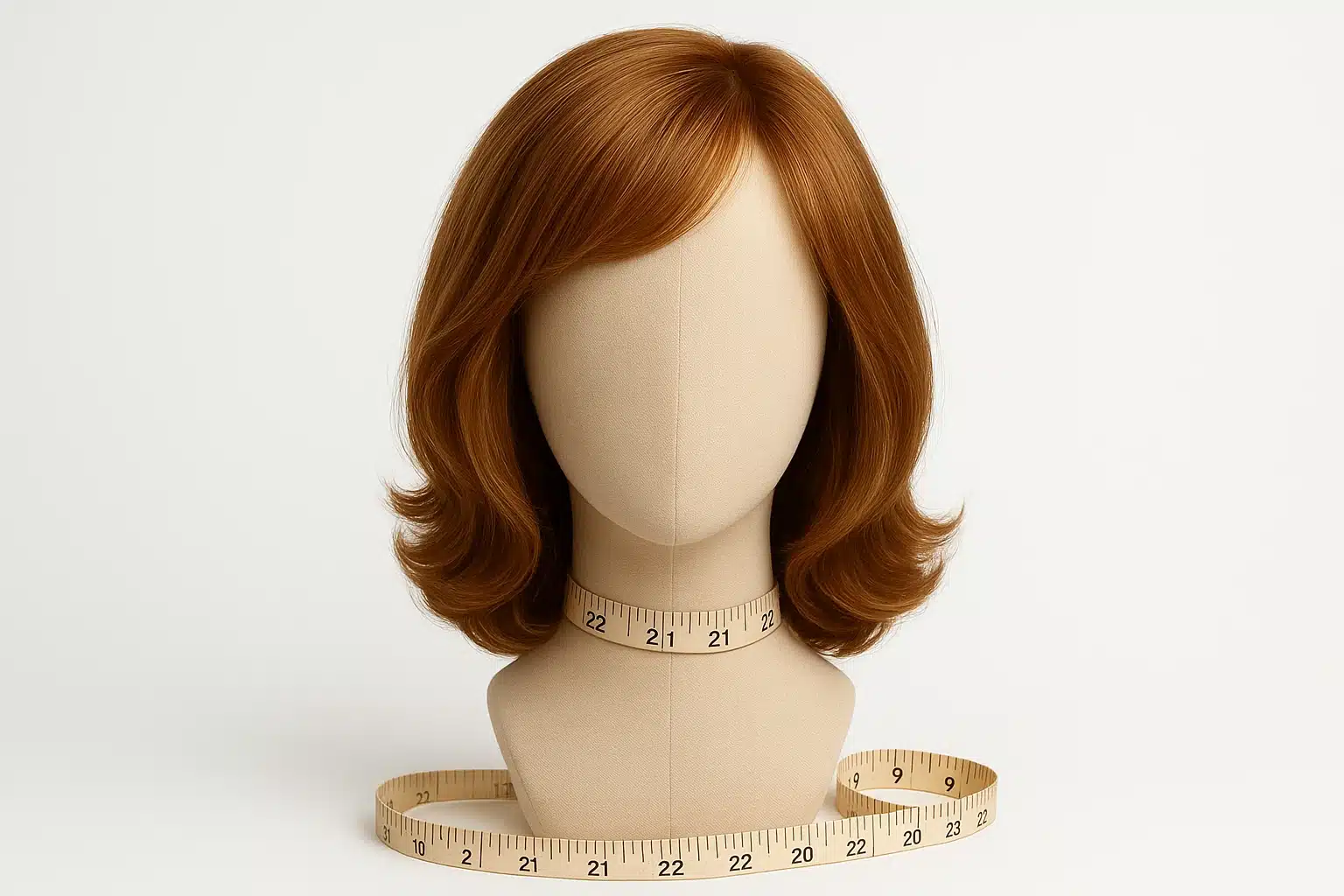
Using a flexible, cloth measuring tape, start at your front hairline. Pull the tape behind your ear, around to the nape of your neck, up behind your other ear, and back to the front hairline. Make sure the tape lies flat and isn’t twisted.
2. Front-to-Nape (The Anchor)
This measurement is crucial to prevent your wig from sliding backward. Start at your front hairline and pull the tape straight back over the crown of your head down to the nape of your neck (where your natural hair stops growing).
The Occipital Anchor: Have you ever wondered why wigs tend to ride up in the back? At the base of your skull, there is a small curve known as the occipital bone. A well-fitting wig should cup directly underneath this bone. If your front-to-nape measurement is too long or too short for the wig cap, it won’t anchor properly under this “bump.”
3. Ear-to-Ear (The Coverage)
Start at the front of one ear where your hairline ends, bring the tape up across your hairline (or about an inch above your eyebrows), and down to the front of the other ear. This ensures that the ear tabs on your wig sit exactly where they should, looking completely natural.
Finding Your Invisible Hairline: The 4-Finger Rule
One of the most common questions we hear from those experiencing total hair loss is: “If I don’t have a natural hairline anymore, how do I know where to start measuring?”
Placing a wig too far down on the forehead is the number one giveaway that you’re wearing alternative hair. To find your natural hairline placement, use the 4-Finger Rule:
- Place your index, middle, ring, and pinky fingers horizontally flat against your forehead.
- Rest your pinky right above your eyebrow bone.
- Wherever your index finger rests is roughly where your natural hairline should begin.
Another fantastic trick is the “Eyebrow Raise.” Look in the mirror and raise your eyebrows as high as you can. The top crease that forms on your forehead is your brow muscle; your wig should sit just above this line so it doesn’t shift when you make facial expressions.
The Definitive Rene of Paris Sizing Matrix
Now that you have your measurements, let’s look at how they align with the Rene of Paris ecosystem.
| Size Category | Circumference | Best Fit Notes |
|---|---|---|
| Petite | Under 21″ | Ideal for smaller head frames. Look for styles specifically tagged “Petite.” |
| Average | 21.25″ – 21.5″ | The ROP sweet spot. Fits the vast majority of ROP wearers comfortably. |
| Large | 22.5″ and above | If you measure over 22.5″, you will need a designated Large cap to ensure the ear tabs reach properly. |
What if you are a “Size 22” or “Extra Large”? If your circumference is exactly 22″, you fall into an outlier category for ROP. An average cap may feel snug, and a large cap may feel loose. In this case, you’ll want to pay close attention to the type of cap construction you choose, as some offer far more stretch than others. For a broader perspective on how different brands handle these in-between measurements, exploring general wig sizing and adjustment principles can be incredibly helpful.
Collection-Specific Fit Nuances: Noriko vs. Amore
Rene of Paris is the parent company to several spectacular sub-collections, most notably Noriko and Amore. A fascinating secret of the trade is that the construction of the cap changes the way the size feels.
Noriko: The Stretchy All-Rounder
Noriko wigs are primarily machine-wefted. Because the hair is sewn onto elastic strips (wefts), the cap has a wonderful amount of give and stretch. If you fall into that 22″ “borderline” category, a standard Noriko cap will often stretch to accommodate you far better than a hand-tied cap would.
Amore: Structured and Secure
The Amore collection is famous for its double-monofilament tops, making them some of the best wigs for sensitive scalps. However, because monofilament materials and hand-tied cap constructions are less elastic than open wefting, Amore wigs have a stiffer base. They are incredibly secure but offer very little stretch. If you are an Average-Large, an Amore Average might feel too restrictive.
Alexander Couture: Premium Precision
This high-end line requires the most precision. The exquisite lace fronts and detailed caps are designed to lay flush against the skin. Accurate measurements are non-negotiable here to ensure the lace doesn’t buckle or lift.
Troubleshooting the Secure Fit
Even with the perfect size, everyone’s head shape is a little different. Many women have “flat backs” (a less pronounced occipital bone), which can cause the wig to slip upwards, regardless of the size.
If you find yourself constantly pulling your wig down throughout the day, you aren’t alone. Learning how to keep your wig from slipping is an essential skill. Often, utilizing the adjustable Velcro or bra-strap nape tabs hidden in the back of your ROP wig can create a custom tension that cups the back of the head perfectly. Additionally, introducing a velvet wig grip can provide the friction needed to keep a wig locked in place on flatter head shapes.
Frequently Asked Questions (FAQ)
Does my hair length affect my wig size?
Absolutely. If you have bio-hair that falls past your shoulders, wrapping it tightly against your head will add volume. Always measure your head with your hair styled exactly as it will be under the wig (e.g., in a wig cap or flat pin curls).
What if my measurements fall into two different sizes?
Always defer to the larger measurement, specifically the circumference. It is much easier to use the adjustable nape tabs to tighten a slightly loose wig than it is to stretch a wig that is too small, which can cause headaches and damage the cap.
Why are my wig’s ear tabs sitting above my temples?
This usually means your “Ear-to-Ear” or “Front-to-Nape” measurement is too large for the cap. The cap is stretching to cover the circumference but doesn’t have enough depth to reach down to your ears. You may need to size up to a Large cap.
Next Steps on Your Hair Journey
Finding your perfect wig size is an empowering moment. It shifts the experience from feeling like you are wearing a costume to feeling like you are wearing your hair.
Take a moment today to grab a measuring tape and map out your Triple Measurements. Once you have those numbers confidently in hand, you unlock the ability to explore the gorgeous textures, vibrant colors, and compassionate artistry that Rene of Paris brings to the world of alternative hair. Remember, you deserve to feel beautiful, secure, and entirely comfortable in your own skin.