Have you ever watched an intense, high-definition close-up in a film and marveled at how perfectly natural the actor’s hair looked as it blew in the wind? That seamless realism doesn’t happen by accident. It is the result of countless hours of an incredibly meticulous craft known as ventilating. Whether it’s for an intimate black-box theater production or an IMAX blockbuster, mastering the mechanics of hand-tied hair is what separates an obvious hairpiece from a living, breathing character.
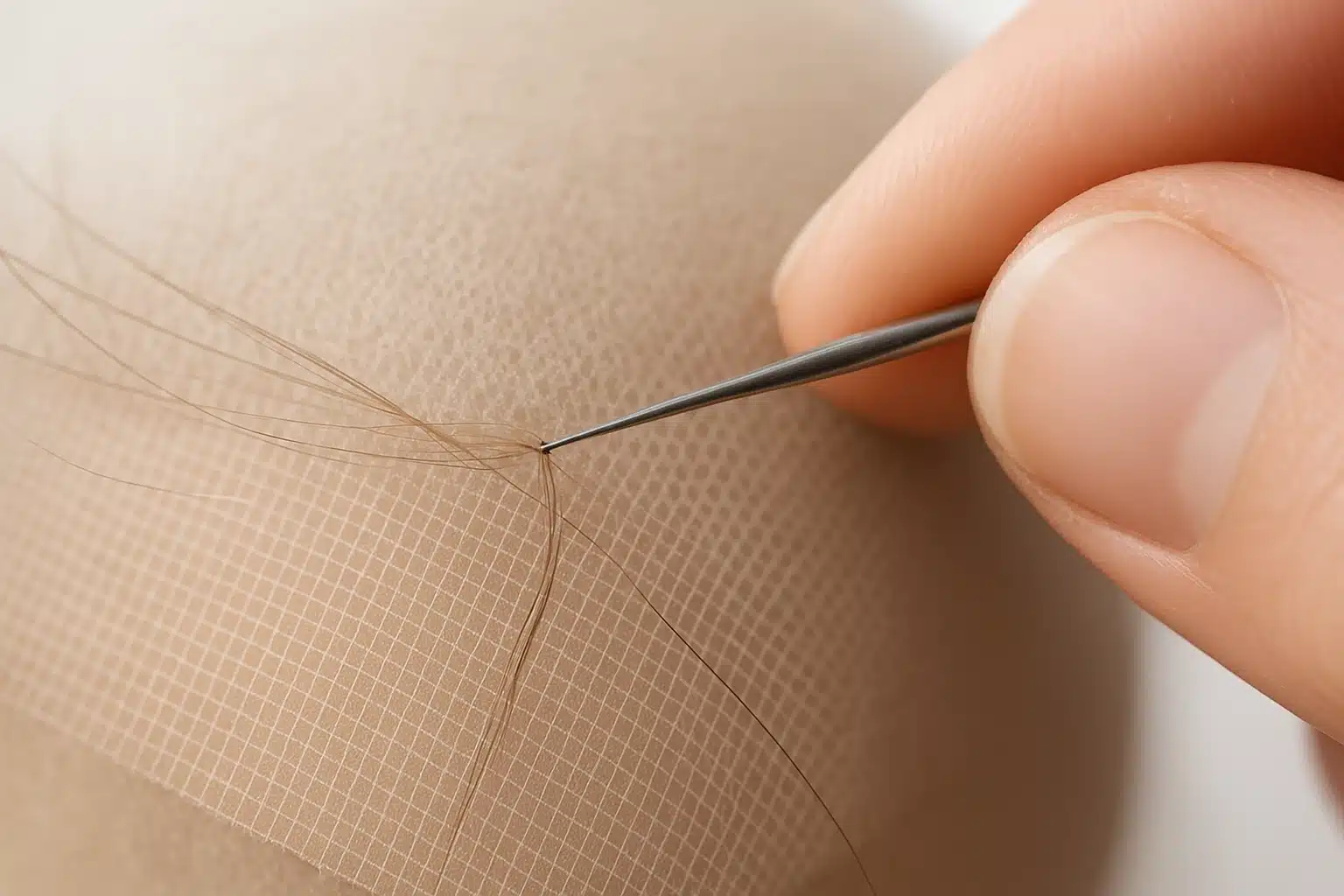
Understanding the unique demands of the wig in entertainment for stage, screen, and performance art means diving into a world where every single strand matters. Ventilating—or knotting—is the precise technique of tying individual hairs into a fine lace foundation. It’s an art form that requires immense patience, technical skill, and an eye for natural human anatomy. Let’s pull back the curtain on how professionals create these breathtakingly realistic hairlines and explore the secrets behind the craft.
The Foundations of the Craft: Tools and Materials
If you are just beginning to explore the world of wig making, the sheer volume of materials can feel overwhelming. Many beginners start by searching for the “best wig caps for wig making,” only to be met with a confusing array of options.
The standard for performance wigs is lace, specifically Swiss lace or French lace. French lace is slightly thicker and more durable, making it an excellent choice for beginners and theatrical performances. Swiss lace is finer, more fragile, and practically disappears against the skin, making it the go-to for film and television.
You may also hear about silk wig caps. It’s important to note that silk isn’t typically used for traditional ventilating. Instead, silk is used for “injected” tops, a specialized technique where hair is pulled through a layer of silk to hide the knots completely, creating the flawless illusion of a natural scalp.
The Latch-Hook Entry
Professional ventilating needles are incredibly fine (ranging from size 00 for delicate lace to size 3 for heavier applications). For a beginner, catching a single strand of hair with a microscopic hook can be incredibly frustrating. If you’re struggling, consider using a latch-hook as a “training wheel.” While it’s too large for fine lace fronts, practicing on a wider mesh foundation helps you build muscle memory for the “Turnaround Loop” and tightening motions before graduating to professional needles.
Stage Durability vs. Screen Undetectability
Not all knots are created equal. The technique a wig maker chooses depends entirely on the “Knot Visibility Scale” and the environment the performer will be in.
Double Knots (The Theater Standard)
In live theater, actors sweat under hot lights, perform rigorous choreography, and undergo rapid quick-changes. Wigs in this environment must be practically indestructible. Here, makers use Double Knots. Tying the hair twice ensures the strands won’t slip out during vigorous brushing or movement. While double knots are slightly more visible, the distance between the stage and the audience renders them completely undetectable.
Single and Split Knots (The Screen Standard)
For 4K and 8K cameras, durability takes a back seat to absolute realism. Filmmakers use Single Knots or Split Knots (where the hair is knotted so that the short return end is split away from the long end). These knots lay incredibly flat against the lace, creating a delicate, undetectable transition that can withstand the scrutiny of an extreme close-up.
The “Wig Clinic”: Troubleshooting Common Frustrations
Even with the right tools, the journey of hand-tying hair is filled with trial and error. Here are a few professional secrets to overcome the most common beginner hurdles.
Curing the Dreaded “Cone Head”
One of the most frequent complaints from new wig makers is that their finished piece bulges at the crown, creating an unnatural “cone” shape. This is rarely a problem with the knotting itself; it’s a structural issue with block work.
When pinning your lace to a canvas block, tension is everything. If the lace isn’t stretched uniformly, or if the canvas block isn’t properly sized to the wearer’s exact measurements, the lace will buckle once it’s removed. Ensuring smooth, moisture-controlled tension over the block prevents this structural collapse.
The Professional’s “Moisture Secret”
Are your hair fibers constantly snapping or resisting the hook? Professional film wig makers use a brilliant trick: the hot water dip. Submerging the root ends of the hair in hot water temporarily breaks down the stiff bonds of the fiber, increasing its pliability. This simple “lightbulb moment” makes the hair infinitely easier to loop and tie, saving both your hands and your materials.
Mastering Directional Flow
Hair does not grow straight up out of the scalp. If you ventilate straight up and down, the wig will look instantly artificial. A natural growth pattern requires knotting the hair at a 45-degree angle. By following the natural swirl of the crown and the directional flow of the temples, the hair will move and fall exactly as it would in nature.
The Hairline Blueprint: Mapping Density
Creating a natural front edge is arguably the most challenging aspect of ventilating. A common mistake is packing too much hair into the front lace, resulting in a thick, “wall of hair” effect.
Professionals use density heatmaps to build out the front. The very edge of the hairline should exclusively feature single-hair knots, spaced out to mimic the fine, sparse baby hairs naturally found on the forehead. As you move back toward the crown, you gradually transition into 2-hair and 3-hair knots to build volume.
A great spatial guide is “The 4-Finger Rule.” Generally, a natural hairline begins about four finger-widths above the eyebrows. Mapping your foundation with this in mind prevents the wig from sitting unnaturally low on the face.
While crafting your own piece is incredibly rewarding, understanding these density principles will also help you identify high-quality, pre-made realistic hairline wigs if you prefer to skip the labor-intensive construction process.
Frequently Asked Questions About Wig Ventilating
How long does it take to hand-tie a full wig?
Creating a fully hand-tied wig for a theatrical or film production is a monumental investment of time. On average, a professional wig maker spends between 35 to 45 hours ventilating a single piece, depending on the required density and knot types.
Can hand-tied wigs be repaired if they tear or shed?
Absolutely. The beauty of a hand-tied foundation is its modularity. Learning these knotting skills is actually the exact same technique used in professional wig maintenance to fix thinning spots, replace lost hairs, or patch torn lace on a beloved piece.
Do I have to make my own wig to get this level of realism?
Not at all. While making a wig custom to your head is the gold standard for film, the commercial wig industry has adopted these exact ventilating techniques to create stunning, ready-to-wear options. Exploring beginner-friendly collections like Revlon wigs can give you a wonderful feel for quality construction and natural movement before you ever pick up a ventilating needle.
What is an outre hand-tied wig?
You might see this term pop up in your research. It refers to commercial wigs that utilize hand-tied techniques, often in the parting space or frontal area, to offer a realistic look at a more accessible price point than fully custom theatrical builds. They make fantastic study pieces if you want to closely examine how factory professionals space their knots.
Continuing Your Journey
Ventilating is far more than a technical skill; it is an act of empathy. Every knot tied is a step toward helping a performer inhabit a character, or helping an individual reclaim their confidence and feel beautiful. The patience required to master the hook and lace is substantial, but the result—hair that moves, breathes, and looks entirely your own—is nothing short of magic.
Whether you’re looking to build your first lace front for the stage, or simply want to be a more educated consumer when selecting your next piece, understanding the architecture of hand-tied hair completely transforms how you view the world of wigs.