We’ve all experienced that fleeting moment of panic. You’re reaching for a high shelf, stepping out into a brisk wind, or hugging a friend, and suddenly your mind flashes to one anxious question: Is my wig shifting? For decades, wig wearers relied solely on tight elastic bands, uncomfortable bobby pins, or messy glues applied directly to delicate lace just to feel secure. This often resulted in tension headaches, damaged edges, or a lingering fear of public embarrassment.
Fortunately, the wig industry has undergone a quiet revolution in material science. To truly appreciate how far we’ve come, we only have to look at the evolution of wig craftsmanship and materials: from human hair to advanced synthetics. Today, the focus has shifted from rudimentary fastening methods to advanced biocompatible engineering. By integrating strategically placed silicone strips and polyurethane (PU) tabs into modern cap constructions, designers have cracked the code on anti-slip security. Understanding how these two distinct materials interact with your scalp, your lifestyle, and even your hair growth will entirely transform your wearing experience.
The Great Security Myth: Why “One Size Fits All” Fails
When you first begin exploring alternative hair, you might assume that a snug cap is a secure cap. This is a common, yet painful, misconception. Relying purely on the mechanical tension of a standard wig cap creates pressure points around the perimeter of your head. Over time, this constant squeezing restricts blood flow, causing tension headaches and potentially damaging your biological hair follicles.
True security isn’t about tightness; it’s about friction and adhesion. By bridging the gap between material science and real-world biology, modern wig caps use specific materials to counteract the natural forces trying to move your wig. To choose the right cap for your needs, you must first understand the fundamental difference between grip and bond.
The Foundations of Security: Grip vs. Bond
While silicone and polyurethane are often mentioned in the same breath, they serve entirely different physical purposes. Understanding this “lightbulb moment” will save you time, money, and frustration.
Silicone Strips: The Physics of Friction and Suction
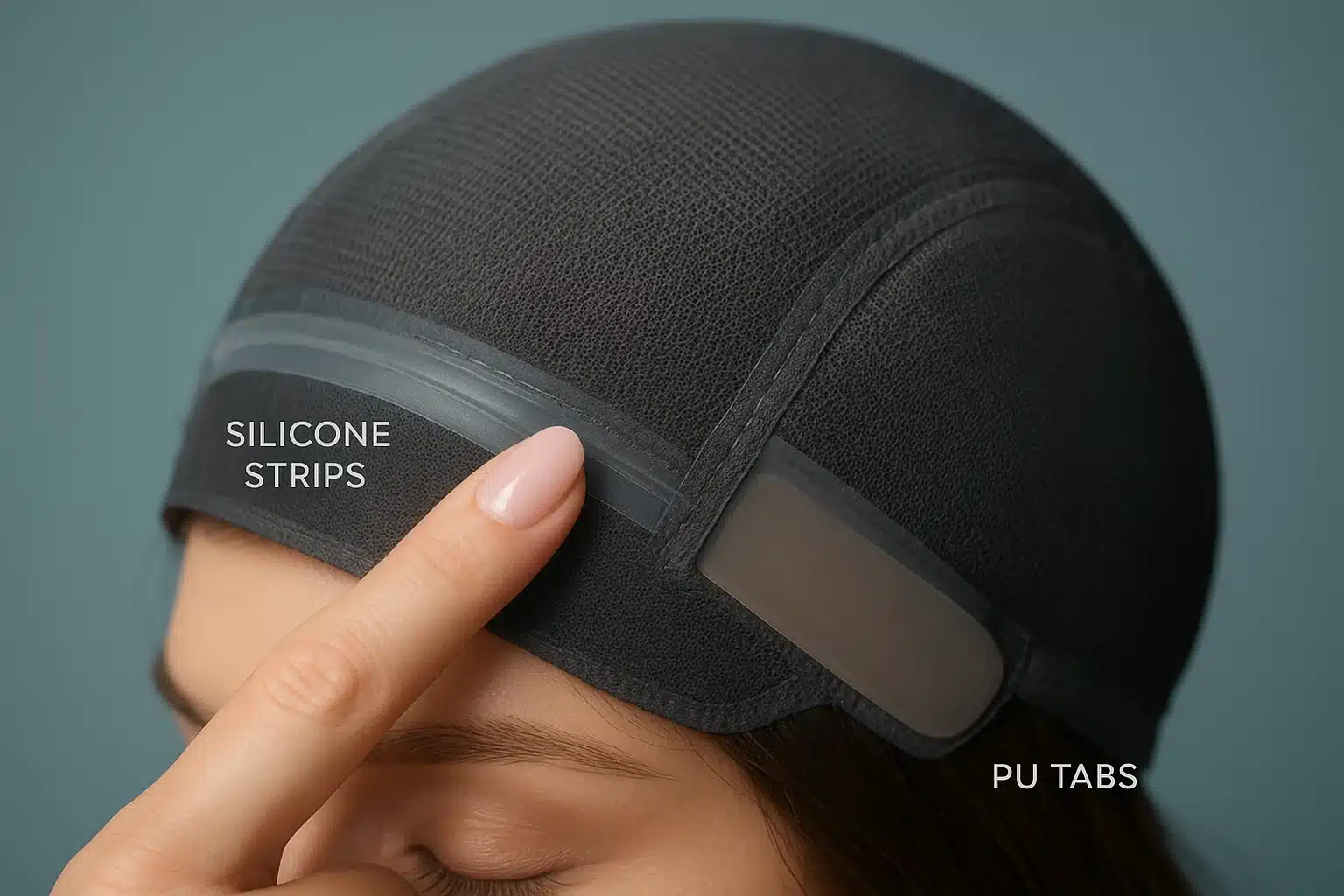
Think of silicone as thousands of microscopic suction cups. When medical-grade silicone is pressed against clean, bare skin, it creates a subtle vacuum seal. It relies entirely on friction and suction to stay in place.
Silicone strips are the heroes of the “glueless” wig movement. Because they require no tape or adhesive, they are incredibly gentle on sensitive skin, making them a premier choice for individuals with total hair loss due to alopecia or chemotherapy. You simply slip the wig on, and the body heat helps the silicone gently grip the scalp.
Polyurethane (PU) Tabs: The Ultimate Anchor
If silicone is a suction cup, polyurethane is a sticker base. Polyurethane (often referred to simply as “poly”) is a smooth, non-porous, skin-like material typically sewn into the front hairline, ear tabs, or nape of the wig cap.
PU doesn’t grip the skin on its own. Instead, it provides an impenetrable, smooth surface specifically designed to hold double-sided wig tape or liquid adhesives safely. If you were to apply tape directly to delicate Swiss lace, removing it would likely tear the lace and pull out the hand-tied hairs. PU tabs act as a protective barrier, allowing you to use strong adhesives for a rock-solid hold without destroying your investment.
The “Sweat & Oil” Paradox and Hair Regrowth
Understanding how these materials work in theory is great, but how do they hold up in the real world? This is where many generic guides fall short, leaving wearers confused when their “foolproof” security methods suddenly fail.
The Sebum Sabotage
Many wearers are frustrated when their silicone-lined wig starts to slide halfway through a hot day. This is due to the “Sweat and Oil Paradox.” Remember that silicone relies on friction. Sebum (your scalp’s natural oil) and sweat act as organic lubricants. The moment a layer of oil builds up between your skin and the silicone strip, the suction is broken, and the wig will slip.
The Hair Regrowth Conflict
Another major point of failure occurs during hair regrowth. Beginners often purchase a silicone-lined cap during treatment because it feels amazing on a bare scalp. However, as hair begins to grow back (even just a quarter inch of stubble), the hair physically lifts the silicone away from the skin, breaking the vacuum seal.
If you are transitioning from total hair loss to patchy or full regrowth, silicone will lose its effectiveness. This is the exact moment when you should transition to a cap with PU tabs, using tape to anchor the wig securely over a wig cap or natural hair.
The Lifestyle Compatibility Matrix: Choosing Your Material
Your physiology and your daily routine should dictate your cap construction. Here is a practical guide to matching materials to your life:
- The Daily Office Professional (Low Sweat, High Convenience): If you spend your days in a climate-controlled environment and want the ease of taking your wig off every night, Silicone Strips are your best match. They offer quick, glueless application and zero sticky cleanup.
- The Active Athlete (High Sweat, High Movement): If you are hiking, working out, or living in a humid climate, silicone will betray you. You need PU Tabs paired with waterproof wig tape. The adhesive will bond with your skin, while the PU protects the wig, keeping everything securely in place regardless of perspiration.
- The Sensitive Scalp (Medical Needs): If your scalp is highly reactive or you are undergoing medical treatments, look strictly for Medical-Grade Silicone. Unlike industrial silicones, medical-grade materials meet strict biocompatibility standards, ensuring they won’t cause contact dermatitis or allergic reactions.
The Troubleshooting Toolkit: Maintenance for Longevity
Advanced materials require specific, yet simple, care routines to maintain their functionality.
Rejuvenating Silicone TackinessOver time, silicone strips will naturally pick up skin cells, oils, and makeup, causing them to feel slick and lose their grip. To restore their original “tackiness,” gently wipe the silicone strips with a cotton pad soaked in 99% isopropyl alcohol or a specialized wig cleanser. This strips away the microscopic oily barrier, returning the silicone to its optimal grippy state.
Protecting Polyurethane from DegradationWhile PU is tough, aggressive scrubbing can cause it to crack or peel over time. When removing tape or glue from PU tabs, always use a dedicated citrus-based adhesive solvent. Let the solvent sit for a few minutes to break down the chemical bond, allowing you to gently wipe the residue away without stretching or tearing the poly material.
Frequently Asked Questions (FAQ)
Can I sew PU tabs or silicone strips into an old wig?
Yes! Many wearers successfully upgrade their older wigs by sewing in aftermarket PU tabs or silicone strips. Just ensure you use a fine needle and clear nylon thread, and only attach them to the sturdy structural seams of the cap, never to delicate lace.
Does silicone cause excessive sweating?
Because silicone is non-porous, it does not breathe. If your wig has massive, solid silicone patches, it can trap heat. However, modern, high-quality wigs use narrow, strategically placed strips (usually at the crown, ear tabs, and nape) to provide maximum security while allowing the rest of the wefted cap to breathe perfectly.
What is the “Four Finger Rule” for tape placement?
Historically, wearers used the “four finger rule” (placing the hairline four fingers above the eyebrows) to position their wigs. Today, modern PU ear tabs serve as a much better physical guide. By aligning the PU ear tabs securely in front of your natural sideburns, the front hairline will naturally fall into its most anatomically correct and secure position.
Continuing Your Journey
Navigating the world of alternative hair can feel like learning a new language, but understanding the basic science behind your wig’s construction puts you entirely in control. You are no longer at the mercy of unpredictable slippage. By choosing silicone strips for gentle, glueless friction, or PU tabs for a rock-solid adhesive anchor, you can step out into the world with absolute confidence.
Your hair should adapt to your lifestyle—not the other way around. As you explore the various cap constructions available today, keep your daily routines, your scalp condition, and your comfort at the forefront of your decision. Armed with this knowledge, you’re ready to find a piece that doesn’t just look beautiful, but feels like it was engineered exactly for you.