If you’ve ever marveled at the incredibly realistic, flowing beard of a professional Macy’s Thanksgiving Day Parade Santa, or wondered how Hollywood makeup artists brought Chewbacca to life, you might be surprised by the secret behind the hair. It isn’t human hair, and it isn’t a plastic synthetic fiber. It’s a centuries-old secret of theatrical artisans: specialty animal hair.
While everyday commercial markets are dominated by beautiful human hair and high-tech synthetics, there is a fascinating, high-end niche in wig-making that relies entirely on nature’s other offerings. Understanding these unique materials is a vital chapter in the evolution of wig craftsmanship and materials, taking us beyond standard fibers into the realm of pure, specialized artistry. Let’s pull back the curtain on the unsung heroes of the custom wig world: yak, alpaca, and mohair.
The Great Fiber Identity Crisis: Yak vs. Yaki
Before diving into the workshop, we need to clear up one of the most common—and confusing—misconceptions in the wig world: the difference between “Yak” and “Yaki.”
To a beginner, these terms sound identical, but structurally, they couldn’t be more different.
- Yak refers to the actual animal (the long-haired bovine native to the Himalayas). It is a natural, heavily structured protein fiber.
- Yaki, on the other hand, is a texture. It refers to human or synthetic hair that has been chemically or heat-processed to mimic the look and feel of mechanically relaxed textured hair.
Understanding this difference is your first step toward true wig-making fluency. You can’t sheer a Yaki, but a genuine Yak provides one of the most durable, structurally sound fibers on the planet.
The Trinity of Specialty Fibers
When master wig makers sit down to create a character piece, they consult what is informally known as the “Fiber Selection Matrix.” They choose the animal based on the specific aesthetic, structural, and historical needs of the wig.
Yak Hair: The Structural Workhorse
Yak hair is the undisputed king of theatrical structure and high-end Santa costuming. Because its protein structure is remarkably thick, its cuticle holds a style much longer than human hair. Furthermore, yak hair boasts an incredible thermal insulation capacity—it is up to 30% warmer than wool. This makes it an absolute lifesaver for outdoor performers in freezing climates.
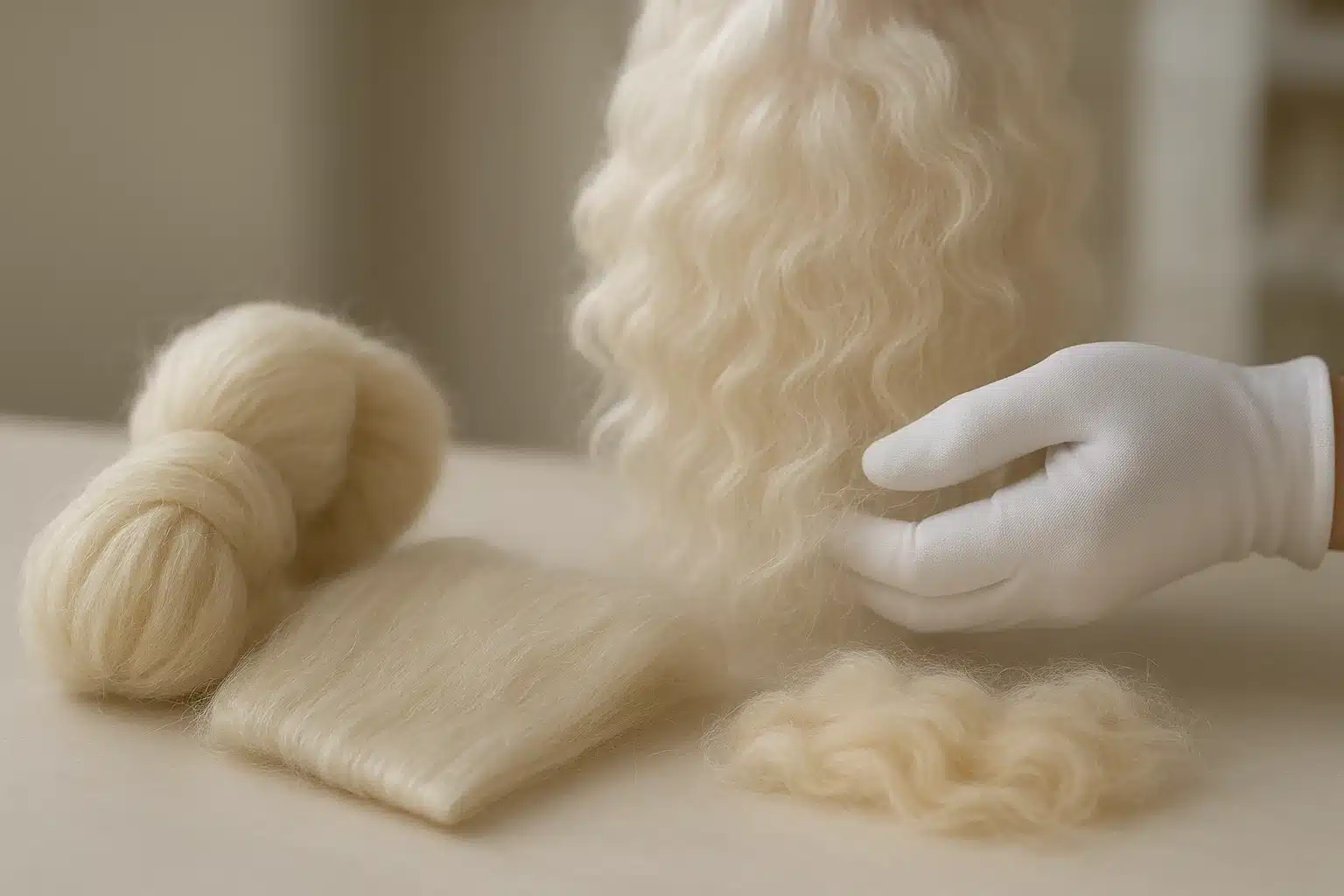
Artisans love yak “down” (the softer undercoat, typically measuring a fine 15-19 microns) because it provides realistic texture while maintaining enough rigidity to build grand, historical silhouettes, perfect for authentic period drama hair.
Mohair: The “Diamond Fiber”
Sourced from the Angora goat, mohair is widely celebrated in the textile and wig industries as the “Diamond Fiber.” It earns this title for two reasons: its dazzling natural luster and its astonishing elasticity. Mohair can stretch up to 30% of its length without breaking.
In custom wig making, mohair is frequently blended with human hair to add volume and a beautiful, natural sheen that catches stage lights perfectly. It is also the gold standard for high-end art dolls, as its fine texture beautifully mimics human hair on a smaller scale.
Alpaca: The Ethereal Silk
If yak is the sturdy workhorse and mohair is the diamond, alpaca (specifically from the Suri alpaca) is the ethereal silk. Alpaca fiber lacks the microscopic scales found on sheep’s wool, making it incredibly smooth and soft to the touch.
Wig makers turn to alpaca when they need fine-gauge realism. Because it mimics the whisper-soft texture of human baby hair, it is heavily utilized in highly detailed, close-up work around lace hairlines to create a seamless, imperceptible transition from skin to wig.
Inside the Master’s Workshop: Artistry and Ethics
Working with specialty animal fibers requires a completely different skill set than handling pre-wefted human hair. Artisans often purchase these materials in “loose bulk.” To create a flawless theatrical piece, they use specialized ventilation tools to knot individual hairs into sheer lace, carefully camouflaging the lace edges by varying the density and direction of the fiber.
The Importance of Ethical Sourcing
As consumers become more conscious of how their products are made, ethical sourcing in wig making has taken center stage. Reputable artisans and theatrical suppliers strictly draw the line between cruelty-free shorn or combed fibers (gathered during the animal’s natural shedding or shearing seasons) versus “skin wigs” (where the hair is still attached to the animal’s hide).
Combed and shorn fibers not only align with compassionate care values, but they also result in a cleaner, more workable material for the artist.
The “Pinch & Burn” Test
How do professionals know they are working with genuine animal fiber and not a clever synthetic mimic? They use the “Pinch & Burn” test. When a tiny pinch of real animal hair is exposed to a flame, it turns to a crumbly ash and smells strongly of burnt hair (due to the burning protein). Synthetics, which are essentially plastics, will melt, bead up, and smell like burning chemicals.
Why Artisans Choose Animal Fibers Over Human Hair
You might wonder: if human hair is considered the premium standard for everyday wigs, why do professionals go through the trouble of sourcing yak or alpaca? It comes down to the required extreme durability and the sheer architectural demands of theatrical styling.
Historically, crafting towering styles—like the famous pouf (the iconic marie antoinette hairstyle name we all recognize)—required robust internal structures just to hold the weight of the hair and decorations. Today, when sourcing materials for top-tier custom wigs new york ny theater productions demand, makers turn to yak and mohair because they can withstand heavy backcombing, intense stage lighting, and continuous restyling without disintegrating.
However, there is a vital distinction to make. While these sturdy fibers are incredible for building theatrical shapes, their coarse nature makes them unsuited for everyday wear against the bare skin. For individuals experiencing hair loss who are seeking comfortable wigs for sensitive scalp needs, premium human hair and advanced, ultra-soft synthetics remain the absolute best and most compassionate choice.
Frequently Asked Questions (FAQ)
Is mohair better than human hair?
It depends entirely on the application. Mohair is exceptionally lustrous and elastic, making it perfect for blending in theatrical wigs, doll making, and creating specific visual textures. However, for everyday wear, human hair is superior in softness, longevity, and natural movement.
How do you dye yak hair without it turning yellow?
Yak hair is highly susceptible to yellowing from UV exposure and improper chemical processing. Professional wig makers use specialized, gentle acid dyes and meticulously control processing times to achieve pure whites (for Santa beards) or rich colors without damaging the cuticle.
Are animal hair wigs cruelty-free?
They can and should be. Ethical wig makers exclusively source fibers that are shorn or naturally combed from the animals, similar to how sheep are sheared for wool. Always look for suppliers who emphasize cruelty-free sourcing rather than utilizing animal hides.
Can you heat style specialty animal fibers?
Yes. Because yak, mohair, and alpaca are natural protein fibers, they can be styled with heat tools, hot rollers, and steam, much like human hair. However, because they lack the natural oils produced by a human scalp, they require careful conditioning to prevent them from becoming brittle.
Continuing Your Journey
The artistry behind specialty animal hair wigs is a testament to the incredible skill, history, and imagination present in the wig-making industry. While your daily style might not require the architectural strength of Himalayan yak hair, understanding the vast world of wig materials helps you appreciate the profound craftsmanship poured into every single piece—from the Broadway stage to the comfortable, beautiful wig you wear every day.
Whether you are fascinated by the history of wig-making, looking for the perfect everyday style, or seeking guidance on caring for your current piece, exploring the rich, diverse world of hair craftsmanship is a journey of endless discovery.