Imagine walking into a crowded room where your hair isn’t just a style—it’s a towering, three-foot-tall billboard broadcasting your political views, your recent triumphs, and your undeniable societal status. This was the breathtaking reality for noblewomen in late 18th-century France. The legendary “Pouf,” popularized by the infamous Queen Marie Antoinette, wasn’t just a bold fashion statement. It was a marvel of structural engineering that completely pushed the boundaries of what human hair could do.
But how did hair go from a simple adornment to an architectural marvel? To truly appreciate this mile-high scandal, it helps to look at the broader timeline of wigs in European nobility and fashion, stretching from Baroque extravagance to Victorian nuance. While early monarchs like Queen Elizabeth I and Louis XIV relied on heavy, full perukes to project absolute authority, the aristocratic women of the 1770s pivoted to something entirely different: a brilliant, intricate hybrid of their natural hair, internal wire scaffolding, and elaborate supplemental hairpieces that would forever cement their place in history.
Grab a cup of coffee, and let’s pull back the curtain on the physics, chemistry, and pure spectacle of the most famous hairpieces in history.
The Mile-High Scandal: More Than Just a Hairstyle
Before we look at the nuts and bolts of how these styles were built, we have to understand why they existed. In the 1770s, Marie Antoinette partnered with Léonard Autié—arguably the world’s first celebrity hairstylist—to create a look that would capture the imagination of the French court.
Autié realized that height equaled hierarchy. The taller the hair, the closer to the heavens, and the further away from the commoners. However, as these styles grew to absurd heights—sometimes rising up to 36 inches above the scalp—they became a lightning rod for criticism. To the starving public of pre-revolutionary France, the time, expensive materials, and sheer excess of the pouf became the ultimate symbol of a monarchy deeply out of touch with reality.
The Anatomy of a Pouf: A 4-Layer Structural Breakdown
The biggest misconception about Marie Antoinette’s hair is that she simply bought a massive wig and placed it on her head. In reality, the pouf was a “hybrid” construction. Modern hairpiece wearers know exactly what this means: seamlessly blending your natural hair with supplemental pieces to create volume and length.
Here is the exact structural engineering Léonard Autié used to build the pouf:
1. The Wire Armature (The Scaffold)
You can’t build a skyscraper without a steel frame, and you couldn’t build a pouf without wire. Stylists crafted a lightweight, flexible wire frame shaped somewhat like a cone or a cage. This cage was strategically balanced over the center of the head to ensure the wearer’s center of gravity wasn’t entirely thrown off—though women still had to learn to walk with a distinct, gliding posture to avoid toppling over.
2. The Toque (The Cushion)
Over the wire cage, stylists placed the “toque,” a firm cushion usually made of tightly packed wool, horsehair, or linen. This served two purposes: it hid the metal wires, and it gave the hairpins a dense, secure material to anchor into.
3. The Hybrid Hair (The Build)
This is where the artistry happened. The noblewoman’s natural hair was pulled up and smoothed over the toque. But natural hair was rarely thick or long enough to cover a three-foot cushion. To bridge the gap, the stylist wove in massive wefts of false hair. While human hair was the gold standard (and the most expensive), stylists frequently utilized yak hair and horsehair to provide the necessary stiffness and bulk.
4. The Narrative Ornaments (The Story)
Once the base was built, the hair became a canvas. Feathers, jewels, and ribbons were standard, but true aristocrats went much further. You could “read” a woman’s pouf like the morning newspaper, as they featured miniature landscapes, glass birds, and even tiny mechanical gadgets.
The Chemistry of the Pouf: Pomatum and Powder
Gravity is a relentless enemy, and mere hairpins weren’t enough to hold this massive structure together. The secret weapon was pomatum.
If you look at the root of the word pomatum, you’ll find the Latin word pomum, meaning apple. Early recipes for this styling pomade literally called for mashing over-ripe apples into animal fats like lard or beef tallow, heavily scented with cloves and lavender to mask the smell. This thick, waxy paste acted as an incredible industrial glue.
Once the hair was glued into place, it was time for the powder. A persistent historical myth claims that French nobles dusted their hair with baking flour while the peasants starved. While this makes for great dramatic irony, it’s largely false. High-quality 18th-century hair powder was actually made from finely milled wheat starch or potato starch. The starch clung perfectly to the greasy pomatum, turning the hair completely matte and brilliant white, pink, or even pale blue.
Wearing the News: The “Pouf à la…” Series
The true genius of the pouf was its use as a communication tool. A noblewoman could express her political allegiances without ever saying a word. Two of the most famous examples include:
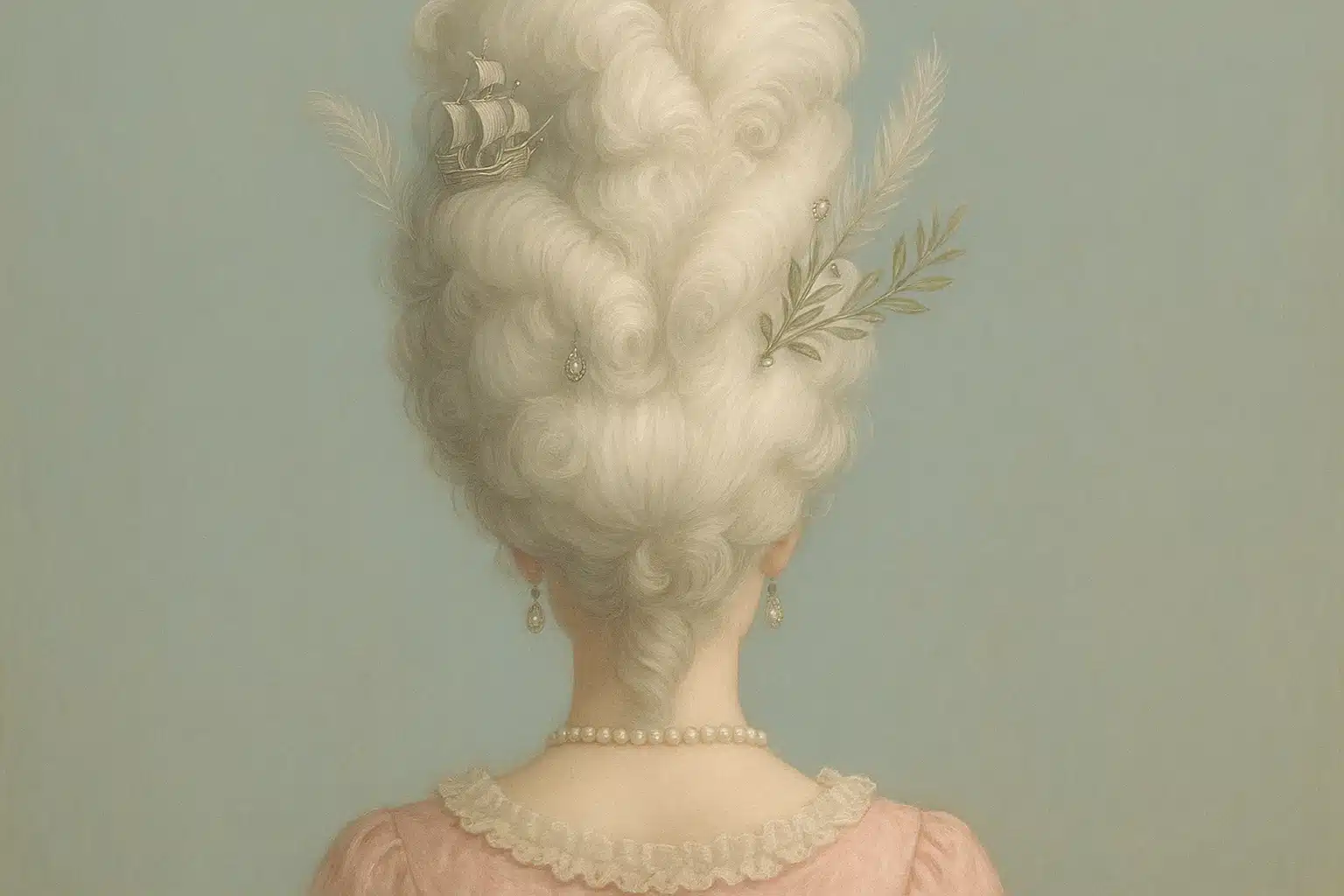
- Le Pouf à la Belle Poule: In 1778, the French frigate La Belle Poule won a famous naval skirmish. To celebrate, Marie Antoinette commissioned a pouf featuring a meticulously crafted replica of the ship—complete with masts, rigging, and tiny cannons—sailing on a sea of her own undulating, powdered hair.
- Le Pouf à l’Inoculation: When King Louis XVI bravely decided to be inoculated against smallpox (a highly controversial and dangerous medical procedure at the time), Marie Antoinette showed her public support by wearing a pouf adorned with an olive tree (symbolizing peace) and a serpent (symbolizing medicine).
Sleeping with Architecture: The Hygiene Reality
If it took a stylist four hours to build a pouf, you certainly didn’t take it down at the end of the night. Women routinely wore these styles for weeks at a time. This brings us to the logistics of 18th-century sleep and hygiene.
To sleep without crushing their architectural masterpieces, women used “neck blocks”—wooden or porcelain cradles that supported the neck while keeping the head suspended in the air.
And what about the infamous rumors of mice and rats making nests in the wigs? This is an exaggeration born from a linguistic misunderstanding! To get the natural hair to cover the toque, stylists aggressively backcombed the hair until it was a tangled, voluminous mesh. In the hair industry, this technique is called “ratting.” Over time, the phrase “ratting the hair” was misinterpreted by the public, giving birth to the myth of actual rodents living in Marie Antoinette’s pouf.
Finding Your Own Perfect Fit
Today, our approach to hairpieces has evolved beautifully. We no longer need heavy wire cages, animal fats, or neck blocks to achieve incredible volume and style. The modern wig and hairpiece industry is built on the exact opposite principles of the 18th-century pouf: breathability, lightweight construction, and supreme, compassionate comfort.
Whether you are exploring hairpieces to conceal hair loss, or simply looking to add a touch of everyday glamour, the journey of finding the right hair solution should feel empowering, not exhausting. At Wig Superstore, our nearly two decades of industry expertise are dedicated to ensuring you find high-quality, perfectly fitted pieces that help you feel beautiful, confident, and entirely yourself.
Frequently Asked Questions
Was Marie Antoinette’s hair actually a wig?
No! While early kings wore traditional full-cap wigs (perukes), the styles worn by Marie Antoinette were “hybrid” styles. They consisted of her natural hair pulled over a structural pad, heavily supplemented with added wefts of human, horse, or yak hair.
Did rats really live in 18th-century wigs?
This is a popular myth! The rumor likely started due to the teasing technique stylists used to create volume, known as “ratting.” While hygiene in the 18th century was certainly different than today, noblewomen did not have actual rodents living in their hair.
How heavy was a traditional pouf?
Because they utilized wire, wooden models, heavily greased pomatum, and pounds of powdered starch, a fully decorated pouf could easily add 2 to 4 pounds to the top of a woman’s head, requiring them to completely alter how they walked and balanced.
What was 18th-century hair powder made of?
Despite the myth that nobles used baking flour during a famine, high-quality hair powder was actually made from finely milled wheat starch or potato starch, often scented with lavender, orange blossom, or cloves to keep the hair smelling fresh for weeks.
***
Ready to explore how far hairpiece technology has come since the days of the towering pouf? Browse our extensive collection of lightweight, high-quality synthetic and human hair wigs designed for absolute comfort and natural beauty.