Choosing a wig is rarely just about aesthetics; it is a significant investment in your confidence and identity. If you are currently evaluating your options, you have likely noticed a staggering range in price and terminology. You might be asking why one piece commands a premium while another, seemingly identical option, costs a fraction of the price. The answer lies not just in the strands you see, but in the microscopic engineering and centuries of artisanal evolution that happen underneath.
The wig market is rapidly shifting. While human hair currently dominates with approximately 73% of the market share due to its unmistakable authenticity, advanced synthetic fibers are the fastest-growing segment, projected to grow at a rate of 14.5% through 2030 according to recent data from Mordor Intelligence and Insight Partners. This isn’t a coincidence—it is the result of massive leaps in material science.
To make the right decision for your lifestyle, you need to understand the mechanics of what you are buying. Let’s look beneath the surface at the materials, construction methods, and technical artistry that define today’s best hair solutions.
The Material Science: Authenticity vs. Innovation
The first major fork in your decision road is the fiber itself. Historically, this was a binary choice: human hair looked real but required work; synthetic hair looked artificial but was easy to wear. Today, that line has blurred significantly.
The Gold Standard: Human Hair
For those seeking the absolute pinnacle of realism, human hair remains unrivaled. It behaves exactly like biological hair because it is biological hair. It reacts to humidity, has weight and texture, and offers the most natural movement.
However, not all human hair is created equal. The term “Remy” refers to hair where the cuticle layer (the outer protective scale of the hair shaft) is kept intact and aligned in one direction. This prevents tangling and maintains a soft sheen. Non-Remy hair, often stripped of its cuticles in acid baths to smooth it out, will matte and lose its luster much faster.
If you are looking for the best human hair wigs, you are investing in longevity and styling versatility. You can heat style, color, and treat these wigs just as you would your own growing hair. This segment of the market is predicted to grow significantly as consumers prioritize authenticity over cost.
The Rise of High-Tech Synthetics
Early synthetic wigs were notorious for their “plastic” shine and stiff movement. Modern polymer technology has revolutionized this. Manufacturers have developed heat-friendly fibers that can withstand styling tools up to 350°F, bridging the gap between convenience and versatility.
One of the most fascinating innovations is “style memory.” Unlike human hair, which droops in rain or humidity, high-grade synthetic fibers are “baked” into a specific style during manufacturing. You can wash them, dry them, and they will snap back to their original curl pattern or straightness without effort.
For those torn between the two, the industry has introduced blends. But what does human hair blend mean exactly? It is a hybrid construction that combines the natural movement and lack of shine of human hair with the style retention and vibrant color availability of synthetic fibers. It offers a middle ground for wearers who want durability without the high maintenance of 100% human hair.
The Engineering of the Cap: Where Comfort Meets Illusion
While the hair draws the eye, the cap determines the experience. Innovations in medical wigs specifically emphasize lightweight, breathable materials to improve wearer comfort, a critical factor noted by Persistence Market Research. The construction method is often the primary driver of cost.
Traditional Wefted vs. Hand-Tied Precision
Standard wigs are often machine-wefted, meaning curtains of hair are sewn onto strips of material. This creates volume and is cost-effective, but it limits styling flexibility and can feel heavier.
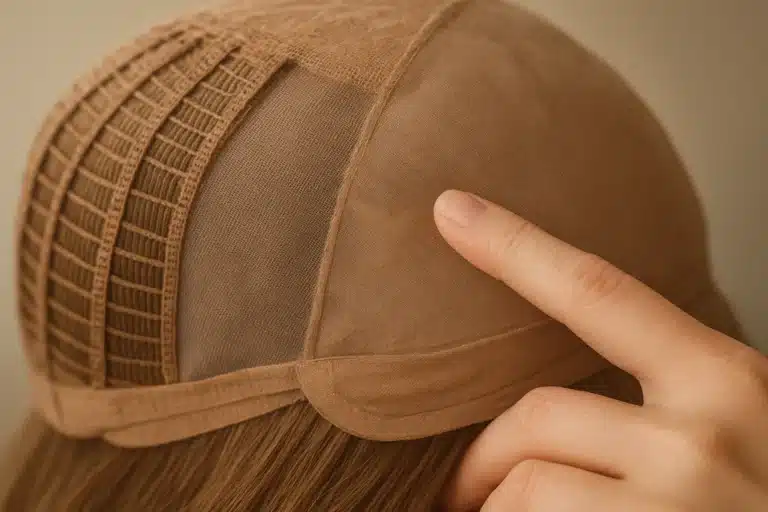
The premium alternative is the hand-tied method. In this labor-intensive process, artisans knot individual strands of hair directly into the mesh cap material. This technique mimics the natural density of a human scalp. When you run your fingers through hand tied wigs, the hair moves independently, allowing for multi-directional parting and a lighter, cooler feel against the scalp.
The Monofilament Revolution
Monofilament tops have changed the game for natural appearances. This involves a sheer mesh fabric (usually nylon or polyester blend) at the crown or part line. Because the fabric is semi-transparent, it takes on the color of your own scalp when placed against your skin. This creates the illusion that the hair is growing directly out of your head, a crucial feature for those experiencing total hair loss.
Lace Front Technology
Originally a secret of theater and cinema, lace fronts utilize a delicate, nearly invisible lace material along the hairline. Each hair is hand-tied into this lace. The result is a hairline that disappears against the skin, allowing the wearer to pull the hair back off the face—a styling option that was historically impossible with standard wig construction.
Sustainability and Ethical Sourcing
As the market expands toward a projected $15.2 billion by 2034, scrutiny regarding sourcing has increased. Authentic human hair is a finite resource. Ethical brands are now transparent about their supply chains, ensuring that hair donors are compensated fairly.
Simultaneously, the synthetic market is addressing environmental concerns. While traditional synthetics are petroleum-based, research is underway to develop biodegradable fibers that offer the same aesthetic benefits without the long-term environmental footprint. When evaluating best wig brands, look for companies that prioritize transparency in their material sourcing.
Future Trends: AI and Customization
The future of wig craftsmanship is digital. We are seeing the early stages of AI-driven customization, where 3D scanning technology maps the exact contours of a client’s head to create a bespoke cap fit. This eliminates pressure points and slippage, addressing one of the biggest pain points for daily wearers.
Furthermore, material innovation continues to accelerate. New cooling technologies are being integrated into caps to regulate body temperature, making wigs more comfortable for wearers undergoing medical treatments that induce heat sensitivity.
How to Choose: A Decision Framework
With this technical context, how do you decide?
- Assess Your Routine: Do you have 20 minutes every morning to style your hair? If yes, luxury human hair wigs offer the most rewarding experience. If you need “shake-and-go” convenience, high-end synthetics are your ally.
- Evaluate Your Sensitivity: If you have a sensitive scalp due to chemotherapy or alopecia, the hand-tied construction is not just a luxury; it is a comfort necessity.
- Longevity Expectations: Human hair wigs can last over a year with proper care; synthetic wigs typically have a lifespan of 4-6 months with daily wear.
Frequently Asked Questions
Why is there such a price difference between hand-tied and machine-wefted wigs?
The price difference reflects labor hours. A fully hand-tied wig can take a skilled artisan up to 40 hours to construct, as every single hair strand is knotted by hand. Machine-wefted wigs can be produced much faster in mass quantities.
Can high-heat synthetic fibers really be styled like human hair?
Yes, but with caveats. You must use tools specifically designed for synthetic hair or keep standard tools below 350°F (176°C). Unlike human hair, you generally cannot dye synthetic fibers, so the color you buy is the color you keep.
Is a human hair wig always better than a synthetic one?
Not necessarily. “Better” depends on your needs. For a humid climate or a low-maintenance lifestyle, a high-quality synthetic wig may actually perform better than human hair, which would frizz and lose its style in damp weather.
How do I know if a wig is ethically sourced?
Reputable manufacturers provide information about their sourcing. Look for established brands that have long-standing relationships with their suppliers. Avoid unverified sellers who cannot explain the origin of their human hair products.
The Verdict
The evolution of wig craftsmanship has moved us from simple hair coverings to sophisticated prosthetic devices that restore confidence. Whether you choose the biological authenticity of human hair or the technological marvel of modern synthetics, you are benefiting from decades of innovation.
At Wig Superstore, we believe the best wig is the one that makes you forget you are wearing it. By understanding the craftsmanship behind the product, you can make a choice that fits not just your look, but your life.