If you’ve recently invested in a beautiful wig to navigate hair loss or simply to change up your style, you already know that finding the perfect piece is an emotional and rewarding milestone. But if you live in the Pacific Northwest, you’ll quickly discover that our constant mist and unique humidity levels introduce an entirely new set of questions. Will the drizzle ruin the style of a synthetic wig? How do you keep a delicate lace front securely in place when the air is thick with moisture?
While you might have already consulted a comprehensive guide to finding the best wig shops in Seattle to purchase your hairpiece, the journey doesn’t end at the register. Understanding the “Maintenance Bridge”—the specific tools, adhesives, and stands required to preserve your investment—is what truly turns a good wig day into a permanent boost of confidence. Proper wig maintenance is a skill that evolves, and sourcing the right tools locally means you never have to wait for shipping when you need a solution today.
Let’s explore how to professionally maintain your hair using the specialized accessory boutiques right here in Seattle.
The Invisible Support: Navigating Adhesives in a Humid Climate
The most common fear among new wig wearers is the dreaded slip. When you factor in Seattle’s humid climate, choosing the right adhesive becomes a science. When you step into a local boutique’s accessory section, you’ll typically be faced with two main categories: liquid glues and double-sided tapes.
Liquid Adhesives (Glues)
Not all glues are created equal, especially when battling Puget Sound’s moisture. Water-based adhesives are fantastic for daily wear and are generally gentler on the skin. However, for extended wear during our wetter months, solvent-based adhesives often provide a more secure hold.
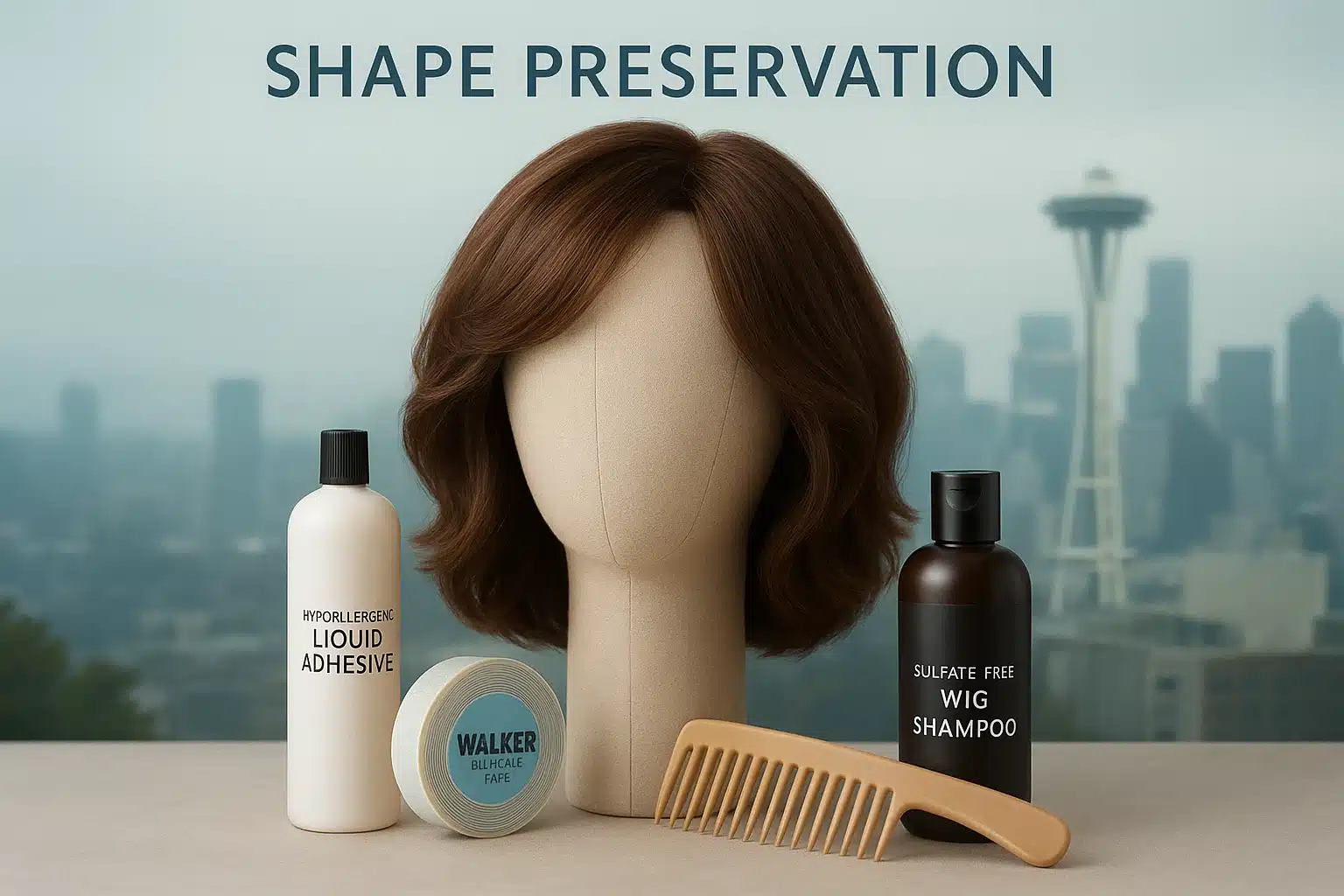
If you have sensitive skin or are experiencing medical hair loss, local shops are invaluable because they allow you to read ingredient labels in person. Finding a high-quality hypoallergenic hair glue locally means you can perform a quick patch test on your arm before applying it near your delicate hairline.
Pro Tip: The Four-Finger Rule. When applying adhesive, always measure four fingers up from your brow bone. This is your natural hairline. Applying adhesive any lower can restrict natural facial movement and damage your wig’s lace.
Wig Tapes
For those who find liquid glues messy, wig tapes (like the popular Walker Blue Lace Tape) offer a fantastic alternative. Tape provides a strong, clean hold that resists the misty Seattle mornings beautifully. Tapes are often sold in rolls or convenient pre-cut contours that match the natural curve of a lace front.
Shape Preservation: The Spectrum of Wig Stands
How you store your wig when you aren’t wearing it is just as important as how you wear it. Many beginners naturally gravitate toward the inexpensive styrofoam heads found at basic beauty supply stores. However, this is a common beginner mistake. Over time, foam heads—which are often slightly larger than an average human head—can permanently stretch out the delicate cap of your wig.
When you explore dedicated wig accessory boutiques, you’ll discover much better wig storage ideas tailored to your specific needs:
- Canvas Block Heads: These mimic the exact shape and circumference of a human head. They are perfect for styling, pinning, and long-term storage without altering the cap size.
- Collapsible Travel Stands: If you live in a compact Seattle apartment, collapsible plastic or wire stands are space-saving miracles. More importantly, their open-air design allows maximum airflow, ensuring the inside of your wig cap dries completely after walking through the rain or giving your wig a wash.
The Seattle Boutique Directory: Where to Find the “Accessory Wall”
While Seattle has many salons, a few stand out for their exceptional “Accessory Walls.” These locations understand that providing the right tools is part of compassionate customer care.
William Collier Design
Known for its deep institutional authority and focus on medical hair loss, William Collier Design offers an incredibly private, tactile experience. Here, you can feel the difference between a silicone wig grip and a velvet one. Their accessory selection is heavily curated toward skin-safe, oncology-friendly adhesives and care products.
Master Hair Care
Located just south in Federal Way, Master Hair Care is the benchmark for sheer inventory volume. If you need a specialized wide-tooth comb, a travel stand, or a specific brand of tape on a Tuesday afternoon, their massive floor space makes them an incredibly reliable resource for quick walk-ins.
Fred Hutch “Shine” Store
For those navigating cancer treatments, the Shine store is a beautiful local resource tailored specifically to oncology care. They stock specialized, ultra-gentle shampoos and soft sleep caps designed for sensitive scalps.
Pro Tip: Next time you schedule a professional wig fitting at a local boutique, take the opportunity to ask your stylist about the specific accessories they recommend for your lifestyle and hairpiece. Many shops also cater to alternative hair enhancements, meaning you can often find specialized removers and gentle brushes meant for pieces like human hair curly tape in extensions that work wonderfully for wig maintenance too.
Troubleshooting Common Beginner Mistakes
Even with the best tools, a little education goes a long way. Here are a few common pitfalls to avoid:
- Using a standard hairbrush: Traditional brushes will catch and tear the delicate hand-tied knots on a lace front wig. A wide-tooth comb or a specialized loop brush is absolutely non-negotiable.
- Washing too frequently: Unlike natural growing hair, wigs do not receive natural scalp oils. Washing them too often strips them of their built-in moisture. Most wigs only need to be washed every 8 to 10 wears.
- Using drugstore shampoo on human hair: Our local Puget Sound water is generally soft, but combining it with harsh, sulfate-heavy drugstore shampoos will quickly dry out a premium human hair wig. Exploring the best wig care products—specifically formulated sulfate-free shampoos and leave-in conditioners—is critical for protecting your investment.
Frequently Asked Questions (FAQ)
Will the Seattle rain ruin my synthetic wig?
No, the rain won’t permanently ruin it! However, because synthetic fibers have a “style memory” baked in through heat, cold rain might cause a temporary loss of volume. Simply let the wig air-dry on an open travel stand, and it will bounce right back to its original shape.
Ghostbond vs. Walker Tape—which is better for Seattle humidity?
Both are excellent, but they serve different preferences. Ghostbond (specifically the XL or Endure lines) is a liquid adhesive formulated to handle moisture and sweat brilliantly. Walker Tape provides an incredibly strong, low-mess hold that is highly water-resistant. Many Seattleites actually use a combination: tape at the nape of the neck and a gentle glue at the front hairline.
Can I use my regular hairspray on my wig?
It is highly recommended to avoid standard hairsprays, especially on synthetic wigs. Regular hairsprays contain alcohols that can degrade synthetic fibers and leave a sticky, white residue that is very difficult to wash out. Always opt for a wig-specific setting spray.
Your Next Steps to Wig Confidence
Stepping into the world of wigs and hairpieces is a journey of self-discovery. By equipping yourself with the right tools—from the perfect canvas block head to a climate-defying adhesive—you take total control over your look, regardless of what the Seattle weather has planned.
With nearly two decades of experience in the hair replacement industry, we believe that education is the foundation of compassionate customer care. Your hair loss journey or stylistic evolution deserves the highest quality support. Take the time to visit local Seattle boutiques, touch the accessories, ask questions, and build a maintenance kit that makes you feel beautiful, secure, and entirely confident.