Imagine taking a brand-new wig out of its box for the very first time. You gently shake it out, place it on your head, and turn to look in the mirror. When you move your head, does the hair gracefully swing and settle back into place, or does it move stiffly, like a single, solid helmet?
If you are navigating the world of hair loss, you already know that the fear of “wiggy” or stiff hair is one of the biggest hurdles to feeling confident. For nearly two decades, we’ve guided individuals through this exact transition, and we understand that finding hair that moves naturally is paramount to feeling like yourself again.
Enter Noriko—a brand that has quietly dominated the mid-range synthetic wig market. But they haven’t done it by chasing the absolute thinnest, finest hair fiber possible. Instead, they’ve mastered the actual physics of synthetic hair.
Today, we are taking a deep dive into the science of Noriko’s signature fibers, decoding their Natural Movement (NM) technology, and explaining why understanding wig construction can completely transform your wearing experience.
The Fiber Lab: Decoding Noriko’s “NM” Technology
When beginners shop for a wig, they often assume that “softer and finer” automatically equals “better and more realistic.” But in the world of synthetic hair chemistry, ultra-fine fibers often lead to a frustrating problem: severe tangling, static, and flat, lifeless hair.
Noriko takes a different approach through their “NM” (Natural Movement) technology.
The Secret of “Denier” and Polymer Blends
To understand NM technology, we have to talk about denier—the industry term for the thickness of an individual hair fiber.
Rather than using an ultra-low denier (which feels silky but clumps together) or a very high denier (which feels coarse and heavy), Noriko utilizes a highly specific mid-weight polymer blend. But the real magic is that an NM wig isn’t made of just one type of fiber. It is a precise blend of varying thicknesses woven together.
Why Noriko Hair “Swings”
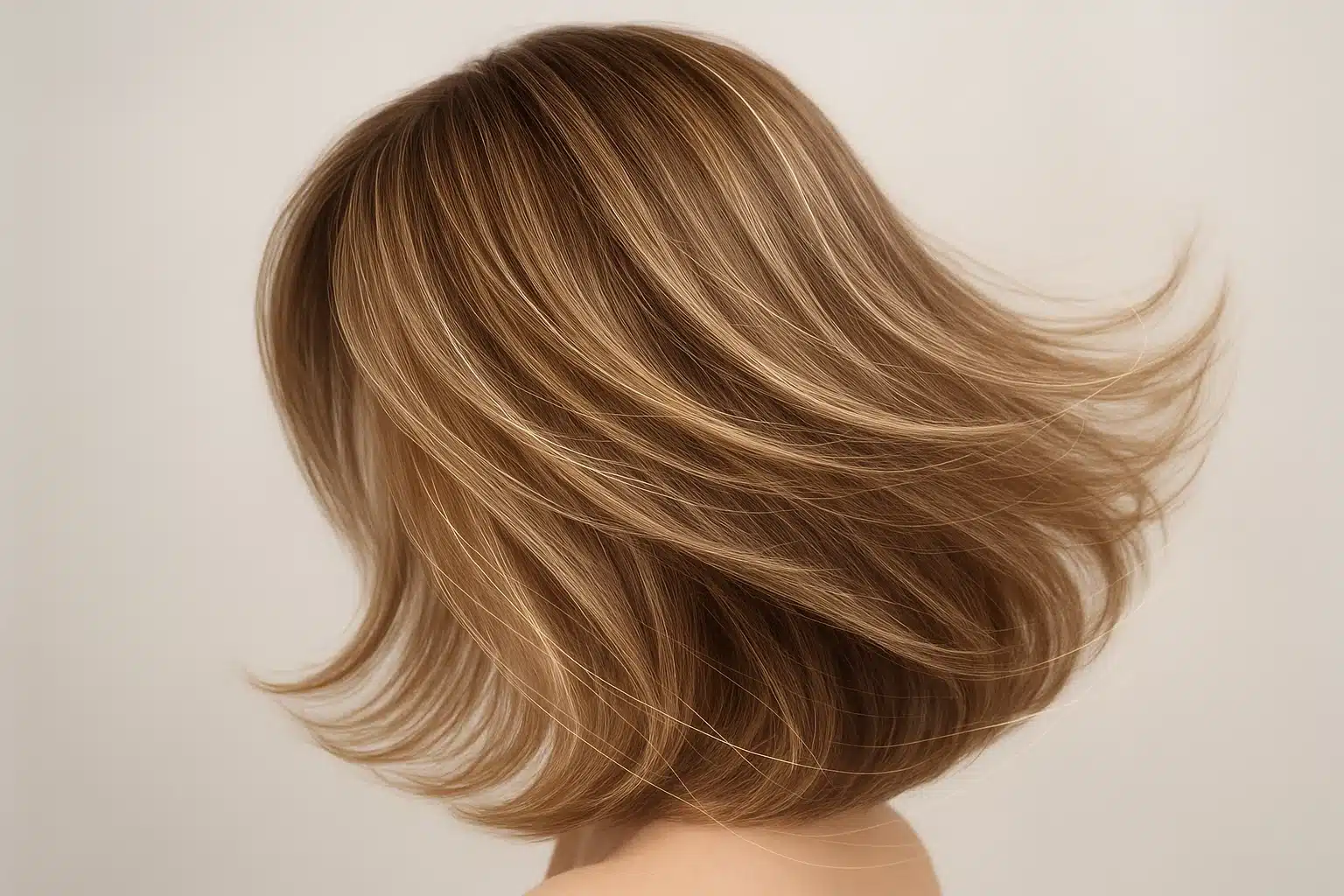
This varied blend creates microscopic spaces between the fibers, drastically reducing static and friction. Because the slightly coarser fibers act as a scaffold for the finer fibers, the hair resists “clumping.” This is exactly why a long Noriko style will sway beautifully when you walk and effortlessly detangle with a simple shake of your head, while other budget synthetics often stiffen and mat against your back.
The Root Secret: Demystifying Permatease
If you’ve spent any time reading wig reviews or browsing forums, you’ve likely encountered a highly polarizing word: Permatease.
Many first-time wearers receive their wig, part the hair, and panic when they see short, fuzzy, crimped-looking fibers at the root. It’s the number one source of beginner confusion, often mistaken for a manufacturing defect or unwanted frizz.
Let’s clear the air: Permatease is a brilliant feature, not a bug.
Volume vs. Realism
In standard, machine-made wig caps, hair is sewn into rows called “wefts.” If the hair were perfectly sleek all the way down to the base, the hair would naturally fall flat against your head, and those fabric wefts would become visible to the world (“weft-peeking”).
Permatease is a specialized, crimped fiber intentionally built into the root structure. It acts like microscopic teasing that never falls flat, providing two crucial benefits:
- The Ultimate Coverage: It completely obscures the cap construction beneath, ensuring no one ever sees the foundation of the wig.
- Weather-Proof Lift: Unlike human hair that loses its volume the second humidity hits, permatease provides structural, architectural lift that lasts all day, every day.
Once you understand that those textured roots are the secret to flawless volume and cap concealment, that “fuzzy” look transforms into a highly appreciated functional feature.
Case Studies in Movement: How Different Styles “Swing”
Because of Noriko’s unique fiber memory, the movement of the hair is deliberately engineered to match the length and cut of the style. Let’s look at how this plays out in real life.
The Long Swing: Managing Density
Take a legendary long style like the Angelica or the Robin. If these styles were made with ultra-fine, uniform fibers, they would quickly turn into a static-filled blanket. By utilizing top-heavy weight distribution and tapering the denier toward the ends, Noriko ensures that the bottom of the hair moves freely, creating a natural “swing” that mimics a fresh salon blowout.
The Short Snap: Textural Memory
For shorter, precision cuts like the Lexy or the Millie, the fiber physics shift. These styles rely on “textural memory.” The fibers are baked with a permanent curve that understands exactly where it needs to sit. This is why a Noriko bob naturally hugs the curve of your jawline and snaps right back into a perfect curl under the chin, even after you’ve been caught in the wind.
The Evolution: From Basic Caps to PM Collections
As wig technology has advanced, so has Noriko. While their traditional machine-made caps are beloved for their incredible volume, they’ve introduced the PM (Partial Monofilament) Collection to offer the best of both worlds.
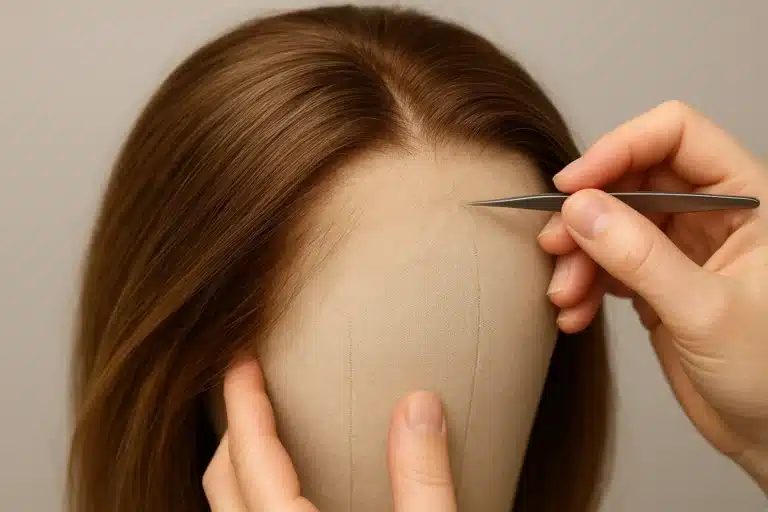
A Partial Monofilament cap incorporates a small, sheer, hand-tied section—usually at the parting area. This allows the hairs at the part to look as though they are growing directly out of your own scalp, providing hyper-realism right where the eye naturally looks, while still maintaining the unbeatable, permatease-supported volume throughout the sides and back.
The Noriko Color-to-Texture Matrix
Did you know that the color of a synthetic wig can actually impact how the texture feels and looks?
Noriko is famous for its multi-tonal technology, particularly in their “Melted” and rooted series (like the beloved Creamy Toffee-R). But this isn’t just about pretty colors. By blending multiple shades—some matte, some with higher “shimmer-levels”—the fiber physically breaks up light reflection. This mimics the natural cuticle of human hair, preventing that solid, artificial glare commonly seen in cheaper synthetics.
Furthermore, “rooted” shades (colors with a darker root mimicking regrowth) often have a slightly different structural lift at the base, utilizing the darker dye process to add just a hint more depth and volume at the crown.
Your Optimization Guide: Perfecting the Noriko Fiber
Even with all this brilliant engineering, a new wig can sometimes feel a bit intimidating right out of the box. Here are our expert tips for getting the most out of your Noriko fiber:
- Defeating the “Box Shine”: Wigs are shipped with a light, protective synthetic coating. If your wig looks overly shiny out of the box, don’t worry! This is temporary. Giving it 1-2 washes in cold water with synthetic-safe shampoo will strip this coating, revealing the beautiful, natural, matte texture beneath.
- The “Shake and Bake” Activation: Because of the fiber’s baked-in memory, the best way to style a Noriko wig is simply to hold it upside down and give it a vigorous shake. This wakes up the permatease, separates the NM fibers, and restores the natural swing.
- Taming the Root: If you find the permatease is giving you too much volume, simply warm your hands by rubbing them together, place your palms flat against the top of the wig, and gently press down for 30 seconds. The slight heat from your hands will temporarily compress the root lift.
Frequently Asked Questions for Beginners
Why does my new wig look so shiny?
That “box shine” is simply a protective conditioning spray applied at the factory to keep the fibers safe during shipping. It will naturally fade after your first couple of washes, leaving a realistic, healthy sheen.
What is this frizzy stuff at the roots?
That is permatease! It’s a crimped, textured fiber purposely built into the base of the wig to hide the cap underneath and provide lasting volume that won’t fall flat throughout the day.
How long does Noriko synthetic hair last compared to others?
Because Noriko uses a slightly higher denier (thicker fiber) in their NM blend, their wigs are highly resistant to friction wear. With proper care, a daily-wear Noriko wig often outlasts thinner-fibered synthetic competitors by several months.
Will the style wash out?
Never. Synthetic fiber memory is permanently baked into the polymer. Whether it’s a tight curl, a gentle wave, or a sleek straight bob, the style will return to its original shape the moment it air-dries after a wash.
Continuing Your Journey
Understanding the science behind your hairpiece is the first step toward wearing it with absolute confidence. When you know why the hair behaves the way it does, a wig stops being a mystery and becomes an empowering tool for self-expression.
If you’re beginning to explore hair loss solutions and want to learn more about finding your perfect fit, we encourage you to keep researching the differences between synthetic and human hair, explore how to measure your head for a flawless cap size, and discover which cap constructions best align with your lifestyle. Your perfect, natural-moving hair is out there waiting for you.