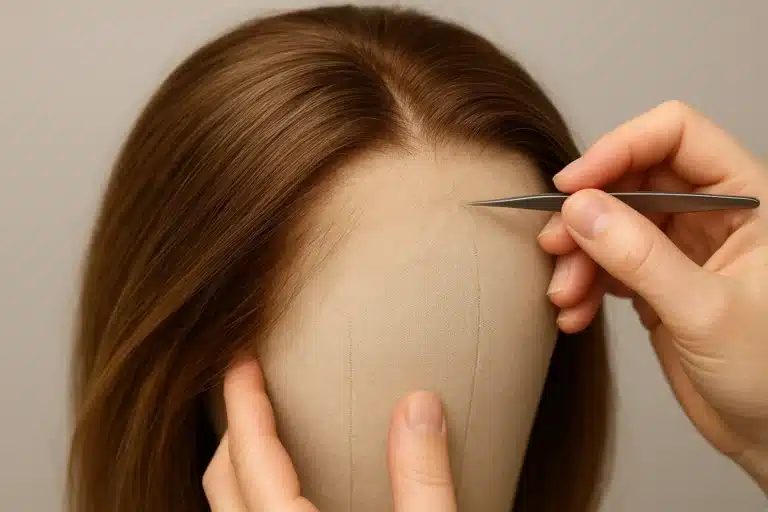
To an outside observer, the practice of a married Orthodox Jewish woman covering her natural hair with a highly realistic, flawlessly styled wig presents a fascinating puzzle. If the primary goal of covering one’s hair is modesty (tzniut), how does wearing an incredibly beautiful hairpiece satisfy that requirement? It’s a question that naturally arises when observing the careful craftsmanship and undeniable beauty of a high-quality wig.
This intriguing paradox sits at the intersection of ancient religious law, personal identity, and centuries of cultural evolution. It is also a vital piece of a much larger global narrative, as explored in Beyond Fashion: The Cultural & Spiritual Authority of Wigs Worldwide, which examines how hair alternatives transcend mere cosmetic utility to serve as profound expressions of devotion across different communities. By looking closer at the sheitel (the Yiddish word for wig), we can move past basic curiosity and discover a sophisticated, deeply meaningful tradition that balances spiritual dedication with modern life.
The Modesty Paradox: Why Wear a Beautiful Wig?
When encountering the concept of a sheitel for the first time, the most common question is: “Isn’t a wig a loophole? If it looks better than a woman’s natural hair, doesn’t it defeat the purpose of modesty?”
To understand the answer, we have to reframe how we think about modesty. In secular culture, modesty often equates to making oneself look plain or actively hiding one’s beauty. In Jewish law (halacha), however, tzniut is about creating a private, sacred boundary.
A sheitel acts as a halakhic barrier. It satisfies the requirement that a married woman’s natural hair remains a private joy shared only within the sanctuary of her marriage, while still allowing her to maintain a dignified, professional, and beautiful appearance in public. The goal was never to force women to look unattractive; rather, it is about reserving a specific part of her natural self for her marital relationship.
Foundations: The Biblical and Talmudic Roots
To fully grasp why Orthodox Jewish women cover their hair, we have to look at one of the most fascinating examples of rabbinic deduction—what we might call “The Sotah Paradox.”
The biblical origin for hair covering doesn’t actually come from a direct command saying “Thou shalt cover thy hair.” Instead, it is derived backwards from the Book of Numbers (Bamidbar 5:18). The text describes the sotah ritual, which involves a woman suspected of infidelity. During this ritual, the priest is instructed to “uncover the woman’s head.”
The great medieval commentator Rashi offers two profound interpretations of this moment:
- The Shaming Aspect: Uncovering her hair was a form of punishment (midah keneged midah—measure for measure), linking her hair to the allure that may have led to her suspected infidelity.
- The Factual Baseline: If the priest had to actively uncover her hair to shame her, it establishes the indisputable fact that married Jewish women naturally kept their hair covered in public.
From this deduction, the Talmud (Ketubot 72a) breaks the practice down into two distinct legal categories:
- Dat Moshe (Torah Law): The fundamental, unshakeable biblical requirement that a married woman must not appear with fully uncovered hair in public spaces.
- Dat Yehudit (Jewish Custom): The evolving, community-standardized rules of modesty that dictate how she covers it—whether with a scarf (tichel), a hat, a snood, or a wig.
The Great Rabbinic Debate: The Historical Evolution of the Sheitel
The transition from fabric head coverings to human hair wigs wasn’t seamless; it was the subject of intense theological debate that spanned centuries.
The 16th-Century Breakthrough
The first major authority to explicitly permit the use of wigs was the 16th-century scholar Rabbi Joshua Boaz, author of the Shiltei Giborim. He presented a groundbreaking halakhic argument: because a wig is completely detached from the wearer’s head, it no longer counts as “her hair.” Even if the wig is made from real human hair, it is legally considered a separate garment. This ruling was later codified by the Rema (Rabbi Moses Isserles), cementing the practice for Ashkenazi Jews (Jews of Eastern European descent).
The Opposition
Not everyone agreed. In the 17th century, the Be’er Sheva strongly opposed wigs based on the concept of marit ayin—the appearance of sin. He argued that if a wig looks too realistic, onlookers might mistakenly assume the woman is parading her natural hair and violating Torah law.
This cautious approach remained a cornerstone in many Sephardic communities (Jews of Spanish and Middle Eastern descent). Prominent modern Sephardic rabbis, such as the late Rabbi Ovadia Yosef, strictly prohibited wigs, strongly encouraging women to wear traditional scarves to avoid any confusion and uphold traditional modesty norms.
The 2004 Indian Hair Controversy
Perhaps the most dramatic moment in modern sheitel history occurred in May 2004, causing a massive upheaval in the Orthodox world.
It was discovered that a significant portion of the premium human hair used to make high-end wigs was sourced from the Tirumala Venkateswara Temple in India. There, millions of Hindu pilgrims undergo tonsure (shaving their heads) as an act of religious devotion. Under Jewish law, it is strictly forbidden to derive any benefit from items used in idolatrous worship (avodah zarah).
Because the temple auctioned this hair to fund its operations, prominent rabbis ruled that these wigs were halakhically contaminated. In an extraordinary display of religious commitment, Orthodox women in enclaves from Brooklyn to Jerusalem threw thousands of dollars worth of exquisite human-hair wigs into public bonfires.
This crisis permanently transformed the global wig industry. It led to the creation of the modern “Kosher Certified” wig—a multi-million dollar ecosystem where rabbinical inspectors track supply chains to ensure hair is ethically sourced from non-idolatrous origins, usually from Europe, South America, or parts of Asia.
The Anatomy, Craft, and Economics of the Modern Sheitel
Today’s sheitels are marvels of cosmetic engineering. Understanding how they are made helps demystify the practice and highlights the incredible craftsmanship involved.
Cap Construction: The Physics of Realism
To achieve a look that passes for natural hair, sheitel makers rely on two primary cap constructions:
- The Silk Top: This features a double-layered silk base. Individual hair strands are injected through the silk from underneath, which completely hides the knots. This creates a hyper-realistic “scalp effect,” making it appear as though the hair is growing straight out of the wearer’s head. While incredibly durable, silk tops tend to be heavier.
- The Lace Top: Made from a fine, breathable mesh, hair is hand-tied directly to the lace. Though the tiny knots are sometimes visible (they are often bleached to blend in), lace tops provide a flawlessly flat, seamless hairline. They are lightweight and ideal for warmer climates, though they require more delicate care.
- Falls and Band-Falls: These are partial wigs designed to be worn beneath hats, thick headbands, or blended seamlessly into the very front of a woman’s natural hair.
The Economics and the Sheitel Macher
Purchasing a premium sheitel is viewed as a significant lifetime investment. Custom pieces made from virgin European hair—prized for its fine texture and lack of chemical processing—can range anywhere from $2,000 to over $10,000.
This demand has birthed a vital micro-economy centered around the sheitel macher (wig maker/stylist). These highly skilled professionals are responsible for cutting, washing, setting, and repairing these investments. More than just stylists, sheitel machers form an essential support network within the Orthodox community, offering private, empathetic spaces for women navigating the deeply personal journey of hair covering.
Comprehensive Jewish Cultural Literacy & FAQ Hub
As you explore the cultural significance of the sheitel, you may encounter other unfamiliar terms and concepts. Here is a comprehensive guide to common top-of-the-funnel questions regarding Jewish culture, traditions, and identity.
What is a sheitel, and why do married Orthodox Jewish women wear them?
A sheitel (Yiddish: שייטל) is a high-quality wig worn by married Orthodox Jewish women. According to classical Jewish law, a woman’s hair holds a unique spiritual intimacy (erva) reserved exclusively for her husband. Covering the hair symbolizes her married status and honors the sacred boundaries of her relationship. Sheitels are highly favored, particularly in Ashkenazi communities, because they allow women to maintain a professional, standard appearance in the modern workforce while strictly adhering to biblical mandates.
What is the biblical and talmudic origin of covering one’s hair?
The rule originates from Numbers (Bamidbar) 5:18 during the sotah ritual, where the priest is commanded to “uncover the woman’s head.” The Talmud (Ketubot 72a) deduced that if her hair had to be uncovered to shame her, Jewish women must have ordinarily kept their heads covered. This formed two laws: Dat Moshe (the absolute biblical requirement to cover the hair) and Dat Yehudit (the community customs dictating how the hair is covered).
What is the difference between a silk top and a lace top sheitel?
The difference lies in how the wig cap is constructed:
- Silk Top: Hair is injected through a double-layered silk base from below, hiding the knots entirely. This creates an ultra-realistic “scalp” effect, though it is heavier.
- Lace Top: Hair is hand-tied to a fine, breathable lace mesh. This provides a very flat, seamless front hairline and is much cooler to wear, though it is more delicate.
What was the 2004 Indian hair sheitel controversy?
In 2004, rabbinical authorities banned wigs made from human hair sourced from Hindu temples in India, where pilgrims shaved their heads as a religious offering. Because Jewish law forbids deriving benefit from idolatrous worship (avodah zarah), these wigs were deemed halakhically impermissible, leading to mass public bonfires of expensive wigs. The crisis birthed the modern “Kosher Certified” wig industry to ensure pristine supply chains.
What is a “clatt” or “glatt” in Jewish terminology, and what is “The Traveling Clatt”?
Glatt (Yiddish for “smooth”) refers to a strict standard of kosher meat, specifically meaning the animal’s lungs were perfectly smooth and disease-free. Colloquially, it means “uncompromisingly kosher.” Conversely, “Clatt” is not a religious term. In modern digital spaces, searchers looking for “what is a clatt jewish” are usually looking for Tal Oran, a popular Israeli-Mizrahi travel vlogger known as “The Traveling Clatt.” He uses his platform to document travel, educate audiences on Middle Eastern Jewish history, and combat antisemitism.
What is a Jewish place of worship called, and what is a Jewish temple called?
A Jewish place of worship is universally called a synagogue (Greek for “assembly”) or a Beit Knesset (Hebrew for “House of Assembly”).
- Shul: (Yiddish for “school”) Predominantly used by Orthodox and Hasidic Jews, reflecting the belief that the building is a sanctuary for constant study.
- Temple: Used mainly by Reform and Conservative communities. Orthodox Jews avoid calling local synagogues “temples” out of reverence for the destroyed Holy Temple (Beit HaMikdash) in Jerusalem, believing there is only one true Temple.
What is a “schvitz” in Jewish culture?
A schvitz (Yiddish for “sweat”) refers to a steam bath or sauna. In the late 19th and early 20th centuries, Eastern European Jewish immigrants in crowded cities like New York built communal bathhouses. “Going to the schvitz” became a cherished social ritual for relaxation, community bonding, and escaping industrial labor. Today, the word playfully describes a sauna or a hot, humid day.
What is Jewish ancestry, and how is it defined?
Jewish ancestry traces genetic, cultural, and historical lineage back to the ancient Israelites of the Near East. Due to the diaspora, distinct subgroups formed based on geography:
- Ashkenazi: Central and Eastern European descent (historically Yiddish-speaking).
- Sephardic: Spanish and Portuguese descent (historically Ladino-speaking).
- Mizrahi: Middle Eastern and North African descent (historically Judeo-Arabic or Judeo-Persian-speaking).Halakhically, ancestry is matrilineal (passed down through the mother), though Reform and Reconstructionist movements also recognize patrilineal descent if the child is raised Jewish.
What is a “Cohen” or “Kohen” in the Jewish religion?
A Kohen (plural: Kohanim) is a male descendant of Aaron (Moses’s brother) from the priestly tribe of Levi. Historically, they performed sacred services in the Holy Temple. Today, their lineage is preserved through specific religious privileges, such as being called first to read the Torah, delivering the Priestly Blessing (Birkat Kohanim), and adhering to strict laws regarding marriage and ritual purity.
What is the meaning behind the phrase “Jewish eyes”?
In literature and culture, “Jewish eyes” is a poetic descriptor used to characterize eyes that are warm, dark, soulful, and expressive. Writers have historically used the phrase to convey a sense of deep wisdom, emotional depth, and a historical resilience reflecting the collective memory of survival and faith. It is a cultural and literary term, rather than a strict biological trait.
What is traditional Jewish flatbread called?
The most famous is Matzah (or matzo), an unleavened bread of flour and water baked in under 18 minutes to prevent rising. It is eaten during Passover (Pesach) to commemorate the Israelites’ hasty flight from Egypt. In Middle Eastern Jewish cuisine, Laffa (a thick Iraqi flatbread) and Pita are also dietary staples.
What was the Jewish year corresponding to 2022?
Because the Hebrew calendar is lunisolar and counts from the biblical creation of the world, it does not perfectly align with the Gregorian calendar. The secular year 2022 overlapped with the Hebrew years 5782 and 5783. The transition happened on the evening of September 25, 2022, marking the start of Rosh Hashanah (the Jewish New Year) and the year 5783.
What is an Orthodox Jewish drug rehab?
An Orthodox Jewish drug rehab is a clinical rehabilitation facility uniquely structured to accommodate the strict religious lifestyle of Orthodox patients while providing addiction therapy. These centers feature glatt kosher kitchens, pause clinical operations to observe Shabbat and high holidays, and provide specialized rabbinical counseling alongside licensed psychologists to help patients navigate recovery without compromising their faith.
At Wig Superstore, with nearly two decades of industry expertise, we understand that alternative hair is rarely just about style. Whether it is worn for religious devotion, medical necessity, or personal expression, a wig represents a deeply personal facet of identity. By understanding the intricate history and craftsmanship behind traditions like the sheitel, we can foster a world of greater empathy, respect, and compassionate care for everyone’s unique journey.