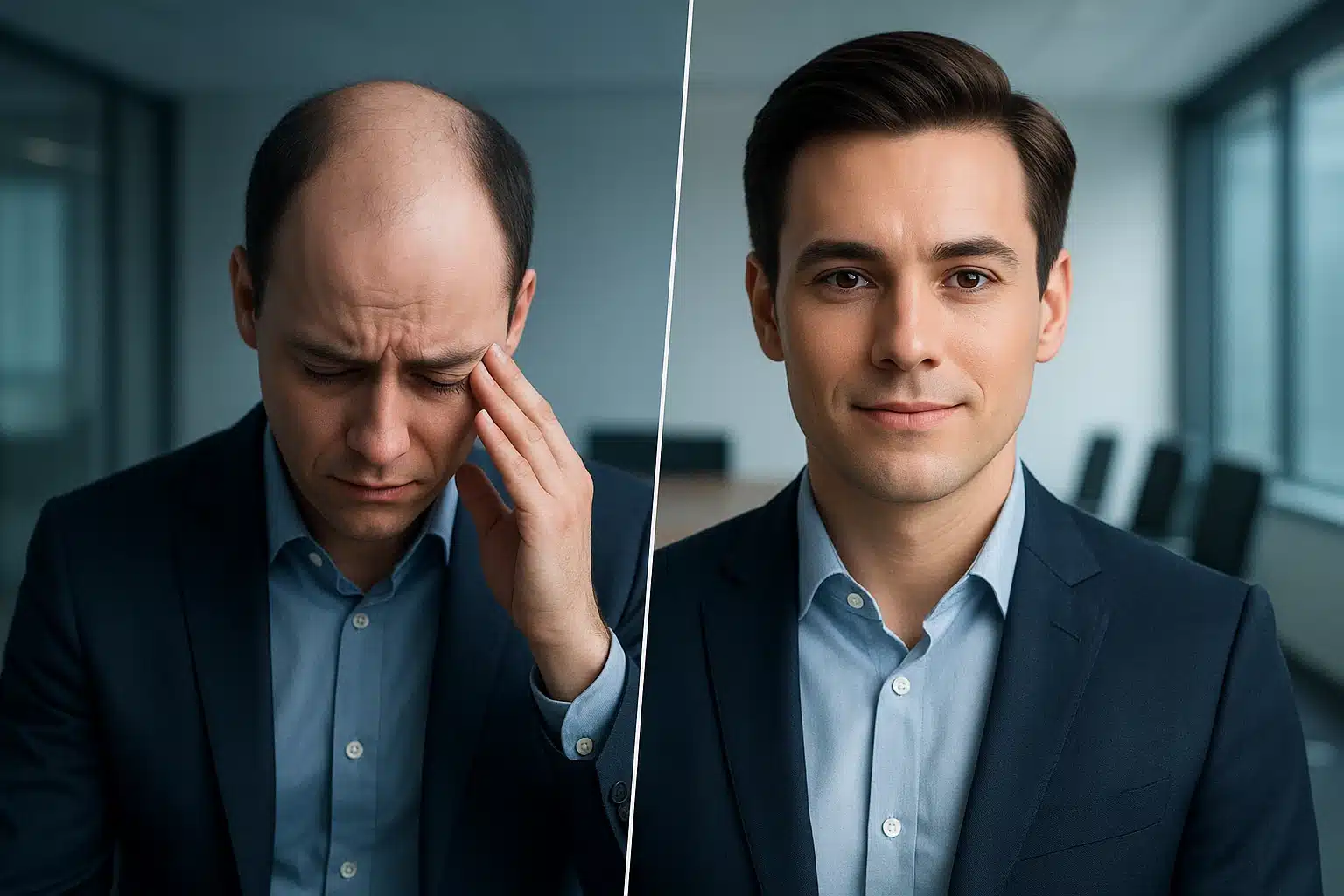
You’ve prepared for the presentation for weeks. Your data is flawless, your talking points are memorized, yet as you step under the harsh fluorescent lights of the boardroom, a familiar, sinking anxiety takes over. For many driven individuals, hair loss isn’t just a cosmetic concern—it’s a silent career disruptor that chips away at confidence right when you need it most.
If you find yourself strategically choosing where to sit to avoid overhead glare or leaving your webcam off during crucial check-ins, you aren’t alone. Navigating the emotional landscape of hair loss in a professional setting is a complex journey, deeply intertwined with how we view our identity, competence, and authority in the workplace. This guide bridges the gap between the clinical realities of hair thinning and the practical, everyday strategies you can use to reclaim your professional narrative.
The Hidden Workplace Cost of Thinning Hair
When you experience hair loss, the emotional toll can feel incredibly isolating. You might wonder, “Am I overreacting by letting this affect my work?” The answer is a resounding no. The psychological impact of hair loss in professional environments is a documented reality.
Clinical psychodermatology uses terms like psychosocial distress and somatic self-consciousness to describe this exact experience. According to a 2021 study by Hoffer et al., the gender disproportion is stark: 63% of women claim to experience career-related problems as a consequence of their hair loss. Meanwhile, research by Alfonso et al. (2005) found that 62% of men feel hair loss actively damages their self-esteem and professional confidence.
These numbers validate what you already know: the hesitation to speak up in a meeting, the avoidance of public speaking opportunities, and the reluctance to apply for promotions are genuine, measurable reactions to a profound identity shift.
The Psychology of Professional Confidence
Understanding the psychology behind your anxiety is the first step in moving from a state of worry to a state of empowerment.
Overcoming the “Spotlight Syndrome”
Cognitive Behavioral Therapy (CBT) identifies a common phenomenon called “spotlight syndrome”—the overwhelming belief that everyone in the room is focused entirely on the one physical trait you are most self-conscious about. In a professional setting, this means assuming your interviewer or client is staring at your thinning crown rather than listening to your pitch. Recognizing this cognitive distortion helps you gently remind yourself that your colleagues are primarily focused on your expertise, not your hair follicles.
Validating the “Attribution Bias”
While it is essential to manage internal anxiety, it’s also important to acknowledge reality. A 2016 study by Bater et al. demonstrated that hair density can influence external perceptions of approachability and success—a concept known as attribution bias.
This means your desire to find solutions isn’t vanity; it’s a strategic professional decision. Acknowledging this bias gives you permission to seek out tools and styles that make you feel secure, allowing you to walk into any room with your head held high.
The Professional Styling Playbook
When anxiety strikes, taking physical, tactical action is one of the best ways to regain control. Here are highly actionable ways to manage your environment and style.
The “Boardroom Lighting” Checklist
Modern workplace environments are uniquely triggering for those with thinning hair. Harsh overhead lights and high-definition webcams can exaggerate scalp visibility. Take control of your environment with a quick self-audit:
- Virtual Meetings: Elevate your webcam to eye level or slightly above. When the camera shoots from below, it naturally highlights the top of the scalp.
- Lighting Control: Avoid sitting directly beneath overhead lights. Instead, place a soft, diffused ring light or lamp in front of your face. This illuminates your features while throwing the top of your head into a softer, forgiving shadow.
- Matte Styling: High-shine styling products reflect light off the scalp, drawing attention to thinning areas. Switch to matte styling powders, dry shampoos, or hair fibers that absorb light and create the illusion of density.
Texture-Specific Solutions
Advice for managing hair loss often ignores the complexities of different hair textures. For instance, styling thinning curly hair at a job interview requires a specific approach. Instead of flattening your hair, leverage your natural texture. Use a diffuser on a low heat setting to maximize volume at the roots, allowing your curls to naturally drape over sparser areas.
If you are looking to integrate cosmetic solutions, you have options that range from subtle enhancements to full coverage. You might explore hair extensions for thin hair to add strategic volume precisely where you need it. Alternatively, many professionals find that wearing a wig to work is the ultimate way to eliminate morning styling anxiety, providing a secure, consistent look that lasts through the longest office shifts.
Speaking Your Truth: Disclosing Alopecia & Disarming Bias
One of the most powerful tools in your professional arsenal is communication. Often, the anxiety of “Will they notice?” is worse than the reality. Taking control of the narrative by speaking truth to hair loss can instantly disarm the “elephant in the room.”
You are never obligated to disclose medical information or discuss your hair loss, but if you choose to, having a behavioral script ready can be incredibly empowering.
- During a Job Interview: “Before we dive in, I want to briefly mention that I have alopecia, which causes my hair loss. It doesn’t impact my health or my ability to do this job, but I like to be upfront so we can focus entirely on how my skills align with your team’s goals.”
- With Human Resources (Regarding Dress Codes): “I am experiencing medical hair loss and will be incorporating hairpieces/head coverings into my professional attire. I wanted to touch base to ensure these align smoothly with our current uniform policies.”
The Professional’s Integration Matrix
Your path forward doesn’t have to rely on a single solution. The most successful professionals build a personalized toolkit that blends both immediate fixes and long-term care.
This might look like implementing medical prevention strategies prescribed by a dermatologist, while simultaneously exploring high-quality cosmetic alternatives for immediate peace of mind. Today’s premium synthetic and human hair pieces are virtually undetectable, lightweight, and incredibly secure. If you’re building out your corporate wardrobe, researching office-appropriate professional wigs recommendations can help you find pieces that look natural under harsh office lighting and remain comfortable during back-to-back meetings.
Frequently Asked Questions (FAQ)
Why does hair loss make me feel so uniquely self-conscious at work?
The workplace is an environment where we are constantly evaluated on our competence and presentation. Hair loss can trigger a sudden identity shift, making you feel as though your external appearance no longer matches your internal vitality and professional drive.
Should I disclose my alopecia to my interviewer?
It is entirely your choice. If trying to hide your hair loss is causing you intense anxiety that distracts you from answering interview questions, offering a brief, confident disclosure script can relieve the pressure. If you feel comfortable presenting as you are, or if you wear a high-quality wig, there is no professional obligation to disclose.
How do I handle high-contrast video calls if my scalp is visible?
Adjust your environment before adjusting yourself. Ensure your primary light source is in front of your face, not above your head. Position your camera at eye level, and consider using matte styling products or tinted dry shampoos to reduce scalp glare on camera.
Are there immediate cosmetic solutions that won’t slip during a presentation?
Absolutely. The technology behind modern wigs, toppers, and hairpieces has advanced tremendously. With features like lace fronts, monofilament tops, and secure clipping mechanisms, high-quality hairpieces are designed to withstand active, long days without shifting, allowing you to focus entirely on your presentation.
Taking the Next Step
Experiencing hair loss shouldn’t mean putting your career ambitions on hold. By understanding the psychology behind your anxiety, optimizing your professional environment, and giving yourself permission to explore high-quality cosmetic solutions, you can reclaim your confidence.
At Wig Superstore, with nearly two decades of experience in the industry, we understand that finding the right solution is a deeply personal journey. We are dedicated to providing compassionate care and the highest quality products to help you feel beautiful, capable, and ready to tackle whatever your career throws your way. When you’re ready to explore your options, start by browsing our educational resources to find the tools that best align with your professional lifestyle.