Picture this: You’ve just unboxed a stunning, perfectly silky human hair wig. It flows beautifully, catches the light just right, and feels like an absolute dream. But fast forward to the third or fourth time you wash it, and suddenly, that dream turns into a dry, matted nightmare. If you’ve ever experienced this “third wash trauma,” you aren’t alone. The culprit rarely has to do with how you washed it, but rather a closely guarded industry secret about how the hair was chemically processed before it ever reached your hands.
Understanding how a wig will behave over time is like putting together a puzzle. Half of the equation is structural—diving into the anatomy of a perfect wig mastering hairline density and texture to ensure a completely natural, undetectable scalp-to-strand transition. But the other half—the part that dictates whether your hair will stay silky for three weeks or three years—comes down to fiber physics. To make an informed, confident purchase, we need to pull back the curtain on hair processing and explore the real differences between Remy, Virgin, and Raw human hair.
The Biological Foundation: Anatomy of a Hair Strand
To understand why some wigs last years while others tangle in a month, we have to zoom in on a single strand of hair. Every strand is made of distinct layers that govern how it behaves:
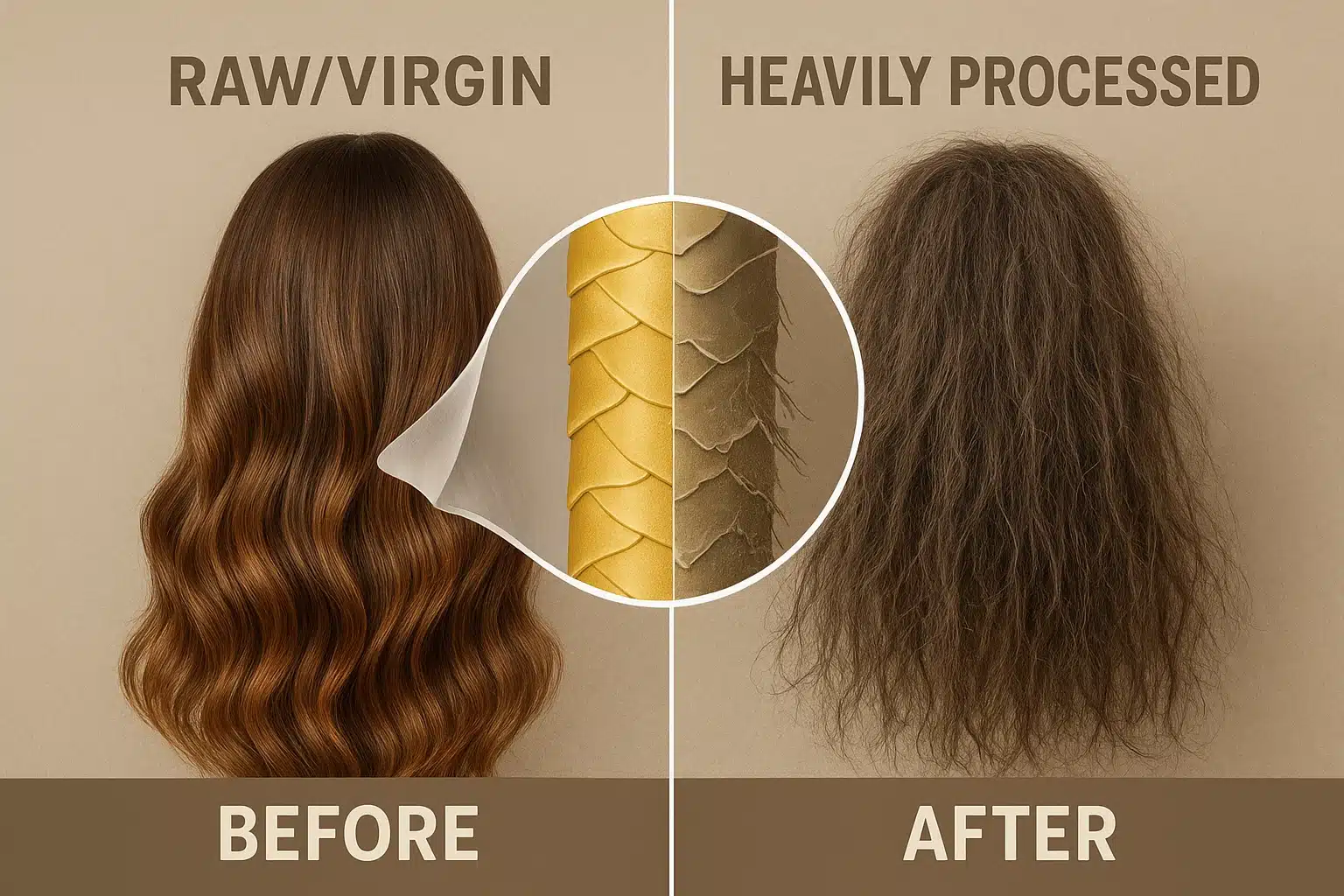
- The Cuticle: Think of this as the hair’s armor. It consists of microscopic, overlapping keratin shingles that point from the root down to the tip. When these shingles are intact and facing the same direction, hair strands glide smoothly past each other.
- The Cortex: The core of the hair fiber that houses melanin (color) and polypeptide chains. This inner structure is what gives hair its strength, elasticity, and wave pattern.
- The Medulla: The innermost hollow core, mostly found in thick or coarse hair.
The “Silicone Coat” Illusion
Here is where the commercial wig industry often cuts corners. To mass-produce cheap wigs, manufacturers collect fallen hair from salon floors, meaning the root-to-tip directions are completely mixed up. If left as is, the opposing cuticles would rub together like Velcro, causing instant, severe matting.
To fix this, the hair is soaked in a highly corrosive acid bath that essentially burns off the cuticle layer. Because this stripped hair is now extremely porous, dry, and brittle, it’s dipped in a heavy bath of cosmetic silicone. Out of the box, this heavy silicone mask makes the wig look impossibly shiny and smooth. But after three to five washes with regular shampoo, that silicone washes away. The raw, unprotected cortex is exposed to the elements, absorbing water unevenly and matting into an unmanageable mass.
Demystifying the Labels: Raw vs. Virgin vs. Remy
If you’ve spent any time shopping for a wig, you’ve likely seen terms thrown around interchangeably. Let’s strip away the marketing fluff and define what these labels actually mean for your wig’s lifespan.
Raw Hair: The Unfiltered Gold Standard
Raw hair is exactly what it sounds like: 100% unprocessed. It comes from a single donor, meaning every single strand has the exact same biological texture, thickness, and cuticle structure. It has never been chemically dyed, bleached, permed, or even steam-processed.
Because the cuticles are perfectly intact and the internal cortex bonds are pristine, Raw hair boasts unmatched elasticity and a lifespan of 2 to 5+ years. It reverts to its natural wave or curl pattern indefinitely after washing, and if you want to bleach it to platinum blonde, it lifts effortlessly and uniformly.
Virgin Hair: The Modern Reality
Historically, “Virgin” meant the same thing as “Raw.” However, in today’s luxury alternative hair market, the definition has shifted. Modern Virgin hair is chemically untouched (no dyes, bleaches, or acid baths), but it is physically altered using high-temperature steam.
If you purchase a Virgin wig with a flawless, uniform curl pattern, those curls were likely locked in by wrapping the hair around rods and baking it with steam. This steam temporarily alters the hydrogen bonds in the hair’s cortex. The cuticles are 100% intact, meaning it won’t matte, but over the course of 1 to 2 years, that steam-processed curl pattern will naturally relax by 15–30% and require restyling.
Remy Hair: Aligned but Altered
Remy simply means the cuticles are aligned—all pointing from root to tip, which drastically reduces friction and tangling. However, Remy hair has been chemically processed. It may have been gently bleached, dyed to achieve a specific color, or texturized.
Because of this chemical processing, the cuticles are intact but structurally weakened. Remy hair is an incredibly practical choice for daily wear because it comes pre-customized in gorgeous shades, but its lifespan is shorter—typically 6 to 12 months—and it requires more diligent moisture care.
The Fabricated “Grade” Scale (5A to 12A)
Have you ever seen a wig marketed as “Premium 12A Grade”? You can safely ignore it. There is no legitimate, standardized grading authority in the hair industry. The “A-scale” is a completely unregulated marketing gimmick invented by wholesale factories to make cheaper hair sound premium. Focus on the processing type (Raw, Virgin, Remy), cuticle alignment, and sourcing, rather than imaginary grades.
The Science of Texture Loss and Bleach Disasters
Understanding the chemistry of hair helps explain two of the most common frustrations in the wig world: lost curls and botched dye jobs.
When chemical perms are used on lower-quality hair, they break the strong disulfide bonds in the cortex, permanently changing the structure but severely weakening the strand. Steam processing (used on Virgin hair) is gentler, only disrupting temporary hydrogen bonds. This is why a steam-processed curly wig requires cold washes—hot water and heat styling will reset those hydrogen bonds, causing the curls to fall flat.
Furthermore, if you try to bleach a wig made from multi-donor hair (hair collected from dozens of different people), you are dealing with different baseline colors, porosities, and cuticle thicknesses. When the bleach hits, every strand reacts differently, resulting in a patchy, uneven, orange-toned mess. Single-donor Raw hair is the only reliable option for flawless, uniform color lifting.
DIY Diagnostics: How to Test Your Wig at Home
You don’t need a microscope to figure out what kind of hair you’ve purchased. You just need to know how to perform a few quick tests during your return window:
- The Cuticle Drag Friction Test: Pinch a single strand of hair between two fingers. Slide your fingers down from the root to the tip—it should feel perfectly smooth. Now, slide your fingers up from the tip toward the root. You should feel slight resistance or friction. If the hair feels equally slippery in both directions, the cuticles have been chemically stripped and coated in silicone.
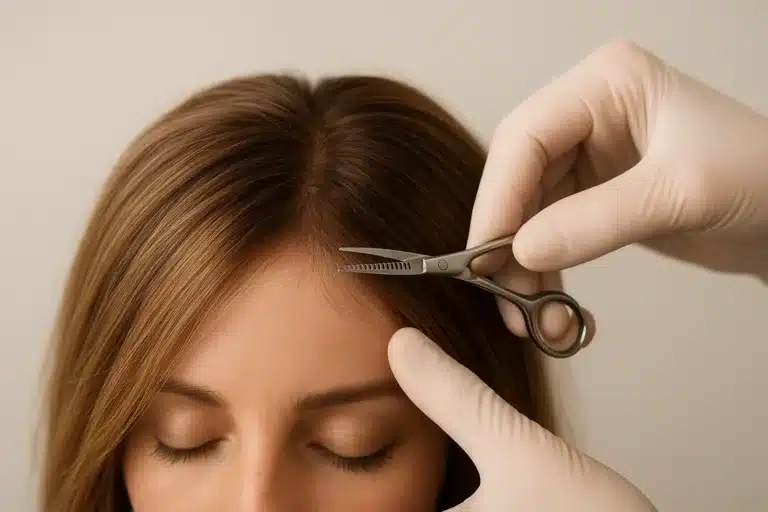
- The Clarifying Wash: To expose a hidden silicone coat, wash a small, hidden section of the wig at the nape of the neck with a clarifying shampoo (or even a drop of dish soap). If the hair instantly becomes dry, matted, and difficult to comb, it is low-tier, non-Remy hair.
- The Wet Tangle Diagnostic: Wet a section of the hair and gently rub it between your palms. High-quality Raw or Remy hair will glide smoothly. Acid-stripped hair will instantly clump together into a bird’s nest.
The Cost-Per-Wear Formula
It’s easy to experience sticker shock when looking at premium Raw or Virgin human hair wigs, but the math tells a different story. Let’s look at long-term utility through a simple formula:
(Purchase Price + Annual Maintenance) ÷ Expected Lifespan in Days = Cost Per Wear
Imagine you buy a $1,200 Raw Hair wig. With proper care, it lasts 3 years (1,095 days). That comes out to about $1.09 per wear. Conversely, if you buy a cheaper, chemically processed $400 Remy wig that mats and degrades every 9 months, you will have to buy four of them over that same 3-year period. You’ve spent $1,600, putting your cost at $1.46 per wear, along with the constant frustration of dealing with deteriorating hair. Investing in cuticle integrity pays for itself.
Tailored Care Protocols for Your Hair Type
Because every hair type is structurally different, there is no “one-size-fits-all” care routine.
- For Raw Hair: Because it lacks any artificial chemical coating, it absorbs moisture like a sponge. It thrives on deep, natural oils and moisture-rich conditioners to keep the pristine cortex hydrated.
- For Steam-Processed Virgin Hair: Temperature control is everything. Rely on strictly cold washes and minimal heat styling to prevent those delicate, temporary steam bonds from relaxing and losing their texture memory.
- For Processed Remy Hair: Because the cuticles are aligned but chemically weakened, you need to artificially supplement that outer layer. High-quality, silicone-based serums are actually your best friend here, as they provide a protective slip that extends the wig’s smooth lifespan.
Frequently Asked Questions (FAQ)
What is the real difference between Remy and Virgin hair?
Virgin hair has never been chemically altered (no dyes, bleaches, or acid washes), though it may be steam-styled. Remy hair simply means the cuticles are all facing the same direction, but the hair has been chemically processed to achieve a certain color or texture.
Why does my curly wig lose its curl pattern after washing?
If it is a steam-processed Virgin wig, the curl pattern was created by altering temporary hydrogen bonds. Exposing the hair to warm water, frequent washing, or heat styling slowly resets those bonds, causing the curls to relax.
Is Raw hair always the better choice?
Not necessarily. While Raw hair is the gold standard for longevity and custom coloring, it behaves exactly like natural human hair—meaning it reacts to humidity and requires styling. If you want a wig that comes in a highly specific pre-dyed color and is ready to wear immediately, a high-quality Remy wig might be more practical for your lifestyle.
How can I tell if my wig is actually 100% human hair?
The most definitive test is the Burn Test (done on a tiny, clipped strand). 100% human hair will turn to ash and smell like burning feathers. Synthetic fibers will melt into a hard, plastic bead and smell like burning chemicals.
***
Your journey with alternative hair is deeply personal, and navigating the vast world of wig terminology shouldn’t feel like a guessing game. By understanding the biological mechanics of how hair is sourced and processed, you can see past the marketing labels, advocate for your own needs, and confidently choose a wig that brings you enduring beauty and comfort.