If you were to rewind the clock just a decade or two, the term “synthetic wig” probably brought to mind something shiny, stiff, and distinctly artificial. But today, right alongside the booming tech innovations of Silicon Valley, alternative hair has undergone a quiet, revolutionary transformation. Modern synthetic fibers now feature a matte finish, natural movement, and a remarkable capability that has changed the industry forever: they are heat-friendly.
When navigating your options for alternative hair, finding a trustworthy local boutique is essential. While consulting our complete evaluation of the best wig stores in San Jose, CA is the ideal starting point to understand the local retail landscape, choosing the right fiber type requires a deeper understanding of styling science and localized availability. This guide will bridge the gap between complex polymer science and where to actually find these transformative hairpieces in your own backyard.
The Science Behind the Strands: Understanding Heat-Friendly Fibers
To truly understand how to care for modern alternative hair, you have to look at what it’s made of. Traditional synthetics and heat-friendly synthetics might look similar on a store shelf, but structurally, they are worlds apart.
Heat-resistant synthetic modacrylic fiber is essentially a specialized polymer cross-linked with flame-retardant additives. If you’ve ever researched kanekalon fibers, you’re already brushing up against this science. Traditional synthetic hair typically melts at around 180°F, meaning a blast of steam from a boiling pot of water or a gust of heat from an open oven can instantly ruin it.
Heat-friendly synthetics, however, are engineered to withstand temperatures up to 350°F. But here is the critical distinction: just because they can withstand 350°F doesn’t mean they should. The optimal styling temperature for these wigs is the “sweet spot” of 275°F to 300°F.
One of the greatest benefits of this fiber is its “Style Memory.” If you live in an area with shifting humidity, you know how quickly human hair falls flat. Modacrylic fibers don’t react to weather. Once a style is baked into the wig, it will hold that exact shape through three to four washes.
Step-by-Step Styling Masterclass: The “Cool-to-Set” Rule
Transitioning to heat friendly synthetic hair wigs comes with a learning curve. Understanding proper synthetic wig thermal styling guidelines is the difference between a wig that lasts two months and one that lasts a year.
Step 1: The Detangling Protocol
Friction is the enemy of synthetic hair. Always use a wide-tooth comb—never a bristle brush. Start from the very ends of the hair and gently work your way upward. Tugging from the root stretches the fiber, leading to permanent damage.
Step 2: Sectioning & Digital Calibration
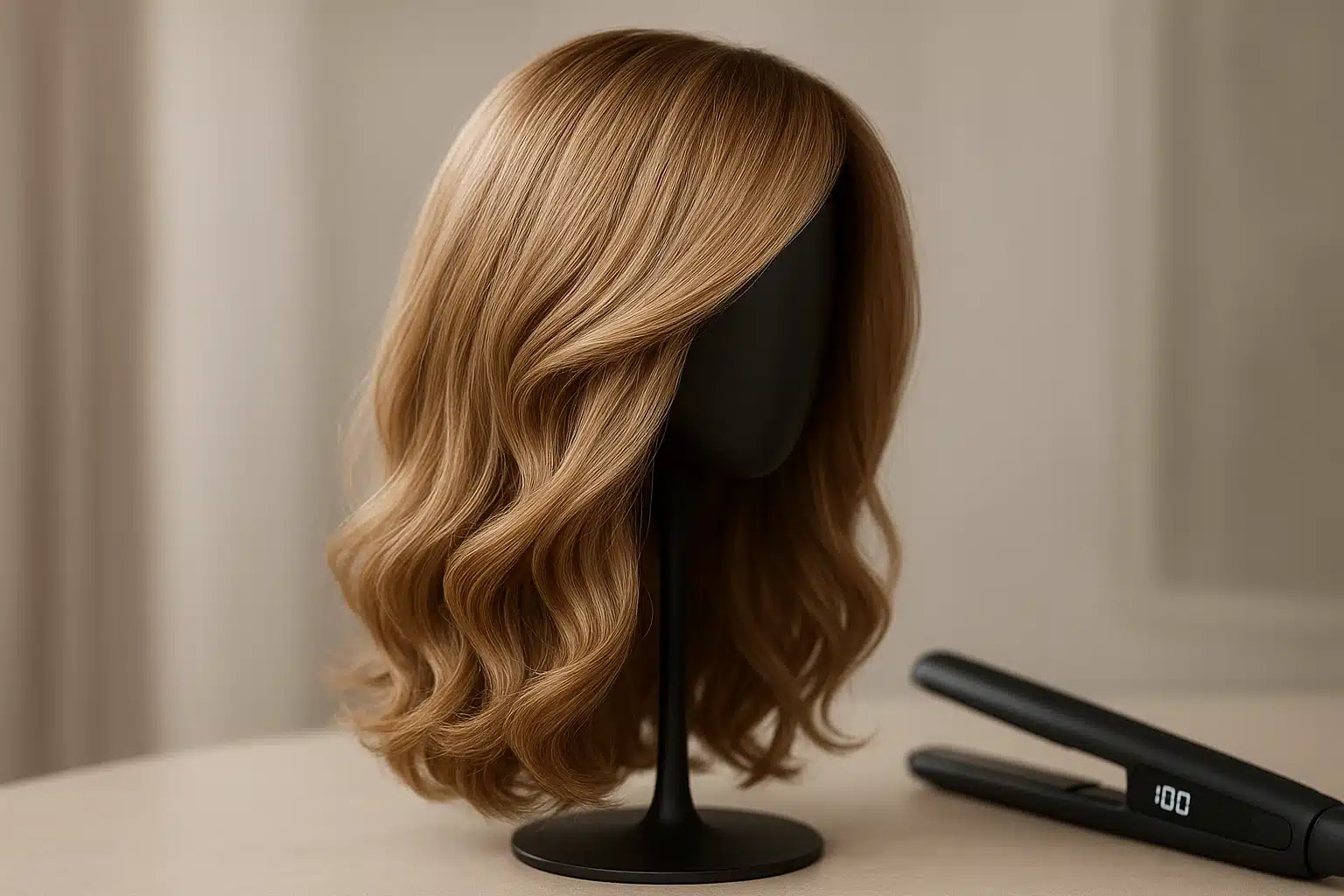
Before applying any heat, throw out your analog styling tools. Analog dials that just say “Low-Medium-High” are incredibly dangerous for synthetics because their temperatures fluctuate. You must use tools with digital temperature displays, setting your iron exactly to 275°F (135°C).
Step 3: The Moisture Barrier (The Wet vs. Dry Debate)
If you’ve searched online, you’ve likely seen conflicting advice: some say never style a wet synthetic wig, while others swear by it. Here is the verdict: for specialized Heat-Defiant (HD) fibers, the “Dripping Wet” styling method works beautifully to lock in slickness and prevent dry polymer drag. However, for generic heat-friendly synthetics, the hair must be styled completely dry or slightly damp to avoid stretching.
Step 4: The Cool-Set
This is the most misunderstood aspect of synthetic styling. When you apply heat to human hair, the heat itself creates the style. With synthetic fibers, heat merely makes the plastic pliable. The style is actually locked in during the cooling phase. If you curl a section of synthetic hair and let it drop while it’s still hot, it will fall completely straight. You must pin the curl against the wig cap construction with a clip, or cup it in your hand, allowing it to cool entirely before letting it down.
Thermal Renovation: Saving a “Ruined” Frizzy Wig
Here is the biggest “Aha!” moment for beginners: you might think that avoiding heat will preserve your heat-friendly synthetic wig. In reality, heat is the cure.
As you wear your wig, the constant friction of the fibers rubbing against your shoulders, collars, and scarves causes the ends to fray, creating what is known as “friction frizz.” When your wig starts feeling rough, gummy, or straw-like, it isn’t ruined—it just needs thermal renovation.
Mastering synthetic wig care means learning how to safely steam-press these fibers. By taking a digital flat iron set to 275°F, lightly misting the frizzy ends with water, and slowly running the iron down small sections of the hair, you are essentially melting away those microscopic frays. This low-temperature heat treatment restores the fibers to their factory-smooth state, extending the life of your wig significantly.
Curated Silicon Valley Alternative Hair Boutiques
If you’re looking for an alternative hair solution, searching online for generic terms often brings up confusing results—ranging from industrial heat treating plants to landscaping warehouses. To cut through the noise, here is an evaluated look at the premier silicon valley alternative hair boutiques where you can find heat-friendly options in person.
Couture Hair Supply (1070 Lincoln Ave)
Best for: Guided Consultations
Tucked away in Willow Glen, Couture Hair Supply offers a true boutique environment. This is an ideal destination for chemotherapy and alopecia clients who need a gentler, more educational approach. They offer personalized styling consultations and customization services, making them a fantastic starting point if you are transitioning to alternative hair for the first time and need professional guidance on heat-friendly care.
Brittney’s Beauty Supply (1350 S Bascom Ave)
Best for: Immediate Off-the-Shelf Variety
If you want to walk in, touch the fibers, and walk out with a new look, Brittney’s is a staple. They are explicitly confirmed to stock heat-safe synthetic wigs alongside traditional fibers. Their vast inventory makes them perfect for those seeking vibrant colors, multi-cultural styles, and budget-friendly pieces to start their collection.
Join US Beauty Supply (1405 W San Carlos St)
Best for: Protective Styling Accessories
A successful wig journey requires the right tools. Join US Beauty Supply boasts a massive inventory of both human hair and synthetic options. More importantly, this is the place to stock up on specialized synthetic wig shampoos, digital flat irons, wide-tooth combs, and conditioning sprays required for the maintenance routines we discussed above.
New Look Institute (1190 S Bascom Ave #239)
Best for: The Medical/Custom Alternative
It’s important to note that New Look Institute operates differently than a standard retail store. They are a clinical, non-surgical hair replacement center that specializes in 3D-mapped custom hair systems rather than off-the-shelf synthetic wigs. If you are experiencing severe hair loss and want a medical-grade, custom-fitted solution rather than a traditional wig, this is the locally recommended clinic.
Frequently Asked Questions About Heat-Friendly Synthetic Wigs
What is the difference between traditional synthetic and heat-friendly synthetic wigs?
Traditional synthetics melt at low temperatures (around 180°F) and cannot be altered with heated styling tools. Heat-friendly synthetics are made from advanced polymers that can withstand temperatures up to 350°F (though 275°F is recommended), allowing you to curl, crimp, and straighten them just like biological hair.
Can I use a normal curling iron or flat iron on a synthetic wig?
You can only use styling tools on a synthetic wig if two conditions are met: first, the wig must explicitly be labeled “heat-friendly” or “heat-defiant.” Second, your styling tool must have a digital temperature readout. Standard curling irons with simple analog dials often spike in temperature and will melt the fibers.
Why did my heat-friendly wig become rough or “gummy” at the ends?
This is known as “friction frizz.” It happens when the synthetic fibers constantly rub against the back of your neck, clothes, or car seat. It does not mean the wig is ruined; it simply means the wig needs to be smoothed out using a low-heat flat iron and a water mist (a process called thermal renovation).
Your Next Steps in Alternative Hair
Stepping into the world of heat-friendly synthetic wigs is incredibly exciting once you understand the science behind the strands. You no longer have to settle for the permanent, unchangeable styles of the past, nor do you have to deal with the high maintenance and weather-dependent nature of human hair.
As you begin your journey, take the time to visit some of the localized San Jose boutiques mentioned above to feel the modacrylic fibers for yourself. Remember: treat your fibers gently with a wide-tooth comb, never fear a digital flat iron set to 275°F, and always allow your curls to cool completely. With a bit of practice, you’ll be managing your alternative hair like a true professional.