Imagine standing in front of your mirror, curling iron in hand, holding a curl for twenty seconds, releasing it… and watching it fall completely flat. If you have ever experienced this frustration with a synthetic wig, you aren’t alone. It is not a lack of skill, and it’s likely not a defect in the wig. It is simply a misunderstanding of physics.
The world of alternative hair has undergone a quiet revolution. Gone are the days of “plastic-looking” hair that melts near an open oven. Today’s heat-friendly synthetic fibers are marvels of polymer science, designed to mimic the movement and texture of biological hair. However, navigating this landscape can be overwhelming. When selecting your ideal wig brand: matching quality to your unique needs & lifestyle, understanding the technology behind the fibers is the first step toward long-term satisfaction. Modern heat-friendly synthetic wigs allow wearers to enjoy the versatility of human hair without the premium cost, provided you understand the rules of the game.
Beyond “Plastic”: Understanding the Polymer Revolution
To master your style, you first have to understand your canvas. Traditional synthetic wigs are “set” at the factory using high-pressure steam. They have a “memory” that snaps back into place after washing. Heat-friendly (HF) fibers are different. They are composed of advanced multifilament blends—often involving polyester or heat-resistant modacrylic—that are designed to withstand thermal styling tools up to specific temperatures (usually between 270°F and 350°F).
But here is the “aha moment” that changes everything: Heat does not curl the hair.
The Science of the “Cooling Phase”
In the world of polymer physics, there is a concept called the Glass Transition Temperature ($T_g$). This is the temperature range where a hard, brittle material (the synthetic fiber) becomes soft and pliable (plastic-like).
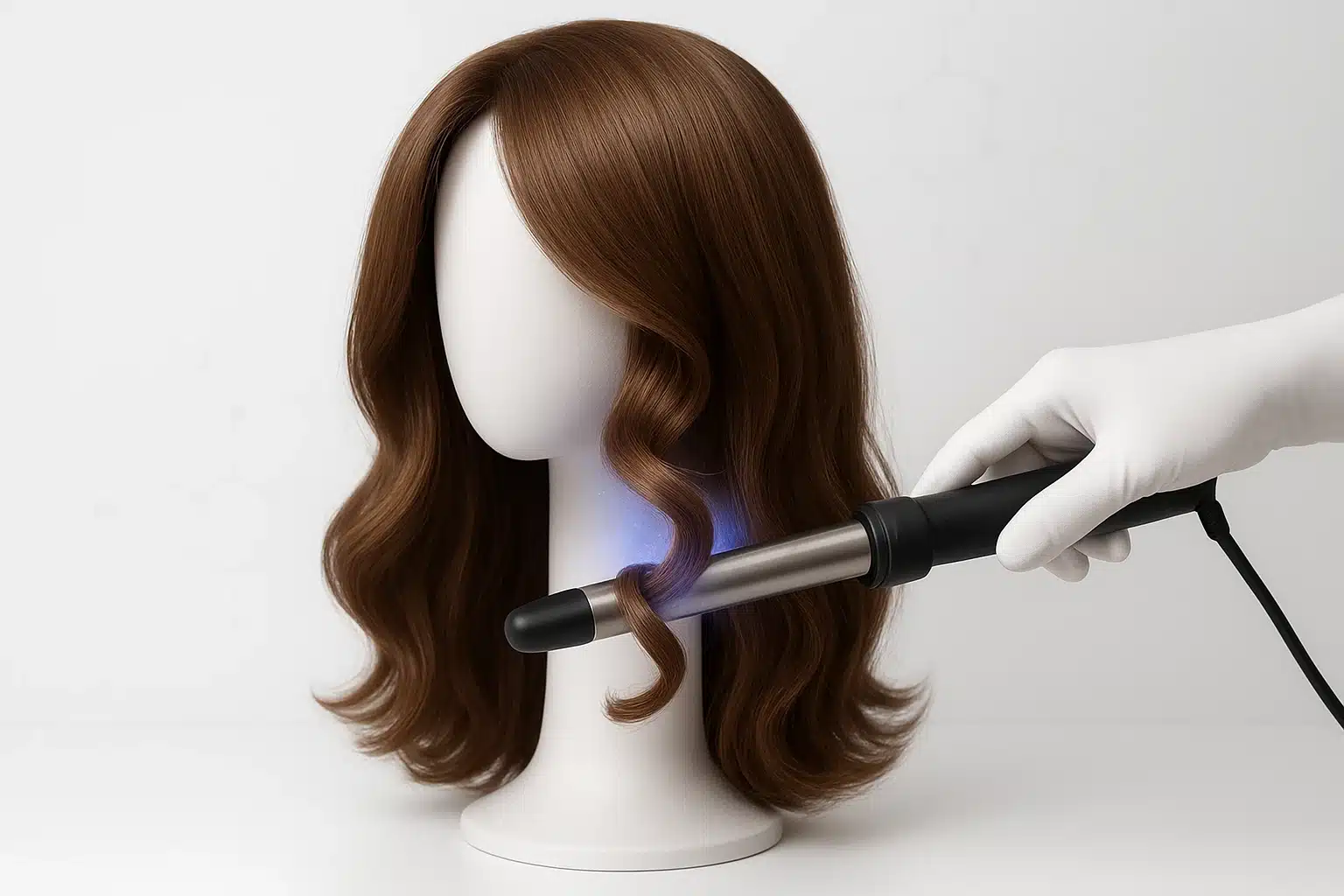
When you wrap a heat-friendly fiber around a curling iron, you are heating it past its $T_g$. You are telling the molecules to relax and become moldable. However, if you release the hair while it is still hot, gravity takes over. The molecules are still relaxed, so the curl stretches out and disappears.
For the style to “lock” in, the fiber must cool down while holding the shape. This allows the polymer chains to re-harden in the new configuration. This is why the “hold-and-cool” technique isn’t just a suggestion; it is a scientific requirement for these fibers.
The Titans of Tech: Who Makes the Best Heat-Friendly Fibers?
Not all heat-friendly fibers are created equal. Different manufacturers use proprietary blends to solve different problems, from shine reduction to weight distribution. Here is a technical look at the best wig brands leading the charge in fiber innovation.
Raquel Welch: The Hollow Core Innovation
Raquel Welch’s Tru2Life fiber is a standout in the industry for a specific architectural reason: the fibers are often hollow or semi-hollow.
- The Technology: By engineering a hollow core within the filament, these fibers reduce the overall weight of the wig. This mimics the natural texture of biological hair, which creates a “featherlight” feel.
- The Benefit: A hollow core dissipates heat differently than a solid core. It tends to have a more realistic, matte finish that avoids the “doll hair” shine.
- Styling Note: Tru2Life fibers are generally safe up to 350°F, but they respond best to wet styling (spritzing with water before applying heat) to protect the structural integrity of the hollow fiber.
Jon Renau: Precision and Uniformity
Jon Renau’s HD (Heat Defiant) collection focuses on denier consistency. “Denier” is a unit of measure for the linear mass density of fibers.
- The Technology: Jon Renau uses an ultra-fine denier that is incredibly consistent (low variance). This uniformity ensures that when heat is applied, the fiber warms evenly.
- The Benefit: The texture of HD fiber is famous for feeling silky and smooth, closely replicating the feel of healthy human hair. It moves with a heavy, luxurious swing.
- Styling Note: Because the fibers are so fine, they are more sensitive to friction. HD fibers generally have a lower recommended heat threshold (around 270°F – 280°F) to prevent damage.
Belle Tress: The Versatility Hybrid
Belle Tress has made waves with their Café Collection, utilizing a proprietary blend that emphasizes durability.
- The Technology: Their fibers are designed with a higher tensile strength, making them slightly more robust against the daily rigors of wear.
- The Benefit: These wigs often come pre-styled in modern, deconstructed waves that hold up remarkably well. They strike a balance between the softness of Jon Renau and the durability needed for daily wear.
The “Friction Paradox”: Why HF Wigs Tangle
It seems counterintuitive: If these are the most advanced fibers on the market, why do they tangle and frizz faster than traditional synthetic wigs?
This is the “Friction Paradox.” To make synthetic hair heat-resistant, manufacturers remove the external silicone coating that usually protects standard synthetic wigs (because that coating would melt under heat). Without that slippery shield, heat friendly synthetic wigs have a slightly coarser surface texture.
When these fibers rub against your collar or skin (especially at the nape of the neck), they create friction. Over time, this friction causes the ends to kink and frizz—a phenomenon known as “fiber fatigue.”
The Solution: Heat is the Cure
Here is the good news: The same property that causes the problem is the solution. Because these fibers are heat-friendly, you can use heat to repair them.
- The Steam Fix: A handheld fabric steamer is a heat-friendly wig’s best friend. The moist heat relaxes the kinked fibers without drying them out.
- The Flat Iron Reset: Using a flat iron on a low setting (with a heat protectant spray) can smooth out the frizzy ends, effectively “resetting” the fiber’s memory to straight and smooth.
Frequently Asked Questions About Heat-Friendly Fibers
Can I use my regular hair tools on heat-friendly wigs?
Technically, yes, but proceed with caution. Most human hair tools have temperature settings that start at 350°F or 400°F, which can melt synthetic fibers instantly. You must use tools with adjustable temperature controls and stay below the manufacturer’s limit (usually 270°F – 300°F is the safe zone).
How often should I wash a heat-friendly wig?
Over-washing can dry out the fibers. Generally, washing every 6-8 wears is recommended. However, you should apply a leave-in conditioner or detangler spray specifically formulated for synthetic hair after every wear to combat friction.
Why does my wig lose its style after I wash it?
Unlike traditional synthetic wigs, which have a permanent “baked-in” style, heat-friendly wigs are more like human hair. If you straighten a curly HF wig and then wash it, it will remain straight. You have to restyle it to get the curls back. This offers incredible versatility but requires more maintenance.
Is heat-friendly synthetic right for me?
If you love changing your look, want to move parting lines, or simply want the most realistic texture available without buying human hair, then yes. If you prefer a “shake-and-go” experience with zero styling effort, a traditional synthetic fiber might be a better fit.
Taking the Next Step in Your Hair Journey
Understanding the science behind the strands empowers you to make better choices. Whether you lean toward the hollow-core realism of Raquel Welch or the silky precision of Jon Renau, knowing how your wig reacts to heat allows you to be the stylist.
The technology behind synthetic wigs is constantly evolving. By mastering the cooling phase and understanding fiber maintenance, you ensure that your investment looks beautiful for months to come. If you are ready to explore the options, looking into the specific technology behind synthetic wigs and cap constructions can further refine your search for the perfect hairpiece.