If you’ve recently run your fingers through a high-quality modern wig, you might have experienced a moment of disbelief. The texture, the movement, and the subtle, natural shine feel almost indistinguishable from a biological head of hair. For decades, synthetic hair carried an unfortunate stigma—it was famously shiny, stiff, and unmistakably “fake.” But today, the hair alternative industry is no longer relying on cheap plastics; it is delivering a masterclass in advanced material science.
Wig manufacturing has undergone an incredible technological revolution over the last century, moving from traditional hand-tied techniques to advanced chemistry-driven engineering. To truly understand this shift, one can trace the evolution of wig craftsmanship and materials from historical human hair processing to the development of highly advanced synthetic polymers. Among these modern marvels, two terms dominate the high-end synthetic market: Kanekalon and Modacrylic.
While these terms are often tossed around interchangeably in beauty supply stores and online forums, understanding the fascinating molecular science behind them can completely transform how you wear, style, and care for your wigs. Let’s look under the microscope to see what makes these fibers behave so beautifully.
Demystifying the Chemistry: What Are We Actually Wearing?
When you begin researching synthetic hair, the terminology can feel like a maze. Is Kanekalon better than modacrylic? Is it a completely different material? To answer this, we have to bridge the gap between chemistry and commerce.
Acrylic vs. Modacrylic
In the textile world, standard acrylic fibers are made of at least 85% acrylonitrile monomers. While great for cozy winter sweaters, pure acrylic is highly flammable and doesn’t hold up well to the specific demands of hair styling.
Enter modacrylic (short for modified acrylic). By definition, modacrylic fibers are copolymers containing between 35% and 85% acrylonitrile, blended with other vinyl elements like vinyl chloride. This chemical modification is the secret recipe that makes the fiber inherently flame-retardant, incredibly durable, and capable of holding a permanent style.
The Kanekalon Connection
Here is the ultimate “aha” moment for many wig wearers: Kanekalon is not a separate material from modacrylic.
Introduced by the Kaneka Corporation in 1957, Kanekalon is simply the gold-standard, patented brand of modacrylic fiber specifically optimized for hair replication. Asking if you should buy Kanekalon or modacrylic is a bit like asking if you should buy a Kleenex or a facial tissue. Kanekalon is simply a masterfully engineered modacrylic that has earned its reputation through decades of structural innovation.
The Optics of Realism: Why Fiber Shape Matters
We’ve all seen cheap costume wigs that look like they belong on a mannequin—they possess a harsh, unnatural plastic sheen. But what exactly causes that? The answer lies in the physics of light diffraction.
Standard synthetic fibers (like cheap polyesters or nylons) are extruded with a perfectly circular cross-section. Because of this round shape, each individual strand of hair acts like a tiny, cylindrical lens. When light hits it, the light is focused and reflected back in a sharp, intense line, creating that telltale “fake” shine.
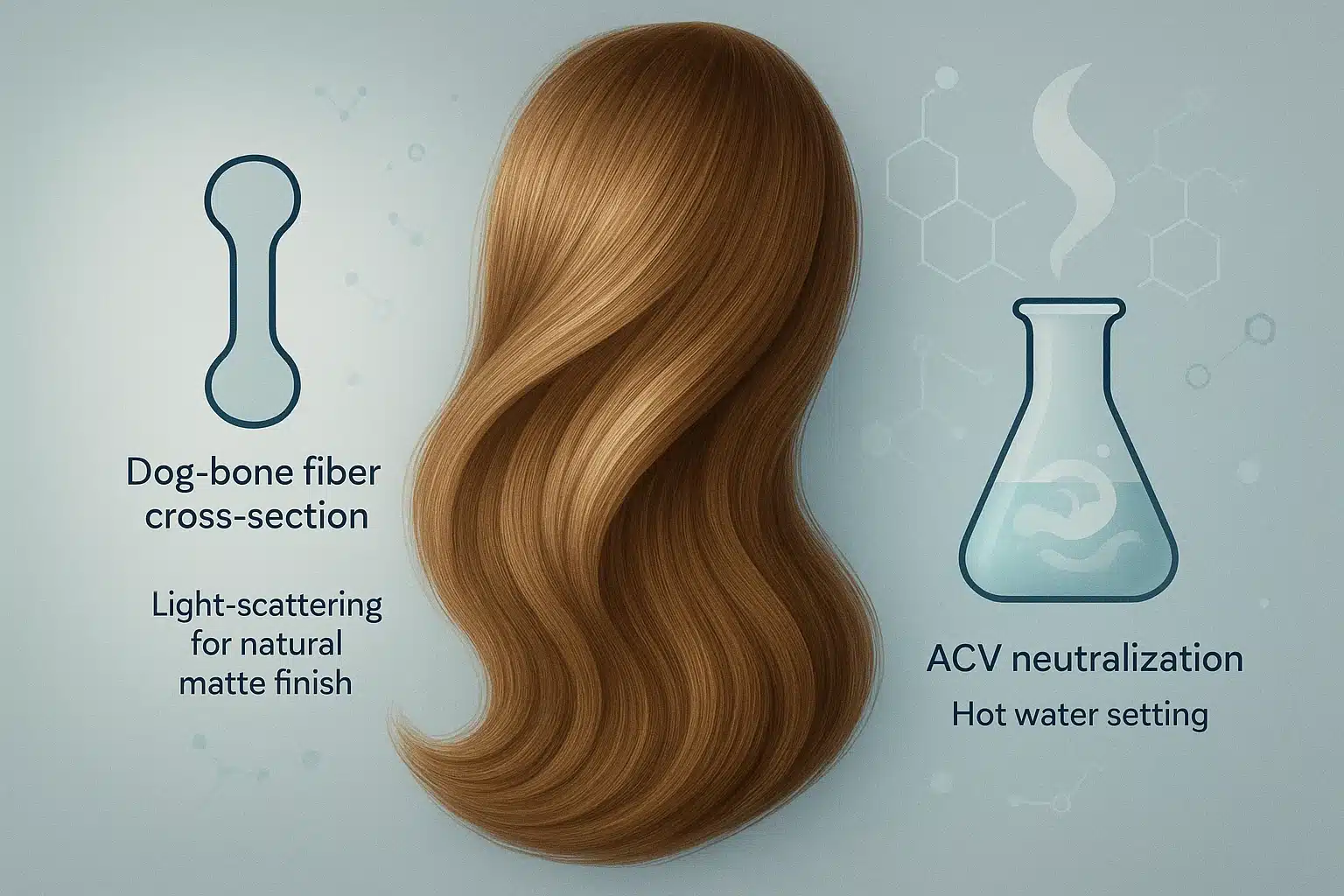
Kanekalon and premium modacrylics solve this with clever geometry. Instead of being perfectly round, premium fibers are engineered with irregular, modified cross-sections—often resembling a “dog-bone” or a “C-shape.” This irregular shape perfectly mimics the slightly flattened, oval cross-section of naturally growing human hair. When light hits a dog-bone fiber, it scatters in multiple directions, producing a soft, realistic, matte luster instead of a harsh glare.
Thermodynamics of Styling: Glass Transition and Style Memory
One of the most beloved features of premium synthetic wigs is their “style memory.” Unlike human hair, which absorbs humidity and loses its curl in the rain, synthetic fibers will hold their style through rain, humidity, and even washing. But how do you change that style if it’s locked in? You have to understand thermodynamics.
Synthetic fibers don’t absorb water to change shape; their molecular structure must be manipulated using heat. This brings us to a crucial concept: the Glass Transition Temperature ($T_g$).
This is the exact temperature sweet spot where the polymer chains inside the hair shift from a rigid, “glassy” state to a flexible, rubbery state.
- Modacrylic/Kanekalon: The $T_g$ is reached at a relatively low $158^\circ\text{F} – 194^\circ\text{F}$ ($70^\circ\text{C} – 90^\circ\text{C}$).
- Standard Dry Heat (Flat Irons): Most flat irons operate between $300^\circ\text{F} – 400^\circ\text{F}$. Direct contact with this level of heat exceeds the melting point of modacrylic, which will permanently scorch and fuse the fibers.
The Magic of the “Hot Water Set”
Because modacrylic’s $T_g$ is just below the boiling point of water, it is the perfect candidate for a “Hot Water Set.” By rolling the hair into curlers or braiding it, and then dipping it into water heated to about $180^\circ\text{F}$, the fiber softens. As it cools, the molecular chains lock into their new positions permanently.
(Note: Heat-resistant polyesters like Futura have a much higher $T_g$ and can withstand dry flat irons, but they lack the ease of hot water setting that makes modacrylic so beloved!)
The Chemistry of Comfort: Solving the Scalp Itch Mystery
If you’ve ever worn a protective style with synthetic braiding hair or a tightly fitted wig and experienced a frustrating, unexplainable scalp itch, you are not alone. For years, people assumed they were simply “allergic to plastic.” The truth is much more scientific—and highly treatable.
During the manufacturing process, synthetic fibers are coated with an anti-static emulsion to keep them from tangling on the factory machines. This coating is highly alkaline (it has a high pH). Human skin naturally features an “acid mantle,” a very thin, slightly acidic film (pH of ~5.5) that protects the scalp. When the alkaline coating of the wig rubs against the acidic scalp, it causes contact dermatitis—better known as the dreaded “synthetic itch.”
The Apple Cider Vinegar (ACV) Cure
Many beauty blogs tout an Apple Cider Vinegar rinse as a miraculous “organic hack,” but it is actually a textbook acid-base neutralization reaction.
The Chemistry:Acetic Acid (from ACV) + Alkaline Coating (on the hair) = Water-Soluble Salts + Cloudy Precipitate
The 4-Step De-Itching Protocol:
- Fill a basin with warm water (around $104^\circ\text{F}$—well below the styling temperature).
- Add 1 cup of Apple Cider Vinegar.
- Submerge the wig or bundles for 15–20 minutes. You will actually see a white, cloudy film rise to the surface—this is the chemical bond of the alkaline coating breaking down!
- Rinse thoroughly with cool water and air-dry.
Once the alkaline base is neutralized, your scalp will thank you. To maintain the longevity and softness of your piece after this process, ensure your ongoing synthetic wig care routine involves products specifically formulated for the unique pH and moisture needs of these advanced fibers.
Safety First: The Flame-Retardant Advantage
Beyond beauty and styling, there is a very practical safety reason why modacrylics are the standard for high-quality wigs. Because modacrylic is copolymerized with vinyl monomers (which contain chlorine), it is inherently flame-retardant.
If modacrylic fibers are exposed to an open flame, the heat triggers the release of free radicals from the chlorine atoms. These radicals essentially starve the immediate area of oxygen, causing the fiber to instantly self-extinguish without dripping dangerous molten plastic. It’s an incredible safety feature engineered directly into the molecular structure of the hair.
Frequently Asked Questions (FAQ)
What exactly is Kanekalon hair made of?
Kanekalon is a proprietary brand of modacrylic fiber, produced by the Kaneka Corporation. It is created through a chemical process that combines acrylonitrile with other vinyl elements, resulting in a soft, flame-retardant, and highly realistic hair alternative.
Can you use heat on Kanekalon or Modacrylic wigs?
Yes, but with strict limitations! Because modacrylic becomes malleable at around $158^\circ\text{F} – 194^\circ\text{F}$, boiling water or low-heat steam is the safest way to alter the style (known as a Hot Water Set). Standard curling irons and flat irons are far too hot and will melt the fiber.
Why does synthetic hair look so shiny sometimes?
Cheaper synthetic hairs use circular fibers that reflect light harshly, acting like tiny magnifying glasses. Premium modacrylics like Kanekalon use “dog-bone” shaped fibers that scatter light, creating a natural, matte appearance similar to biological hair.
Will an ACV rinse ruin my synthetic wig?
No! Because synthetic fibers do not absorb water or ingredients like human hair does, the Apple Cider Vinegar only reacts with the alkaline coating on the outside of the fiber. Once the coating is stripped away, the integrity of the modacrylic fiber remains perfectly intact.
Empowering Your Hair Journey
The leap from hand-tied animal hair in the early 20th century to the sophisticated, flame-retardant, geometrically designed modacrylic polymers of today is nothing short of miraculous. By understanding the science behind the strands, you empower yourself to make better buying decisions, style your pieces safely, and troubleshoot common comfort issues with confidence.
Hair loss or the simple desire to change your style shouldn’t mean compromising on quality or comfort. At Wig Superstore, we believe that education is the first step toward finding a hair piece that makes you feel beautiful, confident, and completely yourself. Explore our educational resources to learn more about finding the perfect match for your unique journey.