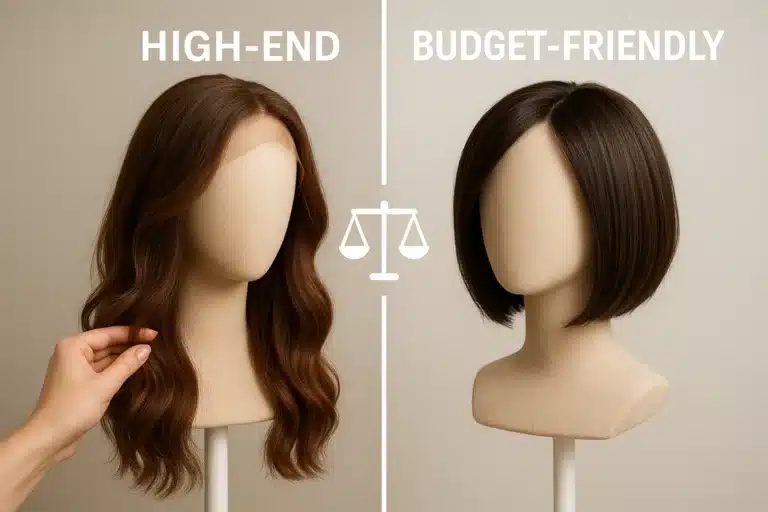
We have all experienced that moment of hesitation. You find a piece that looks absolutely stunning—the movement is natural, the color is radiant, and it feels like “you.” Then, you look at the price tag. It is natural to feel a protective instinct over your finances, especially when you are entering the world of alternative hair for the first time. However, looking at the initial price tag in isolation can be misleading.
To truly understand the value of your investment, you have to look past the upfront number and consider the “Cost Per Wear” (CPW). When you are budgeting for your perfect wig, understanding the initial price is only the first step; the true mastery comes from calculating how much each day of confidence actually costs. By breaking down the lifespan, maintenance, and replacement frequency of different fiber types, we can turn a complex financial decision into a clear, logical choice.
The Sticker Price Trap vs. Long-Term Value
In the retail world, we often fall into the “Sticker Price Trap.” We see a lower number and assume it is the frugal choice. However, wigs are functional items that undergo daily stress from the environment, friction, and handling.
Think of it like buying boots. A $40 pair might last one winter before leaking, requiring you to buy a new pair every year. A $200 pair might last five years with proper care. Over five years, the total cost is identical, but the experience of wearing the higher-quality boots is superior.
The formula for Cost Per Wear is simple:Total Investment (Wig + Care Products) ÷ Days Worn = Cost Per Day
Applying this formula helps you determine whether a wig is an expense or an investment.
Foundations of Fiber: What Are You Paying For?
To calculate the true cost, you first need to understand the variables: the fibers themselves.
Human Hair: The Biological Standard
Human hair wigs, particularly those made from Remy hair (where the cuticle runs in the same direction), are the gold standard for realism. They move, bounce, and react to the environment just like biological hair.
- The Investment: High initial cost.
- The Longevity: With proper care, they can last over a year, sometimes up to two or three with professional refurbishment.
- The Reality: They require styling, hydration, and protection from UV rays (which causes oxidation).
High-Quality Synthetic: The Technological Marvel
Modern synthetic wigs have come a long way. They utilize advanced polymers that mimic the diameter and shine of biological hair. Many feature “Style Memory,” meaning the style is baked into the fiber.
- The Investment: Lower initial cost.
- The Longevity: Typically 4 to 6 months with daily wear.
- The Reality: They are prone to “friction frizz,” where the fibers rub against collars or skin and degrade over time.
The 2-Year Math: A Financial Case Study
Let’s look at a realistic scenario over a 24-month period for a daily wearer. This comparison reveals why the cheapest option isn’t always the most economical.
Scenario A: The Synthetic Cycle
You choose a high-quality synthetic wig priced around $350.
- Lifespan: 6 months (Note: The last two months usually show significant wear at the nape).
- Replacements needed in 2 years: 4 wigs.
- Total Wig Cost: $1,400.
- Hidden Costs: Specific shampoos, detangling sprays, and steamers to combat frizz.
Scenario B: The Human Hair Investment
You choose a premium human hair wig priced around $1,200.
- Lifespan: 12+ months per wig.
- Replacements needed in 2 years: 2 wigs (or 1 wig with professional refurbishment).
- Total Wig Cost: $2,400 (or significantly less if refurbished).
- Hidden Costs: Sulfate-free hydration products, heat protectant, deep conditioners.
The Insight: While the human hair wig requires a higher upfront spend, the gap narrows significantly over time. Furthermore, during those two years, the human hair wearer enjoys a consistent, natural texture, whereas the synthetic wearer likely battles fiber degradation at the end of every 6-month cycle.
The Hidden Maintenance Bill
When calculating your budget, you cannot ignore the ecosystem of products required to keep the wig viable. The “hidden” bill varies by fiber.
For Human Hair
Because human hair has no natural oil supply from the scalp, it is entirely dependent on you for moisture.
- Essential Costs: Argan oil, deep conditioning masks, and heat tools (blow dryer, flat iron).
- Time Cost: High. After washing, you must blow-dry and style the wig, much like biological hair.
For Synthetic Hair
Synthetic fiber is essentially plastic; it does not need hydration, but it needs protection from friction.
- Essential Costs: Wide-tooth combs, wig stands (essential for drying as you cannot use heat on standard synthetic), and synthetic-safe shampoo.
- Time Cost: Low. You wash it, shake it, put it on a stand, and it dries back to its original style. For many, this time-saving aspect is worth its weight in gold.
Visualizing the Lifespan Timeline
Understanding when a wig degrades helps you plan your budget.
Synthetic Timeline:
- Month 1-2: Perfect condition. Looks and feels brand new.
- Month 3-4: The nape (neck area) begins to feel dry or rough due to friction against clothing.
- Month 5-6: Visible matting or frizz may occur. The fiber loses its movement. Replacement is imminent.
Human Hair Timeline:
- Month 1-4: Excellent condition. The hair settles and looks increasingly natural.
- Month 5-9: Ends may become dry; color may lighten slightly due to sun exposure (oxidation).
- Month 10-12: Requires a “trim” or deep conditioning treatment to refresh the ends. If well-maintained, it remains wearable.
The Decision Matrix: Which ROI Fits You?
The “best” value depends entirely on how often you plan to wear the piece.
Choose Synthetic If:
- You are an occasional wearer: If you only wear wigs for events or weekends, a synthetic wig could last you years. Your Cost Per Wear will be incredibly low.
- You value time over realism: If spending 45 minutes styling hair sounds exhausting, the “shake-and-go” nature of synthetic provides an ROI in time saved.
- You like changing styles often: The lower price point allows you to own a bob, a long shag, and a pixie for the price of one human hair wig.
Choose Human Hair If:
- You are a daily wearer: If this is your primary hair for work and social life, the durability of human hair offers a better daily value.
- You crave tactile realism: If the feel of the hair matters to you (and your partner/family), human hair is unmatched.
- You have a sensitivity to texture: As synthetic wigs age, they can become scratchy. Human hair remains soft with proper conditioning.
Frequently Asked Questions
Can I extend the life of a synthetic wig to lower the CPW?
Yes. The enemy of synthetic hair is friction. Wearing silk scarves around your neck, avoiding high collars, and using a steamer to carefully smooth out frizzy ends can extend the life of the wig by a month or two.
Does high-heat synthetic offer a middle ground?
High-heat synthetic fibers allow for heat styling, which is a massive pro. However, the fiber is often finer and can tangle more easily than traditional synthetic. The lifespan is generally comparable to standard synthetic, so the CPW remains similar.
Is professional refurbishment for human hair worth it?
Absolutely. A professional can deep condition, re-dye (to correct oxidation), and trim the ends of a human hair wig. This service might cost $100-$200 but can extend the life of a $1,500 wig by 6 months, drastically improving your ROI.
Why does my wig wear out faster than the estimated timeline?
Longevity estimates assume proper care. Sleeping in your wig, washing it too frequently (or infrequently), or using the wrong products (like drugstore shampoo on synthetic fiber) will accelerate degradation and increase your cost per wear.
Making the Right Investment for You
There is no single “right” answer, only the right answer for your lifestyle. By moving away from the sticker price and looking at the Cost Per Wear, you empower yourself to make a decision based on logic rather than just budget constraints. Whether you choose the ease of synthetic or the longevity of human hair, the smartest investment is the one that makes you feel beautiful every single time you wear it.
If you are ready to explore options that fit your calculated budget, take your time browsing collections with this new perspective on value. Your perfect match is waiting.