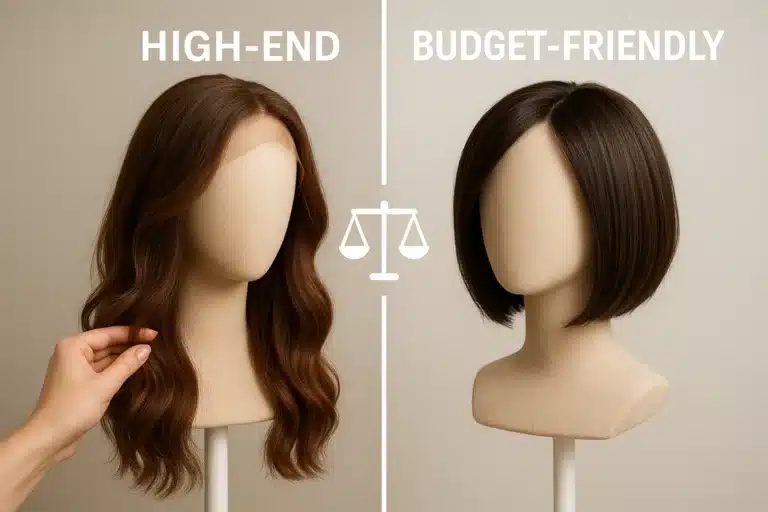
Imagine walking into a local wig boutique. The displays are undeniably stunning, but the price tags range from $200 to well over $3,000, and the terminology on the boxes—words like “Remy,” “12A Grade,” and “Brazilian Virgin”—feels like a completely foreign language. If you’re navigating hair loss or simply looking for a high-quality fashion piece to boost your confidence, this confusion is the last thing you need. It’s incredibly easy to feel overwhelmed when all you truly want is a beautiful, natural-looking solution that makes you feel like you.
To make matters easier, before you even begin worrying about hair cuticles and lace knots, you need to know where to start your search. Navigating the local West Michigan market is a journey in itself, so we highly recommend reading our ultimate guide to the best wig stores in Grand Rapids, MI to find reputable boutiques with private fitting rooms and compassionate staff. Once you know exactly where to go, this guide will serve as your personal blueprint, teaching you exactly what to look for when you walk through their doors.
Let’s demystify the human hair wig industry, decode the jargon, and equip you with the knowledge to shop with total confidence.
The Science of Hair Quality: Decoding the Jargon
To understand why one wig tangles in a week while another lasts for years, we have to look closely at the anatomy of human hair—specifically, the cuticle.
Think of a single hair strand like a roof covered in overlapping microscopic shingles. These “shingles” make up the cuticle layer. When all these shingles point in the exact same downward direction, the hair flows smoothly, catches the light naturally, and remains tangle-free. When they are misaligned, friction occurs, leading to severe matting.
With that in mind, let’s translate the labels you’ll see on boxes in local stores:
- Raw Hair: This is hair in its purest form. It is collected from a single donor, completely unprocessed, and has never been chemically altered or steamed to create a curl pattern.
- Virgin Hair: Similar to raw hair, this hair has never been chemically treated (no dyes, perms, or bleaches). The cuticles are fully intact and aligned.
- Remy Hair: The gold standard for most high-quality wigs. “Remy” simply means the cuticles are kept intact and meticulously aligned in one direction from root to tip. Remy hair can be color-treated or textured by the manufacturer, but its structural integrity remains pristine.
- “100% Human Hair” (Non-Remy): This is where buyers often get tripped up. Yes, it is human hair, but it is often gathered from various sources (like salon floors or hairbrushes). Because the cuticles are pointing in every imaginable direction, the hair will naturally tangle and lock together.
The Silicone Illusion: A Shopper’s Biggest Trap
You might be wondering: If non-Remy hair naturally tangles, why does it feel so soft in the beauty supply store?
To make non-Remy hair sellable, manufacturers put the hair through a harsh acid bath to completely burn off the misaligned cuticles. Then, they coat the stripped hair in a thick layer of industrial silicone. In the store, this hair feels buttery soft and incredibly sleek.
However, this creates the “Silicone Illusion.” After 3 to 5 washes at home, the silicone washes away, exposing the damaged, stripped hair underneath. Almost overnight, the wig becomes a stiff, matted, unmanageable mess. Understanding this single fact will save you hundreds of dollars and endless frustration.
The “8A to 12A” Grading Myth
As you browse wig shops around Grand Rapids, you will inevitably see bundles and wigs labeled as “8A”, “10A”, or even “12A” grade hair.
Here is an industry secret you need to know: The “A-Grade” system is a completely unregulated marketing myth.
There is no scientific board, universal standard, or governing body that dictates what “10A” means. A decade ago, 5A was considered the highest quality. As competitors tried to out-market each other, they simply invented higher numbers. A 10A wig at one shop might be vastly inferior to an 8A wig at another.
Instead of trusting arbitrary numbers on a package, you should trust your hands and your eyes.
Ethical Sourcing and Origin Myths
When you are investing in human hair, understanding where it comes from is just as important as knowing how it was made.
Unmasking “Brazilian” and “Peruvian” Hair
Many wigs are marketed with exotic geographic names like “Brazilian,” “Peruvian,” or “Eurasian.” In reality, these terms are almost always used to describe the texture and style of the hair, not its actual country of origin.
The vast majority of human hair in the global market is sourced from India, China, and Southeast Asia. Calling a wig “Brazilian” is just an industry shorthand for hair that is thick, dense, and holds a curl well.
What “Ethically Sourced” Actually Means
True ethical sourcing goes far beyond marketing buzzwords. It requires three vital elements:
- Voluntary Donation: The donor willingly gave their hair.
- Fair Compensation: The donor (or their community/temple) was fairly compensated for the exchange.
- Traceable Chain of Custody: The manufacturer can trace the hair from the collector to the factory.
Much of the world’s ethically sourced Remy hair comes from Hindu temples in India, where hair is voluntarily tonsured (shaved) as a religious offering, and the temple uses the funds from selling the hair to support local community infrastructure.
The In-Store Quality Inspection Playbook
How do you test a wig’s quality in a Grand Rapids boutique without damaging the store’s display pieces? Use these four non-destructive tests:
Step 1: The Reverse Finger Cuticle Test
Hold a few strands of hair between your thumb and index finger. Slide your fingers down the hair (from root to tip)—it should feel smooth. Now, gently slide your fingers up the hair (from tip to root).
- The Result: If it is true Remy or Virgin hair with intact cuticles, you will feel a slight, microscopic resistance or friction on the way up. If it feels perfectly smooth like glass in both directions, the cuticles have been acid-washed off, and you are feeling a silicone coating.
Step 2: The Knot Inspection
Part the hair on the lace top and look closely at the roots. High-quality wigs utilize single-knot hand-tying, where one or two hairs are tied to the lace at a time, creating an illusion that hair is naturally growing from a scalp. If you see thick, dark, bulky knots (like tiny black dots), the wig was likely mass-produced quickly, which can reduce its realistic appearance.
Step 3: The Moisture & Elasticity Check
Gently gather a small section of the hair and observe how it moves. Premium human hair has natural weight, moisture, and bounce. If the hair looks overly shiny (like a plastic doll) or feels unnaturally stiff when you gently sway it, it may be a synthetic blend masquerading as 100% human hair.
Step 4: Evaluating Cap Architecture
The most beautiful Virgin hair in the world is wasted if it’s sewn onto a cheap, poorly ventilated cap. Inspect the inside of the wig. Does it have a monofilament top (which allows you to change the part anywhere)? Is the lace front soft and sheer (like Swiss or HD lace) to blend with your skin, or is it thick and scratchy?
Navigating Grand Rapids Wig Stores Like a Pro
When you visit local boutiques, you aren’t just shopping for a product; you’re looking for a supportive environment. The best stores in West Michigan will offer:
- Private Fitting Rooms: Hair loss is a deeply personal journey, and you deserve a discreet, comfortable space to try on different styles.
- Consultation Expertise: The staff shouldn’t just be cashiers; they should be consultants who ask about your lifestyle, budget, and daily maintenance preferences.
- Customization Services: High-end shops will often trim the lace, thin out the density, or customize the cut so the wig perfectly frames your face.
Don’t be afraid to ask store owners, “Can you tell me about the sourcing of this piece?” or “What is the expected lifespan of this cap construction with daily wear?” A reputable retailer will welcome these questions and gladly educate you.
Frequently Asked Questions (FAQ)
Is synthetic hair or human hair better for everyday wear?
There is no “better,” only what is best for your lifestyle. High-quality synthetic wigs are “style-memory” pieces—you can wash them, and they air-dry back to their original style perfectly, making them incredibly low maintenance. Human hair offers maximum realism, longevity, and the ability to heat-style or color, but it requires the same daily styling effort as natural biological hair.
What cap construction best pairs with high-grade Remy hair?
For maximum longevity and realism, high-grade Remy hair should be paired with a 100% hand-tied cap, featuring a monofilament top and a sheer lace front. This combination allows for multidirectional parting, supreme scalp comfort, and a virtually undetectable hairline.
Why do some wigs cost $200 and others cost $3,000?
The price discrepancy comes down to three factors: Hair origin (rare, single-donor Virgin hair is expensive), cap construction (hand-tying a wig takes a skilled artisan up to 40 hours, whereas machine wefts take minutes), and processing (meticulously aligning cuticles is highly labor-intensive).
Your Next Steps
Shopping for a human hair wig doesn’t have to be a guessing game. By understanding the critical importance of intact cuticles, seeing through arbitrary grading numbers, and knowing how to respectfully test inventory in-store, you are now equipped to make an empowering, educated choice.
Your perfect hair is out there waiting for you. Take this knowledge, visit a trusted local boutique, and find the piece that makes you feel beautiful, confident, and entirely yourself.