A high-quality wig is much more than a cosmetic accessory; it is a significant emotional and financial investment. Whether you wear a wig to manage medical hair loss, for professional styling, or simply for the joy of personal expression, your wig becomes an extension of you. Like any cherished garment or intricate piece of craftsmanship, it requires specialized care to remain beautiful and functional over time.
However, protecting that investment comes with unique geographic challenges. Navigating Oklahoma City’s notorious prairie winds, severe humidity swings, and 100-degree summer heat takes a measurable toll on even the highest-quality hairpieces. When your favorite piece starts to show signs of wear, you don’t necessarily have to throw it away. Understanding how your wig is built and knowing when to seek out professional wig repair services can save you hundreds, if not thousands, of dollars. For those just starting their journey or looking to find licensed specialists who understand both structural fabrication and our local climate, exploring the best wig stores in Oklahoma City, OK is a vital first step to getting your hairpiece the expert care it deserves.
Understanding Your Wig’s Architecture: Why Breakdowns Happen
To understand how wigs are repaired, it helps to know how they are constructed. Most modern wigs feature complex foundations made of HD Swiss lace, French lace, monofilament, silk tops, and polyurethane perimeters.
Because of this delicate architecture, wear and tear typically happens in four core stress zones:
- The Hairline Perimeter: This area takes the brunt of daily tension. Shear stress from applying and removing the wig, coupled with the chemical stripping of adhesives, often leads to lace fraying and micro-tears.
- The Nape Area: The back of the neck is ground zero for “friction frizz.” As the fibers continually rub against collars and winter scarves, they can quickly become matted and rough.
- The Crown and Parting: This area faces direct exposure to UV oxidation from the sun, as well as the mechanical stress of daily brushing, which can eventually cause localized hair shedding.
- Ear Tabs and Elastic Bands: The daily stretching required to put a wig on and take it off can lead to over-stretching, loss of elasticity, and eventual dry-rot of the internal bands.
The Oklahoma City Climate Penalty
Generic wig care guides often miss a critical factor: your local environment. The Oklahoma City climate acts as an accelerated wear-and-tear test for wigs.
Our spring winds, averaging 12 to 22 mph, place immense strain on cap anchors and hairline perimeters, pulling at the delicate lace structure. In the summer, temperatures soaring past 90°F cause sweat salts and natural sebum to bake directly into the lace knots. Over time, these bodily oils act as a corrosive agent, degrading the delicate hand-tied attachments that hold the hair to the cap. Furthermore, our unpredictable humidity spikes demand specific countermeasures, like anti-humidity serums for human hair wigs to prevent swelling, and anti-static coatings for synthetic strands to keep them manageable.
Under the Hood: How Professional Wig Restoration Works
When you take a damaged wig to a professional, you are tapping into a specialized artisan craft. Here is a look at what actually happens on the restoration workbench:
Cap and Base Reconstruction
If your cap is stretching or tearing, professionals don’t just sew it back together with a standard needle and thread. Doing so creates an inflexible seam that will immediately cause a catastrophic tear right next to the stitch as soon as the wig is stretched over your head. Instead, specialists use micro-stitching and insert invisible backing mesh to distribute tension evenly.
Lace Re-Fronting vs. Lace Patching
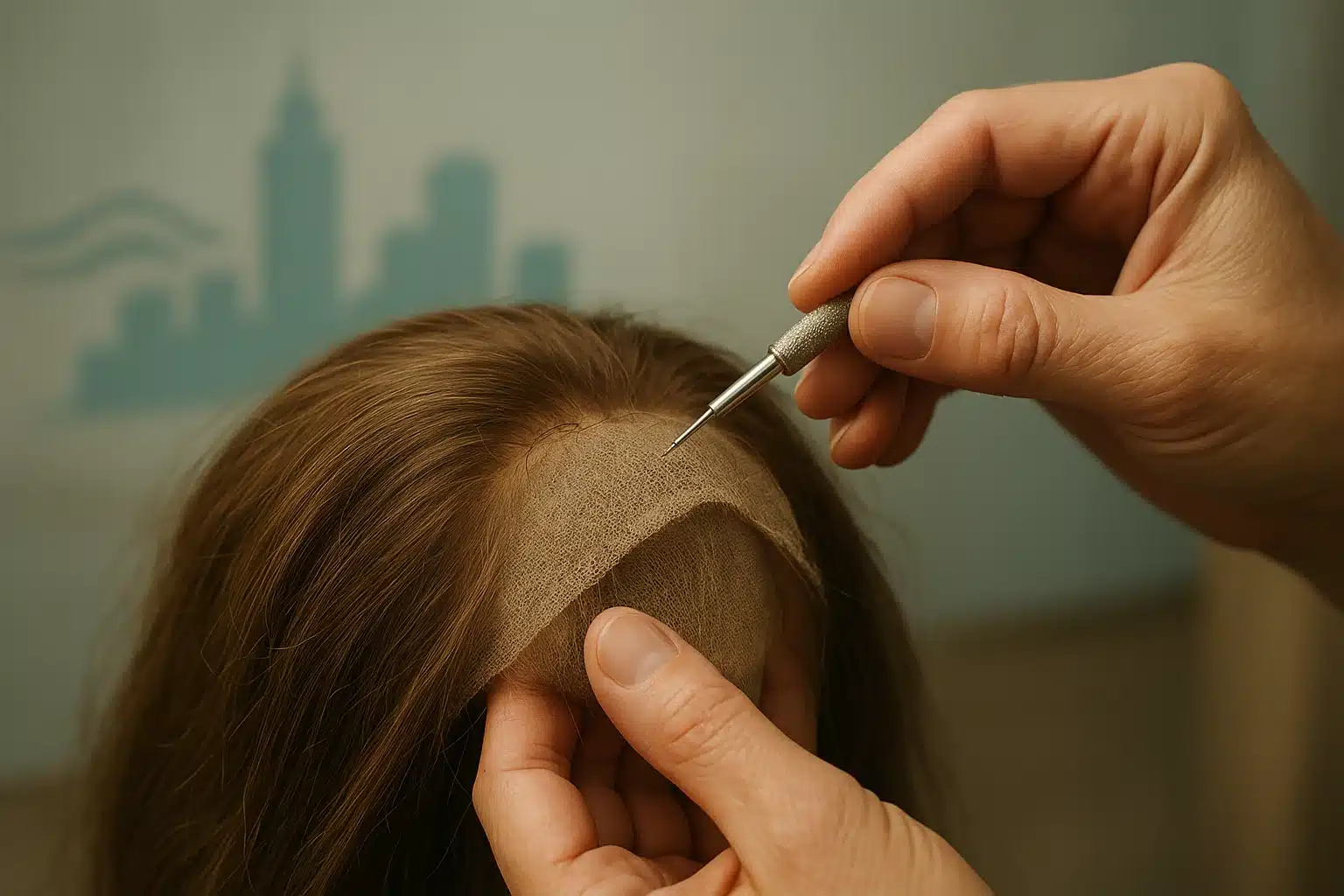
When hairline lace begins to fray or tear, an expert will evaluate the damage to determine if the area can be reinforced with an invisible backing mesh, or if it requires a full “re-fronting.” Re-fronting involves surgically removing the damaged front perimeter and seamlessly attaching a brand-new piece of lace to the existing cap.
Hair Ventilation and Re-Knotting
Have a bald patch from over-brushing? A professional can replace the missing hair strand by strand. Using microscopic ventilating hooks (as tiny as 0.1mm to 0.3mm), technicians loop and knot individual hairs directly into the Swiss lace. They use single flat knots at the hairline for an undetectable look, and double split knots toward the back to safely build up density.
Deep Fiber Restoration
Professional reconditioning goes far beyond a simple shampoo. For human hair wigs, technicians perform deep mineral and adhesive clarifications, followed by lipid restoration and cuticle realignment to bring back the hair’s natural swing. For synthetic wigs, they use highly calibrated steam-smoothing techniques to melt away friction frizz without destroying the fiber’s structural integrity.
The DIY Danger Zone: What You Can Do vs. What Professionals Must Do
It is tempting to look up viral internet hacks to fix a damaged wig, but many of these shortcuts cause irreversible damage.
Safe Home Maintenance:
- Detangling: Always use a wide-tooth comb and work gently from the ends up to the roots.
- Adhesive Removal: Use citrus or alcohol-free adhesive removers to gently dissolve glue without ripping the delicate mesh.
- Washing: Stick to gentle, cool-water soaking with wig-specific shampoos.
Strictly Professional Fixes:
- Ventilating new hair into bare lace
- Repairing hairline tears or performing a full lace replacement
- Resizing a stretched cap
- Chemical color corrections on human hair
Debunking Destructive Internet Myths
You may have seen tutorials suggesting you soak synthetic wigs in fabric softener or boil them in hot water to restore them. Do not do this.
Fabric softeners leave behind a waxy coating that acts as a magnet for Oklahoma’s notorious red dirt and dust. Boiling water is incredibly risky; without factory-calibrated heat control, boiling temperatures will permanently melt synthetic fiber crimps, instantly warp the cap sizing, and destroy the wig. Finally, never try to fix a lace tear with super glue—it will crystallize, ruin the lace, and cause severe skin irritation.
The Repair vs. Replace Calculus: Is Your Wig Salvageable?
How do you know when it’s time to fix your wig versus when to let it go? The decision usually comes down to a simple mathematical threshold.
The Rule of Thumb:If a professional repair and re-ventilation will cost less than 40% to 50% of the price of buying a brand-new equivalent unit, repairing it yields a massive return on investment. For example, spending $150 to $250 to reconstruct the hairline of a high-grade human hair wig that originally cost $1,500 makes perfect financial sense.
Conversely, if you own an entry-level synthetic wig that originally cost $70, comprehensive professional repair will likely outstrip the replacement cost, unless the fix is something very minor like a $15 clasp re-stitching or a basic detangling service.
Signs Your Wig Has Reached End-of-Life:
- The cap foundation feels brittle, crystallized, or crunchy.
- There is total perimeter shedding that requires rebuilding the entire wig.
- There are stacked, multi-zone tears across the lace, monofilament, and wefts.
Navigating Wig Maintenance in OKC
When you are ready to entrust your piece to a local specialist, always ask a few vital questions before dropping it off. Ask about their turnaround time, request a thorough intake assessment, and inquire about fiber guarantees. If you wear a medical wig, ask if they provide maintenance support documentation that can be submitted for cranial prosthesis insurance reimbursement.
Frequently Asked Questions (FAQ)
Can a torn lace front wig be fixed, or do I have to throw it away?
Yes, it can often be fixed! Depending on the severity, a professional can either reinforce the micro-tear with invisible backing mesh or replace the entire front lace perimeter (re-fronting) to make it look brand new.
Why is my synthetic wig frizzing and tangling at the nape of the neck?
This is known as “friction frizz.” It happens when synthetic fibers repeatedly rub against your back, clothing collars, or scarves. A professional can use specialized steam treatments to smooth these fibers out without melting them.
Can you wash lace glue out of a wig without ripping the mesh?
Absolutely, but patience is key. You must use a specialized, alcohol-free adhesive remover. Let the solvent sit and do the heavy lifting to break down the glue; never scrub or pull at the delicate lace, as this will cause tearing and hair shedding.
Does health insurance cover professional wig restoration?
In some cases, yes. If your wig was prescribed as a “cranial prosthesis” for medical hair loss, your provider may offer partial reimbursement for structural maintenance. You will need to check your specific policy details.
Continuing Your Journey
Navigating hair loss or investing in your personal style shouldn’t feel like a journey you have to take alone. Taking proactive steps to care for your wig extends its life, preserves its beauty, and ensures you feel confident every time you step out the door. By understanding the mechanics of your wig and knowing when to call in local Oklahoma City professionals, you can protect your investment for years to come.