Imagine the opening night of a highly anticipated indie theater production in San Francisco. The lead actor steps into the glow of a 10,000-watt stage wash. The crowd goes silent. But under the intense heat and movement, something goes wrong. The actor’s beautifully styled synthetic wig begins to sag, heavy perspiration dissolves the lace adhesive mid-soliloquy, and a hidden microphone cable creates a visible, awkward lump at the nape of their neck.
Why does this happen so often to emerging costume designers, high school drama directors, and independent filmmakers?
Because a wig designed for the street is simply not engineered for the stage.
The theatrical wig ecosystem operates across two distinct worlds: commercial retail boutiques selling beautiful base units, and specialized backstage artisans executing heavy-duty performance engineering. Bridging the gap between these two worlds is an art form.
Whether you are pulling together a community production or simply fascinated by the hidden mechanics of stagecraft, understanding how to transform an off-the-shelf boutique wig into a resilient, period-accurate performance piece is a game-changer. Let’s pull back the curtain on theatrical wig customization, explore San Francisco’s rich wig-making ecosystem, and learn how the professionals ensure there is never a hair out of place.
The Illusion of Distance: Street Wigs vs. Stage Architecture
One of the biggest “aha moments” for new theatrical designers is understanding the Audience Distance Rule.
When you buy a high-quality wig for everyday wear, the goal is close-up realism. You want it to look completely natural from two feet away in an office or a coffee shop. Stage wigs operate on an entirely different scale of legibility.
When an actor is on stage, their features and hair must “read” clearly to an audience member sitting fifty feet away in the balcony, often under harsh, colored lighting.
- Volume and Silhouette: A street wig looks appropriately sized in a dressing room mirror, but on stage, it often washes out and appears flat. Stage wigs require exaggerated 3D volume—sometimes 15% to 20% larger than natural life—to create a readable silhouette.
- Fiber Optics: Standard synthetic wigs often have a shiny finish that looks fine indoors but reflects blindingly under stage lights. Professionals seek out matte-treated, high-heat synthetic fibers or apply dulling treatments so the hair absorbs, rather than reflects, the spotlight.
- Distinct Lines: Part lines and structural waves (like 1920s finger waves) must be exaggerated and deeply sculpted. Subtle styling gets completely lost in the bright stage wash.
Sourcing the Foundation: San Francisco’s Wig Ecosystem
San Francisco boasts a dual theatrical heritage. On one side, you have internationally acclaimed institutional craft—like the San Francisco Opera’s War Memorial wig shop and the American Conservatory Theater (A.C.T.). On the other, you have a vibrant, grassroots drag and performance art scene deeply rooted in neighborhoods like the Castro and SoMa.
You don’t need a Broadway-sized budget to create a stunning theatrical piece. The secret lies in procuring a quality base wig from a local boutique and utilizing master customization techniques.
Where to Find Your Canvas
If you are scouting for retail base units in the Bay Area, a few landmark locations serve as the starting point for many local costume designers:
- Wig Factory Mission (Mission St.): Known for a massive inventory of lace fronts and hairpieces, offering an accessible starting point for base units.
- Trendy Hair Gallery & Beauty Supply (SoMa): A reliable hub for base units, lace tapes, adhesives, and quick backstage supplies.
- Gypsy Rosalie’s Wigs & Vintage (North Beach): A legacy boutique perfect for sourcing vintage shapes, character research, and highly unique pieces.
The magic happens when you take a $100–$150 base unit from one of these boutiques and apply the structural rigging techniques used by top-tier artisans.
The Masterclass: Engineering a Wig for the Stage
Transitioning a commercial wig into a performance-ready piece requires crossing over from cosmetology into pure mechanical engineering. Here is how the pros do it.
1. Head Mapping and the “Four-Finger” Landmark
Actors often make the mistake of pulling a wig too far down on their forehead, which instantly destroys their facial proportions and creates a “helmet” effect.
Professionals use the anatomical landmark system. When fitting a wig, the front hairline should sit exactly four horizontal fingers above the actor’s brow line. The wig’s temple tabs should align perfectly with the actor’s natural temporal bone. To achieve this, costumers take up to six standard head measurements, darting and taking in excess cap material so the foundation fits like a second skin.
2. Thermal Styling: The “Steaming on Canvas” Rule
Perhaps the most common disaster in amateur theater is a well-meaning volunteer melting a synthetic wig with a curling iron.
Here is the transformative insight: Synthetic wig hair is extruded thermoplastic. You cannot “curl” it with dry heat like human hair. Instead, professionals use a method called wet-steaming.
- Block and Roll: The wig is pinned securely to a canvas head-block and the hair is rolled in curlers.
- Steam Softening: A handheld garment steamer is applied in 5-to-10 second bursts. The steam safely softens the plastic memory of the fiber without blistering it.
- The Cure-Cool: This is the most crucial step. The wig must be allowed to cool completely. The shape is only locked in once the plastic fiber drops back to room temperature.
3. Audio Integration: Hiding the Hardware
Wigs on stage aren’t just for aesthetics; they are often equipment hubs. No mainstream beauty guide explains how to hide a wireless lavalier microphone, its cable, and its battery pack inside a hairdo.
Theatrical wig makers create specialized Mic Rigging. They cut reinforced eyelets (grommets) in the foundation mesh at the nape of the neck for the cable to enter. They build hidden channels through the cap’s crown to route the wire, allowing the microphone capsule to exit invisibly at the front hairline—all while preserving the cap’s stretch so singers can articulate their jaws without the wig sliding backward.
4. Sweat Barriers and Backstage Sanitation
Perspiration is the enemy of stage illusion. Traditional spirit gum crystallizes and dissolves under heavy sweat and the natural oils of an actor’s face, leading to lifting lace mid-performance.
Instead, clinical sweat-defense protocols are used. Scalp skin barrier preps are applied, followed by medical-grade silicone tapes or acrylic adhesives like Pros-Aide.
After the curtain falls, sanitation is paramount. Rather than destructively rubbing delicate lace, backstage crews use the “daubing protocol” with 91% isopropyl alcohol to safely dissolve adhesives. They also use baking soda and baby shampoo detox baths to strip away layers of heavy theatrical hairspray.
Building Period Silhouettes on Commercial Base Wigs
Once the foundation is secure, creating historical shapes becomes a matter of architectural illusion.
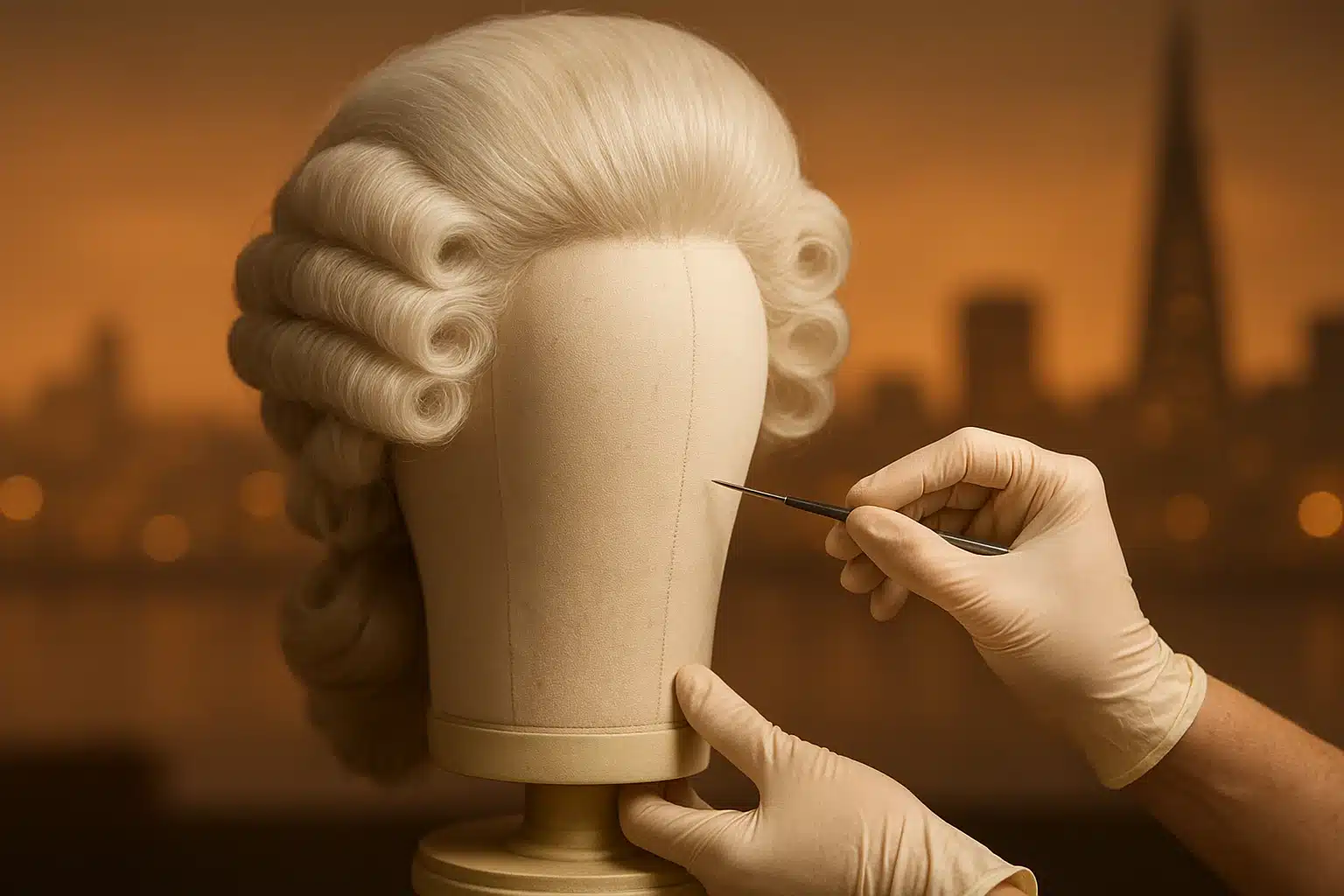
- 18th Century Rococo / Baroque Pouf: To achieve those towering, eight-inch high powdered looks without causing severe neck fatigue for the actor, designers build internal “rats” (cushions made of lightweight aluminum mesh or crinoline). The boutique wig hair is then smoothed over this hidden, weightless cage.
- 1920s Marcel & Finger Waves: To ensure these iconic waves survive heavy choreography, they are damp-set with water-soluble waving gel, sculpted with deep-ridge clamps, steamed, and cool-cured.
- Victorian Gibson Girl Pompadour: This look is achieved by sectioning the front of the wig from the back, heavily backcombing the under-layers to create volume, and sweeping smooth outer “veils” of hair over the top to hide the teasing.
Frequently Asked Questions (FAQ)
Can I buy a wig from a local San Francisco wig shop and use it directly on stage?
While you can certainly wear a retail boutique wig on stage, it typically requires customization to survive the rigors of a performance. Without resizing the cap, reinforcing the lace, and swapping standard styling for sweat-proof adhesives, a commercial wig may shift, shine too brightly under stage lights, or lose its style during vigorous choreography.
Why do synthetic wigs melt or frizz under stage lights, and how do you curl them safely?
Standard synthetic fibers can melt under extreme dry heat, like that from high-wattage stage lighting or traditional curling irons. Because synthetic hair is effectively thermoplastic, it must be restyled using a wet-steaming method. Steaming softens the plastic memory, and allowing it to cool completely on a canvas block locks the new style into place.
What is lace front ventilation, and why does hand-knotting matter?
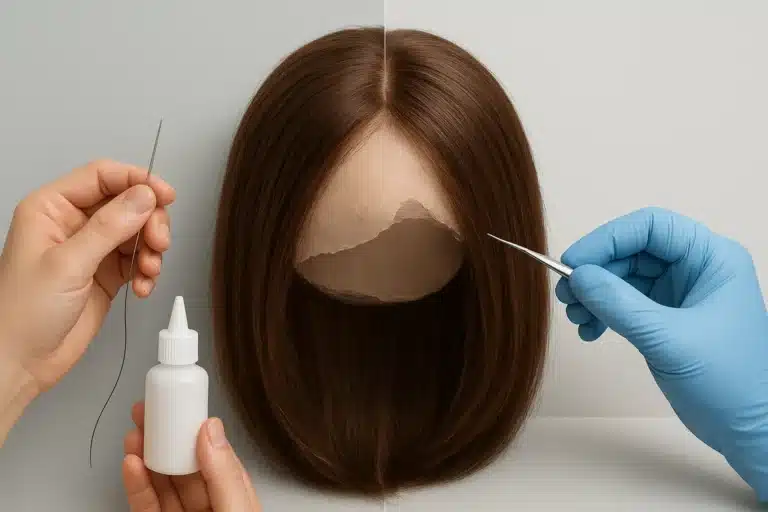
Ventilation is the painstaking process of tying single strands of hair into a fine lace foundation using a tiny hooked needle. For the stage, hand-knotting the front hairline in irregular, micro-peaks mimics natural hair growth. This prevents the wig from looking like a hard, unnatural line, even to audience members in the front row.
How do you rig a 30-second backstage quick-change?
Liquid adhesives take too long to dry for rapid costume changes. Instead, professionals use the “Cage-and-Elastic Rig.” The actor’s natural hair is braided tightly into pin-curls to form an anchor cage. The wig is fitted with silicone-lined perimeter elastic bands and pull-tabs, allowing it to be snapped onto the actor’s head with perfect tension in mere seconds.
Taking Your Next Steps
Understanding the mechanics behind theatrical wig customization completely changes how you view hairpieces. It transforms them from simple accessories into highly engineered tools of self-expression and performance.
Whether you are stepping onto a literal stage, navigating the personal journey of hair loss, or simply looking to confidently transform your everyday style, the secret always lies in starting with a high-quality, durable base unit. When you understand the craftsmanship that goes into a truly great wig, you are empowered to make choices that look beautiful, feel comfortable, and stand up to whatever spotlight you happen to be under.
If you’re ready to explore high-quality foundations that offer both exceptional comfort and premium construction, take the time to research pieces crafted by reputable manufacturers with a deep understanding of hair architecture. Your perfect fit is out there—ready for its opening night.