If you are exploring non-surgical hair replacement in San Francisco for the first time, you are likely facing a steep emotional and technical learning curve. Between the lingering stigma of the highly detectable 1970s toupee and the overwhelming jargon of modern “hair systems,” the research process can feel daunting.
Will people be able to tell under harsh tech-office lighting? How do adhesives hold up to a sweaty bike commute down Market Street or the sudden roll-in of maritime fog? And why can’t you just walk into a standard wig shop and buy a piece off the shelf?
If you are a man experiencing hair loss, you aren’t just looking for hair—you are looking for undetectable realism, secure attachment, and lifestyle compatibility. With nearly two decades of experience helping individuals navigate hair loss with empathy and expertise, Wig Superstore understands that a successful transition starts with education.
Let’s decode the engineering behind modern men’s hair systems, explore the physics of attachment in Bay Area microclimates, and map out exactly how to navigate San Francisco’s specialized studio landscape.
The Death of the “Toupee”: Why Unisex and Women’s Wigs Fail for Men
The single biggest fear for men stepping into hair replacement is looking like they are wearing a helmet. To understand why modern hair systems look natural, we first need to understand the “Density Trap.”
The number one reason a hairpiece looks fake is not the base material—it is excessive hair density. Natural adult male hair thinning, even in a full head of hair, typically sits at about 80% to 100% density. Most unisex or women’s wigs default to 130% to 150% density. When you place a high-density, round-perimeter women’s wig onto a male bone structure, it instantly creates an unnatural, puffy appearance.
Modern men’s hair systems are engineered radically differently:
- Graduated Temporal Recession: Male systems factor in natural temple recession, ensuring the hairline doesn’t look like a solid wall of hair.
- Directional Ventilation: Hairs are tied (ventilated) at specific angles to mimic male hair growth patterns, particularly around the crown and parting.
- Bleached Knots: To prevent the piece from looking like tiny black dots on your scalp, the microscopic knots used to tie the hair to the base are chemically bleached to seamlessly blend with your skin tone.
Cap Construction Decoded: Navigating the Realism vs. Durability Trade-off
When researching hair pieces, you will encounter proprietary jargon like “dermal lens” or “micro-membrane.” Strip away the marketing, and you are generally choosing between a few core base materials: Polyurethane (Poly/Thin Skin), Lace, and Monofilament.
The golden rule of hair systems is the inverse relationship between realism and durability.
Ultra-Thin Skin (0.03mm Poly) & Swiss Lace
- The Profile: 10/10 Realism, 3-6 Week Lifespan.
- The Details: Ultra-thin skin (measuring just 0.03 millimeters) and delicate Swiss lace practically melt into the scalp. These are ideal for men who wear their hair slicked back with fully exposed hairlines. However, because the base is so delicate, hairs shed faster, and the unit requires replacement frequently.
French Lace & Standard Poly (0.06mm – 0.08mm)
- The Profile: 8.5/10 Realism, 2-4 Month Lifespan.
- The Details: This is the sweet spot for most beginners. French lace offers excellent breathability (crucial for active lifestyles), while slightly thicker polyurethane provides a secure surface for tape and liquid adhesives.
Monofilament with Poly Perimeter
- The Profile: 6.5/10 Realism, 6-9 Month Lifespan.
- The Details: Made from a tightly woven mesh, monofilament is highly durable. While the hairline isn’t as invisible as thin skin, it is incredibly sturdy. These systems are best for hairstyles featuring a forward fringe that hides the front hairline.
Norwood Scale Matching: Selecting Coverage for Your Hair Loss Stage
You wouldn’t wear a winter coat on a mild San Francisco summer day, and you shouldn’t wear a full wig if you only have a receding hairline. Your level on the Norwood Scale (the clinical measurement of male pattern baldness) dictates your system architecture.
- Norwood 2 to 3 (Frontal Recession): You likely only need a partial frontal system to restore your hairline, blending seamlessly into your existing mid-scalp hair.
- Norwood 3 Vertex to 5 (Crown and Top Thinning): An oval partial topper is required. This covers the top of the scalp while leaving your natural back and side hair exposed.
- Norwood 6 to 7 (Advanced Loss with Retrograde Alopecia): A full-cap unit with a contoured nape perimeter is necessary, providing full coverage that matches the natural curvature of your skull.
The Bay Area Lifestyle Factor: Attachment Chemistry in San Francisco
A high-quality system is useless without the right attachment chemistry. San Francisco presents a unique microclimate challenge: maritime fog, sudden temperature changes moving from the Financial District to the Sunset, and high-sweat cycling commutes.
Understanding adhesives is critical to preventing edge lift:
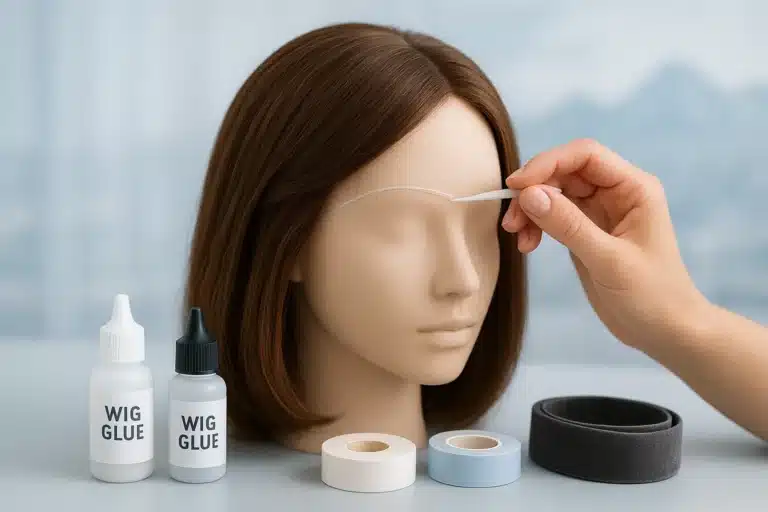
- Water-Based Copolymers (e.g., Ghost Bond): Excellent for those with sensitive skin. They dry clear and resist scalp sebum (oil) well, but can occasionally whiten slightly if exposed to prolonged heavy moisture or steam.
- Acrylic Solvent Bonds (e.g., Walker Ultra Hold): The heavy-duty choice. These handle high humidity, intense gym sessions, and heavy perspiration flawlessly.
- Tapes: Double-sided medical tapes offer an easy cleanup process and strong hold. Many men use a “hybrid” approach: tape around the back and sides for durability, with liquid adhesive at the front hairline for a perfectly invisible edge.
The Anatomy of a Flawless “Cut-In”
A common mistake beginners make is purchasing a premium system online and taking it to their neighborhood barber. Traditional barbering techniques—like blunt shearing—will ruin a hair system.
A professional “cut-in” is a highly technical 10-step procedure. Because system hair doesn’t grow back, a specialist must perform precise bulk reduction, point texturing, and transition feathering. This ensures the system hair graduates flawlessly into your native growing hair on the sides and back, eliminating any visible seams.
The San Francisco Landscape: Where to Find Specialized Care
The local market in the Bay Area is fragmented, but once you know what to look for, you can find exceptional care.
- Corporate Franchises (e.g., HairClub near the Embarcadero):These offer high brand trust, board-certified medical advisor endorsements, and a highly structured process. However, they often rely on gated pricing and proprietary terminology, which can obscure the true long-term costs.
- Local Private Studios (Union Square & Post Street):Studios like Total Cover Plus SF (Sutter St.) and New Hair for Men & Women (Post St.) offer private-room, discreet consultations. These are excellent for men who want a specialized, hands-on salon experience. For instance, some local studios offer clear membership pricing (e.g., a $195 unit with a monthly maintenance fee) focusing heavily on ultra-thin skin systems for tech professionals.
- The Hybrid Approach (Online Quality + Local Cut-In):Many experienced wearers purchase high-quality, transparently priced systems from trusted online authorities, then book a local San Francisco specialist exclusively for the initial $150–$250 cut-in and blending service.
The True Cost of Ownership in the Bay Area
While commercial salons might claim hair systems are “completely effortless,” it is vital to have an honest view of the maintenance and financial commitment.
A realistic annual budget in San Francisco includes:
- Unit Replacements: Depending on the base durability you choose, you will need 2 to 6 systems per year.
- Salon Services: If you don’t perform maintenance yourself, expect to visit a specialist every 3 to 4 weeks for a removal, scalp exfoliation, and re-bond ($95–$150 per visit).
- At-Home Chemistry: Solvents, adhesives, and color-safe shampoos.
In total, a full-service salon membership can run $2,500 to $4,000+ annually, while a more DIY-friendly hybrid approach can reduce that cost by half.
Frequently Asked Questions About Men’s Hair Systems
Can I shower, swim, and workout with a hair system?
Absolutely. Once the adhesive has fully cured (usually 24 to 48 hours after application), modern systems are waterproof. You can swim in the Bay or sweat at the gym. Just be sure to rinse chlorine or saltwater out promptly to protect the hair’s color.
Will my scalp be able to breathe?
Yes. If breathability is a top concern—perhaps you work outdoors or have a very active lifestyle—opt for a French Lace base. Lace allows water and air to pass directly through to the scalp.
How do I know where to place my front hairline?
A major tell of a poorly applied toupee is a hairline that sits too low. A standard rule of thumb is the “four-finger rule”: place four fingers horizontally above your eyebrows. Your new hairline should start just above your top finger to maintain age-appropriate realism.
Taking Your Next Step
Transitioning to a hair system is an incredibly rewarding journey that can instantly restore your confidence. The secret to success lies in understanding the engineering behind the base, respecting the limits of adhesives, and trusting a local specialist to perform a seamless cut-in.
Take your time. Assess your Norwood stage, consider your daily San Francisco commute, and decide whether you prioritize the absolute invisibility of a 0.03mm thin skin or the long-lasting durability of a French lace hybrid. Armed with this knowledge, you are ready to make a choice that truly fits your life.