
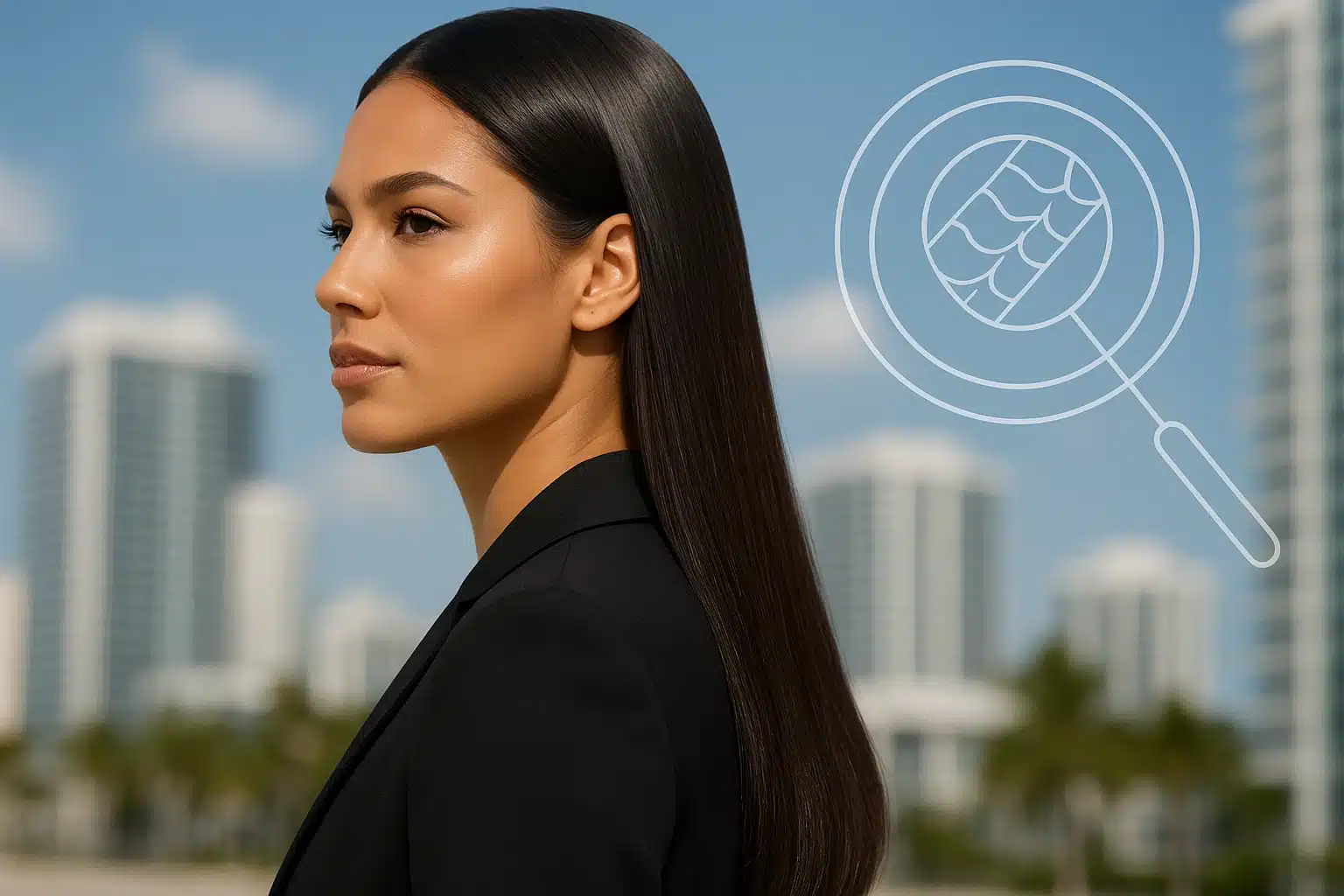
Imagine stepping out of a perfectly air-conditioned boutique in Coral Gables. Your new human hair wig feels like liquid silk, draping flawlessly across your shoulders. But just thirty minutes into the sticky, 80-percent humidity of a South Florida afternoon, something goes terribly wrong. The hair begins to swell erratically, frizzing out of control, and forming an irreversible, matted bird’s nest at the nape of your neck.
We call this the “Miami Washout,” and it is one of the most heartbreaking—and expensive—experiences a wig wearer can go through.
If you are beginning your journey and seeking a reputable wig store miami shoppers trust to make a confident choice, you are likely navigating a sea of confusing marketing jargon. Whether you are dealing with medical hair loss or simply looking to elevate your everyday style, buying premium human hair in South Florida requires more than just picking a beautiful color. You need a grounded understanding of hair science, ethical sourcing, and climate durability.
Let’s pull back the curtain on the hair replacement industry so you can shop with absolute confidence.
The Fiber Anatomy Masterclass: Decoding the Vocabulary
To understand why some wigs survive Miami’s climate while others fail, we have to zoom in on the microscopic structure of a hair strand.
Think of a single strand of hair like a roof covered in overlapping shingles. These “shingles” make up the cuticle. In natural, healthy hair, all of these shingles point downward, from the root to the tip. This allows the hair to fall smoothly and reflect light.
What is Remy Hair?
“Remy” is not a brand name or a geographic location. It simply means that the hair’s cuticles are kept intact and aligned in the same, unidirectional manner they grew in. Because the cuticles flow naturally, the hair resists tangling and stays smooth.
When you visit wig stores in florida, you will hear a lot of terms thrown around interchangeably. Here is the clear difference:
- Remy Hair: Cuticle-aligned hair. It can still be dyed or texturized, but the structural integrity is intact.
- Virgin Hair: Hair that has never been chemically processed, dyed, or permed. (Note: Virgin hair can technically be non-Remy if the cuticles get mixed up during collection, though premium virgin hair is almost always Remy).
- Raw Hair: Pure, untouched hair collected from a single donor in its absolute natural state.
- Non-Remy Hair: Hair where the cuticles are mixed, pointing in different directions.
When non-Remy cuticles rub against each other, they act like microscopic barbed hooks, snagging and locking together. This is the root cause of severe tangling.
The Industry Underbelly: Myths, Traps, and the “Miami Washout”
Why would anyone sell non-Remy hair? The answer lies in mass production. Much of the lower-cost human hair on the market is “collected hair”—often gathered from hairbrushes or salon floors where the roots and tips are hopelessly mixed up.
To fix the barbed-hook problem, factories put this mixed hair through an aggressive chemical acid bath to burn off the cuticles entirely. Stripped of its natural protective layer, the hair becomes brittle. To hide this damage, manufacturers dip the hair in a heavy industrial silicone coating.
The 7A to 12A Grading Scam
You may see packaging boasting “10A” or “12A Grade Human Hair.” This is an entirely unregulated marketing fiction. There is no official governing body certifying hair grades. It is a fabricated scale used to justify higher prices without providing third-party proof of quality.
FTC Compliance: The “100% Human Hair” Loophole
According to Federal Trade Commission standards, a label reading “100% human hair” only guarantees fiber authenticity, not structural integrity. Legally, a product can be labeled 100% human hair even if it consists of acid-stripped floor sweepings.
When you buy a heavily processed, silicone-coated wig, it will feel amazing in the store. But after a few washes—or a few days sweating in the South Florida heat—the temporary silicone washes away. The exposed, porous hair acts like a sponge, absorbing Miami’s ambient humidity and swelling into a matted mess. This is the reality of the Miami Washout.
Ethics & Sourcing: Where Does the Hair Come From?
Understanding where your hair comes from is just as important as how it looks. The global hair trade is vast, and finding ethically sourced human hair miami boutiques stand behind requires asking the right questions.
Cut Hair vs. Collected Hair
Ethically sourced Remy hair is “cut hair.” It is typically gathered by securing a donor’s hair into a ponytail before cutting it, ensuring the cuticles remain perfectly aligned. Much of this comes from Indian temples, where hair is voluntarily donated in tonsure ceremonies, or through fair-trade collector networks in Southeast Asia that offer fair financial compensation to donors.
On the other hand, exploitative supply chains often rely on “collected hair” (those floor sweepings mentioned earlier), offering zero transparency regarding donor consent or fair pay.
As a conscious consumer, you have the right to ask for chain-of-custody documentation. A reputable boutique should be able to explain exactly how their hair is sourced, rather than just brushing off the question.
The Miami Climate Factor: Engineering for Heat and Humidity
Wearing a wig in 90-degree weather with high humidity requires specific cap engineering. Human hair is hygroscopic, meaning it absorbs moisture from the air. While true Remy hair resists erratic swelling, your scalp still needs to breathe.
Long gone are the days of heavy, uncomfortable pieces that look like a retro miami vice wig. Today, cap construction is highly advanced:
- Full Hand-Tied vs. Machine Wefted: Fully hand-tied caps are incredibly lightweight and move naturally, making them ideal for sensitive scalps. Open-wefted caps have built-in ventilation channels to allow scalp heat to dissipate.
- Lace and Monofilament: Swiss lace and HD lace frontals create an invisible hairline, while monofilament tops (where each hair is individually tied to a breathable mesh) give the illusion of hair growing directly from your scalp.
If a full wig feels like too much for your lifestyle, partial hair integration is an incredible alternative. Exploring options like premium toppers or clip in hair extensions miami fl locals use for evening events can provide gorgeous volume without the full-cap heat retention.
The In-Store Verification Protocol: Test Like a Pro
When you are exploring wig stores in miami florida or evaluating hair extensions stores in miami, you don’t have to take the salesperson’s word for it. You can perform a subtle, 60-second inspection right at the counter.
Step 1: The Bidirectional Cuticle Drag Test
Gently pinch a few strands of hair between your thumb and forefinger. Slide your fingers down the hair shaft (from root to tip). It should feel perfectly smooth. Now, slide your fingers up the hair shaft (from tip to root). On authentic Remy hair, you should feel a slight, microscopic resistance—those are the natural cuticles. If the hair feels like slippery glass in both directions, it has likely been acid-stripped and coated in silicone.
Step 2: The Porosity and Color Inspection
Hold the hair up to natural sunlight or a bright ring light. Natural hair usually has a very slight, natural color gradient from root to tip. Overly processed hair often has a flat, uniform, shoe-polish-like dye job to cover up multi-donor inconsistencies.
Step 3: The Knot Audit
Look closely at the lace base. High-quality craftsmanship will feature single-tied knots at the hairline (making them nearly invisible) rather than bulky, double-knotted black dots.
Navigating Retailers for Human Hair Wigs in South Florida
Miami-Dade County is filled with diverse shopping options, but not all retailers offer the same level of quality.
Mass Beauty Supplies vs. Specialty Boutiques
Mass beauty supply superstores focus on inventory volume. While great for temporary fashion pieces, they rarely carry verified, medical-grade Remy wigs. Alternatively, specialty boutiques offer private fitting rooms, licensed cosmetologists, and customized tailoring.
The Risks of Wholesale
You might see advertisements for wholesale hair in miami florida offering unbranded bundles at rock-bottom prices. Approach these with caution. Without brand accountability or a clear return warranty, wholesale unbranded hair is highly susceptible to the 7A-12A grading scams and acid-wash masking.
Whether you are looking for medical wigs or searching for the best extensions in miami to add length for a special occasion, prioritizing specialized salons over mass distributors ensures you get verifiable quality.
Long-Term Preservation in Subtropical Climates
Once you’ve found the perfect Remy human hair wig or extensions, protecting your investment is crucial—especially if you frequent the coast and wear hair extensions miami beach side.
- Combatting Salt and Sweat: Saline air and scalp perspiration can dry out human hair fast. Because wig hair does not receive natural sebum (oils) from your scalp, you must manually hydrate it.
- The Right Regimen: Use only sulfate-free and silicone-free shampoos. Heavy commercial silicones will build up on the hair, eventually attracting dirt and causing nape friction.
- Deep Conditioning: Treat your Remy wig to regular deep moisture masques, focusing on the mid-lengths to the ends, avoiding the delicate hand-tied knots at the root.
Frequently Asked Questions
Why is Remy hair so much more expensive than regular “100% human hair”?
Remy hair requires meticulous, labor-intensive collection to ensure every single cuticle remains facing the same direction. It is a premium raw material that retains its natural protective layer, meaning it will outlast cheaper, chemically stripped hair by months or even years. The price reflects its longevity and ethical sourcing.
Is a human hair wig worth it in Miami’s humidity, or will it frizz immediately?
Authentic, cuticle-intact Remy hair performs beautifully in humidity, much like naturally healthy biological hair. It is only heavily processed, non-Remy hair that turns into a frizzy sponge. A high-quality Remy wig, properly hydrated with lightweight anti-frizz serums, will handle Miami weather gracefully.
What is the difference between a lace front and a full lace wig?
A lace front wig features a sheer lace panel only at the front hairline, giving a natural look off the forehead, while the rest of the cap is made of durable materials. A full lace wig has a base made entirely of lace, allowing the hair to be parted anywhere and styled into high ponytails. Full lace is highly breathable but more delicate.
Can I wear clip-in hair extensions or toppers instead of a full wig in Florida heat?
Absolutely. If you have some biological hair and are looking for volume or top coverage, a monofilament topper or premium miami hair extensions stores offer can provide a beautiful, heat-conscious alternative that blends seamlessly with your natural hair.
Your Next Steps Toward Confidence
Finding the right hair replacement solution doesn’t have to be intimidating. By understanding the science of the cuticle, recognizing the marketing myths of hair grading, and knowing exactly how to test a wig in-store, you are now equipped to make an informed, confident investment.
Your hair is a deeply personal part of your identity. You deserve a solution that not only looks beautifully natural but allows you to live your life freely—from the breezy Miami coastline to your most important everyday moments. Take your time, ask the hard questions, and insist on the quality you deserve.