Many first-time alternative hair wearers experience a specific moment of panic. You’ve just unboxed a beautiful, high-quality wig. But when you put it on, it feels overly thick, the hairline looks a bit too perfect, and the cap puckers awkwardly at the nape of your neck. You might wonder if you chose the wrong piece entirely.
The truth is an unvarnished industry secret: factory-direct wigs are produced for an idealized average, not your individual face, scalp, or style. Standard pieces often arrive with 130% to 180% hair density, which can trigger an uncanny, “helmet-like” feeling. Think of purchasing alternative hair like buying a luxury suit off the rack. It’s an excellent starting point, but true elegance comes from the tailor. Finding the right piece is only step one. If you’re currently looking for that foundational unit, exploring the top wig stores in Cincinnati will help you source a high-quality base. But once you have it, post-purchase customization—professional dyeing, cap resizing, and structural alterations—is the vital second step that transforms a standard wig into an undetectable, custom-fitted crown.
Here is your comprehensive guide to the anatomy of professional wig alterations and how to navigate custom coloring and sizing right here in the Greater Cincinnati area.
The “Tailored Suit” Principle: Why Factory Direct Needs a Personal Touch
Beginners often feel guilt or frustration when an expensive wig feels awkward out of the box. But no high-end garment fits flawlessly without hem and dart adjustments, and your wig is no different.
Before any needle touches the mesh, professionals use the 3-Point Head Measurement Rule to gather objective data:
- Circumference along the hairline.
- Ear-to-ear measurement over the crown.
- Front hairline to the nape of the neck.
Interactive Self-Diagnostic: Does Your Wig Need an Alteration?
Not sure if your discomfort is normal or a sign you need an adjustment? Check these common indicators:
- Ear tabs curl over your ears: Your cap circumference is too large or deep.
- Headaches at the temples: The circumference is too small, creating painful tension.
- The nape lifts when you look down: You have excess slack in the back, requiring nape darting.
The Anatomy of Professional Wig Alterations
When you take a wig to a specialist, they aren’t just hacking away with scissors. Altering a wig requires a deep understanding of trichological mechanics and cap architecture.
Cap Resizing & Contouring
A common misconception is that you can just cut the lace to make a wig smaller. Cutting cap material directly can ruin the structural tension of the piece. Instead, experts use a technique called darting. They fold excess mesh along your natural cranial contours into discrete V-shaped seams, or sew anchor elastics across the occipital bone. This reduces nape slack and adjusts the circumference without severing the structural wefts.
Density Customization & Texturizing
When a wig is too puffy, the instinct is to grab thinning shears. However, root shearing—using thinning shears too close to the wig’s root—creates short, coarse stubble that pokes upward through the cap, permanently ruining the silhouette. Master thinning requires underside channel cutting and mid-shaft-to-end slide cutting to remove bulk while maintaining a smooth, natural overlay.
Hairline Customization & Plucking
To eliminate the “uncanny valley” of a perfectly straight factory hairline, stylists use a micro-plucking gradient. They carefully tweeze hairs to mimic natural varying densities around the face. For medical-grade pieces or a custom cranial prosthesis, stylists might also add silicone grips or velvet ear tabs for sensitive scalps.
Chemistry & Color: The Custom Dyeing Breakdown
Can you dye a wig? The answer depends entirely on the fiber chemistry. Understanding the “Porosity vs. Plastic” rule will save you from destroying a beautiful piece.
Human Hair: Cuticle Lifting
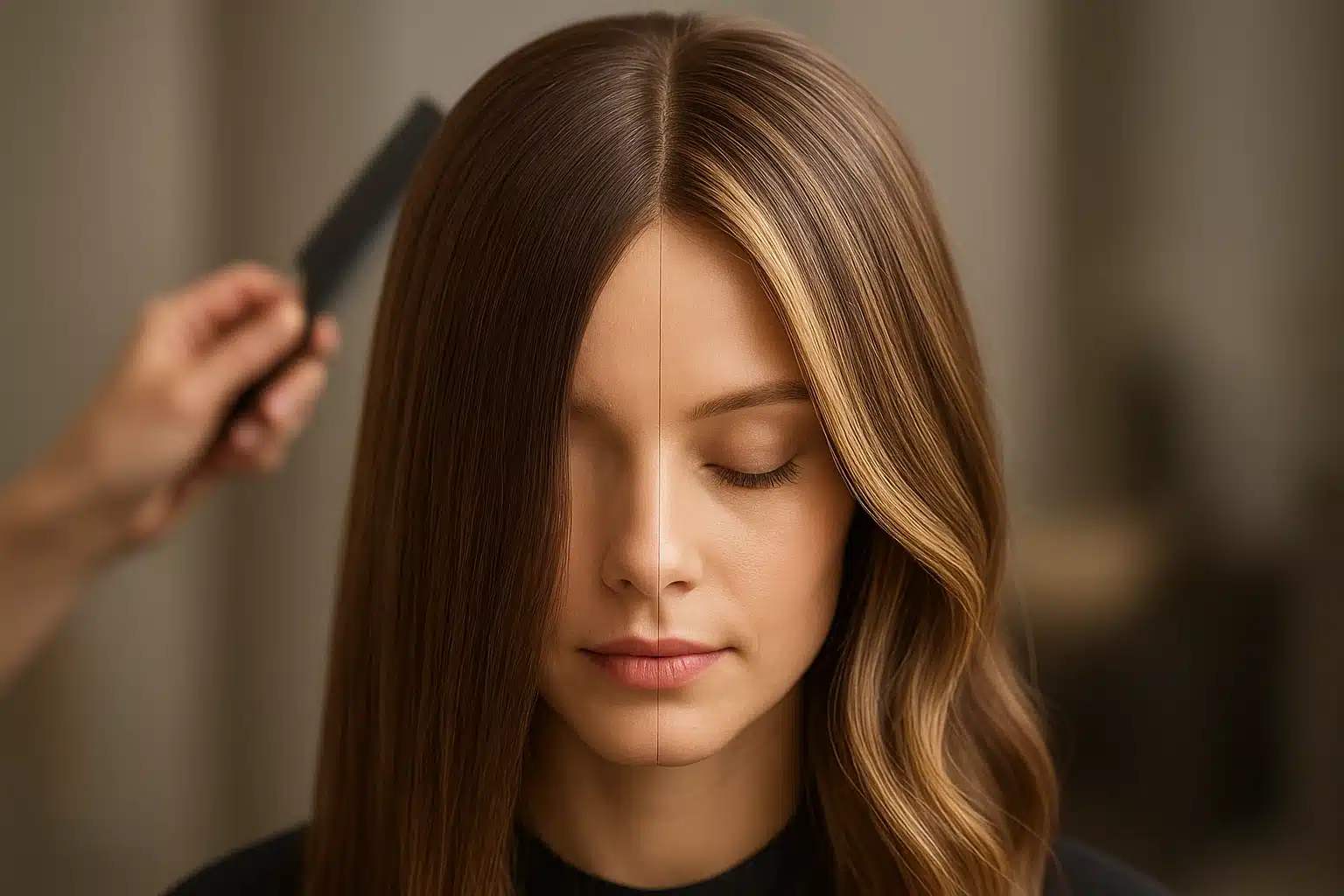
Visualize a natural human hair strand under a microscope: it looks like a roof covered in overlapping shingles (the cuticle). 100% Remy human hair is porous. A skilled colorist can use developer to lift these cuticles and deposit custom colors, formulating stunning balayage, lowlights, and root smudges just as they would with bio hair.
Synthetic Fibers: The Plastic Reality
Now visualize a synthetic hair strand: it is a slick, solid nylon or acrylic fishing line (non-porous extruded plastic). Traditional oxidative salon dye and developer will literally slide right off synthetic hair, often permanently staining the lace cap instead. Color change on synthetics requires pigment staining—such as alcohol ink, acrylic dye baths, or Rit DyeMore—executed under strict temperature controls (usually around 180°F for heat-defiant fibers).
The Lace Barrier Technique
Whether bleaching knots on human hair (to hide the tiny black dots where hair is tied to the cap) or dyeing a unit, professionals use the Lace Barrier Technique. The bleach mixture must be the exact consistency of thick frosting. If it’s too runny, it seeps through the lace grid into the root hair. Over-bleaching weakens delicate single-hand-tied knots, inducing severe shedding known as “knot rot.”
Navigating Cincinnati’s Customization Landscape
Rather than shipping your piece to major Midwestern hair hubs like Chicago or Naperville, there is a wealth of specialized talent locally. When evaluating wigs Cincinnati experts have to offer, different salons specialize in different alteration needs:
- Allusions Hair Solutions (Montgomery Corridor): Highly trusted for medical-aesthetic balance. They excel in hair-loss consultations, medical customization, toppers, and cap rebuilding, ensuring a gentle touch for oncology and alopecia clients.
- Whitney B. Hair Studio & Indie Studios: The go-to for custom unit construction, meticulous lace customization, and drop-off color services tailored to fashion-forward lace-front enthusiasts.
- Dreamcatchers Hair Gallery & Cincy Wigs: Excellent resources for dramatic color transformations, express turnarounds, and precise sizing audits to ensure your unit fits securely.
Your Pre-Salon Consultation Playbook
Before you book your appointment with a local Cincinnati specialist, come prepared.
The Pre-Consultation Checklist:
- Prep your natural hair: Wear your hair exactly how you plan to wear it under the wig (e.g., foundation braids, flattened wrap) so the stylist can measure the fit accurately.
- Bring reference photos: Especially for hairline plucking and color goals.
- Check your warranty: Be aware that chemical alterations or cutting will void manufacturer warranties on factory-direct pieces.
Price Benchmarks & Turnaround Expectations:While prices vary by salon and complexity, regional Cincinnati benchmarks typically range from $45–$150 for structural alterations (like darting or adding bangs) and $100–$300+ for custom dyeing (balayage, root smudging, or watercolor immersion). Turnaround times can range from 48-hour express drop-offs to 5-to-7 days for complex multi-tone coloring.
Frequently Asked Questions (FAQ)
Can I shrink or tighten a wig cap if it’s bunching at the nape?
Yes. A professional can tailor the cap using a technique called darting, where excess material is folded and sewn along the natural curves of your head without cutting the structural lace.
Can you dye a synthetic wig using regular box dye or salon toner?
No. Synthetic hair is made of non-porous plastics (like modacrylic or polyester) that completely repel traditional hair dye. Dyeing synthetic hair requires specialized fabric dyes or alcohol inks and precise temperature control.
How do stylists thin a wig without leaving blunt stubble?
Professionals avoid cutting near the root. Instead, they use a technique called channel cutting on the underside of the wig, combined with slide cutting from the mid-shaft to the ends to remove weight fluidly.
What happens if you bleach the knots on a fragile lace front?
If done correctly with a thick bleach formula, it creates the illusion of hair growing directly from your scalp. If done incorrectly with a runny formula, the bleach bleeds into the hair shafts and weakens the knots, leading to irreversible shedding.
Taking the Next Step in Your Hair Journey
Understanding the mechanics behind wig alterations demystifies the process, turning a point of frustration into a journey of personalization. Your wig should adapt to you, not the other way around.
If you’re at the beginning of your journey and still searching for that perfect foundational piece, take the time to explore reputable local boutiques. Sourcing a high-quality unit from trusted experts ensures that when it’s time to cut, dye, and tailor, you have the best possible canvas to work with.