

A human hair lace front wig can start near $100 or run past $1,300, and the listing copy rarely tells you which one you’re looking at. HD lace, Remy, 150% density, pre-plucked: those are the phrases doing the work in the description. Learning what they actually change is what keeps you from overpaying, or from buying something that won’t hold up past a season.
Human hair lace front wigs are made from real human hair knotted into a sheer lace panel that sits along the front hairline, so the hair looks like it grows from your scalp and can be washed, heat styled, and colored like your own. Most cost $200 to $350, and a well cared for one lasts one to three years. Lace type, hair grade, and density are what decide how natural the result looks.
In this article
- What makes a human hair lace front wig look natural
- HD lace vs. transparent lace vs. Swiss lace
- Hair grade: what Remy, Virgin, and Raw actually mean
- What density actually looks like: 130% to 180%
- What human hair lace front wigs cost
- Human hair vs. synthetic: the tradeoffs that matter
- Caring for a human hair lace front wig
- What people are choosing this year
- Frequently Asked Questions
What makes a human hair lace front wig look natural
Three things have to work together: the lace at the hairline, the hair itself, and how the part is built. The lace does the hairline illusion, because a sheer panel sitting against your skin reads as scalp instead of a hard wig edge. Human hair does the rest, since it moves, takes heat, and catches light the way your own hair does rather than holding one fixed shape forever.
The part matters more than most first-time buyers expect. A monofilament top or a hand-tied cap makes the parting look like hair growing out of skin, and that combination of human hair, a lace front, and a monofilament or hand-tied top is what Oprah Daily points to as the most natural-looking setup you can buy.
Two finishing details do a lot of quiet work. A pre-plucked hairline thins the density right at the front so the hair doesn’t start in a straight, heavy line, and bleached knots lighten the dark dots where each strand is tied so they stop showing through the lace. A third option, lace front wigs with baby hair, softens that same edge with a few fine hairs along the hairline instead. Wig Superstore’s lace front listings name these directly, including pre-bleached knots and the “Bye Bye Knots” construction, which helps when you’re comparing two wigs that look identical in photos.
Get those pieces right and you get a natural hairline that holds up in daylight and in a phone camera, which is the only test that really counts. If yours needs a hand once it arrives, how to make a lace front wig look natural walks through the styling side of that test.
HD lace vs. transparent lace vs. Swiss lace
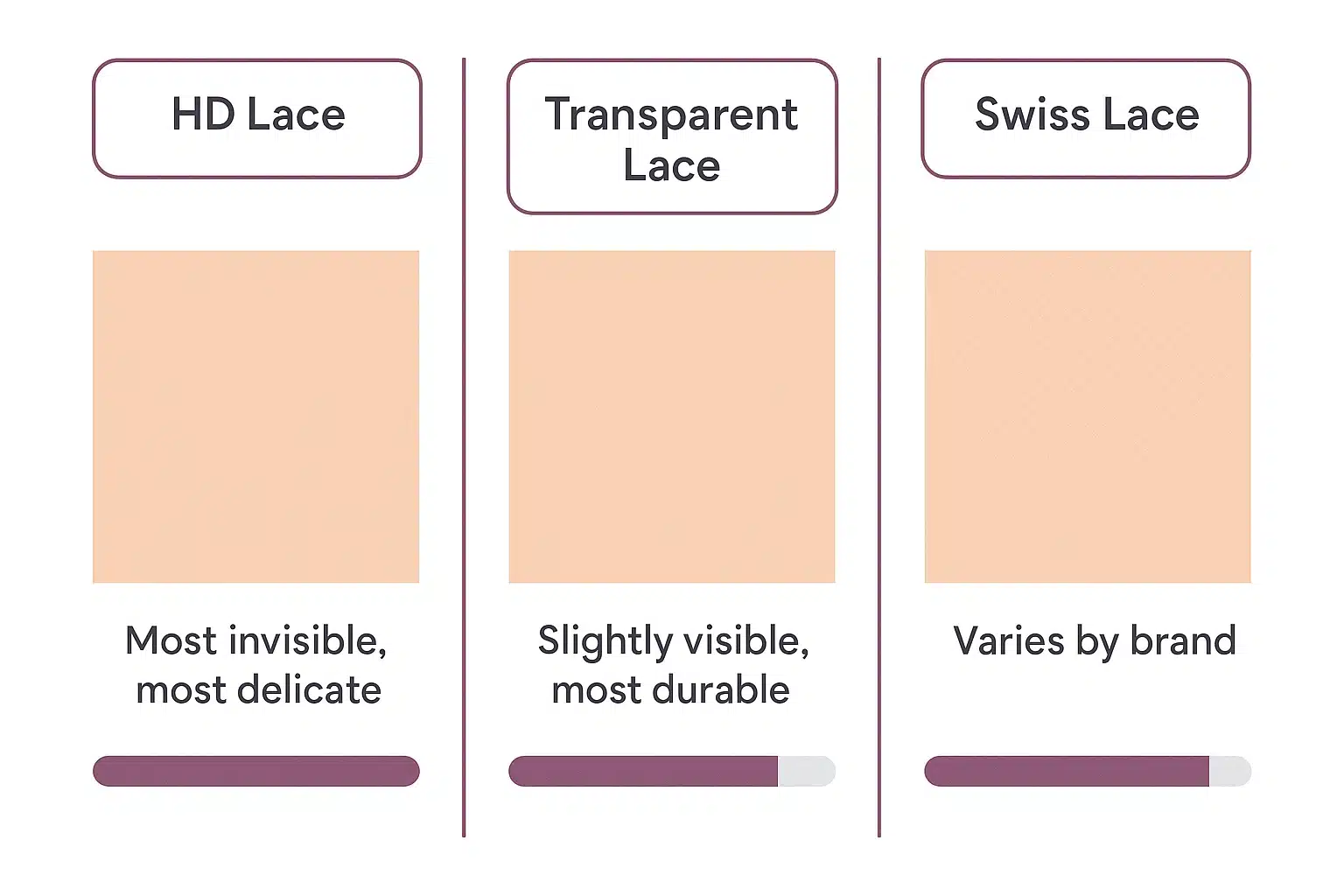
HD lace disappears best but wears delicately; transparent lace trades a little invisibility for everyday durability; Swiss lace varies most by brand.
Of the three lace types, HD is the thinnest and most invisible, transparent is slightly thicker but far more durable for everyday wear, and “Swiss lace” is the least consistent term of the set.
HD lace disappears against skin better than anything else available, and that’s the whole reason it costs more. It’s also delicate. It tears if you’re rough with it, and it won’t forgive a hurried install week after week. Transparent lace gives up a little invisibility in exchange for lace that survives daily handling, which is the better trade for most people who wear a wig every day rather than for occasions.
Swiss lace is where the labels get loose. Some brands use it as the base material that HD lace is a finer version of, and others treat it as a mid-tier option in its own right. If a listing says Swiss lace and nothing else, judge it on the close-up photos and the return policy instead of on the name.
The numbers beside the lace tell you how much hairline you’re buying. A 13×4 is the common wide-front size, enough for a side part and some off-the-face styling. A 13×6 is the deeper version of the same front, so a middle part still reads as scalp further back. The closure sizes, 4×4 and 5×5 and 7×5, place a smaller lace square at the top instead. They cost less and are quicker to get applied, but they leave less of the hairline free to part wherever you like. A full lace wig runs lace across the entire cap and gives you the most freedom of all, at the highest price.
Hair grade: what Remy, Virgin, and Raw actually mean
Grade is mostly a lifespan question, and it’s the one spec that tells you how long the wig will actually last.
Raw hair is unprocessed and usually from a single donor, and it lasts the longest of the three at roughly 1.5 to 3 years or more. Virgin hair is also unprocessed, though donor claims vary a lot from seller to seller, and it typically runs 12 to 24 months. Remy hair has its cuticles aligned in one direction, which is what keeps it from tangling on itself, but it may have been processed along the way. Expect 6 to 18 months from Remy, or up to 24 with excellent care.
Those numbers are worth doing the math on. A cheaper Remy wig replaced every year and a pricier raw wig that lasts three years can land close together on total cost, they just get paid for differently. Grade isn’t a status ranking. It’s a question of how often you want to shop for a replacement.
What density actually looks like: 130% to 180%
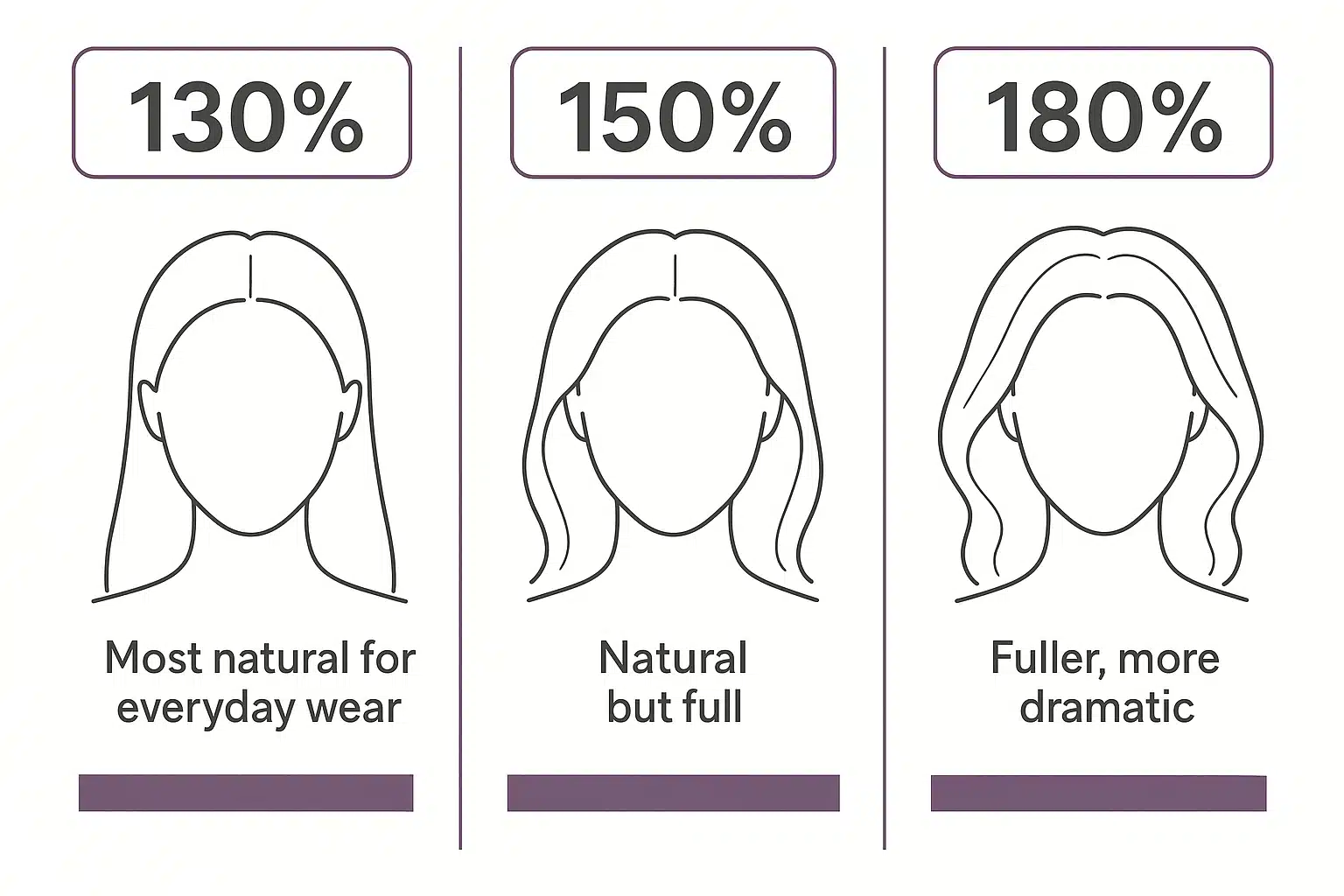
Density is how much hair sits on the cap. 130% to 150% reads as most natural for everyday wear, while 180% is fuller and more dramatic.
Density is how much hair sits on the cap, written as a percentage. 130% to 150% is the band that reads as most natural for everyday wear, 150% is the usual recommendation when you want natural but still full, and 180% is fuller and more dramatic, closer to a styled glamour look than to hair you’d grow.
Higher isn’t better. Too much density at the front is one of the fastest ways to make a wig look like a wig, because real hair thins toward the hairline rather than starting thick. If discretion is what you’re buying for, stay in the 130% to 150% band and you’ll get the most believable results.
Judge density by the number and by customer photos rather than by the hero shot. The density shown in a product image has usually been styled by someone who does this for a living, on hair that was fresh out of the box that morning.
What human hair lace front wigs cost
Most 100% human hair lace front wigs run $200 to $350. The broader market sits between $180 and $600, with the average landing somewhere around $275 to $300. Entry-level pieces start near $100, and premium wigs in longer lengths or raw hair reach $500 to $1,300 and above.
The human hair lace fronts featured on Wig Superstore span roughly $100 to $870 and up, with a Wigs Under $200 section for anyone who wants into the category without the premium price. That entry point matters more than it sounds. At the same price, a sub-$200 human hair lace front and a synthetic lace front wig are different bets: with the human hair one you can learn to install it, restyle it as your taste changes, and keep it for years rather than months.
Two costs never show on the price tag. Shipping and upkeep both add to the real number, and discounts move listings around enough that the cheapest price on a given day isn’t automatically the best value. Reviews are the faster tell here: look for shedding and tangling complaints written a few months in, not first-impression photos taken on day one.
Human hair vs. synthetic: the tradeoffs that matter
Lifespan is the widest gap between them. A human hair lace front lasts one to three years with good care, while a synthetic lace front under the same care gives you about three to six months. Synthetic wigs cost $80 to $200 for a typical piece, with budget options from $20 to $79 and higher-end synthetics reaching $200 to $600.
Styling is the other gap. Synthetic fiber can’t take much heat, it arrives pre-styled, and it doesn’t re-part easily, so what you see in the photo is close to what you get for the life of the wig. It can shine under certain light in a way that reads artificial, it frizzes and tangles at the friction points over time, and most synthetic hair can’t be dyed with standard color.
None of that makes synthetic a mistake.
You can wear one every day if it fits well, stays clean, and your scalp gets regular breaks, and a well-made synthetic piece that’s properly cared for can run 8 to 12 months. But if you want to curl it, color it, part it somewhere new, or still be wearing it in two years, human hair is the version that does those things.
Caring for a human hair lace front wig
Wash every 7 to 10 wears with a sulfate-free, wig-safe shampoo. With daily wear, that works out to roughly every one to two weeks.
Condition the mid-lengths and ends only. Skip the lace and the knots entirely, because conditioner softens the knots and speeds up shedding in the one spot you can least afford to lose hair. Air dry on a wig stand, away from heat and direct sunlight, and store it upright in a cool, dry place instead of folded in a drawer. Heat and sun pull the moisture content out of hair that no longer gets any from your scalp, and that’s what turns a good wig dry and dull ahead of schedule.
Past the weekly routine, plan on a deeper conditioning or reshape every four to eight weeks. If yours is applied with glue or tape, the install typically needs redoing every two to three weeks, while glueless wear stretches that out considerably. That’s a real part of why glueless lace front wigs have become the default for so many daily wearers.
Care is also the difference between the low and high end of every lifespan number above. The same wig can give you one year or three.
What people are choosing this year
Color has moved warm and dimensional. Chocolate brown, mocha, and caramel balayage with a shadowed root have taken over from flat, single-tone color. A root shadow does a lot of the natural-looking work on its own, since hair growing out of a real scalp is almost never one uniform shade from top to bottom.
Texture has moved the same direction. Kinky straight, yaki, and soft coily textures are gaining ground on perfectly uniform patterns, because slightly irregular texture blends against your own hair and your skin tone in a way a flawless pattern doesn’t. And HD lace, glueless caps, and pre-plucked hairlines have stopped being upsells. They’re the baseline buyers expect now.
Which brings you back to those four phrases from the listings. HD lace or transparent, Remy or raw, 130% or 180%, pre-plucked or not: once you can read them, comparing two wigs stops being guesswork and becomes a short list of choices you’ve already made. Take that list with you when you browse Wig Superstore’s lace front wigs and human hair wigs collections, and if you don’t have a good local wig shop to try things on in, that list is the next best thing to a fitting.
Frequently Asked Questions
How much does a human hair lace front wig cost?
Most run $200 to $350. The wider market sits between $180 and $600, and the average is around $275 to $300. Entry-level human hair lace fronts start near $100, and premium pieces run $500 to $1,300 and above.
What type of wig looks most natural?
Human hair with a lace front and either a monofilament top or a hand-tied cap. The lace creates the hairline, the human hair moves and behaves like real hair, and the monofilament or hand-tied construction makes the parting look like real scalp.
What are the disadvantages of synthetic hair wigs?
Limited or no heat styling, less styling flexibility because they come pre-styled and don’t re-part easily, and a shorter lifespan of roughly four to six months with regular wear. Synthetic fiber can look shinier than real hair in some light, it frizzes and tangles over time, and most of it can’t be dyed with standard hair color.
Can you wear a synthetic wig every day?
Yes, as long as it fits well, you keep it clean, and your scalp gets regular breaks. Expect a shorter lifespan than human hair, typically four to six months, or eight to twelve months for a well-made piece that’s well cared for. Sleeping in a wig regularly shortens its life further.
What is the average cost of a synthetic wig?
Roughly $80 to $200 for a typical piece. Budget options start around $20 to $79, and higher-end synthetic wigs reach $200 to $600.