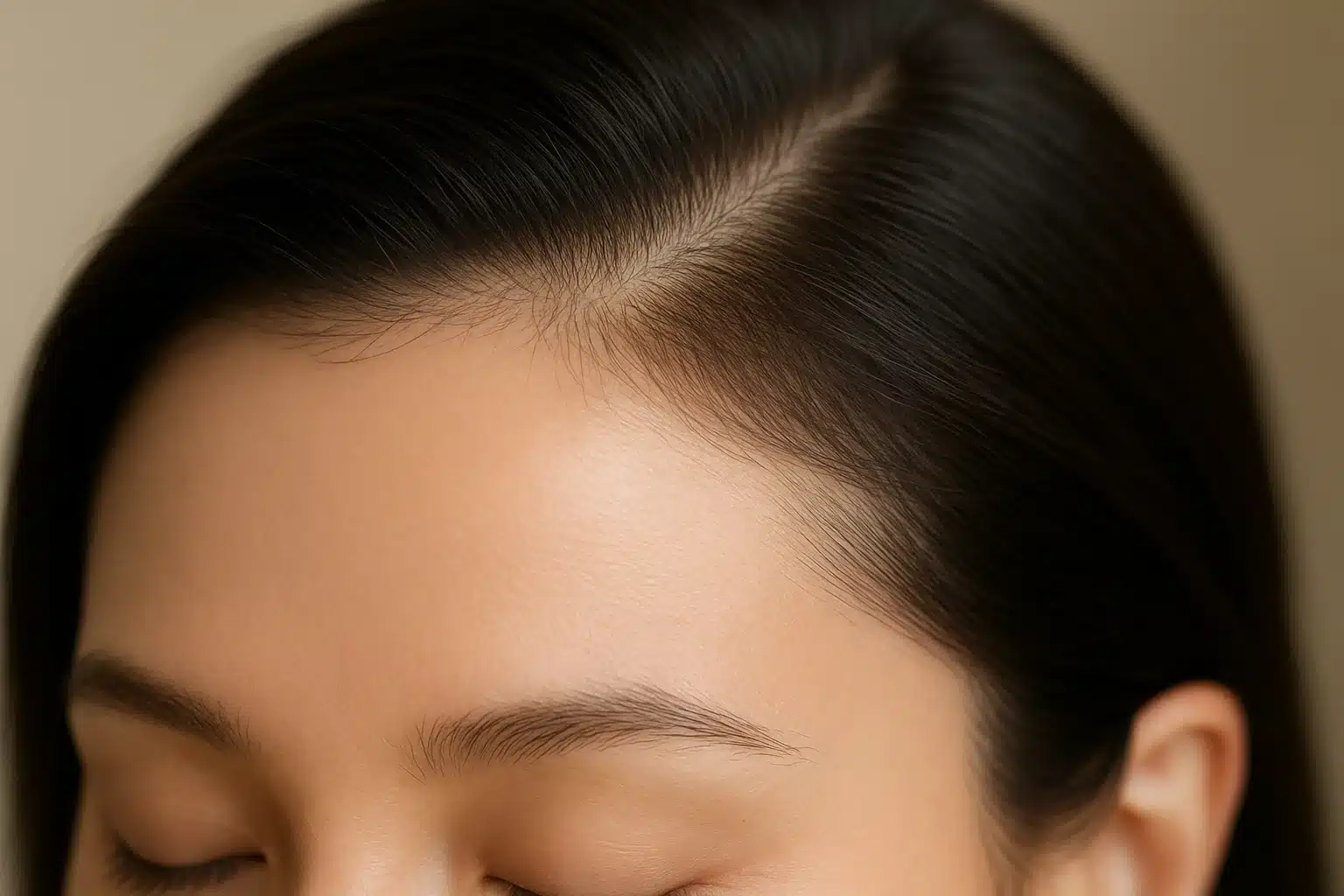
If you’ve been researching hair replacement, you probably know the fear of the “wind test.” It’s that moment a sudden gust of wind blows your hair back, and you instinctively hold your breath, hoping no one notices a harsh, artificial line across your forehead. Today, hair restoration technology has moved far beyond the obvious toupees of the past. Yet, the anxiety around the transition zone—where a hair system meets your natural skin—remains the biggest hurdle for anyone seeking a truly undetectable look.
This is where medical-grade engineering meets advanced cosmetology. For those exploring premium options, the 3D-printed Cesare Ragazzi hair system (also known as CNC) represents the absolute peak of realism. While our foundational guide covers how these bespoke systems are mapped and created for your specific head shape, today we are taking a deep dive into the physical artistry of the “cut-in.” We’re going to explore exactly how a polymer membrane and virgin human hair are sculpted, graduated, and blended so flawlessly that even a barber couldn’t spot the difference.
The Anatomy of a Realistic Hairline
To understand how hyper-realism is achieved, we first have to understand why traditional hairpieces fail. The human eye is incredibly adept at spotting patterns that don’t exist in nature. A straight line, a sudden wall of thick hair, or a base color that doesn’t quite match the scalp all trigger our brains to recognize that something isn’t right.
Creating a hairline that can withstand close-up inspections, bright sunlight, and active lifestyles requires a multi-step approach that addresses geometry, ventilation, and the physics of light.
The Scalp Tone Paradox
One of the most common mistakes beginners make is assuming their hair system’s base should match their facial skin tone. However, a natural scalp is shielded from the sun by hair and is typically one to two shades lighter than the face.
The CNC system utilizes 3D spectral analysis to map your exact epidermal scalp tone—whether it features pale pink, neutral, or olive undertones. By matching the membrane to your true scalp color rather than your forehead, the system prevents the dreaded “helmet” border. When the medical-grade adhesive cures, the polymer visually dissolves into the surrounding skin.
Phase 1: The Geometry of the Edge
You might be wondering: If the polymer base has physical thickness, why doesn’t it show up as a visible plastic line at the front?
The secret lies in a technique called scalloping. In nature, straight lines are extremely rare. If a hair system’s membrane is cut in a perfectly straight line across the forehead, it catches the light continuously, creating a visible edge.
To combat this, skilled stylists hand-carve the ultra-thin front edge of the CNC biomedical polymer into irregular, microscopic waves or zig-zags. This scalloped boundary scatters light and shadow. By breaking up the light reflection, the physical edge becomes mathematically invisible to the naked eye.
Phase 2: The Art of Ventilation and Density Graduation
Have you ever seen a hairpiece that looks like a dense “wall of hair” starting abruptly at the forehead? This happens when a system lacks density graduation. Natural hairlines don’t start at full thickness; they fade in gently.
During the manufacturing of a high-quality CNC system, individual hairs are hand-injected (ventilated) into the base following a precise Density Graduation Blueprint:
- Zone A (0-3mm): The very front edge is populated with “vellus-emulating” baby hairs. These are ventilated at a sparse 30-40% density and injected at a flat, forward-facing angle to mimic the soft, wispy hairs naturally found at the hairline.
- Zone B (3-10mm): The transitional zone steps up to 50-65% density, creating a natural scalp shadow that builds visual weight without looking heavy.
- Zone C (10mm+): This is the target volume zone, sitting at 80-100% density to perfectly match the thickness of your remaining biological hair.
Directional Injection
Realism isn’t just about the amount of hair; it’s about how it moves. Human hair grows in specific directional patterns, swirls, and whorls. During the CNC creation process, hairs are injected at specific angles to mimic these natural exit patterns. This prevents the hair from standing unnaturally upright and ensures it falls exactly as your biological hair would.
Phase 3: The Physics of Blending
Once the hairline is perfected, the next challenge is integrating the system hair with your existing biological hair on the sides and back.
Erasing the Weight Line
A poor “cut-in” (the initial haircut styling the system to your head) can create a visible “shelf” or weight line—a noticeable step where the system ends and your natural hair begins.
Master stylists use advanced texturizing techniques to seamlessly weave the two together. Using methods like slide cutting, point cutting, and channel slithering with a razor, the stylist removes internal bulk from the system hair. This allows the ends of the system to interlock organically with your biological hair, creating a fluid transition even when the wind blows.
The Hair Quality Index (HQI)
Blending also relies heavily on the quality of the hair itself. Cheaper systems often use acid-washed, silicone-coated hair. While it looks shiny at first, the silicone washes away, leaving hair that tangles and reacts differently to light and moisture than your natural hair.
Premium solutions utilize premium, non-processed virgin human hair. This untreated hair retains its natural cuticle, meaning it reacts to sunlight with dimensional underlighting—just like natural hair. When wet, styled, or blown by the wind, the system hair moves at the exact same frequency and speed as your own.
Phase 4: The Chemistry of Bonding and Daily Styling
The final piece of the hyper-realistic puzzle is the daily wear. How does the system hold up in real life?
The attachment process uses a liquid skin-graft adhesive that is completely biocompatible. A critical factor in this process is the “matte factor.” The adhesive must cure completely matte; any shine under the hairline will immediately reflect light and draw attention.
With the foundation perfectly seamlessly blended and matte, you are free to choose hairstyles that actually expose your hairline. Whether you prefer a modern textured crop, a classic swept-back pompadour, or a soft natural fringe, the structural integrity of the graduated hairline supports it.
Frequently Asked Questions (FAQ) About CNC Hairlines
Q: Can I really wear a style that fully exposes my hairline, like a slicked-back look?
A: Absolutely. Because of the scalloped edge, density graduation, and vellus baby hairs, a properly applied CNC system is designed to be completely undetectable, even when the hair is pulled straight back under bright lighting.
Q: Will the hair color fade and look different from my natural hair over time?
A: All human hair—whether growing from your scalp or attached to a system—fades slightly with sun exposure. Because CNC systems use high-quality virgin hair, they fade naturally and dimensionally. During your routine maintenance appointments, your stylist will perform subtle color balancing to ensure the system and your biological hair remain a perfect match.
Q: What happens if my natural hair continues to thin over time?
A: The beauty of a custom hair solution is its adaptability. Your system is designed for your current hair loss pattern. If your biological hair thins further over the years, future systems can be mapped and designed to cover a slightly larger area, seamlessly adapting to your changing needs.
Q: How does the transition feel to the touch?
A: The 3D-printed biomedical polymer is exceptionally thin and designed to fit your scalp like a second skin. When bonded correctly, running your fingers through your hair feels completely natural, with no noticeable bumps, ridges, or thick edges.
Taking the Next Step in Your Hair Journey
Experiencing hair loss can feel isolating, and navigating the world of hair restoration can be overwhelming. But understanding the mechanics behind these advanced systems is the first step toward regaining your confidence. You don’t have to settle for solutions that leave you worrying about the wind or bright lights.
When you know the artistry and science that goes into an undetectable hairline, you can make informed decisions about your hair restoration journey. The perfect blend of empathy, expertise, and cutting-edge technology is out there, ready to help you feel entirely like yourself again.