If you’ve ever spoken to someone who has experienced hair loss, you’ve likely heard the dreaded “wig in a drawer” story. It’s a common tale: someone purchases a beautiful, expensive hairpiece, only to find it uncomfortable, ill-fitting, or unnatural looking once they get it home. Into the drawer it goes, never to be worn again.
This costly mistake almost always stems from a single missing step: a thorough, professional consultation. When evaluating the best wig stores in Tampa, FL, your primary focus shouldn’t just be on the inventory displayed on the mannequins. Instead, it should be on the expertise and empathy of the staff guiding you.
Whether you are navigating medical hair loss or simply looking to enhance your everyday style, a wig consultation should feel less like a retail transaction and more like a collaborative, educational journey. Here is exactly what you should look for to ensure you’re getting a professional, medical-grade fitting.
The True Cost of a Rushed Consultation
The Tampa wig market is highly competitive, and unfortunately, many shops prioritize the “end result”—making a quick sale and rushing through the install—over the educational journey.
A true consultation is about the reintroduction of self. It requires vulnerability, and you deserve a space where your questions are answered with patience and deep technical knowledge. A knowledgeable consultant bridges the gap between what a wig looks like on a stand and how it behaves in your day-to-day life.
The Professional Standards: Decoding a Masterclass Consultation
If you are buying a wig for the first time, you might assume that trying on a few different styles is the extent of the process. In reality, a premium consultation relies on precise geometry and technical standards.
The 6-Point Measurement System
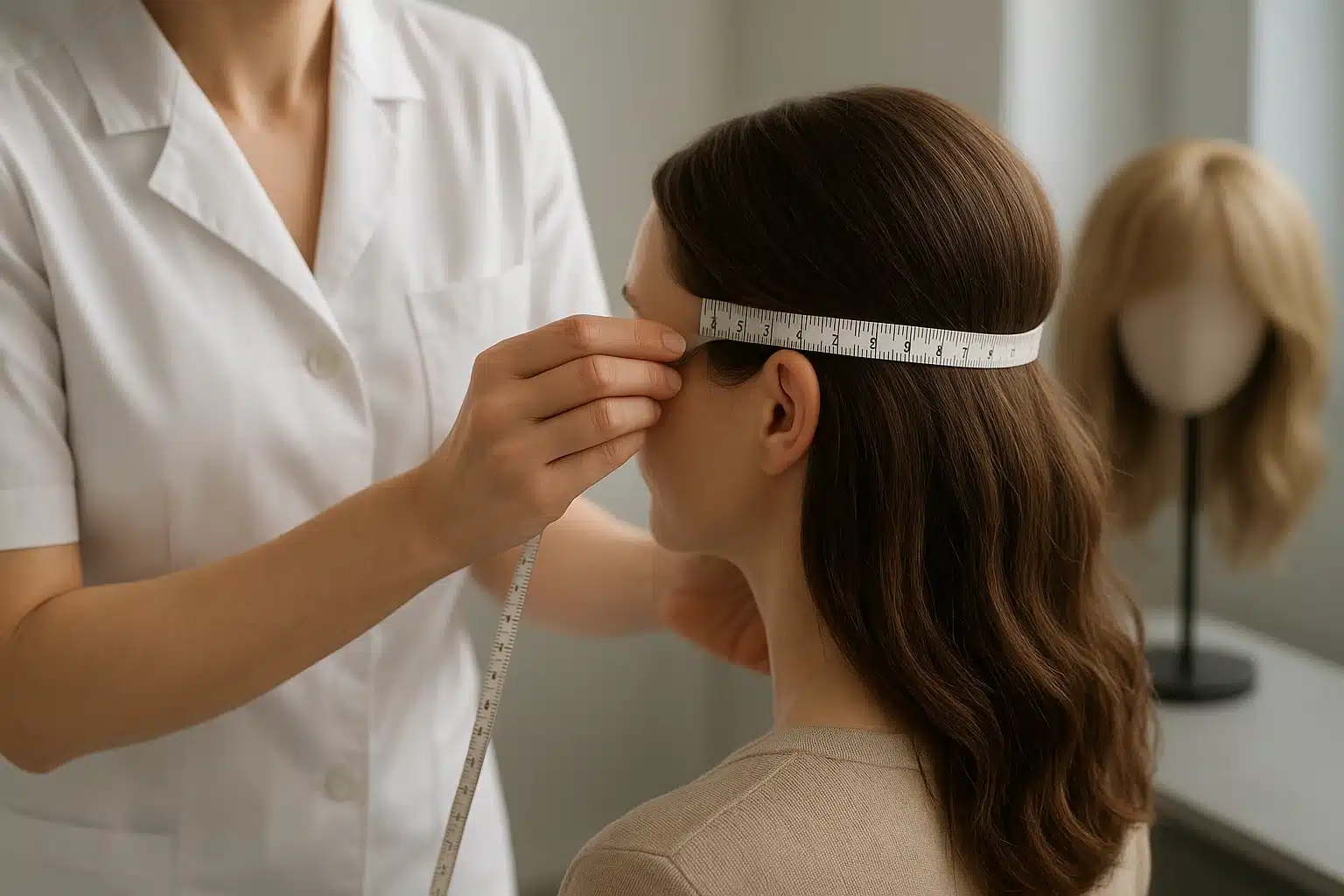
The most glaring red flag during a consultation is a consultant who only measures the circumference of your head. While circumference is important, it is only one piece of the puzzle.
To prevent “wig slide” and ensure all-day comfort, a professional will utilize a comprehensive wig size guide that includes six distinct measurement points:
- Circumference: Around the entire head.
- Front to Nape: From the center of your forehead to the base of your neck.
- Ear to Ear across forehead: Tracing the front hairline.
- Ear to Ear over top: Crucial for ensuring the ear tabs sit correctly.
- Temple to Temple around back: Ensures the wig grips securely around the occipital bone.
- Nape of Neck: Determines how the back of the wig will lay against your skin.
The Four-Finger Rule
A high-quality consultation will also involve education on proper placement. One of the industry’s golden standards is the “Four-Finger Rule.” By placing four fingers horizontally across your forehead, resting just above your eyebrows, your index finger will naturally land exactly where your biological hairline should begin. If a consultant doesn’t teach you how to properly seat the wig using techniques like this, you risk the dreaded “pulled down” look that instantly gives away a hairpiece.
Medical Specifics: Navigating Hair Loss Consultations
For individuals experiencing alopecia or undergoing chemotherapy, a consultation requires an entirely different level of care and expertise.
The Scalp Assessment
Medical hair loss often brings heightened scalp sensitivity. A premier consultant will begin with a thorough scalp assessment. They will explain why understanding wig cap construction is vital for your comfort. For instance, they should guide you through the differences between a Monofilament top (which allows for multidirectional parting and breathability) versus a Silk Top (which hides knots perfectly but may retain more heat), ensuring the cap materials won’t irritate sensitive skin.
The “Cranial Prosthesis” Distinction
If you are seeking insurance reimbursement in Florida, terminology matters immensely. A knowledgeable Tampa shop will educate you on the difference between a “fashion wig” and a “cranial prosthesis.” To qualify for medical reimbursement, your prescription and the shop’s invoicing must use the term “cranial prosthesis.” A shop that doesn’t understand this local medical billing nuance is likely not equipped to handle medical hair loss clients.
Your Tampa Wig Consultation Scorecard
How do you know if you are in the hands of a true expert? Take this mental scorecard with you to your next consultation.
Green Flags (Signs of True Expertise):
- Privacy is Guaranteed: They offer a private, closed-door fitting room that respects HIPAA standards and your personal comfort.
- Density Realism: They educate you on hair density. Instead of pushing an unnaturally thick 200% density wig, they explain why a 130% to 150% density mimics a natural biological hairline far better.
- Inventory Transparency: They willingly show you the hallmarks of quality, pointing out pre-plucked hairlines and bleached knots so you know exactly what you’re investing in.
- Aftercare Education: They don’t just bag up the wig and wave goodbye. They spend time equipping you with proper wig care knowledge, explaining how to wash, store, and maintain your specific hairpiece.
Red Flags (Time to Walk Away):
- They rush the measuring process or guess your size.
- They brush off questions about lace quality (e.g., HD lace vs. standard Swiss lace).
- They pressure you into purchasing “today only” specials before you feel entirely confident.
Frequently Asked Questions
What is the difference between a wig and a cranial prosthesis?
A wig is generally classified as a fashion or cosmetic accessory. A cranial prosthesis is a custom-fitted, medical-grade hair system designed specifically for patients experiencing clinical hair loss (such as alopecia or chemotherapy-induced hair loss). Cranial prostheses are designed with specialized, hypoallergenic materials for sensitive scalps and are recognized by health insurance companies for medical reimbursement.
Is a wig consultation private?
At a reputable, medically focused wig boutique, yes. Your privacy should be a top priority. High-quality shops offer private consultation rooms where you can comfortably remove existing head coverings, discuss medical treatments, and try on different styles without the anxiety of being in a public salon environment.
What should a Tampa shop charge for just a fitting?
Consultation fees in the Tampa area can vary. Many high-end boutiques offer complimentary initial consultations with the expectation of a purchase, while specialized medical hair loss centers might charge a dedicated consultation fee (often ranging from $50 to $100) that can usually be applied toward the final purchase of your cranial prosthesis.
Next Steps on Your Journey
Finding the right hairpiece is a deeply personal experience, and the consultant sitting across from you plays a monumental role in that journey. By arming yourself with the knowledge of proper measurements, cap constructions, and the standards of compassionate care, you transform from a vulnerable buyer into an empowered client.
Before you book your next appointment, take a moment to outline your core needs. Are you looking for the breathability of synthetic hair, or the styling versatility of human hair? Do you need medical-grade comfort, or just a flawless aesthetic? Knowing your priorities—and demanding a consultant who respects them—is the first step toward finding a look that makes you feel beautiful, confident, and entirely yourself.