Have you ever marveled at a wig that looks so impossibly natural you’d swear the hair is growing directly from the scalp, only to find it shedding just a few weeks later? Or perhaps you’ve owned a piece that withstood years of daily wear, but the hairline looked like a dense, unnatural helmet. This constant tug-of-war between flawless realism and long-term durability comes down to a microscopic detail you might never have noticed: the knots.
Wig construction is a precise craft where tiny, mechanical decisions dictate how a hairpiece moves, looks, and lasts. While we’ve previously explored the anatomy of a perfect wig mastering hairline density and texture, the true foundation of those elements lies in how each individual hair is physically tied to the lace base. With nearly two decades of experience helping people navigate the beautiful, sometimes overwhelming world of hair replacement, we know that education is the ultimate confidence booster. Today, we’re demystifying the hidden world of lace ventilation, breaking down single and double knots so you can make empowered choices for your next hair journey.
The Microscopic Battle of Realism vs. Durability
At the heart of every high-quality lace wig is a microscopic tool known as a ventilating needle. Skilled artisans use this tiny hook to pull individual strands of hair through the delicate, hexagonal mesh of the lace cap, tying them into place by hand.
It sounds simple, but the specific way that hair is tied—the knotting technique—changes the fundamental physics of the wig. To understand why some wigs offer an undetectable hairline while others offer tank-like durability, we need to zoom in and look at the anatomy of the knots themselves.
Demystifying the Micro-Mechanics of Wig Knots
If you’ve ever gone sailing or rock climbing, you know that different knots serve different purposes. The exact same principle applies to wig making.
Single Knots: The Illusion of Reality
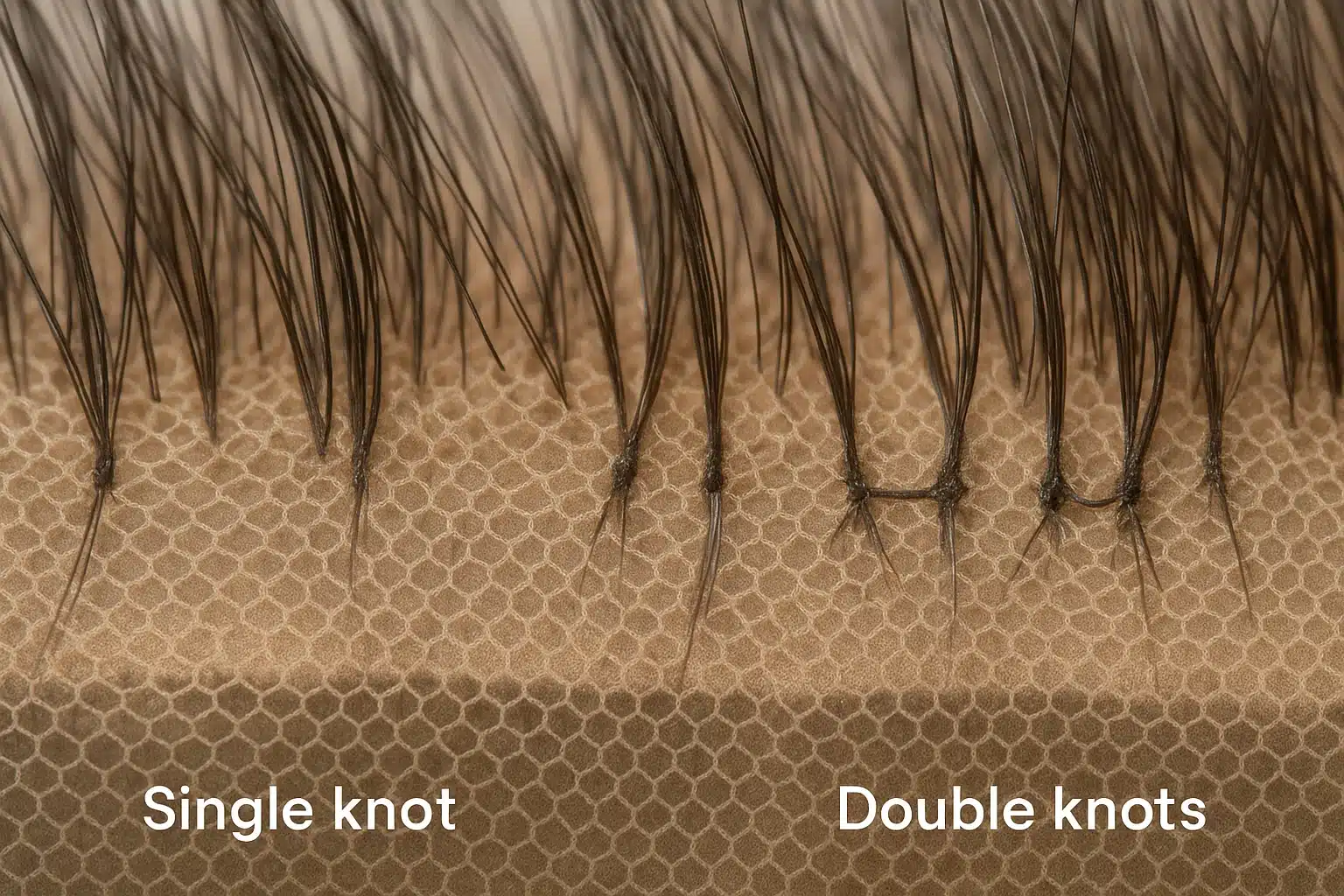
Imagine tying a simple half-hitch to secure a rope. A single knot in a wig works similarly: one to two strands of hair are pulled through the lace and looped exactly once.
The Pros: Because there is only one loop, a single knot is incredibly tiny. When placed against your skin, it practically vanishes, offering the most realistic, undetectable hairline possible. Furthermore, single flat knots force the hair to lie flat in a specific direction, mimicking natural hair growth patterns perfectly at the very front of the face.The Physics of Slippage: The downside of a simple half-hitch is low friction. The “Micro-Shedding Equation” tells us that every time you drag a comb through your hair, you exert directional tension. Over time, this friction can easily pull a single knot right out of the lace hex-mesh, leading to premature shedding.
Double Knots: The Fortress of Durability
Now, picture a double half-hitch—an interlocking, highly secure tie. A double knot loops the hair strand twice around the lace mesh, locking it firmly into place.
The Pros: Double knots are incredibly resilient. They stand up beautifully to the physical friction of daily brushing, styling, and washing. If you want a wig that lasts for years, double knots are your best friend.The Cons: Two loops mean twice the bulk. Double knots create visible “black dots” at the root of the hair. While you might be tempted to just bleach these knots to hide them, there is a chemical cost to bleaching. Bleach degrades the silk protein of the hair fiber. Over-processing double knots to make them invisible often destroys the structural integrity of the hair, leading to breakage right at the root.
The Hybrid Alternatives: Split Knots
What if you want the durability of a double knot but the realism of a single knot? Enter the split knot. Utilizing specialized ventilating needles (specifically sizes #1 and #1-2), artisans create a modified loop that spreads the hair out.
- Single Split Knots: The ultimate compromise. These knots are nearly as tiny as regular single knots but are structured so the hair splits into a “V” shape. This allows for 360-degree free parting, meaning you can flip your hair any which way without it looking stiff.
- Double Split Knots: These offer the secure locking mechanism of a double knot, but the “split” styling helps distribute the volume more naturally, making them excellent for the crown of the head.
The Wig Anatomy Blueprint: Where Each Knot Belongs
A truly perfect wig doesn’t rely on just one type of knot. Instead, it utilizes an anatomical “zoning” approach, strategically placing different knots exactly where they are needed most.
- Zone A (The Hairline & Parting): This is the high-visibility zone. For absolute realism, the front half-inch of the hairline and the primary parting space should feature Single Knots or Single Split Knots.
- Zone B (The Crown & Top): This area requires volume and styling flexibility. Double Split Knots are ideal here, allowing for multi-directional parting, natural lift, and moderate durability.
- Zone C (The Nape & Back): This is the high-friction zone. Your collar, scarves, and pillows rub against the back of your head constantly. To prevent massive hair loss in this area, the nape and back must feature strong Double Knots for high density and ultimate resistance to brush friction.
The Secret Synergy: How Natural Hair Prep Impacts Knot Lifespan
Here is a “lightbulb moment” that transforms how we view wig care: the longevity of your wig’s knots begins with how you prepare your natural hair underneath the cap.
Many people struggle with their lace lifting or single knots shedding rapidly at the hairline, completely unaware that their natural hair preparation is the culprit. If your natural hair is bundled up bulkily underneath your wig cap, it forces the lace base to stretch beyond its intended shape.
When lace stretches, the microscopic hexagonal holes widen. Suddenly, those fragile single knots at your hairline lose their tight grip. They become loose, and the moment you brush your hair, they slip right out.
The Solution: Focus on low-profile foundations. Using neat, flat single braids on natural hair or tightly woven double strand twists minimizes bulk. The flatter your natural foundation, the less tension you place on the lace. Less tension means those delicate single knots remain securely clamped within their mesh, drastically extending the lifespan of your wig.
Your Knot Selection Decision Matrix
Choosing the right wig isn’t about finding the “best” knot; it’s about finding the right knot for your lifestyle.
The Realism Seeker: If your primary goal is an undetectable hairline that you can pull back into a sleek ponytail, prioritize a unit with a single-knotted or single-split knotted front. Just be prepared to handle it with extreme gentleness to prevent shedding.
The Long-Term Investor: If you need a high-density, voluminous piece for daily, rigorous wear and you tend to wear styles with bangs or sweeping side parts that hide the exact hairline, double knots are your most economical and durable choice.
Common Mistakes to Avoid:
- Mistake 1: Brushing wet single knots. Water relaxes the lace fibers, causing single loops to slide open easily. Always wait until the base is completely dry before detangling the root area.
- Mistake 2: Trying to aggressively bleach double knots at the crown. You will likely destroy the hair before achieving full transparency.
Frequently Asked Questions About Wig Knots
What is the exact mechanical difference between a standard single knot and a single split knot?
A standard single knot forces the two ends of the tied hair strand to point in the same flat direction. A single split knot alters the looping technique so the two ends of the hair separate in opposite directions. This allows the hair to move freely and be parted anywhere, whereas a standard single knot wants to lay flat in one fixed direction.
Why do single knots shed so easily?
Because a single knot only loops around the lace one time, it relies entirely on the tightness of the lace mesh to hold it in place. Daily friction from brushing, stretching the cap over bulky hair, or washing slowly loosens that single loop until the hair slides out.
How do I bleach knots without damaging the hair?
Bleaching should primarily be reserved for single knots at the hairline. Use a gentle developer (no higher than 20 volume) and keep a close eye on the clock. Leaving bleach on the knots for too long compromises the hair’s structural integrity, causing it to snap off at the root.
Why is my lace lifting at the hairline?
Lace lifting is usually a tension issue. If your natural hair underneath isn’t completely flat, the cap is forced to stretch. This stretching causes the edges of the lace to pull back and lift away from your skin or adhesive. A flatter natural hair prep routine is the best fix.
Your Next Steps to Hair Confidence
Understanding the subtle physics behind wig knotting transforms you from a casual browser into an educated consumer. When you know why a wig behaves the way it does, you can care for it better, style it more confidently, and choose the perfect system for your unique needs.
For nearly 20 years, we’ve believed that compassionate care starts with sharing the right knowledge. Whether you are navigating hair loss or simply looking to enhance your everyday style, knowing your options is the first step toward feeling beautiful and secure.
Take a moment to look at your current hair prep routine. Could flatter braids or a better cap placement relieve the tension on your lace? As you continue your educational journey, remember that every detail—from the microscopic knots to the density of the hairline—works together to create the perfect frame for your face. Keep exploring, keep learning, and most importantly, keep finding what makes you feel like your most authentic self.